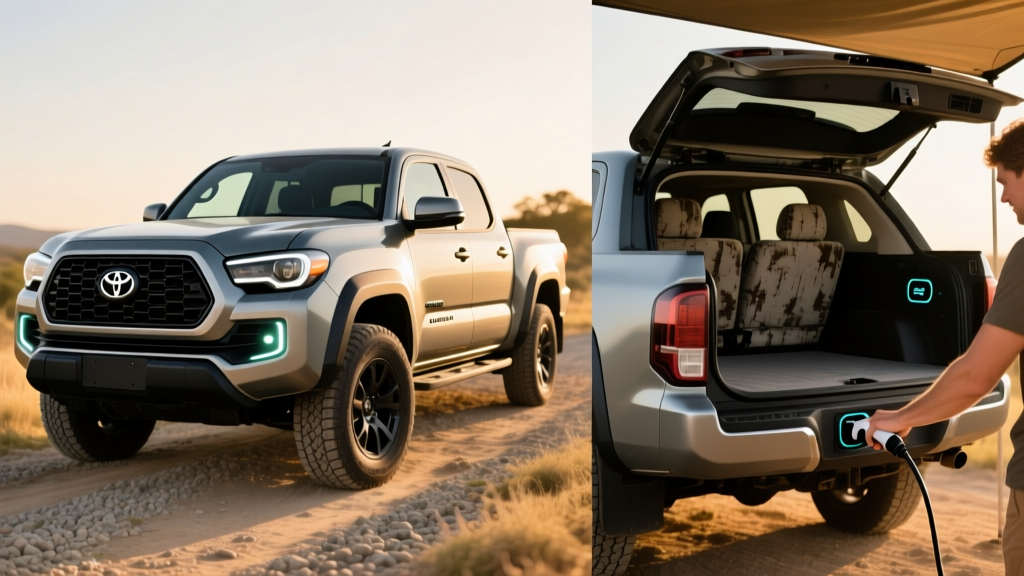
The midsize truck segment has gone hybrid, and the Toyota Tacoma is leading the charge. The 2026 Tacoma Hybrid — officially badged as the i-FORCE MAX — pairs a turbocharged four-cylinder with an electric motor to deliver V6-rivaling power while squeezing extra miles from every gallon. But does a hybrid truck make sense for your daily drive, trail runs, or towing duties?
We've analyzed EPA data, real-world owner reports, and Toyota's latest powertrain specs to give you the definitive buyer's guide to the 2026 Tacoma Hybrid. Here's what you need to know before you head to the dealership.
What Is the Tacoma Hybrid? HEV vs. PHEV Explained
The 2026 Toyota Tacoma Hybrid is a conventional hybrid electric vehicle (HEV), not a plug-in hybrid (PHEV). That distinction matters for how you'll use the truck every day.
| Feature | Tacoma i-FORCE MAX (HEV) | Typical PHEV Truck |
|---|---|---|
| Plug-in charging required? | No — self-charging via regenerative braking | Yes — plug in for electric-only range |
| Electric-only driving | Limited (low-speed assist only) | 20–40 miles on battery alone |
| Battery size | ~1.87 kWh (nickel-metal hydride) | 12–20+ kWh (lithium-ion) |
| Federal tax credit (§30D) | Not eligible | Up to $7,500 if requirements met |
| Charging infrastructure needed | None | Level 1 or Level 2 home charger ideal |
As an HEV, the Tacoma Hybrid never needs to be plugged in. The small battery recharges through regenerative braking and the gasoline engine. You simply fill up at the pump like any other truck, but the electric motor provides torque fill, smoother stop-start behavior, and measurable fuel savings — especially in city driving.
Fuel Economy: EPA Ratings and Real-World MPG
Fuel efficiency is the Tacoma Hybrid's headline advantage over its gas-only siblings. Here's what the EPA says, followed by what you can actually expect on the road.
| Configuration | City MPG | Highway MPG | Combined MPG |
|---|---|---|---|
| Tacoma i-FORCE MAX 4x2 | 24 | 27 | 25 |
| Tacoma i-FORCE MAX 4x4 | 23 | 26 | 24 |
| Tacoma Gas i-FORCE 4x4 (non-hybrid) | 20 | 23 | 21 |
Source: fueleconomy.gov — EPA estimates. Your mileage will vary based on driving conditions, cargo load, and terrain.
Real-World MPG: What Owners Actually See
The Tacoma Hybrid's electric motor does its heaviest lifting at low speeds, where it fills in torque gaps and reduces engine load. That means city and suburban driving often yields results at or above the EPA sticker, with some owners reporting 25–27 MPG combined in mixed suburban use.
Highway-only driving at sustained 70–80 mph speeds reduces the hybrid system's advantage. Expect 22–24 MPG on long highway hauls in the 4x4 configuration. Towing a 4,000-lb trailer drops economy significantly — plan for 14–17 MPG while towing, depending on grade and wind.
Compared to the non-hybrid i-FORCE 4x4 (21 MPG combined), the hybrid system delivers a roughly 3 MPG combined improvement. Over 15,000 miles per year at $3.50/gallon, that translates to approximately $370 in annual fuel savings.
Powertrain and Performance Specs
The i-FORCE MAX powertrain isn't just about efficiency — it's also the most powerful engine option in the Tacoma lineup, surpassing even the standard turbo four-cylinder.
| Specification | 2026 Tacoma i-FORCE MAX (Hybrid) |
|---|---|
| Engine | 2.4L turbocharged inline-4 |
| Electric motor | Integrated between engine and transmission |
| Combined horsepower | 326 hp |
| Combined torque | 465 lb-ft |
| Transmission | 8-speed automatic |
| 0–60 mph (est.) | ~6.5 seconds |
| Max towing capacity | 6,000 lbs (properly equipped) |
| Max payload | ~1,700 lbs (varies by trim) |
| Battery type | Nickel-metal hydride (NiMH), ~1.87 kWh |
| Drivetrain | RWD or 4WD (part-time, with low range on 4x4) |
The 465 lb-ft of torque arrives low in the rev range thanks to the electric motor's instant contribution. That makes the Tacoma Hybrid feel responsive from a stoplight and confident when merging onto highways with a load. The hybrid system also enables a quieter, smoother idle at stops — the engine shuts off and the motor handles accessories and creep.
For off-road enthusiasts, the i-FORCE MAX is available on the TRD Off-Road and Trailhunter trims, meaning you don't sacrifice trail capability for hybrid efficiency.
Pricing, Trims, and Tax Credit Eligibility
The 2026 Tacoma Hybrid carries a price premium over the standard gas powertrain, but it's positioned as the performance-and-efficiency upgrade rather than a standalone model.
| Trim (i-FORCE MAX) | Starting MSRP (approx.) |
|---|---|
| TRD Off-Road 4x4 | $42,990 |
| Limited 4x4 | $50,990 |
| TRD Pro 4x4 | $64,990 |
| Trailhunter 4x4 | $62,990 |
Pricing based on Toyota's published MSRP. Dealer markups and regional adjustments may apply.
Federal Tax Credit: Does the Tacoma Hybrid Qualify?
No. The Tacoma i-FORCE MAX is a conventional hybrid (HEV), and under current IRS §30D rules, only plug-in electric vehicles (BEVs and PHEVs with sufficient battery capacity) qualify for the federal clean vehicle credit. The Tacoma Hybrid does not have a plug or a large enough battery to meet the minimum 7 kWh threshold.
Some states offer separate rebates or reduced registration fees for hybrids, but these vary widely. Check your state's energy office or department of environmental quality for current programs. Toyota's own website and Toyota Financial Services occasionally offer lease or finance incentives on hybrid models — worth checking at purchase time.
Battery Warranty, Reliability, and Replacement Cost
Hybrid battery longevity is one of the most common concerns among first-time hybrid truck buyers. Toyota has decades of hybrid engineering behind it, and the Tacoma benefits from that track record.
Tacoma Hybrid Battery Warranty
- Hybrid battery warranty: 10 years / 150,000 miles (whichever comes first)
- Hybrid system components: 8 years / 100,000 miles
- Powertrain warranty: 5 years / 60,000 miles
- Basic bumper-to-bumper: 3 years / 36,000 miles
Warranty covers defects and capacity loss below a defined threshold under normal use. See your dealer for full terms.
Expected Battery Lifespan
Toyota's NiMH hybrid batteries have demonstrated remarkable longevity across the Prius, Camry Hybrid, and Highlander Hybrid lineups. Many owners report 150,000–200,000+ miles on original hybrid batteries with minimal degradation. The Tacoma's relatively small 1.87 kWh pack undergoes shallow charge-discharge cycles, which is gentler on battery chemistry than the deep cycles in a full EV.
If replacement is eventually needed out of warranty, a Tacoma hybrid battery pack replacement is estimated at $2,500–$4,000 including labor — significantly less than a full EV battery replacement, which can exceed $10,000–$20,000.
Reliability Outlook
Toyota's hybrid systems are among the most proven in the industry. The i-FORCE MAX uses a conventional planetary gearset and clutch-based integration rather than an exotic e-CVT, which simplifies the drivetrain. Early reliability data on the redesigned Tacoma platform (introduced for 2024) has been generally positive, though some owners have noted turbo-related hesitation in early model years that Toyota addressed through software updates.
For peace of mind, the Tacoma carries NHTSA safety ratings and Toyota Safety Sense 3.0 as standard equipment, including pre-collision braking, lane departure alert, and full-speed adaptive cruise control.
Tacoma Hybrid vs. Gas Tacoma vs. Full EV Truck
Not every truck buyer needs a hybrid, and not every hybrid buyer needs a truck. Here's how the Tacoma i-FORCE MAX stacks up against its alternatives.
Choose the Tacoma Hybrid If:
- You want more torque and quicker acceleration than the base turbo-4
- You drive a mix of city and highway and want 3+ MPG improvement
- You don't have access to home or workplace charging (no plug needed)
- You tow occasionally but not at max capacity daily
- You want Toyota's proven hybrid reliability with a 10-year battery warranty
Consider a Gas Tacoma or Full EV Instead If:
- Gas Tacoma: You want the lowest upfront price and simplest powertrain; you drive mostly highway where hybrid gains are smaller
- Full EV (e.g., Ford F-150 Lightning, Rivian R1T): You have reliable home charging, want zero tailpipe emissions, and prioritize fuel cost savings of $1,500+ per year
- PHEV (e.g., upcoming electric midsize trucks): You want electric-only commuting with gas backup for longer trips
Cost of Ownership Snapshot: 5-Year Comparison
| Factor | Tacoma Hybrid 4x4 | Tacoma Gas 4x4 | EV Truck (e.g., R1T Dual-Motor) |
|---|---|---|---|
| Starting MSRP | ~$42,990 | ~$38,000 | ~$73,000 |
| Federal tax credit | $0 | $0 | Up to $7,500 (if eligible) |
| Annual fuel/energy cost | ~$2,100 | ~$2,500 | ~$600–$900 |
| 5-year fuel spend | ~$10,500 | ~$12,500 | ~$3,000–$4,500 |
| Maintenance (5-yr est.) | ~$2,500 | ~$2,800 | ~$1,200 |
| Home charger needed? | No | No | Yes (Level 2 recommended) |
The Tacoma Hybrid occupies a practical middle ground: modest fuel savings over gas, no charging infrastructure required, and a price point well below full electric trucks. For buyers who can't charge at home or who regularly exceed 300 miles between stops, the hybrid is the path of least resistance.
Which Tacoma Hybrid Trim Should You Buy?
The i-FORCE MAX powertrain is available on select trims, each targeting a different buyer profile:
- TRD Off-Road: Best value for the hybrid powertrain. Includes CRAWL control, Multi-Terrain Select, and an electronic locking rear differential. The sweet spot for weekend warriors who commute during the week.
- Limited: Luxury-leaning with leather, premium audio, and a panoramic moonroof. Ideal if your Tacoma doubles as a daily family hauler.
- Trailhunter: Factory overlanding rig with ARB bumpers, Old Man Emu suspension, and integrated recovery points. The hybrid's low-end torque is an asset on technical trails.
- TRD Pro: The halo model. FOX internal-bypass shocks, skid plates, and exclusive styling. You're paying for off-road performance, with the hybrid as a bonus.
Frequently Asked Questions
How many MPG does the 2026 Tacoma Hybrid get?
The EPA rates the Tacoma i-FORCE MAX 4x4 at 23 city / 26 highway / 24 combined MPG. The 4x2 model earns 24/27/25. Real-world results vary: city-heavy drivers often see 25–27 MPG combined, while sustained highway driving and towing reduce efficiency to 22 MPG or lower.
Do I need to plug in the Tacoma Hybrid?
No. The Tacoma i-FORCE MAX is a conventional hybrid (HEV). Its small battery recharges automatically through regenerative braking and the gasoline engine. There is no plug, no charging cable, and no need for a home charger.
Does the Tacoma Hybrid qualify for a federal tax credit?
No. Under current IRS §30D rules, only plug-in electric vehicles (BEVs and qualifying PHEVs) are eligible for the federal clean vehicle credit. The Tacoma Hybrid does not have a plug or a battery large enough to qualify. Check your state for possible hybrid-specific incentives.
How long will the Tacoma Hybrid battery last?
Toyota covers the hybrid battery for 10 years or 150,000 miles. Based on Toyota's track record with NiMH hybrid batteries across millions of vehicles, many packs last 150,000–200,000+ miles. Replacement cost, if needed out of warranty, is estimated at $2,500–$4,000.
Is the Tacoma Hybrid good for towing?
Yes, with a caveat. The i-FORCE MAX produces 465 lb-ft of torque and is rated to tow up to 6,000 lbs when properly equipped. However, towing significantly reduces fuel economy — expect 14–17 MPG under load. For frequent heavy towing near max capacity, a larger-displacement engine in a full-size truck may be more appropriate.
Hybrid vs. PHEV vs. EV truck — which should I choose?
Choose the Tacoma Hybrid (HEV) if you want better fuel economy and more torque without changing your fueling habits. Choose a PHEV truck if you can charge at home and want 20–40 miles of electric commuting with gas backup. Choose a full EV truck if you have reliable charging, want the lowest operating costs, and don't need 400+ miles of range between stops.
Is the Tacoma Hybrid reliable?
Toyota's hybrid systems have an extensive reliability record spanning over 25 years. The i-FORCE MAX uses proven components, and the Tacoma carries Toyota Safety Sense 3.0 standard. Early model-year reports (2024–2025) have been generally positive, with Toyota issuing software updates to address initial turbo calibration concerns.