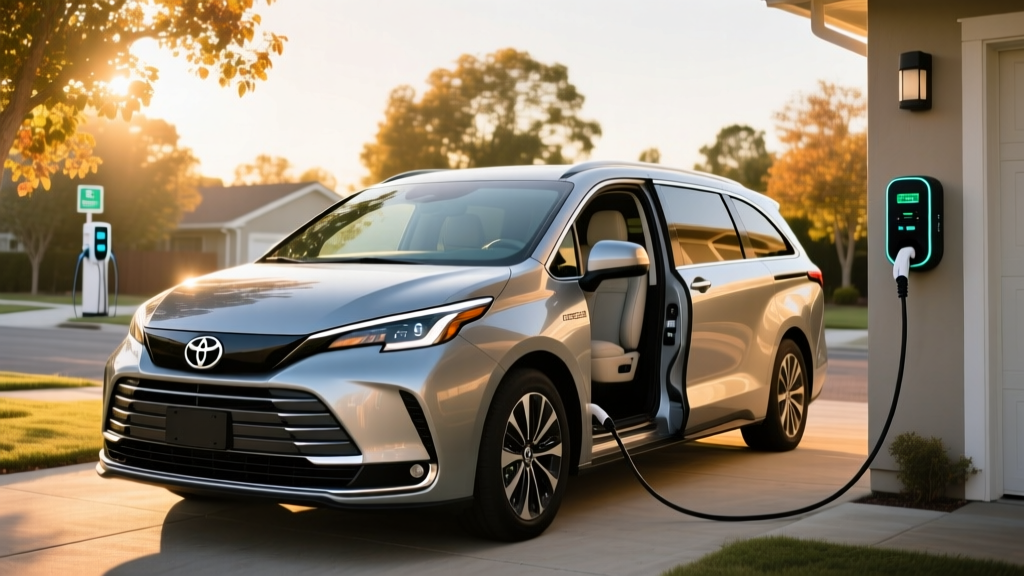
The 2026 Toyota Sienna hybrid minivan remains one of the most fuel-efficient family haulers on the market, and it achieves that without a plug. Toyota's fourth-generation Sienna has been a hybrid-only nameplate since 2021, and the 2026 model year carries forward the proven 2.5-liter four-cylinder hybrid powertrain with standard all-wheel drive availability and seating for up to eight. If you're cross-shopping minivans and want max-cargo space without the range anxiety or charging logistics of a full EV, the Sienna's 36 MPG EPA combined rating makes a compelling case.
This guide breaks down the exact fuel economy figures, powertrain specs, real-world MPG expectations, battery longevity data, and pricing for every 2026 Sienna trim — plus how it compares to the Chrysler Pacifica PHEV and whether any federal tax credits apply.
HEV vs PHEV: Where the Sienna Fits
A common point of confusion for minivan shoppers is the difference between a conventional hybrid (HEV) and a plug-in hybrid (PHEV). The 2026 Toyota Sienna is a conventional hybrid (HEV). It does not plug in. Its small traction battery recharges through regenerative braking and the gasoline engine. You fuel it like any other car and never think about charging.
HEV vs PHEV: Quick Comparison
| Feature | HEV (Toyota Sienna) | PHEV (e.g., Pacifica Hybrid) |
|---|---|---|
| Plugs in? | No | Yes (Level 1/Level 2) |
| Electric-only range | ~1 mile at low speed | 32 miles (Pacifica) |
| Battery size | 1.9 kWh (NiMH) | 16 kWh (Li-ion) |
| Combined MPG/MPGe | 36 MPG | 30 MPG / 82 MPGe |
| Federal tax credit | No | Up to $7,500 (§30D) |
| Home charging needed? | No | Yes (for EV range benefit) |
The Sienna trades electric-only driving capability for simplicity — no charger install, no plug-in routine, and lower upfront cost.
Fuel Economy: EPA MPG and Real-World Results
According to EPA data on fueleconomy.gov, the 2026 Toyota Sienna hybrid achieves:
| Cycle | FWD | AWD (Electronic) |
|---|---|---|
| City | 36 MPG | 35 MPG |
| Highway | 36 MPG | 36 MPG |
| Combined | 36 MPG | 35 MPG |
Real-World MPG: What Owners Actually See
Toyota's hybrid system excels in stop-and-go city driving, where the electric motor handles low-speed propulsion and regenerative braking recaptures energy. In real-world use:
- City/suburban driving: Many owners report 37–40 MPG in warm weather with moderate acceleration — the Sienna often exceeds its EPA city estimate.
- Highway cruising (70–80 mph): Expect 30–33 MPG. Hybrids lose their efficiency advantage at sustained high speeds where the gas engine does all the work and aerodynamic drag dominates.
- Cold weather (below 30°F): Plan for 28–32 MPG combined. The engine runs more frequently to maintain cabin heat and battery temperature, reducing electric-motor contribution.
- Loaded/towing: With passengers and cargo approaching the Sienna's ~3,500-lb towing capacity, fuel economy drops to roughly 25–28 MPG.
Powertrain Specs: Engine, Motors, and Horsepower
The 2026 Sienna uses Toyota's fourth-generation hybrid system, pairing a 2.5-liter inline-four Atkinson-cycle engine with electric motor-generators through an eCVT (planetary gearset, not a belt-driven CVT).
| Specification | Value |
|---|---|
| Engine | 2.5L 4-cyl Atkinson cycle (189 hp) |
| Front electric motor | 134 hp / 199 lb-ft |
| Rear electric motor (AWD) | 54 hp / 89 lb-ft |
| Net combined system output | 245 hp |
| Transmission | eCVT (planetary gearset) |
| Drivetrain | FWD standard; Electronic AWD available |
| Hybrid battery | 1.9 kWh, Nickel-Metal Hydride (NiMH) |
| 0–60 mph | ~7.1 seconds |
| Towing capacity | 3,500 lbs |
| Fuel tank | 17.9 gallons |
| Total range (est.) | ~640 miles |
The 245 hp output provides adequate acceleration for merging and passing, though the Sienna is tuned for smoothness rather than sportiness. The eCVT eliminates shift shock entirely. The electronic AWD system (available on most trims) engages the rear motor only when slip is detected, preserving fuel economy in dry conditions.
Pricing by Trim and Tax Credit Eligibility
The 2026 Toyota Sienna hybrid is available across a wide trim range. Estimated MSRP by trim (destination included):
- LE (base): ~$39,500
- XLE: ~$43,500
- XSE: ~$45,000
- Limited: ~$49,500
- Platinum (top): ~$54,000
- Woodland Edition (AWD, rugged trim): ~$47,500
Does the 2026 Sienna Hybrid Qualify for a Federal Tax Credit?
No. Under current IRS §30D Clean Vehicle Credit rules, conventional hybrids (HEVs) that do not plug in are not eligible for the federal EV tax credit. The §30D credit requires a minimum battery capacity of 7 kWh and plug-in capability — criteria the Sienna's 1.9 kWh NiMH pack does not meet.
However, some states offer rebates or HOV-lane access for hybrids. Check your state's energy office or Alternative Fuels Data Center for local incentive details, as these vary significantly by jurisdiction and change frequently.
Hybrid Battery Longevity, Warranty, and Replacement Cost
Battery lifespan is the single most common concern among first-time hybrid buyers. Here's what the data shows for Toyota's hybrid systems:
2026 Sienna Hybrid Battery Warranty
- Hybrid battery: 10 years / 150,000 miles (whichever comes first)
- Hybrid system components: 8 years / 100,000 miles
- Capacity retention threshold: Toyota warrants the battery against defects and abnormal loss of function — there is no published minimum capacity percentage, as the HEV system manages a narrow state-of-charge window that minimizes degradation
Real-World Battery Lifespan
Toyota's NiMH hybrid batteries have an exceptionally strong longevity track record. The Prius taxi fleet data and owner reports consistently show:
- Most Toyota hybrid batteries last 150,000–200,000+ miles before requiring replacement.
- The Sienna's hybrid system uses a narrow state-of-charge window (roughly 40–80% SoC), which dramatically reduces cell stress and extends cycle life.
- NiMH chemistry is less energy-dense than lithium-ion but is highly tolerant of heat and charge cycling — ideal for a vehicle that never plugs in.
Battery Replacement Cost
If the hybrid battery does fail outside warranty:
- New OEM replacement: $3,000–$4,000 (parts + labor at a Toyota dealer)
- Refurbished/remanufactured: $1,500–$2,500 from independent hybrid specialists
- Individual module replacement: $500–$1,000 if only a few cells have degraded (common in higher-mileage units)
Compared to a full EV battery replacement ($10,000–$20,000+), the Sienna's hybrid battery is relatively inexpensive to service — and far less likely to need it within the vehicle's normal lifespan.
Sienna Hybrid vs Pacifica PHEV vs Full EV: Which Fits You?
The minivan and three-row SUV segment now offers genuine electrified choices. Here's how to decide:
| Factor | Toyota Sienna HEV | Chrysler Pacifica PHEV | Full EV (e.g., Kia EV9) |
|---|---|---|---|
| Base price | ~$39,500 | ~$51,000 | ~$56,000 |
| After federal credit | ~$39,500 | ~$43,500* | ~$48,500* |
| Fuel/energy cost per mile | ~$0.10 | ~$0.06 (EV mode) | ~$0.04 |
| Home charging needed | No | Yes (for EV benefit) | Yes (essential) |
| Road trip simplicity | Gas station, 5 min | Gas station, 5 min | DC fast charge, 20–40 min |
| Seating | 7–8 passengers | 7 passengers | 6–7 passengers |
| Cargo (behind 3rd row) | 33.5 cu ft | 32.3 cu ft | 20–22 cu ft |
* Tax credit eligibility depends on MSRP caps, buyer income limits, battery sourcing requirements, and point-of-sale transfer rules under §30D. Verify at irs.gov before purchase.
Decision Framework
Choose the Sienna HEV if: You want maximum fuel efficiency without changing your fueling habits, you don't have reliable home charging access, you need 8-passenger seating and maximum cargo space, and you want the lowest upfront cost.
Choose the Pacifica PHEV if: You have home Level 2 charging, most of your daily driving is under 32 miles, you want to drive on electricity most days while keeping gas flexibility for road trips, and you qualify for the §30D credit.
Choose a full EV (EV9, etc.) if: You have reliable home charging, your daily commute is within range, you want the lowest per-mile energy cost, you want to eliminate oil changes and emissions system maintenance entirely, and your budget allows the higher upfront price.
2026 Sienna Trim-by-Trim Breakdown
Every 2026 Sienna trim shares the same hybrid powertrain. Differences are in features, upholstery, and technology:
- LE (~$39,500): 8-passenger, Toyota Safety Sense 3.0, 9-inch touchscreen, wireless Apple CarPlay/Android Auto, tri-zone climate, 18-inch wheels. The value pick.
- XLE (~$43,500): SofTex seats, power sliding doors and liftgate, 7-passenger with captain's chairs, wireless charging pad. The most popular family config.
- XSE (~$45,000): Sport-tuned suspension, 20-inch wheels, black exterior accents, 7-passenger. For the style-conscious buyer.
- Limited (~$49,500): Leather, 12.3-inch display, JBL 12-speaker audio, heated/ventilated front seats, dual sunroofs.
- Platinum (~$54,000): Head-up display, 360-degree camera, rear-seat entertainment, heated second-row seats, digital rearview mirror.
- Woodland Edition (~$47,500): Standard AWD, all-terrain tires, raised ride height, roof rails, 7-passenger. For camping and light trails.
All trims include Toyota Safety Sense 3.0: adaptive cruise control, lane-keeping assist, automatic emergency braking with pedestrian detection, and road-sign assist. Note: this is a Level 2 driver-assist system per SAE definitions — you must remain engaged and keep your hands on the wheel at all times.
Pros, Cons, and the Verdict
Pros
- 36 MPG combined — best-in-class for minivans
- No plug-in required; zero lifestyle change
- 10-year/150,000-mile hybrid battery warranty
- Available AWD with electronic rear motor
- 33.5 cu ft cargo behind 3rd row (best in segment)
- ~640-mile total range per tank
- Toyota Safety Sense 3.0 standard on every trim
- Proven powertrain with 5+ years of real-world data
Cons
- No federal tax credit (HEV, not PHEV)
- 245 hp feels modest when fully loaded
- Highway MPG drops to ~30–33 at 75+ mph
- Infotainment lags behind rivals in responsiveness
- No plug-in hybrid variant offered
- AWD slightly reduces fuel economy (35 vs 36 MPG)
- Base LE lacks power sliding doors (add ~$4K for XLE)
The 2026 Toyota Sienna hybrid minivan is the pragmatic choice for families who want to cut fuel costs dramatically without adopting plug-in charging infrastructure. Its 36 MPG combined rating translates to roughly $1,400–$1,600 in annual fuel savings versus a gas-only minivan (at 15,000 miles/year and $3.50/gallon), paying back any price premium within the first few years of ownership.
Frequently Asked Questions
How many MPG does the 2026 Toyota Sienna hybrid get?
The EPA rates the FWD Sienna at 36 city / 36 highway / 36 combined MPG. The AWD model rates 35/36/35 MPG. In real-world city driving, many owners report 37–40 MPG. Highway cruising at 75+ mph typically yields 30–33 MPG.
Does the Toyota Sienna hybrid need to be plugged in?
No. The Sienna is a conventional hybrid (HEV). Its 1.9 kWh battery charges through regenerative braking and the gasoline engine. You never plug it in — you simply refuel at a gas station like any conventional vehicle.
Is there a plug-in hybrid (PHEV) Toyota Sienna?
As of the 2026 model year, Toyota does not offer a PHEV Sienna. If plug-in hybrid capability with electric-only driving is a priority, the Chrysler Pacifica Hybrid (32 miles electric-only, ~$51,000 base) is the only PHEV minivan currently available in the US market.
How long will the Sienna hybrid battery last?
Toyota's NiMH hybrid batteries routinely last 150,000–200,000+ miles based on Prius fleet data and owner reports. The 2026 Sienna's hybrid battery is covered by a 10-year/150,000-mile warranty. Replacement cost, if needed out of warranty, is $3,000–$4,000 for a new OEM unit or $1,500–$2,500 for a refurbished pack.
Is the 2026 Sienna hybrid reliable?
Toyota's hybrid powertrain is among the most proven in the industry, with over 25 years of production history dating to the 1997 Prius. The Sienna's 2.5L hybrid system has been in production since 2021 with no major reliability recalls. Toyota consistently ranks at or near the top of J.D. Power and Consumer Reports reliability surveys.
Does the 2026 Sienna qualify for any tax credits?
The Sienna HEV does not qualify for the federal §30D Clean Vehicle Credit, which requires plug-in capability and a minimum 7 kWh battery. Some states may offer hybrid-specific incentives or HOV-lane access — check your state energy office and the Alternative Fuels Data Center for details.
How does the Sienna hybrid compare to a full electric SUV?
A full EV like the Kia EV9 offers lower per-mile energy costs (~$0.04/mile vs ~$0.10/mile for the Sienna) and zero tailpipe emissions, but costs $15,000+ more upfront, requires home charging installation, and has less cargo room and fewer seats. The Sienna is the better choice for families without reliable home charging, frequent long-distance drivers, and those who prioritize cargo/passenger capacity.
What's the total driving range on a full tank?
With a 17.9-gallon fuel tank and 36 MPG combined, the Sienna delivers approximately 640 miles of total range. Highway-heavy driving reduces this to roughly 550–590 miles. City-heavy driving can push it past 660 miles.