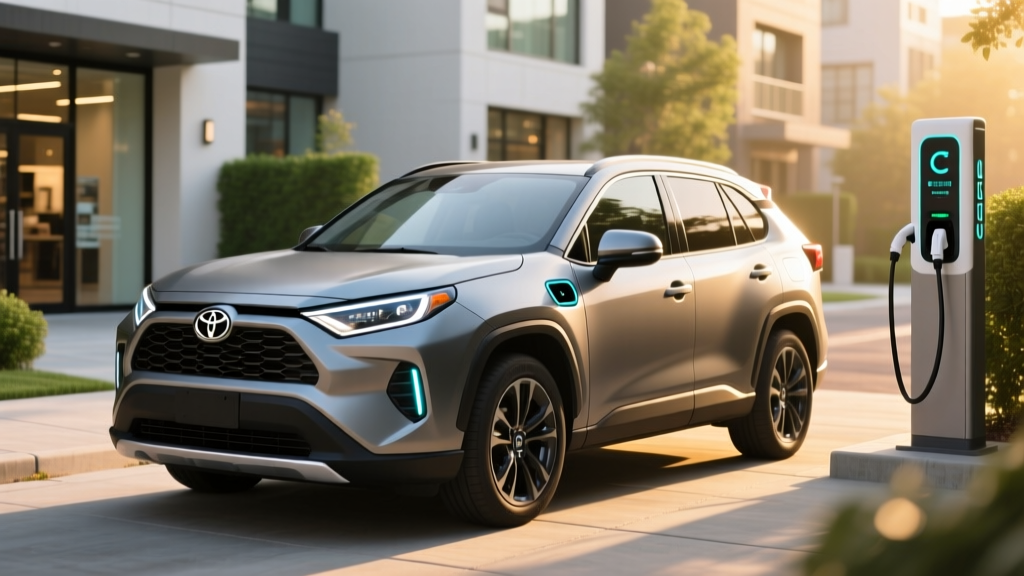
The Toyota RAV4 Prime has been one of the best-selling plug-in hybrids in the United States for good reason: it pairs a usable electric-only range with Toyota's proven hybrid reliability, all in the compact-SUV body that American buyers actually want. For 2026, the RAV4 Prime returns with its 42-mile EPA electric range, 302 combined horsepower, and a starting MSRP that — depending on your income and the vehicle's battery sourcing — may still qualify for a partial or full federal tax credit under IRS §30D rules.
But spec sheets only tell half the story. Below, we break down the real-world MPG and range you can expect, the charging setup you'll need at home, the battery warranty that protects your investment, and the decision framework to determine whether this PHEV, a conventional hybrid, or a full battery-electric vehicle (BEV) is the right move for your garage.
HEV vs PHEV: What's the Difference on the RAV4 Lineup?
Toyota sells three RAV4 powertrains: a conventional gas model, a standard hybrid (HEV), and the RAV4 Prime plug-in hybrid (PHEV). Understanding the distinction matters because it changes how you fuel, how you charge, and what you pay at the pump.
Conventional Hybrid (RAV4 Hybrid — HEV)
- No plug required. The 1.6 kWh battery charges solely through regenerative braking and the gas engine.
- EPA rating: 41 MPG city / 38 highway / 40 combined (fueleconomy.gov).
- Electric-only driving: Less than 1 mile at low speeds. The electric motor assists the engine; it does not replace it.
- Best for: Drivers without home charging access who want better fuel economy without changing habits.
Plug-In Hybrid (RAV4 Prime — PHEV)
- Plug-in required for full benefit. The 18.1 kWh (usable) lithium-ion battery charges via Level 1 (120V) or Level 2 (240V) charging.
- EPA rating: 42 miles electric-only, then 38 MPG combined once the battery is depleted (fueleconomy.gov).
- Electric-only driving: Up to 42 miles at speeds up to 84 mph in EV mode — enough for most daily commutes without burning a drop of gas.
- Best for: Drivers with home Level 2 charging who commute under 40 miles round-trip but want gas-engine flexibility for road trips.
The critical point: a conventional hybrid never needs to be plugged in. A PHEV functions perfectly fine as a hybrid when the battery is depleted — you just lose the electric-only miles and the fuel-cost advantage. If you can't charge at home or work, the RAV4 Prime's price premium over the standard RAV4 Hybrid becomes harder to justify.
2026 RAV4 Prime Specs: Powertrain, Battery, and Performance
| Specification | 2026 Toyota RAV4 Prime |
|---|---|
| Powertrain | 2.5L 4-cylinder Atkinson-cycle engine + 2 electric motors (front + rear), eCVT |
| Combined Horsepower | 302 hp |
| 0–60 mph | 5.7 seconds |
| Drivetrain | Electronic AWD (eAWD) — rear motor powers rear axle |
| Battery Capacity | 18.1 kWh usable (lithium-ion, NMC chemistry) |
| EPA Electric-Only Range | 42 miles |
| EPA Combined Range (EV + Gas) | 600 miles |
| EPA Fuel Economy (Hybrid Mode) | 40 city / 36 highway / 38 combined MPG |
| MPGe (Electric + Gas Combined) | 94 MPGe |
| Level 1 Charging (120V) | ~12 hours (0–100%) |
| Level 2 Charging (240V, 6.6 kW onboard) | ~2.5 hours (0–100%) |
| DC Fast Charging | Not supported |
| Towing Capacity | 1,500 lbs |
| Cargo Volume (rear seats up) | 33.5 cu ft |
| Starting MSRP (SE trim) | $44,515 |
| XSE trim MSRP | $48,425 |
A few notes on these numbers that spec sheets often gloss over:
The 6.6 kW onboard charger matters. Unlike some PHEVs limited to 3.3 kW Level 2 charging, the RAV4 Prime can accept 6.6 kW on a 240V Level 2 circuit. That means a full charge in about 2.5 hours — fast enough to top off during a lunch break at a workplace charger or overnight on a home Level 2 unit. However, the RAV4 Prime does not support DC fast charging. You won't find a CCS or NACS port here; this is J1772 Level 2 only. For a PHEV with an 18.1 kWh battery, DC fast charging would be overkill, and most PHEV owners charge exclusively at home overnight.
302 hp makes this the quickest RAV4. The combined output of the 2.5L engine and dual electric motors gives the Prime a 5.7-second 0–60 time — quicker than many sport compacts and significantly faster than the standard RAV4 Hybrid (7.4 seconds). The instant torque from the electric motors is noticeable in city merging and passing situations.
Fuel Economy: EPA vs Real-World MPG
| Driving Scenario | EPA Estimate | Real-World Expectation |
|---|---|---|
| City (hybrid mode, battery depleted) | 40 MPG | 38–43 MPG (hybrids often exceed EPA in stop-and-go due to regen braking) |
| Highway (hybrid mode, battery depleted) | 36 MPG | 33–36 MPG (aerodynamic drag reduces hybrid advantage at speed) |
| Combined (hybrid mode) | 38 MPG | 36–40 MPG |
| Electric-only (mixed driving) | 42 miles range | 36–42 miles (reduced in cold weather, high speeds, or hilly terrain) |
In practice, most RAV4 Prime owners with home charging and a sub-40-mile commute report using the gas engine fewer than 10 times per month. If your daily round-trip is 30 miles and you charge nightly, you might visit a gas station once every two months. Toyota's hybrid system is mature enough that the transition between EV and hybrid mode is seamless — most drivers don't notice the engine engaging.
Charging Setup: What You Need at Home
The RAV4 Prime's 18.1 kWh battery is small enough that charging infrastructure is straightforward and affordable compared to a full BEV.
| Charging Level | Power | Time (0–100%) | Equipment Needed |
|---|---|---|---|
| Level 1 (120V outlet) | ~1.4 kW | ~12 hours | Included portable charging cord (no electrician required) |
| Level 2 (240V, 32A circuit) | 6.6 kW (vehicle-limited) | ~2.5 hours | Level 2 EVSE ($300–$600) + electrician install ($400–$1,200) |
Level 1 is viable for PHEVs. Unlike full BEVs where Level 1 charging adds only 3–5 miles per hour, a RAV4 Prime on a standard 120V outlet gains roughly 4 miles of range per hour — enough to fully recharge the 42-mile battery overnight (10–12 hours). If your commute is short and your car sits parked for 12+ hours nightly, Level 1 alone may suffice.
Level 2 is recommended. A 240V Level 2 home charger (like a ChargePoint Home Flex or Emporia Level 2) completes a full charge in about 2.5 hours. This matters if you want to "opportunity charge" — for example, plugging in when you get home at 5 PM and having a full battery by 7:30 PM for an evening errand. Installation typically costs $400–$1,200 depending on your electrical panel's proximity to the garage and whether a panel upgrade (to 200A service) is needed. Total home charging setup: roughly $700–$1,800 including equipment and labor.
Public Level 2 chargers (at grocery stores, workplaces, or malls) can also top off the RAV4 Prime during a 1–2 hour stop. Because the vehicle doesn't support DC fast charging, there's no advantage to seeking out 150 kW or 350 kW DC stations.
Tax Credits and Incentives: Does the RAV4 Prime Qualify?
Federal tax credit eligibility for the RAV4 Prime under IRS §30D is nuanced and depends on three factors that change periodically:
- MSRP cap: SUVs must have an MSRP at or below $80,000. Both RAV4 Prime trims (SE at $44,515 and XSE at $48,425) clear this easily.
- Buyer income cap: Modified adjusted gross income must not exceed $150,000 (single), $225,000 (head of household), or $300,000 (joint filers).
- Battery sourcing requirements: The vehicle must meet critical-mineral and battery-component sourcing thresholds that tighten annually. As of the 2026 model year, verify current sourcing compliance on fueleconomy.gov or with your Toyota dealer, as these requirements can change mid-year.
Maximum potential credit: Up to $7,500, split into $3,750 for critical-mineral sourcing and $3,750 for battery-component sourcing. The RAV4 Prime has historically qualified for at least a partial credit, but the exact amount depends on the current model year's battery supply chain. Starting in 2024, the credit can be transferred to the dealer as a point-of-sale discount, reducing your purchase price directly rather than waiting for a tax refund.
State incentives: Several states (California, Colorado, New York, among others) offer additional rebates or HOV-lane access for PHEVs with a minimum electric range. Check your state's energy office or DMV for current programs, as these vary by jurisdiction and funding availability.
Battery Warranty, Reliability, and Replacement Cost
Reliability track record. Toyota's hybrid synergy drive system is one of the most proven electrified powertrains on the road, with over two decades of deployment since the original Prius. The RAV4 Prime uses a derivative of this system with a larger battery. Independent reliability data from Consumer Reports and J.D. Power consistently ranks Toyota's hybrid systems among the most dependable, with battery failures before 150,000 miles being uncommon.
Battery replacement cost. If the high-voltage battery fails outside of warranty, a replacement from Toyota currently costs approximately $4,000–$6,000 including parts and labor at a dealership. Independent hybrid-battery specialists can sometimes refurbish or replace individual modules for $1,500–$3,000. Given the 10-year/150,000-mile warranty coverage, most original owners will never face this cost.
Degradation expectations. PHEV batteries experience less deep-cycle stress than full BEV batteries because the system maintains a buffer (typically 15–20% of total capacity is reserved and not user-accessible). Based on fleet data from earlier Toyota PHEVs, expect 8–12% capacity loss over 10 years — meaning a 42-mile electric range might become 37–39 miles after a decade. This is gradual and rarely affects daily usability.
Who Should Buy the RAV4 Prime vs a Full EV or Gas Car?
Choose the RAV4 Prime PHEV if:
- Your daily round-trip commute is 20–40 miles and you can charge at home (Level 1 or Level 2).
- You take road trips 3+ times per year where charging infrastructure may be sparse.
- You want to reduce gas consumption by 60–80% without committing to a full BEV.
- You live in a cold climate where BEV range loss (20–30% in winter) is a concern — the PHEV's gas engine eliminates range anxiety entirely.
- You want AWD in an electrified vehicle without paying BEV-SUV premiums (Tesla Model Y, Hyundai Ioniq 5).
Choose the RAV4 Hybrid (HEV) instead if:
- You cannot charge at home or at work (apartment, street parking, no garage outlet).
- Your budget is tighter — the RAV4 Hybrid starts ~$12,000 less than the Prime.
- You drive mostly highway miles where the electric-only advantage is minimized.
- You want Toyota hybrid reliability with zero behavior change — just drive and refuel normally.
Choose a full BEV (e.g., Tesla Model Y, Hyundai Ioniq 5) instead if:
- You have reliable home Level 2 charging and rarely drive more than 250 miles in a single day.
- You want to eliminate gas-engine maintenance entirely (no oil changes, no spark plugs, no exhaust system).
- Your state offers significant BEV-only incentives (some states give $5,000–$7,500 for BEVs but nothing for PHEVs).
- You want the lowest per-mile fuel cost — electricity at $0.13/kWh costs roughly $0.04/mile vs. $0.12–$0.15/mile for gas at 38 MPG.
Ownership Costs: 5-Year Breakdown
| Cost Category | RAV4 Prime PHEV | RAV4 Hybrid HEV | Gas RAV4 (AWD) |
|---|---|---|---|
| Purchase Price (MSRP) | $44,515 | $32,725 | $30,425 |
| Est. Federal Tax Credit | –$3,750 to –$7,500 | $0 | $0 |
| Fuel/Energy (5 yr, 15k mi/yr) | $2,800–$4,200* | $6,900 | $8,400 |
| Maintenance (5 yr) | $2,500 | $3,000 | $3,500 |
| Insurance (5 yr est.) | $8,500 | $7,200 | $7,000 |
| Est. 5-Year Total** | $52,500–$56,500 | $49,800 | $49,300 |
*Fuel cost for the RAV4 Prime depends heavily on how often you drive in EV mode. If 80% of your miles are electric and you pay $0.13/kWh for home charging, your 5-year energy cost could be as low as $2,800. If you rarely charge and drive mostly on gas, expect closer to $4,200.
**Totals exclude depreciation, which varies by region and market conditions. Historically, Toyota RAV4 models (including the Prime) hold value well, often retaining 55–65% of MSRP after 5 years.
The RAV4 Prime's higher upfront cost is partially offset by fuel savings and tax credits, but it rarely reaches cost-parity with the standard RAV4 Hybrid within 5 years unless you drive mostly electric miles and qualify for the full $7,500 credit. The Prime's value proposition is as much about the driving experience (302 hp, instant torque, quiet EV commuting) as it is about pure economics.
Frequently Asked Questions
How many MPG does the RAV4 Prime get?
Once the battery is depleted, the RAV4 Prime operates as a conventional hybrid and achieves an EPA-rated 40 MPG city / 36 highway / 38 combined. In real-world city driving, owners often report 38–43 MPG thanks to regenerative braking. Highway driving at 75+ mph typically yields 33–36 MPG. When the battery is charged, the first 42 miles use no gasoline at all.
How far can the RAV4 Prime go on electric only?
The EPA rates the RAV4 Prime at 42 miles of electric-only range. In real-world conditions, expect 36–42 miles in mild weather at city speeds, 33–38 miles in freezing temperatures, and 30–35 miles at sustained highway speeds above 70 mph. The gas engine seamlessly engages once the battery depletes, giving a total combined range of approximately 600 miles.
Does the RAV4 Prime qualify for a federal tax credit?
The RAV4 Prime may qualify for up to $7,500 under IRS §30D, depending on current battery-sourcing and critical-mineral requirements, which tighten annually. The vehicle's MSRP ($44,515–$48,425) is well below the $80,000 SUV cap. Buyer income must not exceed $150,000 (single) or $300,000 (joint). Verify current eligibility at fueleconomy.gov or with your dealer before purchasing, as sourcing compliance can change.
Is the RAV4 Prime reliable and what does battery replacement cost?
Toyota's hybrid system has a 25+ year reliability track record. The RAV4 Prime's high-voltage battery is warranted for 10 years / 150,000 miles in all 50 states. Out-of-warranty battery replacement costs approximately $4,000–$6,000 at a dealership, or $1,500–$3,000 through an independent hybrid specialist. Based on fleet data, expect 8–12% battery capacity loss over 10 years — rarely enough to affect daily usability.
Can the RAV4 Prime DC fast charge?
No. The RAV4 Prime supports Level 1 (120V, ~12 hours for a full charge) and Level 2 (240V at 6.6 kW, ~2.5 hours) charging only. It uses a standard J1772 connector. DC fast charging is not available, which is typical for PHEVs — the 18.1 kWh battery is small enough that Level 2 charging is adequate for overnight and opportunity charging.
Hybrid vs PHEV vs EV — which is right for me?
Choose a conventional hybrid (HEV) if you can't charge at home and want better MPG without behavior change. Choose a PHEV like the RAV4 Prime if you have home charging, commute under 40 miles, but want gas-engine backup for road trips. Choose a full BEV if you have reliable home charging, rarely exceed 250 miles daily, and want to eliminate gas and oil changes entirely. The PHEV is the "best of both worlds" compromise — it trades the BEV's lowest per-mile cost and zero tailpipe emissions for the gas engine's unlimited range and cold-weather security.