Quick Verdict: The PHEV Sweet Spot for SUV Buyers
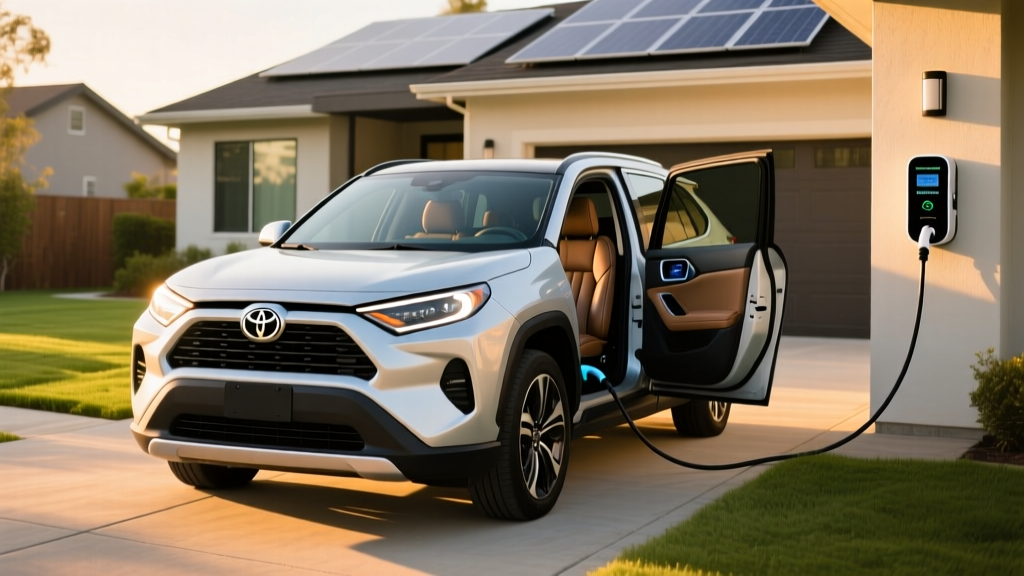
The 2026 Toyota RAV4 Plug-In Hybrid (formerly known as the RAV4 Prime through the 2025 model year) remains one of the most compelling electrified SUVs on the market for drivers who want meaningful electric-only commuting without sacrificing road-trip flexibility. With an EPA-rated 42 miles of electric-only range, a combined 302 horsepower, and standard all-wheel drive, it bridges the gap between a conventional hybrid and a full battery-electric vehicle. For households that can charge at home and drive under 40 miles round-trip on most days, this PHEV can operate as an EV the majority of the time while retaining a 520-mile total range for longer hauls.
Starting at approximately $44,500 for the SE trim and climbing to around $48,500 for the XSE, the RAV4 Plug-In Hybrid carries a premium over the standard RAV4 Hybrid — but the performance upgrade, electric-only capability, and potential federal tax credit help narrow that gap. Here is everything you need to know before buying.
HEV vs PHEV: Which RAV4 Is Right for You?
Toyota sells two electrified RAV4 variants, and confusing them at the dealership is one of the most common buyer mistakes. Here is the functional difference:
| Attribute | RAV4 Hybrid (HEV) | RAV4 Plug-In Hybrid (PHEV) |
|---|---|---|
| Plugs in? | No — self-charging via regen + engine | Yes — plug in to charge the larger battery |
| Electric-only range | ~1 mile at low speed | 42 miles (EPA) |
| Battery capacity | 1.6 kWh | 18.1 kWh |
| Combined horsepower | 219 hp | 302 hp |
| 0–60 mph | 7.4 seconds | 5.7 seconds |
| EPA combined (gas) | 39 MPG | 35 MPG (charge-sustaining) |
| MPGe (electric mode) | N/A | 94 MPGe |
| Starting MSRP (2026) | ~$33,500 | ~$44,500 |
| Federal tax credit | Not eligible | Up to $7,500 (§30D, see eligibility below) |
Bottom line: The conventional RAV4 Hybrid is the right pick if you cannot charge at home and simply want better fuel economy without changing your habits. The RAV4 Plug-In Hybrid is for drivers with home or workplace charging who want to drive on electricity most days but still need the freedom to take 500-mile road trips without planning around chargers.
Electric-Only Range and Total Range
The 2026 RAV4 Plug-In Hybrid carries an 18.1 kWh lithium-ion battery pack (usable capacity approximately 14.9 kWh, with the remainder reserved as a buffer to protect long-term battery health). The EPA rates it at 42 miles of electric-only range, which is among the highest of any compact PHEV SUV — beating the Ford Escape PHEV's 37 miles and the Hyundai Tucson PHEV's 33 miles.
EPA Electric Range: 42 miles
Real-world expectation: Expect 36–40 miles in mixed driving in moderate temperatures (55–75°F). In highway-heavy driving at 70+ mph, plan for 30–34 miles. In cold weather (below 32°F), expect 28–33 miles due to cabin heating load and reduced battery efficiency. The RAV4 PHEV does include a heat pump on higher trims, which helps mitigate cold-weather losses compared to resistive heating systems.
Once the battery is depleted, the RAV4 Plug-In Hybrid seamlessly switches to charge-sustaining hybrid mode, operating essentially like a standard RAV4 Hybrid. The total combined range (electric + gasoline) is approximately 520 miles on a full charge and a full 14.5-gallon tank.
Fuel Economy: EPA MPG and Real-World Numbers
When operating in hybrid mode after the battery is depleted, the 2026 RAV4 Plug-In Hybrid returns solid — though not class-leading — fuel economy. The extra weight of the larger battery pack slightly reduces gas-only efficiency compared to the standard RAV4 Hybrid.
| Mode | City | Highway | Combined |
|---|---|---|---|
| Electric-only (MPGe) | — | — | 94 MPGe |
| Hybrid (charge-sustaining) | 36 MPG | 34 MPG | 35 MPG |
Real-world MPG note: Toyota hybrids tend to meet or slightly exceed EPA city estimates in stop-and-go driving because regenerative braking recaptures energy that would otherwise be lost. On the highway, where regen benefits are minimal and aerodynamic drag dominates, expect figures closer to or slightly below the EPA highway rating. Drivers who regularly charge and commute within the 42-mile electric envelope may use very little gasoline for weeks at a time. Source: fueleconomy.gov.
Powertrain, Performance, and Charging
The RAV4 Plug-In Hybrid pairs a 2.5-liter inline-4 Atkinson-cycle gasoline engine with three electric motors — one integrated into the front transaxle, one on the rear axle (providing standard electronic AWD), and one serving as a generator/starter. Combined system output is 302 horsepower, making this the quickest RAV4 variant Toyota sells.
| Specification | 2026 RAV4 Plug-In Hybrid |
|---|---|
| Engine | 2.5L 4-cyl Atkinson-cycle |
| Combined system HP | 302 hp |
| 0–60 mph | 5.7 seconds |
| Drivetrain | Electronic AWD (e-AWD) |
| Battery capacity | 18.1 kWh (total) / ~14.9 kWh usable |
| Battery chemistry | Lithium-ion (NMC) |
| Level 1 charging (120V) | ~12 hours (full charge) |
| Level 2 charging (240V, 16A) | ~4.5 hours (full charge) |
| Level 2 charging (240V, 32A) | ~2.5 hours (full charge) |
| DC fast charging | Not supported |
| Charge connector | J1772 (Level 1/2) |
| Towing capacity | 1,500 lbs |
| Cargo volume (rear seats up) | 33.5 cu ft |
Charging reality check: The RAV4 Plug-In Hybrid does not support DC fast charging. This is typical for PHEVs — the battery is small enough that Level 2 charging fully replenishes it overnight or during a workday. If you install a 240V Level 2 charger at home (a NEMA 14-50 outlet or hardwired station), you will wake up to a full battery every morning. A standard 120V household outlet will also work but requires roughly 12 hours for a full charge, which is sufficient for overnight top-ups if your daily electric driving is under 30 miles.
Pricing, Trims, and Federal Tax Credit Eligibility
The 2026 RAV4 Plug-In Hybrid is offered in two trims:
- SE: ~$44,500 MSRP (destination included)
- XSE: ~$48,500 MSRP (adds premium interior, heated rear seats, panoramic moonroof, upgraded audio)
Both trims include Toyota Safety Sense 3.0 (adaptive cruise control, lane-keeping assist, automatic emergency braking, blind-spot monitoring), an 8-inch or 10.5-inch touchscreen with wireless Apple CarPlay and Android Auto, and a power liftgate.
Does the 2026 RAV4 Plug-In Hybrid qualify for the federal tax credit?
The RAV4 Plug-In Hybrid may qualify for up to $7,500 under IRS §30D, but eligibility depends on multiple requirements that change periodically. As of 2026, the key criteria include:
- MSRP cap: SUVs must be priced at or below $80,000 — the RAV4 PHEV clears this easily.
- Buyer income cap: Modified adjusted gross income must not exceed $150,000 (single), $225,000 (head of household), or $300,000 (joint filers).
- Battery sourcing: A percentage of critical minerals and battery components must be sourced from the U.S. or free-trade-agreement countries. This requirement tightens annually and can disqualify otherwise eligible vehicles mid-year.
- Point-of-sale transfer: Eligible buyers can transfer the credit to the dealer at purchase, reducing the purchase price directly rather than waiting to claim it on their tax return.
- Final assembly: Vehicle must undergo final assembly in North America. The RAV4 is assembled in Japan, which has historically been a disqualifying factor for the §30D new-vehicle credit.
Critical note: The RAV4 Plug-In Hybrid's Japan assembly location has been a significant barrier to §30D eligibility since the Inflation Reduction Act's North American final assembly requirement took effect. Toyota has explored production shifts, but buyers should verify current eligibility on the official fueleconomy.gov tax credit lookup or consult a tax professional before counting on the credit. State-level incentives (such as those in California, Colorado, and New York) may still apply regardless of federal eligibility.
Reliability, Battery Warranty, and Long-Term Ownership
Toyota's hybrid systems are among the most proven in the industry, with over two decades of real-world data from the Prius lineage. The RAV4 Plug-In Hybrid benefits from this institutional knowledge, using a more conservative battery buffer strategy than many competitors to reduce degradation stress on the cells.
Hybrid Battery Warranty: 10 years / 150,000 miles (whichever comes first) in all 50 states for 2020 and newer Toyota hybrids and PHEVs. This covers battery capacity below a specified threshold (typically 60–70% of original capacity) and defects.
Powertrain Warranty: 5 years / 60,000 miles
Basic Warranty: 3 years / 36,000 miles
Battery replacement cost: If the high-voltage battery requires replacement outside of warranty, expect a cost between $4,500 and $7,000 including parts and labor at a Toyota dealer. However, PHEV battery failures before 150,000 miles are rare based on Toyota's track record. Many Toyota hybrid batteries from the early 2000s Prius models have exceeded 200,000 miles with acceptable capacity retention.
Reliability data: Toyota consistently ranks at or near the top of J.D. Power and Consumer Reports reliability surveys. The RAV4 lineup, including the hybrid and PHEV variants, has historically scored well above average. The e-AWD system eliminates the mechanical complexity of a traditional driveshaft and rear differential, reducing potential failure points. Source: IIHS safety ratings and Toyota's manufacturer specifications.
Who Should Buy the RAV4 Plug-In Hybrid?
Pros
- 42-mile electric-only range covers most daily commutes gas-free
- 302 hp makes it the quickest RAV4; confident highway merging
- Standard AWD for snow and rain without a mechanical drivetrain penalty
- 520+ mile total range eliminates road-trip range anxiety
- 10-year/150,000-mile hybrid battery warranty
- Strong resale value and proven Toyota reliability
Cons
- ~$11,000 premium over the standard RAV4 Hybrid
- No DC fast charging (expected for PHEVs, but limits quick top-ups)
- Federal §30D tax credit eligibility uncertain due to Japan assembly
- 35 MPG in gas-only mode is lower than the standard RAV4 Hybrid's 39 MPG
- Cargo space slightly reduced vs. gas RAV4 (33.5 vs. 37.6 cu ft)
- Towing limited to 1,500 lbs
Choose the RAV4 Plug-In Hybrid if:
- You have access to Level 1 or Level 2 charging at home or work
- Your typical daily driving is under 45 miles round-trip
- You want EV-like daily operating costs but need road-trip flexibility several times a year
- You value acceleration and AWD performance alongside efficiency
Choose the standard RAV4 Hybrid (HEV) if:
- You cannot charge at home or work (apartment, street parking, no outlet access)
- You want the lowest purchase price and the best gas-only MPG
- Your daily commute regularly exceeds 50 miles
Choose a full EV (like the Toyota bZ4X or Tesla Model Y) if:
- You want zero gasoline use and minimal maintenance (no oil changes, fewer moving parts)
- You have reliable home charging and your road trips are under 250 miles or you're willing to use DC fast charging on longer trips
- You want to maximize federal and state EV incentives
Frequently Asked Questions
How many MPG does the 2026 RAV4 Plug-In Hybrid get?
In hybrid (charge-sustaining) mode after the battery is depleted, it achieves 36 city / 34 highway / 35 combined MPG. When factoring in electric-only driving, the combined rating is 94 MPGe. Most owners who charge daily use very little gasoline during the work week.
How far can the RAV4 Plug-In Hybrid go on electric only?
The EPA rates it at 42 miles of electric-only range. In real-world driving, expect 36–40 miles in moderate conditions, 30–34 miles on the highway, and 28–33 miles in freezing weather. Once depleted, the gasoline engine takes over seamlessly.
Does the RAV4 Plug-In Hybrid qualify for a tax credit?
It may qualify for up to $7,500 under the IRS §30D new clean vehicle credit, but the North American final assembly requirement has historically been a barrier since the RAV4 is built in Japan. Always verify current eligibility at fueleconomy.gov or with a tax professional before purchasing. State-level incentives may still apply.
How long does the hybrid battery last and what does replacement cost?
Toyota covers the hybrid battery for 10 years or 150,000 miles. Based on Toyota's track record with hybrid batteries lasting well beyond 200,000 miles, premature failure is uncommon. Out-of-warranty replacement costs approximately $4,500–$7,000 at a dealer.
Can I charge the RAV4 Plug-In Hybrid at a public fast charger?
No. The RAV4 PHEV does not support DC fast charging. It uses a J1772 connector for Level 1 (120V) and Level 2 (240V) charging only. A full Level 2 charge takes approximately 2.5 to 4.5 hours depending on amperage. This is standard for PHEVs — the battery is small enough that overnight home charging fully replenishes it.
Is the RAV4 Plug-In Hybrid better than a full EV?
It depends on your situation. If you can charge at home and rarely drive more than 40 miles daily, the PHEV gives you EV-like commuting with unlimited road-trip range. If you want zero gas use, lower long-term maintenance, and have reliable charging access, a full EV may be a better fit. The PHEV is the pragmatic choice for one-car households that need maximum flexibility.