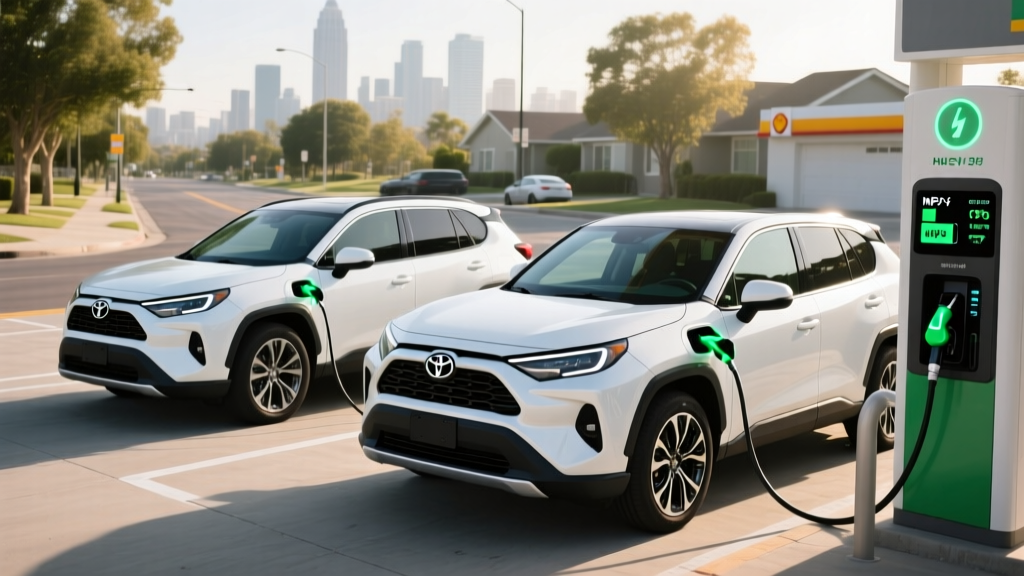
The Toyota RAV4 remains America's best-selling non-truck, and its electrified variants — the conventional RAV4 Hybrid (HEV) and the plug-in RAV4 Prime (PHEV) — are the benchmark for anyone shopping an SUV hybrid. For 2026, Toyota has refreshed both powertrains with modest efficiency gains and updated infotainment, but the core formula that made these models category leaders remains intact: class-leading fuel economy, standard all-wheel drive, and a battery warranty that outlasts most ownership cycles.
This guide breaks down the exact EPA numbers, real-world efficiency expectations, battery longevity data, and total cost math you need to decide between the HEV, the PHEV, or a fully electric alternative.
HEV vs. PHEV: Which RAV4 Electrified SUV Are You Looking At?
Before comparing specs, the distinction matters because it changes how you fuel, how you pay, and whether you need home charging infrastructure.
| Feature | RAV4 Hybrid (HEV) | RAV4 Prime (PHEV) |
|---|---|---|
| Plug-in required? | No — self-charging via regenerative braking and engine | Yes — plug in to access electric-only driving |
| Battery size | 1.6 kWh (nickel-metal hydride) | 18.1 kWh usable (lithium-ion) |
| Electric-only range | Not applicable (EV mode limited to ~1 mile at low speed) | 42 miles (EPA) |
| Charging hardware | None | J1772 Level 2 AC; no DC fast charging |
| Federal tax credit | Not eligible (§30D requires plug-in) | Up to $7,500 (subject to sourcing, income, and MSRP caps) |
| Starting MSRP (2026) | $33,425 (LE AWD) | $44,900 (SE AWD) |
The conventional hybrid is a drop-in replacement for a gas car: you fill up at the pump and never think about charging. The Prime rewards owners who can charge at home or work with 42 miles of daily electric commuting, then operates as a highly efficient hybrid once the battery is depleted.
Fuel Economy: EPA MPG and Real-World Expectations
| Model | City MPG | Highway MPG | Combined MPG | MPGe (PHEV EV mode) |
|---|---|---|---|---|
| RAV4 Hybrid AWD (LE/XLE) | 41 | 38 | 40 | — |
| RAV4 Hybrid AWD (Woodland Ed.) | 38 | 35 | 37 | — |
| RAV4 Prime AWD (EV mode) | — | — | — | 94 MPGe |
| RAV4 Prime AWD (charge-sustaining) | 40 | 36 | 38 | — |
Source: fueleconomy.gov (EPA estimates, 2026 model year).
Real-world MPG reality check: Toyota's hybrid system excels in stop-and-go city driving, where the electric motor handles low-speed propulsion and regenerative braking recaptures energy. Many RAV4 Hybrid owners report 42-45 MPG in city-heavy commutes, exceeding the EPA city estimate. Highway driving at 75+ MPH favors the engine more directly, and real-world highway MPG often lands between 34-36 MPG. In cold weather (below 30°F), expect a 5-10% MPG reduction as the engine runs longer to provide cabin heat and warm the catalytic converter.
For the RAV4 Prime in charge-sustaining (hybrid) mode after the battery is depleted, expect 35-38 MPG combined in mixed driving — slightly less than the standard hybrid due to the 300+ lbs of additional battery mass.
RAV4 Prime Electric-Only Range and Charging Details
The 2026 RAV4 Prime's 18.1 kWh lithium-ion battery pack delivers an EPA-rated 42 miles of electric-only range. In moderate temperatures (50-80°F) with city-speed driving, some owners extract 45-48 miles. At sustained highway speeds or in freezing temperatures, expect 32-36 miles before the gasoline engine engages.
| Charging Level | Power | 0-100% Time | Notes |
|---|---|---|---|
| Level 1 (120V household outlet) | ~1.4 kW | ~12 hours | Emergency/top-up only |
| Level 2 (240V, 16A) | 3.3 kW (onboard charger limit) | ~5.5 hours | Standard home charging |
| Level 2 (240V, 32A+) | 3.3 kW (capped by vehicle) | ~5.5 hours | Higher-amperage charger won't speed up charging |
| DC Fast Charge | Not supported | — | CCS/NACS DC charging unavailable |
A critical limitation: the RAV4 Prime's onboard charger maxes out at 3.3 kW. Even if you plug into a 48-amp Level 2 station capable of 11.5 kW, the vehicle will only draw 3.3 kW. This means overnight home charging is the practical norm — public Level 2 stops won't meaningfully top up the battery during a quick errand.
Total combined range (electric + gasoline) is approximately 600 miles for the Prime, thanks to its 14.5-gallon fuel tank and efficient hybrid operation after battery depletion.
Powertrain and Performance Specs
| Specification | RAV4 Hybrid AWD | RAV4 Prime AWD |
|---|---|---|
| Engine | 2.5L 4-cylinder Atkinson cycle | 2.5L 4-cylinder Atkinson cycle |
| Electric motors | Front (88 kW) + Rear (40 kW) | Front (134 kW) + Rear (40 kW) |
| Combined system horsepower | 219 hp | 302 hp |
| 0-60 mph | 7.4 seconds | 5.5 seconds |
| Drivetrain | AWD (electronic rear axle) | AWD (electronic rear axle) |
| Towing capacity | 1,750 lbs | 1,750 lbs |
| Cargo volume (rear seats up) | 37.5 cu ft | 33.5 cu ft (battery intrusion) |
The Prime's 302 combined horsepower makes it the quickest RAV4 Toyota sells — quicker than the turbocharged gas-only RAV4 and genuinely rapid for a family SUV hybrid. The trade-off is 4 fewer cubic feet of cargo space, as the larger battery pack sits beneath the rear seat and slightly raises the load floor.
Pricing, Trims, and Tax Credit Eligibility
| Trim | MSRP | Powertrain |
|---|---|---|
| RAV4 Hybrid LE AWD | $33,425 | HEV |
| RAV4 Hybrid XLE AWD | $35,925 | HEV |
| RAV4 Hybrid XLE Premium AWD | $38,325 | HEV |
| RAV4 Hybrid Woodland Edition AWD | $37,425 | HEV |
| RAV4 Hybrid Limited AWD | $41,075 | HEV |
| RAV4 Prime SE AWD | $44,900 | PHEV |
| RAV4 Prime XSE AWD | $48,100 | PHEV |
Federal tax credit for the RAV4 Prime: Under IRS §30D Clean Vehicle Credit rules current for 2026, the RAV4 Prime may qualify for up to $7,500, split into two $3,750 halves — one for critical minerals sourcing and one for battery component sourcing. However, eligibility depends on:
- MSRP cap: SUVs must be under $80,000 (both Prime trims qualify).
- Buyer income cap: Modified AGI must not exceed $150,000 (single), $225,000 (head of household), or $300,000 (joint).
- Battery sourcing requirements: Critical minerals and battery components must meet escalating domestic/free-trade-partner thresholds. Toyota's supply chain has been adjusting, but specific eligibility can change by production batch. Verify the VIN on the IRS portal before purchase.
- Point-of-sale transfer: As of 2024+, you can transfer the credit to the dealer for an upfront price reduction, rather than waiting to claim it on your tax return.
The conventional RAV4 Hybrid does not qualify for the §30D federal credit, as it is not a plug-in vehicle. Some states offer separate rebates for HEVs — check your state energy office for current programs.
Battery Longevity, Warranty, and Replacement Costs
Hybrid battery warranty: Toyota covers the hybrid battery pack in both the RAV4 Hybrid and RAV4 Prime for 10 years or 150,000 miles (whichever comes first) in all 50 states. This applies to the original owner and all subsequent owners if the vehicle is sold within the warranty period.
Toyota's hybrid battery track record is among the best in the industry. Data from fleet operators and long-term owners suggests:
- RAV4 Hybrid (NiMH, 1.6 kWh): Degradation is minimal because the battery is small and the system never fully charges or depletes it (operating in a 40-80% state-of-charge window). Failures before 150,000 miles are uncommon. Replacement cost if out of warranty: approximately $2,500-$4,000 for a refurbished or new pack, plus ~$500 labor.
- RAV4 Prime (Li-ion, 18.1 kWh): Lithium-ion degradation typically results in 10-15% capacity loss over 8-10 years, meaning electric-only range might drop from 42 miles to ~36 miles. Full battery replacement out of warranty: estimated $8,000-$12,000, though this figure is projected as few 2021-2022 Primes have needed replacement yet.
For context, IIHS and long-term reliability surveys consistently rank the RAV4 Hybrid among the most dependable compact SUVs, with the hybrid powertrain adding few failure points compared to the conventional gas model.
Who Should Buy This SUV Hybrid — and Who Should Look Elsewhere?
Choose the RAV4 Hybrid (HEV) if:
- You cannot charge at home or work (apartment, street parking, no garage)
- You want maximum MPG with zero behavioral change from a gas car
- Your budget is $33,000-$41,000 and you don't need electric-only commuting
- You drive 12,000-15,000 miles/year and want the lowest fuel cost without plug-in infrastructure
Choose the RAV4 Prime (PHEV) if:
- You can install a Level 2 charger at home and your commute is under 40 miles round-trip
- You want electric daily driving but need gas-engine flexibility for road trips
- You value the 302 hp performance upgrade and qualify for some or all of the federal tax credit
- You want to reduce gasoline consumption by 70-90% without range anxiety on longer trips
Hybrid vs. PHEV vs. Full EV — The Decision Framework
Choose a conventional HEV (RAV4 Hybrid) if you have no reliable charging access and want a simple, proven efficiency upgrade. You'll save roughly $600-$900/year in fuel versus the gas RAV4 at 15,000 miles/year.
Choose a PHEV (RAV4 Prime) if you have home charging and a short commute. You'll drive on electricity most days and only burn gas on road trips, saving $1,000-$1,400/year with the tax credit potentially bringing the effective price close to the Hybrid Limited.
Choose a full BEV (like the Tesla Model Y or Hyundai Ioniq 5) if you have home charging, your daily driving is under 250 miles, and you want zero tailpipe emissions, minimal maintenance, and access to DC fast charging for road trips. The trade-off is higher upfront cost and the need to plan longer trips around charging infrastructure.
Frequently Asked Questions
How many MPG does the RAV4 Hybrid actually get in real driving?
The EPA rates the RAV4 Hybrid AWD at 41 city / 38 highway / 40 combined. In real-world driving, city-heavy commuters frequently report 42-45 MPG, while highway-dominant driving at 75+ MPH yields 34-36 MPG. Cold weather reduces MPG by 5-10%. Overall, most owners average 38-41 MPG across mixed driving — right at or slightly above the EPA combined figure.
How far can the RAV4 Prime go on electric only?
The EPA rates the 2026 RAV4 Prime at 42 miles of electric-only range. In practice, expect 45-48 miles in warm city driving and 32-36 miles in cold or highway-heavy conditions. Once the battery depletes, the Prime operates as a conventional hybrid with 38 MPG combined — there is no "range cliff."
Does the RAV4 Hybrid or Prime qualify for a tax credit?
The conventional RAV4 Hybrid does not qualify for the federal §30D credit because it is not a plug-in vehicle. The RAV4 Prime may qualify for up to $7,500 depending on battery sourcing requirements, buyer income, and MSRP. Always verify your specific vehicle's VIN eligibility through the IRS portal and consult a tax professional, as sourcing rules tighten annually.
Is the hybrid battery reliable, and what does replacement cost?
Toyota's hybrid batteries are among the most durable in the industry, backed by a 10-year/150,000-mile warranty. The RAV4 Hybrid's small NiMH battery rarely fails within warranty, and out-of-pocket replacement runs $2,500-$4,000. The Prime's larger lithium-ion pack may lose 10-15% capacity over a decade, with full replacement estimated at $8,000-$12,000 out of warranty. Most owners will sell or trade the vehicle before battery replacement is needed.
Can I charge the RAV4 Prime at a public DC fast charger?
No. The RAV4 Prime only accepts AC charging via its J1772 port, with a maximum onboard charge rate of 3.3 kW. DC fast charging (CCS, NACS, CHAdeMO) is not supported. This is typical for PHEVs — the battery is small enough that overnight Level 2 home charging fully replenishes it in about 5.5 hours.
Is the RAV4 Hybrid better than a gas-only RAV4?
Yes, for most buyers. The hybrid delivers 40 MPG combined versus 30 MPG for the gas AWD model, saving roughly $600-$900 per year in fuel at 15,000 miles driven. The hybrid also provides smoother acceleration from stops (the electric motor fills the torque gap before the engine revs up) and standard AWD. The price premium over the gas model is typically $1,500-$2,000, which pays back in fuel savings within 2-3 years.