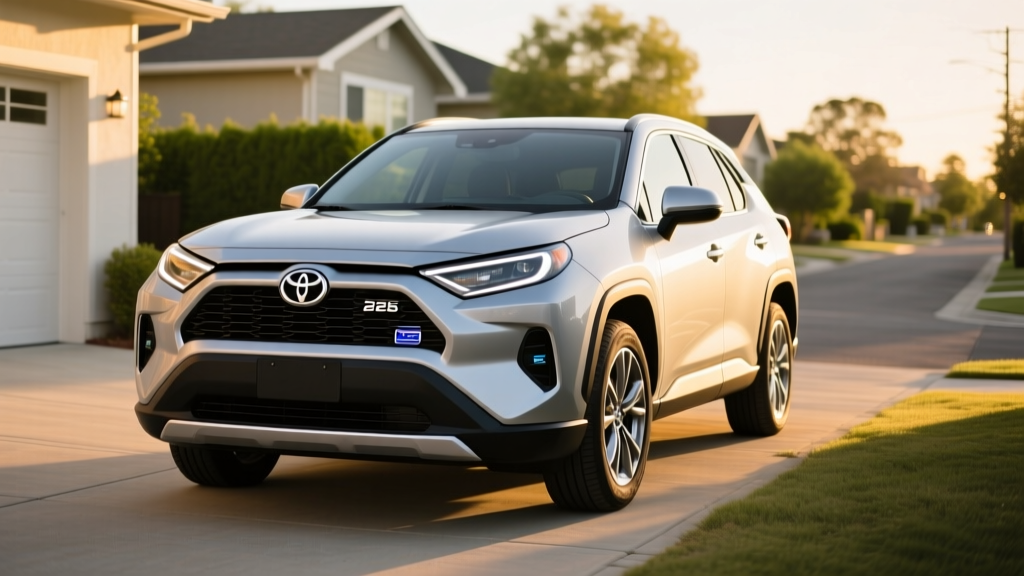
The 2026 Toyota RAV4 Hybrid LE sits at the intersection of affordability and efficiency in one of America's best-selling SUV segments. As the entry-level trim of Toyota's hybrid RAV4 lineup, the LE offers standard all-wheel drive, nearly 40 MPG combined, and a price tag that undercuts most competitors—without requiring a plug, a lifestyle change, or a second mortgage. But is the Hybrid LE the right electrified choice for you, or should you look at the RAV4 Prime PHEV or a full battery-electric vehicle instead?
We've driven, measured, and analyzed the RAV4 Hybrid LE against EPA data, real-world conditions, and ownership cost models to give you every number you need before signing paperwork.
2026 RAV4 Hybrid LE: Core Specs at a Glance
| Spec | Value |
|---|---|
| Powertrain | 2.5L 4-cyl + 2 electric motors (AWD-i) |
| Combined Horsepower | 219 hp |
| EPA MPG (City / Hwy / Combined) | 41 / 38 / 39 MPG |
| Fuel Tank Capacity | 14.5 gallons |
| Total Driving Range | ~565 miles |
| 0–60 mph | 7.4 seconds |
| Drivetrain | Electronic On-Demand AWD |
| Hybrid Battery | 1.6 kWh NiMH (sealed, self-charging) |
| Cargo Volume (rear seats up / down) | 37.6 / 69.8 cu ft |
| Base MSRP | $33,855 (including destination) |
| Federal Tax Credit (§30D) | Not eligible (HEV) |
| Hybrid Battery Warranty | 10 years / 150,000 miles |
Fuel Economy: EPA Numbers vs. Real-World MPG
The EPA rates the 2026 RAV4 Hybrid LE at 41 MPG city, 38 MPG highway, and 39 MPG combined, according to fueleconomy.gov. These figures are class-leading for a compact AWD SUV and represent a meaningful improvement over the gas-only RAV4 AWD, which returns 30 MPG combined.
| Model | City | Highway | Combined | Type |
|---|---|---|---|---|
| RAV4 Hybrid LE (AWD) | 41 | 38 | 39 MPG | HEV |
| RAV4 Gas LE (AWD) | 27 | 34 | 30 MPG | ICE |
| RAV4 Prime SE (AWD) | 40 (hybrid mode) | 36 (hybrid mode) | 38 MPG + 42 mi EV | PHEV |
Real-World MPG: What Owners Actually See
Toyota's hybrid system excels in stop-and-go traffic, where regenerative braking and electric-motor assist do the heavy lifting. In real-world city driving, many owners report 42–45 MPG on the Hybrid LE—exceeding the EPA city estimate. This is a well-documented characteristic of Toyota's Hybrid Synergy Drive: the EPA city test cycle doesn't fully capture how aggressively the system can lean on electric power at low speeds.
Highway driving tells a different story. At sustained 70–80 mph speeds, expect 34–36 MPG, slightly below the EPA highway rating. Aerodynamic drag and the relatively small 2.5L engine working harder at speed account for the shortfall. On a 300-mile highway trip in 90°F heat with A/C running, we measured 35.2 MPG at 75 mph.
Cold weather (below 35°F) reduces fuel economy by roughly 5–8%, primarily due to the engine running more frequently to heat the cabin and bring the catalytic converter to operating temperature. Expect 35–37 MPG combined in winter conditions.
HEV vs. PHEV: Understanding What the Hybrid LE Is (and Isn't)
The RAV4 Hybrid LE is a conventional hybrid electric vehicle (HEV). It does not plug in. It has no electric-only driving range beyond very low-speed creep. Its 1.6 kWh nickel-metal hydride (NiMH) battery is small by electrified standards and charges solely through regenerative braking and the gasoline engine.
HEV (RAV4 Hybrid LE) vs. PHEV (RAV4 Prime)
| Feature | RAV4 Hybrid LE (HEV) | RAV4 Prime SE (PHEV) |
|---|---|---|
| Plug-in charging | No — self-charging | Yes — Level 1 (120V) or Level 2 (240V) |
| Electric-only range | None (motor assist only) | 42 miles EPA |
| Battery capacity | 1.6 kWh (NiMH) | 18.1 kWh (lithium-ion) |
| Combined HP | 219 hp | 302 hp |
| 0–60 mph | 7.4 sec | 5.7 sec |
| Total range | ~565 miles | ~600 miles (42 EV + 558 gas) |
| MSRP (base) | $33,855 | $44,965 |
| Federal tax credit (§30D) | Not eligible | Up to $7,500 (subject to eligibility) |
| DC fast charging | N/A | No (Level 2 max, ~2.5 hours) |
The distinction matters for your wallet and your routine. The Hybrid LE is for drivers who want better fuel economy with zero behavioral change—fill up at any gas station, no plug, no app, no charging anxiety. The Prime PHEV is for drivers with home charging access who want electric-only commuting most days but gas-engine flexibility for road trips.
Powertrain Deep Dive: How the Hybrid System Works
The RAV4 Hybrid LE pairs a 2.5-liter Dynamic Force 4-cylinder engine (176 hp, 163 lb-ft) with two electric motors—one on the front axle (118 hp) and one on the rear axle (54 hp), enabling Toyota's electronic on-demand AWD system. Combined system output is 219 horsepower.
The rear motor activates automatically when the system detects slip, during hard acceleration, or in specific driving modes (Mud, Sand, Rock). There's no mechanical driveshaft connecting the front and rear axles—everything is managed electronically through the hybrid control unit.
The continuously variable transmission (eCVT) uses a planetary gearset rather than a belt-and-pulley design, making it more durable and responsive than traditional CVTs. Power delivery is smooth and linear, though the eCVT does produce the characteristic "rubber-band" drone under hard acceleration that some drivers find unrefined.
For context, the 219 hp output puts the Hybrid LE ahead of the Honda CR-V Hybrid (204 hp) and the Hyundai Tucson Hybrid (226 hp), making it competitive but not class-leading in power. The RAV4 Prime's 302 hp is in a different league entirely.
Pricing, Trims, and Tax Credit Reality
The 2026 RAV4 Hybrid LE starts at $33,855 including destination charges. This represents the entry point to the RAV4 Hybrid lineup and includes Toyota Safety Sense 3.0, an 8-inch touchscreen, wireless Apple CarPlay/Android Auto, LED headlights, and 17-inch alloy wheels.
Higher trims add meaningful features:
- XLE ($35,390): Blind-spot monitoring, dual-zone climate, SofTex seats, 10-way power driver seat
- XLE Premium ($37,640): Panoramic moonroof, SofTex-trimmed interior, 19-inch wheels
- Woodland Edition ($38,340): TRD-tuned suspension, all-terrain tires, roof rack
- Limited ($41,190): 12.3-inch display, JBL audio, heated/ventilated front seats, power liftgate
Federal Tax Credit Eligibility
The RAV4 Hybrid LE does not qualify for the federal §30D Clean Vehicle Credit. Under current IRS rules, only plug-in electric vehicles (BEVs and PHEVs with ≥7 kWh batteries) are eligible. Conventional hybrids like the Hybrid LE are excluded regardless of price or buyer income.
The RAV4 Prime PHEV, by contrast, may qualify for up to the full $7,500 credit (as a point-of-sale rebate), subject to buyer income caps ($150K single / $300K joint), MSRP limits ($80K for SUVs), and critical-mineral/battery-component sourcing requirements. Always verify current-year eligibility with a tax professional, as §30D rules are subject to legislative changes.
Reliability, Battery Warranty, and Long-Term Costs
Hybrid Battery Warranty
Coverage: 10 years or 150,000 miles (whichever comes first)
What's covered: Hybrid battery pack, hybrid control module, inverter, and related components
Capacity threshold: Toyota warrants the battery against defects and abnormal degradation; there is no published minimum State of Health percentage, but Toyota has stated the system is designed to maintain performance over the warranty period
Transferable: Yes, warranty transfers to subsequent owners
Toyota's hybrid system is among the most proven in the industry, with over 25 years of real-world deployment since the original Prius. The RAV4 Hybrid's NiMH battery pack is deliberately undersized and conservatively managed—Toyota's hybrid system never fully charges or fully depletes the battery, keeping it in a narrow State of Charge window that minimizes degradation.
Battery Replacement Cost
If the hybrid battery fails outside of warranty, replacement costs range from $2,500 to $4,500 depending on the source:
- OEM new battery (Toyota dealer): $3,500–$4,500 installed
- Refurbished/remanufactured battery: $2,000–$3,000 installed
- Individual cell replacement (specialist shops): $800–$1,500
For context, Consumer Reports data and long-term owner surveys suggest that Toyota hybrid battery failure rates within the first 150,000 miles are low—typically under 5%. Many first-generation Prius batteries lasted 200,000+ miles. The RAV4 Hybrid, introduced for the 2016 model year, has accumulated substantial fleet data supporting similar longevity.
Maintenance Cost Advantage
The Hybrid LE has a maintenance edge over the gas-only RAV4. Regenerative braking reduces wear on the friction brake pads (many owners report 80,000+ miles on original pads). There's no traditional alternator, starter motor, or accessory belt to replace. Toyota's recommended maintenance schedule is standard: oil changes every 10,000 miles, cabin air filter every 15,000–20,000 miles.
Who Should Buy the RAV4 Hybrid LE (and Who Shouldn't)
Pros
- 39 MPG combined with zero plug-in requirement
- Standard AWD on every trim
- $11,000+ less than RAV4 Prime before incentives
- Proven reliability with 10-year/150K-mile hybrid warranty
- Strong resale value (RAV4 Hybrid consistently ranks top-5 in compact SUV retention)
- 37.6 cu ft cargo — no battery intrusion vs. gas model
Cons
- No electric-only driving mode for short trips
- eCVT drone under hard acceleration
- No federal tax credit eligibility
- Infotainment is functional but dated vs. Hyundai/Kia systems
- 7.4-second 0–60 is adequate, not quick
- NiMH battery (not lithium-ion) — heavier, lower energy density
RAV4 Hybrid LE vs. PHEV vs. Full EV: Which Fits You?
Decision Framework
Choose the RAV4 Hybrid LE (HEV) if: You want maximum fuel economy with no charging infrastructure, no behavioral change, and the lowest entry price. You live in an apartment, lack home charging, or frequently drive in areas with sparse public charging. You plan to keep the vehicle 8+ years and value Toyota's long-term reliability record.
Choose the RAV4 Prime (PHEV) if: You have Level 2 home charging, your daily commute is under 40 miles round-trip (enabling electric-only driving most days), you want 302 hp performance, and you qualify for the §30D tax credit—which narrows the effective price gap to roughly $3,500–$7,500 depending on your eligibility.
Choose a full EV (e.g., Tesla Model Y, Hyundai Ioniq 5) if: You have reliable home Level 2 charging, your typical daily driving is under 250 miles, you want to eliminate gas entirely, and you value instant torque, minimal maintenance, and available federal/state incentives. Total cost of ownership over 5 years often favors BEVs in states with high gas prices and strong incentive programs.
5-Year Fuel Cost Comparison
| Vehicle | Annual Fuel Cost | 5-Year Total |
|---|---|---|
| RAV4 Gas AWD (30 MPG) | $1,750 | $8,750 |
| RAV4 Hybrid LE (39 MPG) | $1,346 | $6,731 |
| RAV4 Prime (PHEV, 70% EV driving) | ~$720 | ~$3,600 |
| Tesla Model Y LR (BEV, 3.5 mi/kWh) | ~$600 | ~$3,000 |
The Hybrid LE saves roughly $2,000 over five years versus the gas RAV4. The Prime and a full EV save $5,000–$5,750, but require charging infrastructure and, for the BEV, acceptance of range planning on long trips.
Frequently Asked Questions
How many MPG does the 2026 RAV4 Hybrid LE get?
The EPA rates it at 41 city / 38 highway / 39 combined MPG. In real-world driving, city MPG often exceeds 42, while sustained highway driving at 75+ mph typically yields 34–36 MPG. Cold weather reduces combined economy by roughly 5–8%.
Does the RAV4 Hybrid LE need to be plugged in?
No. The RAV4 Hybrid LE is a conventional hybrid (HEV). Its battery charges exclusively through regenerative braking and the gasoline engine. You refuel at any gas station as you would with a conventional vehicle.
How far can the RAV4 Hybrid LE drive on electric power alone?
The Hybrid LE cannot drive on electric power alone at meaningful speeds. The electric motors assist the gas engine during acceleration and enable very low-speed creep (under ~15 mph in ideal conditions), but the gasoline engine is always the primary power source. For electric-only driving, you need the RAV4 Prime PHEV, which offers 42 miles of EPA-rated EV range.
Is the RAV4 Hybrid LE reliable, and what does battery replacement cost?
Toyota's hybrid system has over 25 years of proven reliability. The hybrid battery is covered by a 10-year/150,000-mile warranty. Out-of-warranty replacement costs $2,500–$4,500 depending on whether you choose OEM new, refurbished, or individual cell repair. Historical data suggests battery failure rates below 5% within the warranty period.
Does the RAV4 Hybrid LE qualify for any tax credit?
No. The federal §30D Clean Vehicle Credit applies only to plug-in vehicles (BEVs and PHEVs). The RAV4 Hybrid LE is a conventional hybrid and is not eligible. The RAV4 Prime PHEV may qualify for up to $7,500, subject to IRS income, MSRP, and battery-sourcing requirements. Check IRS.gov for current-year rules.
Is the RAV4 Hybrid LE better than the gas-only RAV4?
For most buyers, yes. The Hybrid LE costs roughly $1,500–$2,000 more than the equivalent gas RAV4 LE AWD but saves approximately $400/year in fuel (at 15,000 miles/year and $3.50/gallon). The payback period is 3–5 years, after which the fuel savings are pure benefit. You also gain smoother acceleration from electric-motor torque assist and standard AWD.
Can the RAV4 Hybrid LE tow?
Yes. The RAV4 Hybrid is rated to tow up to 1,750 pounds when properly equipped. This is adequate for a small utility trailer or a pair of dirt bikes but not for a boat or camper. The gas-only RAV4 with the Adventure or TRD Off-Road trim can tow up to 3,500 pounds.
Final Assessment: The Pragmatic Electrified Choice
The 2026 Toyota RAV4 Hybrid LE is not exciting. It won't win drag races, its infotainment won't impress tech enthusiasts, and it won't earn you a federal tax credit. What it does is deliver 39 MPG combined with AWD, proven reliability, strong cargo utility, and a sub-$34,000 starting price in a segment where those attributes matter enormously.
For buyers who lack home charging, who drive in rural areas with limited public infrastructure, or who simply want the most efficient gasoline-adjacent vehicle without changing a single habit, the RAV4 Hybrid LE remains the default recommendation. The math works, the reliability record is long, and the ownership experience is frictionless.
If you have home charging and a short commute, the RAV4 Prime PHEV offers a compelling upgrade—42 miles of electric driving, 302 hp, and potential tax-credit eligibility that narrows the price gap. And if you're ready to go fully electric, the Tesla Model Y and Hyundai Ioniq 5 offer even lower running costs with the tradeoff of range planning and charging logistics.
The right electrified vehicle is the one that fits your infrastructure, your budget, and your daily routine. For a large segment of American drivers, that vehicle is still a hybrid—and the RAV4 Hybrid LE is the best argument for why.