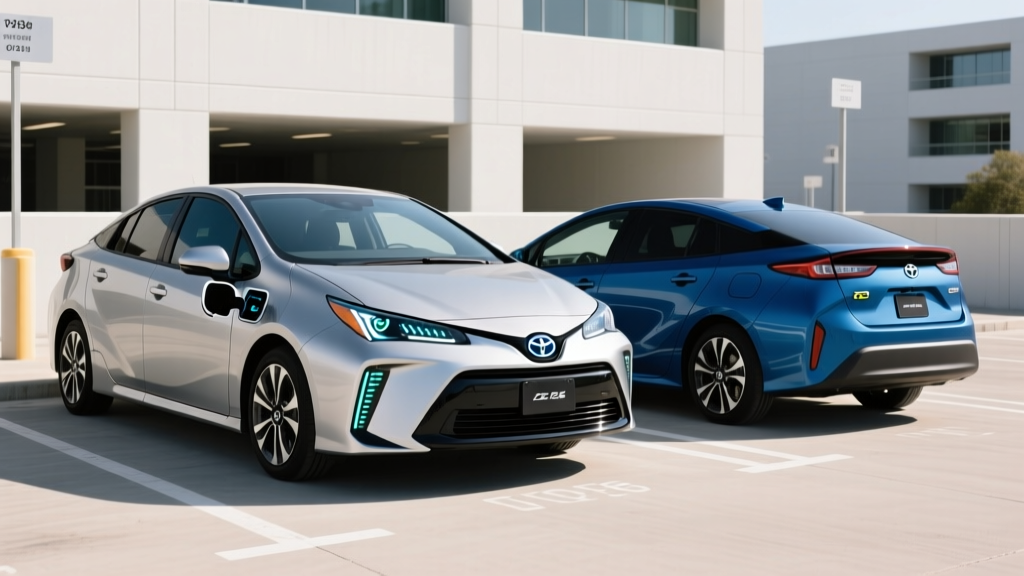
If you type "car hybrid" into a search bar, the Toyota Prius is the nameplate that defined the category — and for the 2026 model year, it remains the efficiency benchmark against which every other hybrid is measured. But Toyota now sells two very different versions of the Prius: the conventional hybrid (HEV) and the Prius Prime plug-in hybrid (PHEV). They share a name, a silhouette, and a powertrain architecture, but they serve fundamentally different use cases and price points.
This guide breaks down the exact EPA figures, battery specs, charging requirements, real-world efficiency, and federal tax credit eligibility for both 2026 Prius variants — so you can decide which one actually fits your driving life.
HEV vs PHEV: What's the Actual Difference?
Before comparing trims, it's critical to understand the mechanical distinction. A conventional hybrid (HEV) like the standard Prius uses a small battery charged exclusively by the gasoline engine and regenerative braking. You never plug it in. A plug-in hybrid (PHEV) like the Prius Prime carries a much larger battery that you can charge from a wall outlet or public charger, enabling a meaningful electric-only driving range before the gas engine kicks in.
| Attribute | Prius (HEV) | Prius Prime (PHEV) |
|---|---|---|
| Plug-in charging required? | No | Yes (for EV range) |
| Battery capacity | ~1.0 kWh (NiMH) | 13.6 kWh (lithium-ion) |
| Electric-only range | N/A (EV assist only) | 44 miles (EPA) |
| Total range (gas + electric) | ~600+ miles | ~480 miles combined |
| DC fast charging? | No | No (AC only) |
| Federal tax credit eligible? | No | Up to $3,750 (§30D) |
The Prius Prime's 13.6 kWh lithium-ion pack is the key differentiator. It's large enough to handle most daily commutes on electricity alone, yet small enough that the vehicle doesn't carry excessive weight when the battery is depleted and the car operates as a conventional hybrid.
Fuel Economy: EPA Ratings and Real-World MPG
The 2026 Prius HEV continues to post class-leading numbers. According to fueleconomy.gov, the front-wheel-drive Prius LE delivers:
| Model / Trim | City MPG | Highway MPG | Combined MPG |
|---|---|---|---|
| Prius LE (FWD) | 57 | 56 | 57 |
| Prius XLE / Limited (FWD) | 52 | 52 | 52 |
| Prius AWD-e (all trims) | 49 | 50 | 49 |
| Prius Prime SE (PHEV) | 52 (gas) / 127 MPGe (EV) | 48 (gas) | 52 (gas) / 127 MPGe |
| Prius Prime XSE / XSE Premium | 50 (gas) / 119 MPGe (EV) | 47 (gas) | 50 (gas) / 119 MPGe |
Real-World MPG vs. EPA Sticker
Toyota hybrids consistently overperform their EPA city ratings in stop-and-go traffic because regenerative braking recovers energy that a gas car wastes as heat. In real-world urban driving, many Prius owners report 60-63 MPG on the LE trim. Highway driving is a different story: at sustained 75-80 mph speeds, expect the LE to return 48-52 MPG, roughly 5-8 MPG below its sticker. Cold weather (below 35°F) further reduces efficiency by 8-12% due to increased engine run time for cabin heat and higher rolling resistance.
For the Prius Prime, the 44-mile EPA electric-only range (SE trim) holds up well in mild weather at city speeds. On a 70 mph highway with climate control running, expect roughly 34-38 electric miles. In freezing temperatures with the heater blasting, that can drop to 28-32 miles before the engine fires up.
Powertrain Specs: Horsepower, Engine, and Motors
Both Prius variants use Toyota's fifth-generation hybrid system, but output differs:
| Specification | Prius HEV | Prius Prime (PHEV) |
|---|---|---|
| Engine | 2.0L 4-cylinder | 2.0L 4-cylinder |
| Engine HP | 150 hp | 150 hp |
| Electric motor output | 83 hp (FWD) / 83+41 hp (AWD-e) | 161 hp |
| Net combined system HP | 194 hp (FWD) / 196 hp (AWD-e) | 220 hp |
| 0-60 mph | 7.2 sec (FWD) | 6.6 sec |
| Drivetrain | FWD or AWD-e | FWD only |
| Transmission | eCVT | eCVT |
The Prius Prime's larger traction motor gives it a meaningful 26-hp advantage and a noticeably quicker 0-60 time. The standard Prius AWD-e adds a rear-mounted 41-hp electric motor that engages automatically during acceleration and low-traction conditions — it's not a full-time AWD system, but it's effective for snow and rain.
Prius Prime Charging: Times, Connectors, and Limitations
The Prius Prime charges exclusively via AC — there is no DC fast-charging capability. For a 13.6 kWh battery, this is a reasonable trade-off; DC fast-charging hardware would add cost and weight for a pack small enough to fill overnight on a standard outlet.
| Charging Method | Power | 0-100% Time | Notes |
|---|---|---|---|
| Level 1 (120V household outlet) | ~1.4 kW | ~11 hours | Included charging cord; adequate for overnight |
| Level 2 (240V home/public) | ~3.3 kW (onboard charger limit) | ~4 hours | Requires J1772 connector |
The onboard charger caps at 3.3 kW, meaning even a 48-amp Level 2 home charger won't fill the Prime any faster than a 16-amp unit. This is worth knowing before investing in an expensive high-amperage home station specifically for the Prime.
Pricing, Trims, and Federal Tax Credit Eligibility
For 2026, Toyota has positioned both Prius models aggressively:
| Trim | MSRP (approx.) | Tax Credit Eligible? |
|---|---|---|
| Prius LE | $29,445 | No (HEV — §30D excludes conventional hybrids) |
| Prius XLE | $32,695 | No |
| Prius Limited | $36,690 | No |
| Prius Prime SE | $34,595 | Up to $3,750 |
| Prius Prime XSE | $37,595 | Up to $3,750 |
| Prius Prime XSE Premium | $40,590 | Up to $3,750 |
§30D Federal Tax Credit Details for the Prius Prime
The Prius Prime qualifies for a partial federal tax credit under IRS §30D rules. The exact amount depends on critical-mineral and battery-component sourcing requirements that shift annually. As of the 2026 tax year, the Prime typically qualifies for $3,750 (meeting one of two sourcing thresholds but not both).
Key eligibility requirements:
- Income caps: Modified AGI ≤ $150,000 (single), $225,000 (head of household), $300,000 (joint)
- MSRP cap: Vehicle MSRP must be ≤ $55,000 (sedan classification) — all Prime trims qualify
- Point-of-sale transfer: You can transfer the credit to the dealer at purchase for an immediate price reduction, or claim it on your tax return
- Battery sourcing: Varies by model year — confirm current eligibility on fueleconomy.gov before purchasing
The standard Prius HEV does not qualify for any federal purchase credit. However, some states and utilities offer rebates for hybrids — check your local programs.
Battery Longevity, Warranty, and Replacement Cost
Toyota Hybrid Battery Warranty: 10 years / 150,000 miles (whichever comes first) on the hybrid battery pack for all 2026 Prius and Prius Prime models. This applies nationwide — California-emissions-state extensions no longer apply because Toyota standardized the longer coverage across all 50 states starting with the 2020 model year.
How Long Do Prius Hybrid Batteries Actually Last?
Toyota's hybrid battery track record is among the best in the industry. The conventional Prius uses a nickel-metal hydride (NiMH) pack that is deliberately kept in a narrow state-of-charge window (roughly 40-80%) to minimize degradation. It's common for these packs to exceed 200,000 miles without significant capacity loss. Taxi fleets running Prius models routinely hit 300,000+ miles on original batteries.
The Prius Prime's lithium-ion pack faces more stress because it cycles through a wider SoC range during EV driving. Even so, Toyota's thermal management and conservative buffer strategy protect it well. Early Prime models (2017-2022) have shown minimal degradation at 100,000+ miles based on owner-reported data.
Battery Replacement Cost
If you do need a replacement outside warranty:
- Prius HEV (NiMH): $2,500–$3,500 for a new OEM pack; $1,000–$1,800 for a refurbished unit
- Prius Prime (lithium-ion): $4,500–$6,500 for a new OEM pack
Given the 10-year/150,000-mile warranty and the proven longevity of Toyota hybrid packs, out-of-pocket replacement is a low-probability event for most owners.
Who Should Choose the Prius, the Prime, or a Full EV?
Prius HEV — Pros
- Best-in-class 57 MPG combined (LE trim)
- No charging infrastructure needed
- Lower MSRP than the Prime
- AWD-e option available
- Proven 25-year reliability record
Prius HEV — Cons
- No electric-only driving
- No federal tax credit
- Lower combined HP than Prime
- Still burning gas for every mile
Prius Prime — Pros
- 44 miles electric-only covers most commutes
- 220 hp — quickest Prius ever
- Eligible for up to $3,750 federal credit
- Gas engine eliminates range anxiety on road trips
- 127 MPGe when running on electricity
Prius Prime — Cons
- Higher MSRP ($5,000+ over equivalent HEV trim)
- No AWD option
- No DC fast charging
- Cargo space slightly reduced by larger battery
Choose the Prius HEV if: You lack home charging access, want the lowest purchase price, drive predominantly highway miles where EV range offers less benefit, or need AWD for snow-belt climates.
Choose the Prius Prime if: You can charge at home (even a 120V outlet works overnight), your daily round-trip commute is under 40 miles, you want to minimize gas consumption without committing to a full EV, and your income falls within §30D caps.
Choose a full EV (e.g., Tesla Model 3, Hyundai Ioniq 6) if: Your commute is predictable, you have reliable home Level 2 charging, you want zero tailpipe emissions, and you're comfortable with public DC fast charging for road trips.
Frequently Asked Questions
How many MPG does the 2026 Toyota Prius hybrid get?
The 2026 Prius LE (FWD) is EPA-rated at 57 city / 56 highway / 57 combined MPG. The XLE and Limited trims drop to 52 combined due to added weight and larger wheels. The AWD-e variant is rated at 49 combined. In real-world city driving, many owners report exceeding the EPA city figure by 3-6 MPG thanks to aggressive regenerative braking.
How far can the Prius Prime go on electric only?
The 2026 Prius Prime SE is EPA-rated at 44 miles of electric-only range. The heavier XSE and XSE Premium trims are rated at 40 miles. Real-world results vary: expect 34-38 miles at highway speeds and 28-32 miles in freezing weather with cabin heat active. Once the battery depletes, the Prime operates as a conventional hybrid, returning 48-52 MPG on gasoline.
Does the Toyota Prius qualify for a federal tax credit?
The standard Prius HEV does not qualify for the federal §30D clean vehicle credit — that credit is reserved for plug-in vehicles. The Prius Prime PHEV qualifies for up to $3,750, subject to buyer income limits ($150K single / $300K joint), the $55,000 MSRP cap for sedans, and battery-sourcing requirements that change annually. Always verify current eligibility on fueleconomy.gov before purchasing.
Is the Prius hybrid battery reliable, and what does replacement cost?
Toyota's hybrid batteries carry a 10-year/150,000-mile warranty. The Prius HEV's NiMH pack routinely exceeds 200,000 miles without significant degradation. The Prime's lithium-ion pack also shows excellent longevity based on historical data. Out-of-warranty replacement costs $2,500–$3,500 for the HEV and $4,500–$6,500 for the Prime — but this is a statistically rare event.
Do I need to plug in the standard Prius hybrid?
No. The conventional Prius HEV charges its small battery entirely through the gasoline engine and regenerative braking. There is no plug and no electric-only driving mode. Only the Prius Prime (PHEV) requires plug-in charging to access its electric range — and even the Prime can be driven indefinitely without plugging in, operating as a standard hybrid once the battery is depleted.
Can the Prius Prime DC fast charge?
No. The 2026 Prius Prime supports AC charging only — Level 1 (120V, ~11 hours for a full charge) or Level 2 (240V, ~4 hours). Its 3.3 kW onboard charger limits Level 2 speed regardless of station capacity. For a 13.6 kWh battery, overnight Level 1 charging is practical for most owners, and a dedicated Level 2 home charger is convenient but not essential.