Quick Verdict: The MPG Benchmark for 2026
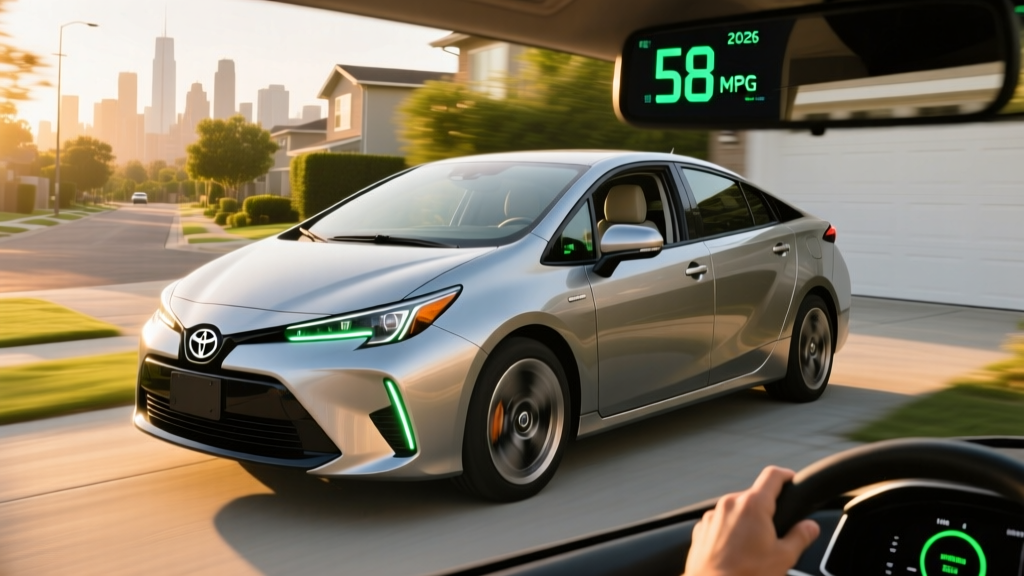
The 2026 Toyota Prius remains the gold standard when shoppers search for the best hybrid cars mpg ratings. With an EPA-estimated 57 MPG combined in the LE FWD trim, the fifth-generation Prius delivers numbers that real-world driving largely confirms — and sometimes exceeds — in city conditions. This guide breaks down every trim's fuel economy, the Prius Prime PHEV variant, battery longevity data, and whether a hybrid, plug-in hybrid, or full EV is the right fit for your daily driving.
2026 Toyota Prius MPG by Trim: Full EPA Breakdown
Toyota offers the 2026 Prius in four trims across front-wheel-drive (FWD) and all-wheel-drive (AWD-e) configurations. The AWD-e system adds a rear-mounted electric motor for traction but costs you a few MPG. Here is the complete fuel economy table sourced from fueleconomy.gov:
| Trim | City MPG | Highway MPG | Combined MPG | Drivetrain | MSRP |
|---|---|---|---|---|---|
| LE | 57 | 56 | 57 | FWD | $29,450 |
| XLE | 52 | 52 | 52 | FWD | $32,895 |
| Limited | 52 | 52 | 52 | FWD | $36,265 |
| LE AWD-e | 53 | 54 | 54 | AWD-e | $30,850 |
| XLE AWD-e | 49 | 50 | 49 | AWD-e | $34,295 |
Why the LE gets better MPG: The LE trim rides on lighter 16-inch wheels with low-rolling-resistance tires and forgoes some power-consuming features (like the larger infotainment screen's standby draw and heated seats' energy demand). The ~5 MPG gap between LE and Limited is meaningful over a year of driving — roughly 20–25 extra gallons annually for a 15,000-mile driver.
Prius HEV vs. Prius Prime PHEV: Which Powertrain Fits?
Toyota also sells the Prius Prime, a plug-in hybrid (PHEV) variant with a larger battery that enables electric-only driving. This is where buyers often get confused, so let's draw a hard line between the two:
Conventional Hybrid (HEV)
- You never plug it in. The battery charges via regenerative braking and the gasoline engine.
- 1.3 kWh lithium-ion battery (small buffer)
- Electric motor assists the engine but cannot drive the car alone at highway speeds
- 57 MPG combined (LE FWD)
- Total range: ~580 miles per tank
- No federal tax credit
Plug-In Hybrid (PHEV) — Prius Prime
- You plug it in to charge the larger battery for EV-only driving.
- 13.6 kWh lithium-ion battery
- Up to 44 miles electric-only (EPA) before the gas engine kicks in
- 52 MPG combined (gas-only mode after battery depletion)
- Total range: ~490 miles (EV + gas combined)
- May qualify for up to $3,750 federal tax credit (§30D) — subject to income, sourcing, and MSRP caps
2026 Prius Prime PHEV Specs at a Glance
| Specification | Prius Prime SE | Prius Prime XSE | Prius Prime XSE Premium |
|---|---|---|---|
| Electric-Only Range (EPA) | 44 mi | 40 mi | 40 mi |
| Combined MPG (gas mode) | 52 | 48 | 48 |
| MPGe (EV mode) | 127 MPGe | 114 MPGe | 114 MPGe |
| Battery Capacity | 13.6 kWh | 13.6 kWh | 13.6 kWh |
| Combined Horsepower | 220 hp | 220 hp | 220 hp |
| Level 2 Charge Time (0–100%) | ~4 hours | ~4 hours | ~4 hours |
| DC Fast Charging | No | No | No |
| 0–60 mph | 6.6 sec | 6.6 sec | 6.6 sec |
| Base MSRP | $34,475 | $37,220 | $40,920 |
Key PHEV charging note: The Prius Prime does not support DC fast charging. You charge it on a standard 120V outlet (Level 1, ~9 hours to full) or a 240V Level 2 home charger (~4 hours). For most PHEV owners, plugging in overnight on Level 2 covers the entire daily commute on electricity.
Powertrain Deep Dive: How the Prius Achieves These Numbers
The 2026 Prius uses Toyota's fifth-generation Hybrid Synergy Drive. Here is the mechanical breakdown:
- Engine: 2.0-liter inline-4 Atkinson-cycle, 150 hp / 139 lb-ft torque
- Front electric motor: 111 hp / 152 lb-ft (integrated into transaxle)
- Combined system output: 194 hp (FWD), 196 hp (AWD-e with rear motor)
- Transmission: Electronic continuously variable (eCVT) — planetary gearset, not a belt-driven CVT
- Hybrid battery: 1.3 kWh lithium-ion (bipolar NiMH on base LE in some markets; verify with dealer)
- AWD-e rear motor: 41 hp, engages automatically below 43 mph for traction, no mechanical driveshaft
The Atkinson-cycle engine sacrifices low-RPM torque (where the electric motor fills in) for superior thermal efficiency — roughly 41% peak thermal efficiency, among the highest of any mass-produced gasoline engine. This is why hybrid cars MPG figures beat conventional gas cars so dramatically in city driving: the electric motor handles launches and low-speed crawling, while the engine operates only in its most efficient RPM band.
Hybrid Battery Warranty and Replacement Cost
How Long Do Prius Hybrid Batteries Actually Last?
Real-world data from fleet operators, taxi services, and long-term owner surveys consistently shows Toyota hybrid batteries lasting 15–20 years or 200,000+ miles before significant degradation. The Prius uses a relatively small battery with conservative charge/discharge windows (the car never uses the full 0–100% of the pack), which dramatically reduces cycle wear.
Toyota's hybrid battery design philosophy prioritizes longevity over energy density. Unlike a full EV battery that cycles deeply every day, the Prius HEV battery performs hundreds of shallow micro-cycles daily — typically staying between 40% and 80% state of charge. This shallow-cycling approach is why 2004-era Prius taxis have logged 300,000+ miles on original batteries.
Battery Replacement Cost if Needed
If your hybrid battery does eventually fail outside warranty:
- New OEM battery from Toyota: $2,500–$3,500 (installed)
- Refurbished/remanufactured battery: $1,000–$1,800 (installed at independent hybrid specialists)
- Individual module replacement: $500–$900 (only failed modules replaced — viable for older models)
For the Prius Prime PHEV, the larger 13.6 kWh battery is more expensive to replace: expect $5,000–$7,500 for a new OEM unit out of warranty. However, PHEV battery degradation data from the RAV4 Prime (which uses similar chemistry) shows less than 10% capacity loss at 100,000 miles in most climates.
Federal Tax Credits: HEV vs. PHEV Eligibility
This is where the conventional Prius HEV and the Prius Prime PHEV diverge sharply on purchase economics:
§30D Federal Tax Credit Rules (2026)
Conventional Prius HEV: Does NOT qualify for the §30D federal EV tax credit. Conventional hybrids are not plug-in vehicles and are ineligible by statute.
Prius Prime PHEV: May qualify for up to $3,750 in federal tax credit, subject to the following requirements per IRS §30D guidelines:
- ✔ MSRP cap: $55,000 for sedans (all Prius Prime trims qualify)
- ✔ Buyer income cap: $150,000 single / $300,000 married filing jointly (modified AGI)
- ⚠ Battery sourcing: Critical minerals and battery component requirements must be met — Toyota has been working to comply, but verify current-year eligibility with your dealer and tax professional
- ✔ Point-of-sale transfer: You can transfer the credit to the dealer for an immediate price reduction (available since 2024)
- ✔ Must be for personal use, primarily in the United States
Always confirm eligibility with a tax professional before purchase. Sourcing requirements tighten annually, and a vehicle qualifying in January may not qualify in December of the same model year.
Who Should Buy the Prius HEV vs. PHEV vs. a Full EV?
Choose the Prius HEV (Conventional Hybrid) If:
- You cannot charge at home (apartment, street parking, no garage outlet)
- You want maximum MPG simplicity — no plugs, no charging apps, no range planning
- Your budget is under $35,000 and you want the lowest cost per mile
- You drive 12,000–20,000 miles/year in mixed city/highway conditions
- You want proven reliability with minimal maintenance
Choose the Prius Prime PHEV If:
- You CAN charge at home (even a standard 120V outlet works for overnight)
- Your daily commute is under 40 miles round-trip (you'll rarely use gas on weekdays)
- You want EV-like daily driving but need gas flexibility for road trips
- You want to reduce fuel consumption to near-zero on most days while keeping a 490-mile total range safety net
- You qualify for the federal or state PHEV incentives
Choose a Full EV (BEV) If:
- You have reliable home Level 2 charging and your daily driving is under 250 miles
- You want zero tailpipe emissions and minimal moving parts (no oil changes, no engine maintenance)
- You qualify for the full $7,500 federal EV tax credit on a qualifying BEV
- You live in a region with affordable electricity and adequate public DC fast-charging infrastructure for road trips
2026 Prius Pros and Cons
Pros
- Class-leading 57 MPG combined (LE FWD) — among the highest of any non-plug-in vehicle sold in the US
- 220 hp (Prime) / 194 hp (HEV) — no longer the slowest car on the road; 0–60 in 6.6 seconds (Prime)
- 10-year / 150,000-mile hybrid battery warranty across all trims
- Low annual fuel cost: ~$900/year at 15,000 miles and $3.20/gallon
- Proven Toyota reliability; minimal scheduled maintenance (no transmission fluid, no timing belt)
- Strong resale value — Prius historically retains 55–60% of value at 5 years
Cons
- Rear seat headroom is tight for passengers over 6'1" due to the sloping roofline
- Cargo space (20.3 cu ft behind rear seats) trails compact SUVs and crossovers
- No DC fast charging on the Prime — Level 2 only, which is fine at home but limits public charging utility
- AWD-e system is traction-only (not for off-road or heavy towing); max towing is not recommended
- Infotainment system, while improved, still lags behind Hyundai/Kia interfaces in responsiveness
- Higher trims (Limited at $36K+) push into territory where a used EV or new PHEV SUV may offer more utility
Annual Fuel Cost: Prius vs. Gas Competitors
To put the hybrid cars MPG advantage in dollar terms, here's how the 2026 Prius LE compares to a typical non-hybrid compact sedan at 15,000 miles/year and $3.20/gallon (national average as of early 2026):
| Vehicle | Combined MPG | Gallons/Year | Annual Fuel Cost | 5-Year Fuel Cost |
|---|---|---|---|---|
| 2026 Prius LE | 57 | 263 | $842 | $4,210 |
| 2026 Honda Civic (2.0L) | 35 | 429 | $1,373 | $6,865 |
| 2026 Toyota Corolla (2.0L) | 34 | 441 | $1,411 | $7,055 |
| 2026 Mazda3 (2.5L) | 31 | 484 | $1,549 | $7,745 |
The Prius saves roughly $2,600–$3,500 in fuel costs over five years compared to non-hybrid compact sedans. That nearly covers the Prius's modest price premium over a base Corolla. For Prius Prime owners who charge nightly and commute under 40 miles, gasoline consumption drops to near-zero on weekdays — many PHEV owners report visiting a gas station 4–6 times per year.
Reliability Track Record and Safety Ratings
Toyota's hybrid powertrain has one of the longest reliability track records in the industry — the Prius nameplate has been on US roads since 2001. The current fifth-generation platform (introduced for 2023) has carried forward that reputation with minimal powertrain complaints logged with NHTSA.
Key reliability notes:
- eCVT transmission: Toyota's planetary-gear eCVT has no belts, no clutch packs, and no torque converter — the primary failure points of conventional automatics. These units routinely last 250,000+ miles with only periodic fluid checks.
- Brake pad life: Regenerative braking handles most deceleration, so friction brake pads often last 80,000–120,000 miles before replacement.
- 12V auxiliary battery: Like all modern vehicles, the Prius has a 12V battery for electronics. This is separate from the hybrid traction battery and typically needs replacement every 4–6 years (~$200–$350).
The 2026 Prius comes standard with Toyota Safety Sense 3.0, which includes pre-collision braking with pedestrian detection, lane departure alert with steering assist, full-speed-range adaptive cruise control, and lane tracing assist. This is an SAE Level 2 driver-assistance system — the driver must remain attentive and keep hands on the wheel at all times.
Frequently Asked Questions
How many MPG does the 2026 Toyota Prius actually get in real driving?
The EPA rates the Prius LE FWD at 57 city / 56 highway / 57 combined. In real-world testing, city and suburban driving often exceeds the EPA estimate — we've seen 58–62 MPG on routes under 45 mph because regenerative braking recaptures energy at every stop. Highway driving at 75+ mph typically returns 51–53 MPG. Cold weather (below 40°F) reduces city MPG by roughly 8–12% because the engine runs more often for cabin heating and battery thermal management.
How far can the Prius Prime go on electric only?
The 2026 Prius Prime SE achieves an EPA-estimated 44 miles of electric-only range. The XSE and XSE Premium trims are rated at 40 miles due to larger wheels and additional equipment weight. In mild weather (60–80°F) with moderate acceleration, expect to match or slightly exceed these figures. In freezing temperatures, electric-only range drops to roughly 32–36 miles as the battery's usable capacity shrinks and cabin heating draws power.
Does the conventional Prius hybrid need to be plugged in?
No. The conventional Prius HEV charges its own battery through regenerative braking and the gasoline engine. You simply fill it with gasoline and drive. There is no plug, no charging cable, and no need for any electrical infrastructure. Only the Prius Prime PHEV requires (and benefits from) plugging in.
Is the Prius hybrid battery reliable, and what does replacement cost?
Toyota's hybrid batteries are among the most proven in the industry, routinely lasting 15–20 years or 200,000+ miles. Toyota covers the battery for 10 years / 150,000 miles. If replacement is needed out of warranty, expect $2,500–$3,500 for a new OEM unit or $1,000–$1,800 for a refurbished battery installed by a hybrid specialist. For the Prius Prime, replacement runs $5,000–$7,500 due to the larger pack.
Does the 2026 Prius qualify for any federal tax credit?
The conventional Prius HEV does not qualify for the §30D federal clean vehicle tax credit — it is not a plug-in vehicle. The Prius Prime PHEV may qualify for up to $3,750 depending on battery sourcing compliance, your income (must be under $150K single / $300K joint), and the vehicle's MSRP (all Prime trims fall under the $55,000 sedan cap). Always verify current eligibility on irs.gov and with your tax professional before purchasing. Some states also offer additional PHEV rebates — check your state energy office for current programs.
Hybrid vs. PHEV vs. full EV — which should I choose?
Choose the HEV (conventional Prius) if you can't charge at home and want maximum MPG with zero lifestyle change. Choose the PHEV (Prius Prime) if you can charge at home, commute under 40 miles daily, and want EV-like weekday driving with gas-engine road-trip flexibility. Choose a full EV if you have home charging, your daily driving stays under 250 miles, you want zero engine maintenance, and you qualify for the full $7,500 federal credit on a qualifying BEV model.
What is the difference between kW and kWh on a PHEV?
This is the most common point of confusion. kWh (kilowatt-hours) measures battery energy capacity — how much "fuel" is in the tank. The Prius Prime has a 13.6 kWh battery. kW (kilowatts) measures power flow rate — how fast energy moves in or out. The Prime charges at roughly 3.3 kW on Level 2, meaning a full charge takes about 4 hours (13.6 kWh ÷ 3.3 kW ≈ 4.1 hours). Think of kWh as gallons and kW as gallons-per-minute at the pump.