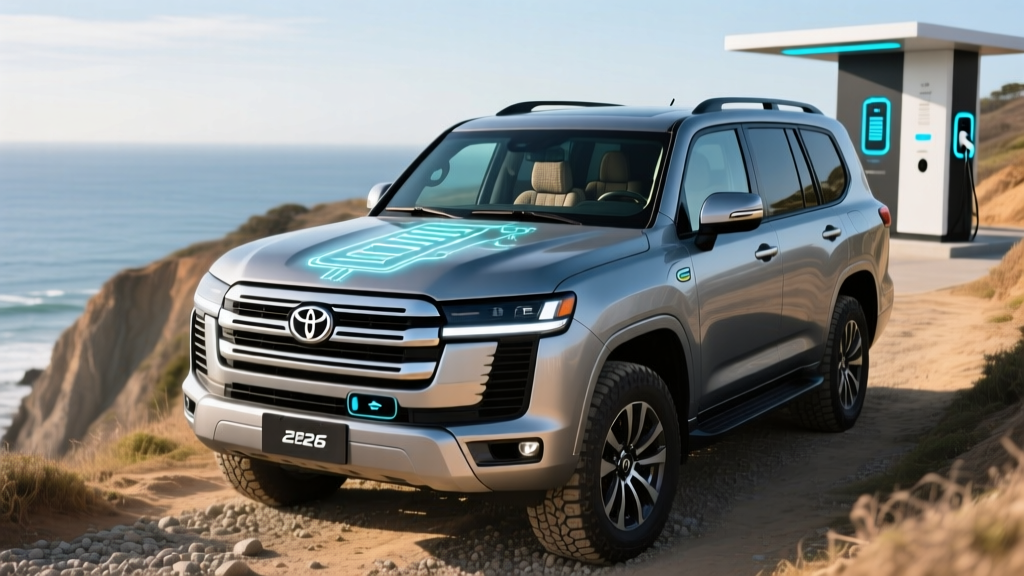
The Toyota Land Cruiser returned to the U.S. market with a turbocharged hybrid powertrain, and for 2026 it remains Toyota's most capable body-on-frame SUV with electrification. The 2026 Toyota Land Cruiser hybrid pairs a 2.4-liter turbocharged four-cylinder engine with a 48-horsepower electric motor integrated into an eight-speed automatic transmission — a system Toyota calls i-FORCE MAX. The result is 326 combined horsepower, 465 lb-ft of torque, and an EPA-estimated 27 MPG combined that makes this midsize off-roader genuinely efficient for its class.
This is a conventional hybrid (HEV), not a plug-in hybrid (PHEV). You never plug it in. The small battery recharges through regenerative braking and engine operation, and it delivers tangible fuel savings — especially in stop-and-go driving where electric torque fills in the gaps between turbo spool-up. If you're cross-shopping this against the Toyota 4Runner, Jeep Grand Cherokee 4xe, or Land Rover Defender, the Land Cruiser's hybrid system is the simplest and arguably the most proven of the bunch.
HEV vs PHEV: Where the Land Cruiser Fits
Toyota offers the Land Cruiser exclusively as a conventional hybrid (HEV) in the United States. There is no plug-in variant, and Toyota has not announced one. Understanding the distinction matters for your daily routine and your wallet:
| Feature | 2026 Land Cruiser (HEV) | Typical PHEV SUV | Full BEV SUV |
|---|---|---|---|
| Plug-in required? | No | Yes (for EV range) | Yes (always) |
| Electric-only range | N/A (motor assists only) | 25–40 miles | 250–350+ miles |
| Battery size | ~1.87 kWh (NiMH) | 15–25 kWh (Li-ion) | 75–120 kWh (Li-ion) |
| Fueling | Gas station only | Gas + Level 1/2 charging | Charging only |
| Best for | No home charging access | Short commutes + road trips | Home charging + daily driving |
The Land Cruiser's HEV system is ideal for buyers who want better fuel economy without changing their refueling habits. If you have home charging and a short commute, a PHEV like the Jeep Grand Cherokee 4xe (25 miles electric-only) might save more on daily driving. But the Land Cruiser trades plug-in capability for simplicity — fewer components to fail, no charging cable to manage, and no range anxiety on remote trails.
Fuel Economy: EPA Ratings and Real-World MPG
The EPA rates the 2026 Toyota Land Cruiser at 27 MPG combined — broken down as 26 MPG city and 28 MPG highway. For a 5,000+ pound body-on-frame SUV with full-time four-wheel drive and serious off-road hardware, those numbers are genuinely impressive.
| Driving Scenario | EPA Estimate | Real-World Expectation |
|---|---|---|
| City | 26 MPG | 25–28 MPG (hybrids often beat EPA in city) |
| Highway (70–75 mph) | 28 MPG | 24–27 MPG (aero drag hurts at speed) |
| Combined | 27 MPG | 25–27 MPG mixed driving |
| Off-road / low-range | N/A | 12–16 MPG (heavy load, low gears) |
| Towing (max 6,000 lbs) | N/A | 14–18 MPG depending on trailer weight |
Real-world note: Conventional hybrids like the Land Cruiser tend to match or slightly exceed their EPA city rating because stop-and-go traffic lets the electric motor do more work. Highway driving is where you'll see the biggest shortfall — the brick-like aerodynamics and all-terrain tires create drag that the hybrid system can't offset. On a 400-mile highway road trip at 75 mph, expect roughly 24–25 MPG. In mixed suburban and city driving, many owners report 26–28 MPG consistently.
For context, the non-hybrid 2026 Toyota 4Runner (turbo four-cylinder, no hybrid assist) returns about 22 MPG combined. The Land Cruiser's hybrid system saves roughly 5 MPG — about 1.5 gallons per 100 miles — which translates to roughly $300–$400 in annual fuel savings at current gas prices and 12,000 miles driven per year.
i-FORCE MAX Powertrain: Engine, Motor, and Performance
The i-FORCE MAX is Toyota's turbocharged hybrid system designed for trucks and SUVs. It's fundamentally different from the power-split hybrid system in the RAV4 Hybrid or Prius. Instead of a continuously variable transmission (e-CVT), the Land Cruiser uses a traditional eight-speed automatic with an electric motor sandwiched between the engine and the transmission.
| Specification | 2026 Toyota Land Cruiser |
|---|---|
| Engine | 2.4L turbocharged inline-4 |
| Electric motor | 48 hp / 184 lb-ft (integrated in transmission) |
| Combined output | 326 hp / 465 lb-ft |
| Transmission | 8-speed automatic |
| Drivetrain | Full-time 4WD with locking center differential |
| 0–60 mph | ~6.5 seconds |
| Towing capacity | 6,000 lbs |
| Curb weight | ~5,090 lbs |
| Hybrid battery | ~1.87 kWh, nickel-metal hydride (NiMH) |
| Fuel tank | 17.9 gallons |
| Total range | ~483 miles (EPA combined) |
The 465 lb-ft of torque is the headline number. The electric motor provides instant low-end shove that fills in the turbo lag inherent to a small-displacement four-cylinder. Off the line, the Land Cruiser feels punchy and responsive — the electric torque bridges the gap until the turbo spools up around 1,800 RPM. This makes it feel considerably quicker than its 6.5-second 0–60 time suggests in around-town driving.
The eight-speed automatic is a welcome choice over a CVT. Shifts are firm and predictable, and you get actual gear ratios for engine braking on steep descents — critical for off-road use. The hybrid system also enables a quieter, smoother idle-stop experience than a conventional engine, since the electric motor can creep the vehicle forward in traffic without restarting the engine.
Pricing, Trims, and Tax Credit Eligibility
The 2026 Toyota Land Cruiser is available in two trims:
| Trim | MSRP | Key Features |
|---|---|---|
| Land Cruiser 1958 | $58,950 | Retro styling, round LED headlights, fabric seats, 8-inch touchscreen |
| Land Cruiser | $63,350 | SofTex seats, 12.3-inch touchscreen, heated front seats, power liftgate |
A fully loaded Land Cruiser with options (Premium package, roof rack, tow hitch) can approach $68,000–$70,000 out the door.
Federal and State Tax Credits
The 2026 Toyota Land Cruiser does not qualify for the federal §30D new clean vehicle tax credit. Under current IRS rules, the credit requires a minimum battery capacity of 7 kWh and specific critical-mineral and battery-component sourcing thresholds. The Land Cruiser's ~1.87 kWh NiMH battery falls well below the 7 kWh minimum. This is a conventional hybrid, and the federal plug-in vehicle credit was never designed for HEVs.
Some states may offer modest incentives for hybrid purchases, but these vary significantly by jurisdiction and change frequently. Check your state's energy office or department of environmental quality for current programs. Toyota's own Land Cruiser page lists any available regional incentives.
§30D Federal Tax Credit — Why the Land Cruiser Doesn't Qualify:
- Battery capacity must be ≥ 7 kWh (Land Cruiser: ~1.87 kWh) ✗
- Vehicle must be a plug-in EV or PHEV (Land Cruiser: HEV) ✗
- MSRP caps: $80,000 for SUVs (Land Cruiser qualifies on price, but fails battery/plug requirements)
- Buyer income caps apply regardless ($150K single / $300K joint)
Source: IRS §30D guidelines
Battery Warranty, Reliability, and Replacement Cost
Toyota has been building hybrid vehicles longer than any other automaker — the Prius launched in 1997 — and their hybrid battery warranty reflects that institutional knowledge.
2026 Land Cruiser Hybrid Battery Warranty:
- Hybrid battery: 10 years / 150,000 miles (whichever comes first)
- Hybrid system components: 8 years / 100,000 miles
- Powertrain (engine + transmission): 5 years / 60,000 miles
- Bumper-to-bumper: 3 years / 36,000 miles
The 1.87 kWh NiMH battery in the Land Cruiser is small and conservatively managed — Toyota never fully charges or fully depletes it, which dramatically extends cycle life. Based on data from millions of Toyota hybrids on the road, NiMH hybrid batteries routinely last 150,000–200,000+ miles before significant degradation. Many first-generation Prius taxis exceeded 300,000 miles on the original hybrid battery.
Replacement cost: If the hybrid battery does fail outside warranty, a new OEM replacement runs approximately $2,500–$3,500 installed at a Toyota dealer. Refurbished or aftermarket NiMH modules are available for $1,200–$2,000. This is significantly cheaper than a full EV battery replacement ($8,000–$20,000+) because the Land Cruiser's hybrid battery is small and accessible.
Toyota's hybrid reliability track record is among the best in the industry. According to NHTSA data and long-term owner surveys, the i-FORCE MAX system has shown no widespread failure patterns since its introduction in the Tundra and Sequoia. The most common hybrid-related service item is the hybrid battery cooling fan filter, which should be cleaned or replaced every 30,000 miles to prevent overheating.
Land Cruiser Hybrid vs. the Alternatives
The Land Cruiser occupies a specific niche: a midsize, body-on-frame SUV with serious off-road credentials and a hybrid powertrain for daily efficiency. Here's how it stacks up against the most common cross-shops:
| Vehicle | Powertrain | Combined MPG | Starting MSRP | 0–60 mph |
|---|---|---|---|---|
| 2026 Toyota Land Cruiser | Turbo-4 HEV | 27 MPG | $58,950 | ~6.5 sec |
| 2026 Toyota 4Runner | Turbo-4 (no hybrid) | 22 MPG | $42,220 | ~7.5 sec |
| 2026 Jeep Grand Cherokee 4xe | Turbo-4 PHEV | 56 MPGe / 25 MPG gas | $62,995 | ~6.0 sec |
| 2026 Land Rover Defender 110 P400e | I-6 PHEV | 50 MPGe / 21 MPG gas | $78,600 | ~5.4 sec |
The Grand Cherokee 4xe offers 25 miles of electric-only range and qualifies for a partial federal tax credit, making it appealing if you have home charging and a short commute. But it adds PHEV complexity — a larger battery, charging hardware, and a higher curb weight. The Land Cruiser's HEV approach is simpler, lighter, and more proven for remote off-road use where charging infrastructure doesn't exist.
Pros
- 27 MPG combined — best-in-class for body-on-frame SUVs
- 465 lb-ft torque with instant electric assist off the line
- Proven Toyota hybrid reliability with 10-year battery warranty
- No plug-in required — no charging infrastructure dependency
- Genuine off-road capability (locking diffs, crawl control, 8.7" ground clearance)
- Lower long-term maintenance vs PHEV or full EV
Cons
- No electric-only driving mode — always uses gasoline
- No federal tax credit eligibility
- Highway MPG drops to ~24 at 75 mph (aero penalty)
- Only two trims — limited customization vs competitors
- ~5,090 lb curb weight affects braking distances and tire wear
- No third-row seat (unlike 4Runner and Grand Cherokee)
Who Should Buy the 2026 Land Cruiser Hybrid?
The 2026 Toyota Land Cruiser hybrid is the right choice if:
- You want a capable off-road SUV but drive it daily. The 27 MPG combined makes it viable as a commuter vehicle, unlike the 4Runner (22 MPG) or Wrangler (20–22 MPG).
- You don't have home charging access. If you live in an apartment, park on the street, or simply don't want to install a Level 2 charger, the HEV system delivers fuel savings without any infrastructure.
- You value simplicity and long-term reliability. Toyota's hybrid system has fewer failure points than a PHEV (no charging port, no large Li-ion battery, no onboard charger). The NiMH battery is robust and cheap to replace.
- You tow occasionally but not constantly. The 6,000-lb rating handles most boat and camper trailers, and the hybrid torque curve makes towing feel effortless around town.
Look elsewhere if:
- You want electric-only commuting. A PHEV like the Grand Cherokee 4xe or a full EV like the Rivian R1S will eliminate gas use on short trips.
- You need a third row. The Land Cruiser is a two-row, five-passenger SUV. The 4Runner and Sequoia offer optional third rows.
- You're chasing tax credits. The Land Cruiser's HEV system doesn't qualify for §30D credits. A PHEV or BEV is required for federal incentives.
The Bottom Line: The 2026 Toyota Land Cruiser hybrid is the most fuel-efficient body-on-frame SUV you can buy that doesn't require a plug. It won't drive on electricity alone, and it doesn't qualify for federal tax credits. But for buyers who want genuine off-road capability, Toyota's proven hybrid reliability, and 27 MPG without changing their refueling routine, it's the most practical choice in the segment. The i-FORCE MAX powertrain delivers truck-like torque with sedan-like city efficiency — and the 10-year hybrid battery warranty means you won't be facing a five-figure battery bill anytime soon.
Frequently Asked Questions
How many MPG does the 2026 Toyota Land Cruiser hybrid get?
The EPA rates the 2026 Land Cruiser at 26 MPG city, 28 MPG highway, and 27 MPG combined. In real-world mixed driving, most owners report 25–28 MPG. Highway driving at sustained speeds above 70 mph typically yields 24–25 MPG due to aerodynamic drag. City driving often matches or slightly exceeds the 26 MPG EPA estimate because the hybrid system recaptures energy during braking.
Is the 2026 Land Cruiser a plug-in hybrid (PHEV)?
No. The 2026 Toyota Land Cruiser is a conventional hybrid (HEV). It cannot be plugged in and has no electric-only driving range. The 48-hp electric motor assists the gasoline engine and recaptures braking energy, but the vehicle always runs on gasoline. Toyota does not offer a PHEV version of the Land Cruiser in the U.S. market.
Does the Land Cruiser hybrid qualify for a federal tax credit?
No. Under current IRS §30D rules, the federal clean vehicle credit requires a plug-in vehicle with a battery capacity of at least 7 kWh. The Land Cruiser's ~1.87 kWh NiMH battery does not meet this threshold. Some states may offer separate hybrid incentives — check your state's energy office for details.
How long will the Land Cruiser hybrid battery last?
Toyota covers the hybrid battery for 10 years or 150,000 miles. Based on Toyota's track record with millions of NiMH hybrid vehicles (Prius, Camry Hybrid, Highlander Hybrid), these batteries routinely last 150,000–200,000+ miles. The conservative charge/discharge strategy — the battery never fully charges or depletes — significantly extends lifespan. If replacement is needed, expect $2,500–$3,500 for a new OEM battery installed.
Hybrid vs PHEV vs EV — which is right for me?
Choose the Land Cruiser HEV if you lack home charging, drive in remote areas, or want maximum simplicity. Choose a PHEV (like the Grand Cherokee 4xe) if you have home charging, a commute under 30 miles, and want some electric-only driving plus gas for road trips. Choose a full EV (like the Rivian R1S or Tesla Model X) if you have reliable home charging, want zero tailpipe emissions, and don't need extreme off-road capability.
What's the real-world range on a full tank?
With a 17.9-gallon fuel tank and 27 MPG combined, the EPA-estimated total range is approximately 483 miles. In real-world mixed driving, expect 430–480 miles before the low-fuel warning. Highway-only trips at 75 mph will reduce this to roughly 430–450 miles. Off-road use or towing will cut range significantly — plan for 250–350 miles in those conditions.
Is the i-FORCE MAX hybrid reliable for off-road use?
Yes. The i-FORCE MAX system is designed for Toyota's truck platform (shared with the Tundra and Sequoia) and includes sealed hybrid components rated for water fording. The electric motor provides precise low-speed torque control that actually improves rock-crawling modulation compared to a conventional engine. Toyota's hybrid system has no exposed high-voltage connections in the wheel wells or underbody.