Quick Verdict: The Family SUV That Sips Fuel Like a Sedan
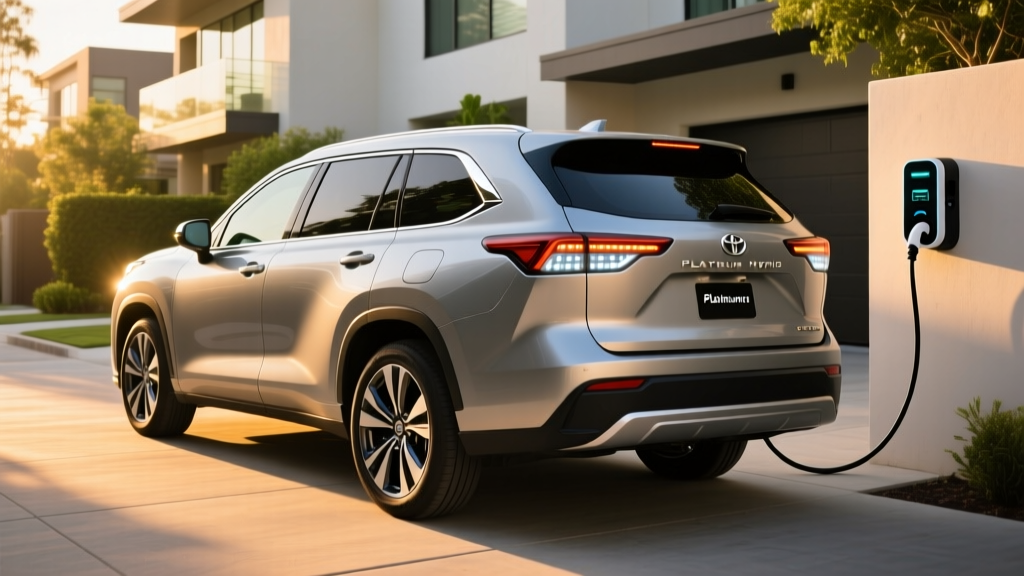
The 2026 Toyota Highlander Platinum Hybrid occupies a specific niche: three-row family hauler with the fuel appetite of a midsize sedan. With an EPA-estimated 35 MPG combined, Toyota's fourth-generation hybrid powertrain delivers meaningful savings over the gas-only Highlander — without requiring you to plug in, change your routine, or worry about charging infrastructure. The Platinum trim sits at the top of the lineup, bundling panoramic roof, heated and ventilated front seats, a 12.3-inch infotainment display, and Toyota's full Safety Sense 3.0 suite into a package starting around $54,170.
But the real question for 2026 buyers isn't whether this hybrid is efficient — it is — it's whether a conventional hybrid (HEV) still makes sense in a market increasingly populated by plug-in hybrids (PHEVs) and full battery-electric vehicles (BEVs). This review breaks down the exact numbers, real-world driving observations, and ownership economics to help you decide.
The Highlander Hybrid is a conventional hybrid (HEV). It cannot be plugged in. Its 1.87 kWh nickel-metal hydride (NiMH) battery charges exclusively through regenerative braking and the gasoline engine. This is fundamentally different from a plug-in hybrid (PHEV) like the Toyota RAV4 Prime, which carries a much larger battery (18.1 kWh), offers 42 miles of electric-only driving, and qualifies for federal tax credits. The Highlander Hybrid prioritizes simplicity: no charging cable, no electric-only range to manage, just consistently strong MPG in every driving condition.
Powertrain and Performance Specs
| Spec | Value |
|---|---|
| Powertrain | 2.5L 4-cyl + 2 electric motors (AWD) / 3 motors (FWD) |
| Combined Horsepower | 243 hp (net system) |
| Battery | 1.87 kWh NiMH (sealed, self-charging) |
| Drivetrain | Electronic On-Demand AWD (Platinum standard) |
| 0–60 mph | ~7.8 seconds |
| Towing Capacity | 3,500 lbs |
| Cargo Volume (behind 3rd row) | 16.1 cu ft |
| Base MSRP (Platinum AWD) | $54,170 |
The hybrid system pairs a 2.5-liter Atkinson-cycle four-cylinder engine with front and rear electric motors. The rear motor provides electronic all-wheel drive without a mechanical driveshaft — it engages only when slippage is detected or during hard acceleration. Net system output is 243 horsepower, which moves the 4,600-pound Highlander with adequate but not sporty urgency. The CVT-style e-CVT transmission is smooth, if occasionally droning under heavy throttle.
One practical note: the hybrid powertrain sacrifices nothing in cargo or passenger space versus the gas Highlander. The battery pack is compact enough to sit under the second-row seats, preserving the flat load floor and 3,500-pound tow rating.
Fuel Economy: EPA Ratings vs. Real-World MPG
| Cycle | EPA MPG | Real-World Expectation |
|---|---|---|
| City | 35 | 36–38 (hybrids often exceed EPA in stop-and-go) |
| Highway | 35 | 32–34 (less regen benefit at sustained speed) |
| Combined | 35 | 33–36 depending on driving mix |
Toyota's hybrid system shines in city driving, where regenerative braking recaptures energy at every stop and the electric motor handles low-speed propulsion. Owners who drive predominantly in urban or suburban conditions frequently report 36–38 MPG on the trip computer — exceeding the EPA city estimate. This is a known pattern with Toyota hybrids: the EPA city test cycle doesn't fully capture how aggressively regen can recover energy in heavy traffic.
Highway driving is the reverse. At sustained 70–80 mph speeds, the gasoline engine does most of the work, and the aerodynamic drag of a three-row SUV works against efficiency. Expect 32–34 MPG on long interstate trips. Cold weather further reduces efficiency by roughly 8–12% due to increased engine warm-up time and cabin heating demands. In sub-freezing winter testing, combined MPG typically settles around 30–32.
For context, the gas-only 2026 Highlander AWD (2.4L turbo) rates at 24 MPG combined — meaning the hybrid saves approximately 11 MPG, or roughly 150 gallons per year at 15,000 miles. At $3.50/gallon, that's about $525 in annual fuel savings.
Hybrid vs. PHEV vs. Full EV: Which Powertrain Fits You?
The 2026 Highlander exists only as a conventional hybrid (HEV) or a gas-only turbo. Toyota does not currently offer a Highlander PHEV or BEV variant. Here's how the Highlander Hybrid stacks up against the alternatives:
| Factor | Highlander Hybrid (HEV) | PHEV SUV (e.g., Kia Sorento PHEV) | Full EV (e.g., Kia EV9) |
|---|---|---|---|
| Plug-in required? | No | Yes (for EV range) | Yes |
| Electric-only range | 0 mi (motor assists only) | 32 mi | 270+ mi |
| Combined MPG / MPGe | 35 MPG | 79 MPGe / 34 MPG gas | 89 MPGe |
| Federal tax credit (§30D) | Not eligible | Up to $7,500 (if eligible) | Up to $7,500 (if eligible) |
| Home charging needed? | No | Recommended (Level 2) | Essential |
| 3-row seating? | Yes (7 seats) | Yes (6–7 seats) | Yes (6–7 seats) |
| Approx. starting MSRP | $54,170 | $51,090 | $54,900 |
- Choose the Highlander Hybrid if: You want three rows, strong MPG, zero charging hassle, and Toyota's reliability reputation — and you don't have reliable home charging access for a PHEV or BEV.
- Choose a PHEV SUV if: You have home Level 2 charging, your daily commute is under 35 miles (so you can run mostly electric), and you want the option of gas-free weekday driving with road-trip flexibility.
- Choose a full EV like the Kia EV9 if: You have dependable home charging, want the lowest per-mile fuel cost, qualify for the §30D tax credit, and are comfortable planning DC fast-charging stops on road trips.
Pricing, Trims, and Tax Credit Eligibility
The 2026 Toyota Highlander Hybrid is available in LE, XLE, Limited, and Platinum trims. The Platinum — the top-tier model — carries an MSRP of approximately $54,170 including destination. Key Platinum-standard features include:
- Panoramic glass roof with power sunshade
- Heated and ventilated front seats, heated second-row seats
- 12.3-inch touchscreen with wireless Apple CarPlay and Android Auto
- 11-speaker JBL premium audio
- 360-degree camera with curb-view monitor
- Head-up display
- Toyota Safety Sense 3.0 (pre-collision, lane-trace, adaptive cruise, road-sign assist)
- Electronic On-Demand AWD
The Highlander Hybrid is a conventional hybrid (HEV) and does not qualify for the federal §30D Clean Vehicle Credit. That credit applies only to plug-in vehicles (PHEVs and BEVs) that meet battery-sourcing, critical-mineral, MSRP cap, and buyer income requirements as defined by the IRS. There is no current federal tax credit for conventional hybrids. Some states offer rebates for hybrids — check your state energy office or fueleconomy.gov for state-level incentive details, which vary by jurisdiction.
Reliability, Battery Lifespan, and Warranty
Toyota's hybrid system is among the most proven in the industry, with over 25 years of continuous production since the original Prius. The Highlander Hybrid's 1.87 kWh NiMH battery is small, lightly stressed, and never deeply discharged — the hybrid system keeps the state of charge (SoC) in a narrow 40–80% window to maximize longevity.
- Hybrid battery: 10 years / 150,000 miles (whichever comes first)
- Hybrid system components (inverter, motor, control module): 8 years / 100,000 miles
- Basic vehicle warranty: 3 years / 36,000 miles
- Powertrain warranty: 5 years / 60,000 miles
Toyota's hybrid battery warranty is among the longest in the segment. Real-world data from millions of Toyota hybrids on the road shows most original batteries last well beyond 150,000 miles with gradual capacity loss rather than sudden failure.
If the hybrid battery does require replacement out of warranty, expect a cost of approximately $3,000–$4,500 for a new OEM battery pack, including labor. Refurbished or reconditioned packs are available from third-party suppliers for $1,500–$2,500. Individual battery modules can also be replaced by specialist hybrid repair shops for $500–$1,200 if only a few cells have degraded — a far cry from the $15,000+ replacements some BEV owners face.
According to NHTSA and owner surveys, the fourth-generation Highlander has maintained strong reliability scores. The hybrid variant, with its e-CVT (which has no conventional transmission bands or clutch packs to wear), actually has fewer mechanical failure points than the gas-only model's 8-speed automatic.
Ownership Economics: 5-Year Cost Snapshot
| Cost Factor | Hybrid Platinum | Gas Platinum AWD |
|---|---|---|
| MSRP (approx.) | $54,170 | $52,420 |
| Fuel cost (75k mi @ $3.50/gal) | $7,500 (35 MPG) | $10,938 (24 MPG) |
| Estimated maintenance (5 yr) | $2,800 | $3,200 |
| Federal tax credit | $0 | $0 |
| Total (purchase + fuel + maint.) | $64,470 | $66,558 |
The hybrid's $1,750 MSRP premium over the gas model is recovered in roughly 3.3 years through fuel savings alone. The hybrid also benefits from lower brake wear (regenerative braking reduces mechanical brake use by 30–50%) and no conventional transmission fluid changes.
Pros and Cons
Pros
- 35 MPG combined — exceptional for a 3-row AWD SUV
- No plug-in charging required; zero lifestyle change vs. gas car
- Proven Toyota hybrid reliability with 10yr/150k battery warranty
- Platinum trim loaded with premium features at ~$54K
- Electronic AWD with 3,500-lb tow rating
- Strong city MPG — often exceeds EPA in real-world traffic
Cons
- No federal tax credit eligibility (HEV, not PHEV/BEV)
- 243 hp feels adequate, not quick — 7.8s 0–60 is leisurely
- Third row is tight for adults; best for children or short trips
- Highway MPG drops to ~32 at 75+ mph
- No PHEV or EV variant available in the Highlander lineup
- Cargo space behind 3rd row (16.1 cu ft) is modest for the class
Frequently Asked Questions
How many MPG does the 2026 Highlander Hybrid get?
The EPA rates the 2026 Highlander Hybrid AWD at 35 MPG city, 35 highway, and 35 combined. In real-world driving, city MPG often reaches 36–38 thanks to regenerative braking, while sustained highway driving at 75+ mph typically yields 32–34 MPG. Cold weather reduces combined efficiency by approximately 8–12%.
Does the Highlander Hybrid need to be plugged in?
No. The Highlander Hybrid is a conventional hybrid (HEV). Its small 1.87 kWh battery charges entirely through regenerative braking and the gasoline engine. You fuel it like any other car — just at the pump less often.
How far can it drive on electric power alone?
The conventional Highlander Hybrid cannot drive on electric power alone for any meaningful distance. The electric motors assist the gasoline engine during acceleration and low-speed maneuvers, but the engine is always available and frequently running. If you want electric-only driving, you'd need to look at a PHEV (like the RAV4 Prime with 42 miles EV range) or a full BEV.
Is the hybrid battery reliable, and what does replacement cost?
Toyota's hybrid batteries are among the most reliable in the industry. The 10-year/150,000-mile warranty covers premature failure, and real-world data shows most original batteries last well beyond 150,000 miles. If replacement is needed out of warranty, expect $3,000–$4,500 for a new OEM pack, or $1,500–$2,500 for a refurbished unit. Module-level repairs can cost as little as $500–$1,200.
Does the 2026 Highlander Hybrid qualify for any tax credit?
No federal tax credit is available for conventional hybrids. The IRS §30D Clean Vehicle Credit applies only to plug-in electric vehicles (PHEVs and BEVs) meeting specific battery-sourcing, MSRP, and income requirements. Some states may offer hybrid-specific rebates — consult your state energy office for current programs. See IRS.gov for federal rules.
How does the Highlander Hybrid compare to a full EV like the Kia EV9?
The EV9 offers lower per-mile energy costs (~$0.04/mi vs. ~$0.10/mi for the hybrid), qualifies for up to $7,500 in federal tax credits (subject to eligibility), and delivers instant torque with zero tailpipe emissions. However, it requires reliable home charging, road-trip planning around DC fast chargers, and carries range-reduction risk in extreme cold (20–30% loss). The Highlander Hybrid eliminates all charging concerns, offers consistent 35 MPG regardless of weather, and is the pragmatic choice for buyers without home charging or who frequently drive in areas with sparse EV infrastructure.
Sources: fueleconomy.gov (EPA ratings), Toyota.com (manufacturer specifications), IRS.gov (§30D credit rules). All figures reflect 2026 model-year data available at time of publication. Verify current pricing and incentive eligibility with your dealer and tax professional.