The 2026 Toyota Highlander Hybrid at a Glance
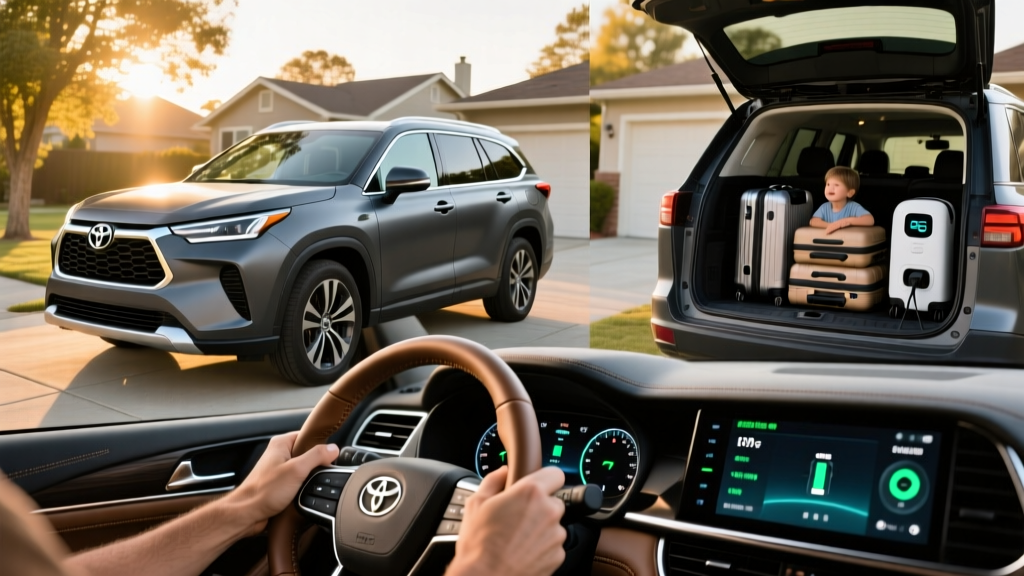
Three-row SUVs that don't punish you at the pump are rare. The 2026 Toyota Highlander Hybrid remains one of the few midsize crossovers that seats up to eight, offers standard all-wheel drive, and returns an EPA-estimated 35 MPG combined — figures that rival compact sedans from a decade ago. Toyota's fourth-generation hybrid powertrain pairs a 2.5-liter four-cylinder engine with three electric motors (two front, one rear) for a combined 243 horsepower, delivering smooth, responsive acceleration without requiring a plug.
This guide covers everything a buyer needs: exact EPA fuel economy across trims, how real-world MPG stacks up, battery longevity and warranty coverage, pricing with tax-credit context, and whether the Highlander Hybrid is the right fit versus a plug-in hybrid or full battery-electric vehicle.
EPA Fuel Economy and Real-World MPG
The 2026 Highlander Hybrid uses Toyota's proven series-parallel hybrid system with an electronically controlled continuously variable transmission (eCVT). All trims come with electronic on-demand AWD, which uses a dedicated rear-axle electric motor rather than a mechanical driveshaft — a setup that preserves efficiency while providing traction when needed.
| Trim | City MPG | Highway MPG | Combined MPG | Fuel Tank (gal) | Est. Total Range |
|---|---|---|---|---|---|
| LE / XLE | 36 | 35 | 35 | 17.9 | ~626 mi |
| XSE / Limited / Platinum | 35 | 34 | 35 | 17.9 | ~626 mi |
Source: EPA Fuel Economy Guide
Powertrain Specs: Engine, Motors, and Performance
| Engine | 2.5L DOHC 4-cylinder (Dynamic Force) |
| Engine Output | 186 hp / 186 lb-ft torque |
| Front Electric Motors | Two (MG1 generator + MG2 drive motor) |
| Rear Electric Motor | 54 hp (AWD traction motor) |
| Combined Net Horsepower | 243 hp |
| Transmission | eCVT (planetary gearset) |
| Drivetrain | Electronic On-Demand AWD (standard) |
| 0–60 MPH | ~7.8 seconds |
| Towing Capacity | 3,500 lbs (when properly equipped) |
| Hybrid Battery | 1.87 kWh nickel-metal hydride (NiMH) |
The 2.5-liter Dynamic Force engine operates on the Atkinson cycle, sacrificing peak power for thermal efficiency (Toyota rates it above 40%). The eCVT is not a belt-driven CVT — it uses a planetary gearset to blend engine and motor power seamlessly, which is why Toyota hybrids avoid the rubber-band acceleration feel that plagues some competitors. The rear motor engages automatically under acceleration or when front-wheel slip is detected, providing AWD without the parasitic drivetrain loss of a mechanical system.
Hybrid (HEV) vs. Plug-In Hybrid (PHEV): Where the Highlander Fits
Toyota does not currently offer a plug-in hybrid version of the Highlander in the United States. The Highlander Hybrid is a conventional hybrid (HEV), meaning it generates all its electricity internally through regenerative braking and the gasoline engine — you never plug it in.
Conventional Hybrid (HEV) — Highlander Hybrid
- No plug-in charging required
- Small battery (1.87 kWh) charged by regen + engine
- Electric motor assists engine; brief EV-only at low speed
- No electric-only range rating
- Lower upfront cost vs. PHEV
- No federal tax credit under §30D
Plug-In Hybrid (PHEV) — e.g., Toyota RAV4 Prime
- Plug-in charging (Level 1 or Level 2)
- Larger battery (~18 kWh) enables 25–42 mi electric-only
- Gas engine kicks in after battery depletes
- May qualify for partial or full §30D credit
- Higher upfront cost ($5,000–$8,000 premium)
- Requires home charging access for full benefit
If Toyota were to introduce a Highlander PHEV, it would likely carry an 18–20 kWh battery for roughly 30–35 miles of electric-only range. For now, buyers wanting plug-in capability in a three-row Toyota must look to the Toyota Grand Highlander Hybrid (HEV, 36 MPG combined) or consider the Kia Sorento PHEV (32 miles EV range, 79 MPGe) as an alternative.
Pricing, Trims, and Tax Credit Eligibility
| Trim | MSRP (incl. destination) | Key Features |
|---|---|---|
| LE | $41,670 | 8-seat, Toyota Safety Sense 3.0, 8" touchscreen |
| XLE | $44,720 | SofTex seats, power liftgate, wireless CarPlay/Android Auto |
| XSE | $47,270 | Sport-tuned suspension, 20" wheels, 2nd-row captain's chairs |
| Limited | $49,870 | Leather, 12.3" screen, panoramic roof, JBL audio |
| Platinum | $53,420 | Head-up display, 360° camera, heated/ventilated 2nd row |
Battery Warranty, Reliability, and Replacement Cost
Toyota Hybrid Battery Warranty
- Coverage: 10 years / 150,000 miles (whichever comes first)
- What's covered: Hybrid battery pack, hybrid control module, inverter
- Capacity threshold: Toyota replaces or repairs if the battery cannot hold sufficient charge to operate the hybrid system
- Transferable: Yes, to subsequent owners
Toyota's hybrid battery track record is among the strongest in the industry. The Highlander Hybrid uses a nickel-metal hydride (NiMH) battery pack — a mature, proven chemistry that sacrifices some energy density for exceptional cycle stability and thermal tolerance. Unlike the lithium-ion packs in full EVs and PHEVs, NiMH cells in Toyota's conventional hybrids experience minimal degradation because they operate in a narrow state-of-charge window (typically 40–80% SoC), never fully charging or fully discharging.
Real-world longevity data: Toyota Prius taxis and fleet vehicles have logged 300,000+ miles on original hybrid batteries. For a Highlander Hybrid driven 15,000 miles annually, the 10-year/150,000-mile warranty should cover the vehicle's entire first-ownership cycle. Independent data from Consumer Reports and J.D. Power consistently ranks Toyota among the top three brands for long-term hybrid reliability.
Out-of-warranty replacement cost: If the hybrid battery fails after the warranty period, a new OEM replacement typically costs $3,000–$4,500 including parts and labor. Refurbished or reconditioned packs are available from third-party suppliers for $1,500–$2,500. Individual cell modules can sometimes be replaced for under $1,000 if only one or two cells have degraded — a repair option available at hybrid-specialist shops.
Who Should Buy the Highlander Hybrid?
✓ Choose the Highlander Hybrid If:
- You need three rows and AWD but want 35 MPG
- You lack home charging access (apartment, street parking)
- You tow occasionally (3,500-lb rating covers a small boat or trailer)
- You want Toyota's reliability reputation and strong resale value
- You drive mostly city/suburban where hybrids excel
- You prefer a lower purchase price over PHEV premiums
✗ Look Elsewhere If:
- You want electric-only commuting (consider a PHEV or full EV)
- You need more than 35 MPG highway (a sedan hybrid beats this)
- You want a federal tax credit (requires PHEV or BEV eligibility)
- You need maximum third-row cargo space (Grand Highlander or Telluride offer more)
- You want sporty driving dynamics (the eCVT prioritizes efficiency)
- You regularly tow over 3,500 lbs
Hybrid vs. PHEV vs. Full EV: Which Three-Row SUV Fits You?
| Factor | HEV (Highlander Hybrid) | PHEV (Kia Sorento PHEV) | BEV (Kia EV9) |
|---|---|---|---|
| Combined MPG / MPGe | 35 MPG | 79 MPGe (elec) / 34 MPG (gas) | 89 MPGe |
| Electric-Only Range | N/A | 32 miles | 270–304 miles |
| Home Charging Needed? | No | Yes (for EV benefit) | Yes (required) |
| Starting Price | $41,670 | $51,590 | $54,900 |
| Federal Tax Credit | None | Up to $7,500* | Up to $7,500* |
| Fuel Cost (15k mi/yr) | ~$1,540 | ~$900–$1,400 | ~$550–$750 |
| Best For | No-plug convenience | Short EV commute + gas road trips | Home charging + lowest running cost |
*§30D credit eligibility depends on MSRP caps, buyer income limits, battery sourcing requirements, and point-of-sale transfer rules. See IRS.gov for current-year rules. Consult a tax professional.
Frequently Asked Questions
How many MPG does the 2026 Toyota Highlander Hybrid get?
The EPA rates the Highlander Hybrid at 36 city / 35 highway / 35 combined MPG for LE and XLE trims. XSE, Limited, and Platinum trims rate 35/34/35 MPG. In real-world city driving, owners frequently report 36–38 MPG thanks to aggressive regenerative braking. Highway cruising at 75+ MPH typically yields 30–32 MPG.
Does the Highlander Hybrid need to be plugged in?
No. The Highlander Hybrid is a conventional hybrid (HEV). Its small 1.87 kWh battery charges itself through regenerative braking and the gasoline engine. You fuel it like any other vehicle — just fill up at a gas station. There is no plug, no charging cable, and no electric-only range rating.
Is there a plug-in hybrid (PHEV) version of the Highlander?
Not as of the 2026 model year. Toyota has not announced a Highlander PHEV for the U.S. market. The closest Toyota alternative is the Grand Highlander Hybrid (36 MPG combined, HEV) or the RAV4 Prime (42 miles EV range, PHEV — but only two rows). If you need three rows with plug-in capability, the Kia Sorento PHEV (32 miles EV, 79 MPGe) is the primary competitor.
How long will the hybrid battery last?
Toyota covers the hybrid battery for 10 years or 150,000 miles. The NiMH chemistry and narrow state-of-charge operating window (40–80%) minimize degradation. Real-world data from Toyota's hybrid fleet shows many batteries lasting 200,000+ miles without replacement. Out-of-warranty replacement costs $3,000–$4,500 for a new OEM pack, or $1,500–$2,500 for a refurbished unit.
Does the 2026 Highlander Hybrid qualify for a tax credit?
No. The federal §30D Clean Vehicle Credit requires plug-in capability and a battery capacity of at least 7 kWh. The Highlander Hybrid's 1.87 kWh NiMH battery and conventional hybrid system do not meet these requirements. Some states offer modest rebates for high-efficiency hybrids — check the Alternative Fuels Data Center for programs in your state.
How does AWD work on the Highlander Hybrid?
The Highlander Hybrid uses Toyota's electronic on-demand AWD. A dedicated 54-hp electric motor powers the rear axle — there is no mechanical driveshaft connecting the front and rear. The rear motor engages during hard acceleration, from a stop, or whenever front-wheel slip is detected. This system is lighter and more efficient than a traditional mechanical AWD setup, though it's designed for traction in rain and light snow rather than serious off-road use.
What's the towing capacity?
The 2026 Highlander Hybrid is rated to tow up to 3,500 pounds when properly equipped with the factory tow package. This covers a small utility trailer, a pair of jet skis, or a light pop-up camper. It falls short of body-on-frame SUVs (5,000–8,000 lbs) but matches or exceeds most unibody competitors in the hybrid three-row segment.