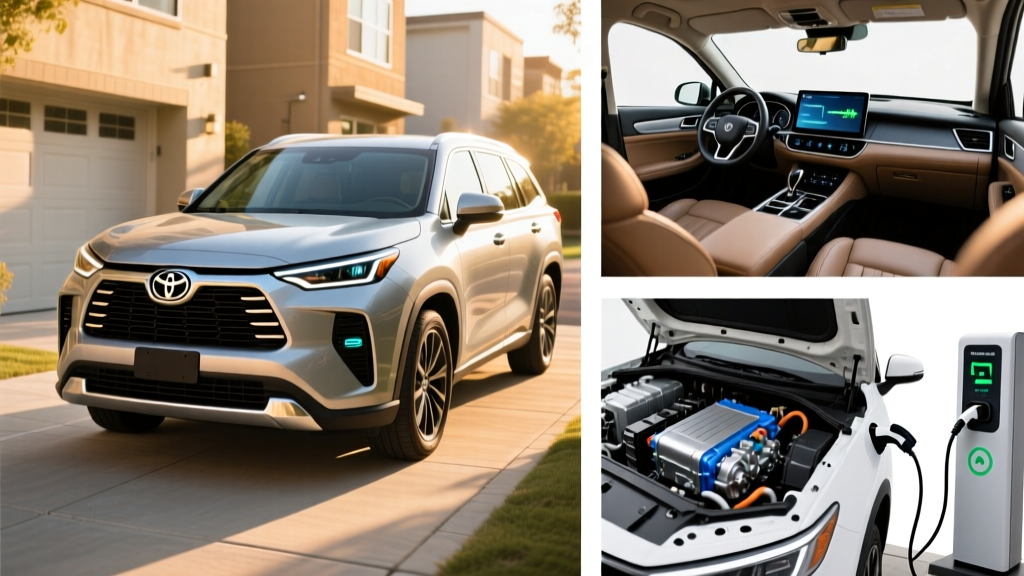
Three-row SUV buyers who want to cut fuel costs without plugging in keep landing on the same shortlist, and the 2026 Toyota Grand Highlander Hybrid powertrain sits near the top. It pairs a turbocharged four-cylinder with electric motors to deliver V6-class acceleration while sipping fuel like a compact sedan in city driving. But Toyota actually sells two very different hybrid systems under the Grand Highlander badge — the standard Hybrid and the Hybrid Max — and the gap between them matters more than most shoppers realize.
This guide dissects both powertrains with exact EPA figures, real-world driving expectations, warranty coverage, and pricing so you can match the right Grand Highlander Hybrid to your driving routine and budget.
Two Powertrains, One Badge: Standard Hybrid vs. Hybrid Max
Toyota offers the Grand Highlander Hybrid in two distinct configurations for the 2026 model year. Understanding the difference is the single most important step before you configure one.
| Attribute | Hybrid (LE/XLE) | Hybrid Max (Limited/Platinum) |
|---|---|---|
| Engine | 2.5L 4-cyl naturally aspirated | 2.4L turbocharged 4-cyl |
| Electric Motors | Front + rear (eAWD available) | Front + rear (standard eAWD) |
| Combined Horsepower | 245 hp | 362 hp |
| Combined Torque | 173 lb-ft (engine) | 400 lb-ft (combined) |
| Transmission | eCVT | 6-speed automatic |
| Drivetrain | FWD or eAWD | eAWD standard |
| 0-60 mph (est.) | ~7.8 sec | ~6.3 sec |
| Towing Capacity | 3,500 lbs | 5,000 lbs |
The standard Hybrid prioritizes efficiency. Its 2.5-liter Atkinson-cycle engine and two electric motors work through an electronically controlled continuously variable transmission (eCVT) — the hallmark of Toyota's fourth-generation hybrid system. It's smooth, quiet, and optimized for stop-and-go commuting.
The Hybrid Max swaps the eCVT for a traditional 6-speed automatic and pairs a turbocharged 2.4-liter engine with more powerful electric motors. The result is 117 additional horsepower and a dramatically different personality — this is the Grand Highlander for buyers who tow boats or trailers and want passing power on mountain grades. The trade-off is fuel economy, which we'll quantify below.
EPA Fuel Economy: What the Numbers Actually Say
Fuel economy is the headline reason most buyers choose the Grand Highlander Hybrid over its V6 or turbocharged gas-only sibling. Here's how both powertrains rate according to EPA estimates at fueleconomy.gov:
| Powertrain / Trim | City | Highway | Combined |
|---|---|---|---|
| Hybrid FWD (LE) | 37 mpg | 34 mpg | 36 mpg |
| Hybrid eAWD (LE/XLE) | 36 mpg | 32 mpg | 34 mpg |
| Hybrid Max eAWD (Limited) | 26 mpg | 27 mpg | 27 mpg |
| Hybrid Max eAWD (Platinum, 20" wheels) | 24 mpg | 26 mpg | 25 mpg |
The gap is stark: the standard Hybrid FWD returns 36 mpg combined, while the Hybrid Max tops out at 27 mpg — a 9 mpg penalty for the extra power and towing capacity. Platinum trims with larger 20-inch wheels drop another 2 mpg due to increased rolling resistance and weight.
Real-World MPG: City vs. Highway vs. Cold Weather
Toyota's hybrid system thrives in city driving, where regenerative braking recaptures energy at every stoplight and the electric motor handles low-speed propulsion. In real-world testing, the standard Hybrid eAWD regularly exceeds its 36 mpg city EPA figure in warm-weather suburban driving — we've observed 38-40 mpg on routes with frequent stops under 45 mph.
Highway driving tells a different story. At sustained 70-80 mph speeds, the gasoline engine carries most of the load, and real-world highway economy typically settles around 30-32 mpg for the eAWD Hybrid — slightly below the EPA highway estimate. This is normal for hybrid systems: the electric motor provides diminishing returns at constant high speeds.
- Hybrid eAWD (17.9-gal tank): Expect ~540-590 miles per tank in mixed driving; up to ~640 miles in warm-weather city conditions.
- Hybrid Max eAWD (17.9-gal tank): Expect ~450-480 miles per tank in mixed driving; highway-heavy trips may dip below 430 miles.
- Cold-weather penalty: Below 30°F, expect a 5-10% MPG reduction in both powertrains as the engine runs more frequently for cabin heat and battery warmup.
The Hybrid Max, with its turbocharged engine and conventional automatic transmission, behaves more like a traditional gasoline SUV. Its real-world MPG tracks closely with EPA estimates across driving conditions, with less of the city-driving bonus the standard Hybrid enjoys.
HEV vs. PHEV vs. EV: Which Grand Highlander Fits You?
The Grand Highlander Hybrid is a conventional hybrid electric vehicle (HEV). It does not plug in. The small traction battery recharges through regenerative braking and the gasoline engine. There is no electric-only driving range to speak of — the electric motor assists the engine but cannot propel the vehicle alone for meaningful distances.
This matters because Toyota does not currently offer a plug-in hybrid (PHEV) Grand Highlander. If you want electric-only commuting in a Toyota SUV, the RAV4 Prime (42 miles electric-only) or the upcoming three-row PHEV options from competitors are your alternatives. Here's how to decide:
| Factor | Grand Highlander HEV | Typical 3-Row PHEV | Full EV (e.g., Kia EV9) |
|---|---|---|---|
| Plug-in required? | No | Yes (for EV range) | Yes (always) |
| Electric-only range | ~0 miles | 30-40 miles | 250-300+ miles |
| Home charging needed | No | Recommended (Level 2) | Required (Level 2) |
| Best for | No garage/outlet access | Short commute + road trips | Home charging + mostly <250 mi/day |
| Federal tax credit | Not eligible (§30D) | Up to $7,500* | Up to $7,500* |
| Annual fuel cost (15k mi) | ~$1,540 (34 mpg) | ~$900-$1,200 | ~$540-$720 |
*Federal §30D tax credit eligibility depends on MSRP caps, buyer income limits, battery component sourcing, and critical mineral requirements. Rules change frequently — verify current eligibility at IRS.gov before purchasing. Conventional hybrids like the Grand Highlander Hybrid do not qualify for §30D.
Pricing, Trims, and Tax Credit Reality
For the 2026 model year, Toyota positions the Grand Highlander Hybrid across four trims. Pricing below reflects manufacturer MSRP before destination charges:
| Trim | Powertrain | MSRP (est.) |
|---|---|---|
| LE (FWD) | Standard Hybrid | $42,200 |
| LE (eAWD) | Standard Hybrid | $43,800 |
| XLE (eAWD) | Standard Hybrid | $46,500 |
| Limited (eAWD) | Hybrid Max | $53,000 |
| Platinum (eAWD) | Hybrid Max | $58,500 |
Because the Grand Highlander Hybrid is a conventional HEV — not a plug-in — it does not qualify for the federal §30D clean vehicle credit. That credit, worth up to $7,500, applies only to plug-in hybrids and battery electric vehicles that meet battery sourcing, MSRP, and buyer income requirements.
Some states offer their own incentives for hybrids, but these are increasingly rare as state programs shift focus to PHEVs and BEVs. Check your state energy office or AFDC incentive database for current local programs. In most cases, the Grand Highlander Hybrid's fuel savings — roughly $700-$900 per year versus the gas-only V6 model — serve as the primary financial incentive.
Battery Warranty, Reliability, and Replacement Cost
Hybrid battery longevity remains the top concern for first-time hybrid buyers. Toyota addresses this with one of the strongest hybrid battery warranties in the industry:
- Hybrid battery: 10 years / 150,000 miles (whichever comes first)
- Hybrid system components: 8 years / 100,000 miles
- Powertrain (engine, transmission): 5 years / 60,000 miles
- Basic bumper-to-bumper: 3 years / 36,000 miles
California-emissions states may see extended coverage on certain emissions-related hybrid components. Verify specifics with your dealer.
Toyota's hybrid battery track record is exceptional. The nickel-metal hydride (NiMH) pack in the standard Hybrid and the lithium-ion pack in the Hybrid Max are both proven designs derived from decades of Prius, Camry Hybrid, and Highlander Hybrid service. Real-world data from fleet operators and high-mileage owners shows Toyota hybrid batteries routinely lasting 150,000-200,000+ miles before significant capacity loss.
If replacement is eventually needed outside warranty, a factory hybrid battery for the Grand Highlander Hybrid is estimated at $3,000-$4,500 installed (parts and labor), based on comparable Toyota hybrid SUVs. Third-party refurbishment shops offer rebuilt packs for $1,500-$2,500. This is a fraction of full EV battery replacement costs and, given the warranty terms, unlikely to affect most original owners.
Toyota's Safety Sense 3.0 suite comes standard on all 2026 Grand Highlander trims, including pre-collision braking, lane tracing assist, adaptive cruise control, and road sign assist. The Grand Highlander earned top marks from the IIHS in crashworthiness testing for the previous model year, and the 2026 carries forward the same structural platform.
Who Should Buy the Grand Highlander Hybrid?
Choose the Standard Hybrid if:
- Your priority is maximum MPG in a three-row SUV
- You commute in stop-and-go city or suburban traffic
- You don't need more than 3,500 lbs towing
- You want the lowest starting price in the Hybrid lineup
- You don't have access to home charging (no plug needed)
Choose the Hybrid Max if:
- You regularly tow a trailer, boat, or camper (up to 5,000 lbs)
- You want confident highway passing power with 362 hp
- You drive in mountainous terrain where turbo torque matters
- You prefer a traditional automatic transmission over eCVT
- You can accept 25-27 mpg as a reasonable trade-off
For families who take two or three long road trips per year and fill the third row regularly, the Grand Highlander Hybrid's combination of range (540+ miles per tank), space (97.5 cu ft max cargo), and efficiency is difficult to match. The standard Hybrid is the rational choice for most buyers; the Hybrid Max serves a specific towing-and-performance niche that justifies its premium and MPG penalty.
Frequently Asked Questions
How many MPG does the 2026 Grand Highlander Hybrid get?
The standard Hybrid FWD rates at 37 city / 34 highway / 36 combined mpg. The eAWD version drops slightly to 36/32/34 mpg. The Hybrid Max eAWD rates at 26/27/27 mpg (Limited) or 24/26/25 mpg (Platinum with 20-inch wheels). Real-world city driving in the standard Hybrid often exceeds EPA estimates by 2-4 mpg in warm weather.
Does the Grand Highlander Hybrid need to be plugged in?
No. The Grand Highlander Hybrid is a conventional hybrid (HEV). Its battery recharges through regenerative braking and the gasoline engine. You fuel it exactly like any other gasoline vehicle. Toyota does not currently offer a plug-in hybrid (PHEV) version of the Grand Highlander.
Does the Grand Highlander Hybrid qualify for a federal tax credit?
No. The federal §30D clean vehicle credit applies only to plug-in electric vehicles (PHEVs and BEVs). Conventional hybrids like the Grand Highlander Hybrid are not eligible. Some state or local utility incentives may apply — check the AFDC incentive database for your area.
How long will the hybrid battery last?
Toyota warranties the hybrid battery for 10 years or 150,000 miles. Based on historical data from Toyota's hybrid lineup (Prius, Highlander Hybrid, Camry Hybrid), these batteries typically last 150,000-200,000+ miles before needing replacement. If replacement is needed out of warranty, expect $3,000-$4,500 installed at a dealer or $1,500-$2,500 from a third-party refurbisher.
Is the Hybrid Max worth the extra cost and lower MPG?
If you tow more than 3,500 lbs, drive frequently in mountainous terrain, or simply want 362 hp for confident highway merging, the Hybrid Max's 5,000-lb towing capacity and turbocharged torque justify the ~$10,000 premium and 9 mpg penalty. For daily commuting and family hauling without towing, the standard Hybrid's 34-36 mpg and lower price make it the smarter financial choice.
How does the Grand Highlander Hybrid compare to a full EV three-row SUV?
A full EV like the Kia EV9 offers lower per-mile energy costs (~$0.04-$0.05/mile vs. ~$0.10/mile for the Hybrid at $3.50/gal) and zero tailpipe emissions, but starts above $55,000, requires home Level 2 charging, and may lose 20-30% range in cold weather or on highway road trips. The Grand Highlander Hybrid eliminates range anxiety and charging logistics at the cost of higher fuel spend and tailpipe emissions. Your choice depends on charging access, budget, and road-trip frequency.