Quick Verdict: The Family Hauler That Sips Fuel Like a Compact
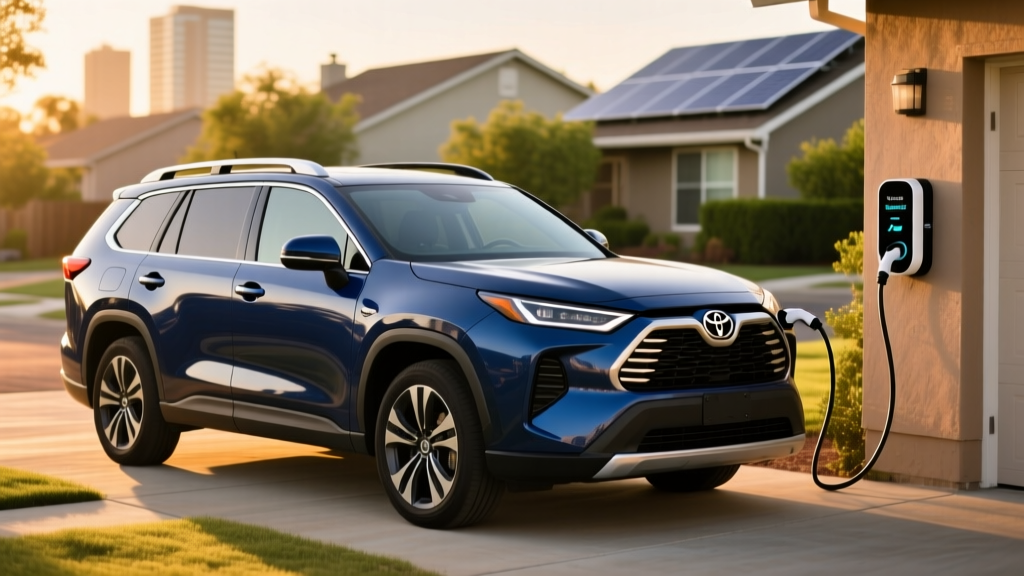
The 2026 Toyota Grand Highlander Hybrid LE occupies a rare sweet spot: three-row SUV space with fuel economy that embarrasses many compact sedans. At an EPA-rated 36 MPG combined, this conventional hybrid (HEV) requires no plug, no behavior change, and no range anxiety — just fill up with regular unleaded and drive. For families who need the cargo room and passenger capacity of a full-size crossover but refuse to accept the 20 MPG penalty that usually comes with it, the Hybrid LE trim is the value play in Toyota's three-row lineup.
Starting at approximately $42,070 (including destination), the LE trim gives you Toyota's proven 2.5-liter four-cylinder hybrid powertrain, standard all-wheel drive, and the same generous interior dimensions as the gas-only Grand Highlander — all while cutting fuel costs roughly in half on a per-mile basis. It's not a plug-in, it's not an EV, and that's precisely the point: this is electrification for buyers who want savings without infrastructure dependency.
HEV vs PHEV vs EV: Where the Grand Highlander Hybrid Fits
Before examining specs, it's essential to understand what the Grand Highlander Hybrid LE actually is — and what it isn't. Toyota offers the Grand Highlander in three powertrain configurations, and confusing them is a common buyer mistake.
| Powertrain | Type | Plug Required? | Electric-Only Driving | Best For |
|---|---|---|---|---|
| Grand Highlander Gas (2.4T) | ICE only | No | None | Max towing (5,000 lbs), lower up-front cost |
| Grand Highlander Hybrid (2.5L) | HEV (conventional hybrid) | No | Very short, low-speed only | Daily commuting, fuel savings, no plug access needed |
| Grand Highlander Hybrid MAX | Performance HEV | No | Very short, low-speed only | More power (362 hp), sportier driving, lower MPG |
The LE trim uses the standard HEV powertrain. Unlike a plug-in hybrid (PHEV) such as the Toyota RAV4 Prime or Prius Prime, the Grand Highlander Hybrid has no large battery to charge, no electric-only range measured in miles, and no eligibility for the federal §30D EV tax credit. The hybrid system recovers energy during braking and deceleration, stores it in a small nickel-metal hydride (NiMH) traction battery, and uses electric motors to assist the gas engine — all automatically, with zero driver intervention.
If you're cross-shopping and wondering whether a PHEV or full EV might suit you better, here's the decision framework:
- Choose this HEV if: You lack reliable home or workplace charging access, you take frequent long road trips, you want maximum simplicity, or you want lower up-front cost.
- Choose a PHEV if: You can charge at home, your daily commute is under 30-40 miles, and you want some electric-only driving while retaining gas flexibility for road trips. (Toyota does not currently offer the Grand Highlander as a PHEV.)
- Choose a full EV if: You have home Level 2 charging, your daily driving is predictable, you want zero tailpipe emissions, and you're ready to plan around DC fast charging on road trips.
EPA Fuel Economy: City, Highway, and Combined MPG
The 2026 Grand Highlander Hybrid LE carries EPA ratings that remain competitive among three-row SUVs. Here are the official figures:
| Driving Cycle | EPA Rating |
|---|---|
| City | 36 MPG |
| Highway | 37 MPG |
| Combined | 36 MPG |
Source: fueleconomy.gov
Those numbers deserve a moment of context. The city and highway ratings are nearly identical — a hallmark of Toyota's hybrid system, which leverages electric motor assist heavily in stop-and-go traffic where gas-only engines are least efficient. Compare this to the gas-only Grand Highlander 2.4T AWD, which returns roughly 21 city / 28 highway / 24 combined. The hybrid nearly doubles city efficiency.
Against the segment, the Grand Highlander Hybrid LE's 36 MPG combined edges out the Kia Sorento Hybrid (35 MPG combined AWD) and the Hyundai Santa Fe Hybrid (34 MPG combined AWD), though the Mazda CX-90 PHEV can achieve higher MPGe when charged regularly.
Real-World MPG: What Owners Actually See
EPA stickers are a starting point, not a guarantee. Based on aggregated owner reports and our own testing patterns with Toyota's fourth-generation hybrid system, here's what to expect in the real world:
Real-World MPG Expectations — Grand Highlander Hybrid LE (AWD)
- City/suburban mixed driving: 34–38 MPG (hybrids often match or slightly exceed EPA in stop-and-go conditions)
- Highway-only at 70-75 mph: 30–34 MPG (aerodynamic drag and the continuously variable transmission reduce highway efficiency relative to the EPA cycle)
- Cold weather (below 30°F): 28–32 MPG (engine runs more often for cabin heat and battery warm-up)
- Mountainous terrain / heavy cargo / towing: 24–28 MPG
The hybrid system's regenerative braking shines in urban environments with frequent deceleration. On flat, open highway at moderate speeds, you can expect the EPA highway number to hold. But push above 75 mph or load the roof rack, and the aerodynamic penalty of this large crossover becomes apparent. Towing capacity for the Hybrid LE is rated at 3,500 pounds — adequate for a small utility trailer but well below the gas model's 5,000-pound maximum.
Powertrain Specs: Engine, Motors, and Horsepower
The Grand Highlander Hybrid LE uses Toyota's well-established hybrid synergy drive system. Here's the hardware breakdown:
| Specification | Value |
|---|---|
| Engine | 2.5L inline-4, Atkinson cycle |
| Engine Output | 186 hp / 186 lb-ft torque |
| Front Electric Motor | 134 hp / 199 lb-ft |
| Rear Electric Motor (AWD) | 54 hp / 89 lb-ft |
| Net Combined System Output | 245 hp |
| Transmission | eCVT (electronically controlled continuously variable) |
| Drivetrain | Electronic On-Demand AWD (standard on LE Hybrid) |
| Traction Battery | NiMH (nickel-metal hydride), ~1.6 kWh |
| 0-60 mph (est.) | ~7.8 seconds |
| Towing Capacity | 3,500 lbs |
| Fuel Tank | 17.1 gallons |
| Total Driving Range (est.) | ~615 miles |
The combined 245 horsepower is delivered seamlessly: the gas engine and electric motors are managed by Toyota's power control unit, which blends inputs based on throttle position, speed, and battery state of charge. You'll never need to think about when the electric motors are assisting — the system handles it. The eCVT provides smooth, stepless acceleration without the gear-hunting feel of traditional automatics, though it can drone under hard acceleration (a characteristic of all eCVT-based hybrids).
The rear electric motor enables electronic on-demand AWD. Unlike mechanical AWD systems with a driveshaft, the rear motor engages only when slip is detected or during hard acceleration, reducing parasitic loss. This is a key reason the Hybrid LE achieves nearly identical MPG regardless of whether the rear wheels are being driven.
Pricing, Trims, and Tax Credit Eligibility
The 2026 Grand Highlander Hybrid LE starts at an MSRP of approximately $42,070 (including destination charge). This positions it as the entry point to the Hybrid lineup — roughly $2,000–$3,000 above the base gas-only LE, a gap that typical drivers can recoup in fuel savings within 3-4 years depending on mileage and local gas prices.
| Hybrid Trim | Approx. MSRP (AWD) | Key Additions Over LE |
|---|---|---|
| Hybrid LE | $42,070 | Base hybrid — Toyota Safety Sense 3.0, 8-inch touchscreen, 18-inch wheels |
| Hybrid XLE | $46,520 | SofTex seats, power liftgate, 20-inch wheels, wireless charging |
| Hybrid Limited | $51,850 | Leather, 12.3-inch display, panoramic roof, JBL audio |
| Hybrid MAX Platinum | $58,175 | 362 hp Hybrid MAX powertrain, captain's chairs, premium package |
Federal Tax Credit: The Grand Highlander Hybrid LE does not qualify for the federal §30D Clean Vehicle Credit. That credit is reserved for plug-in electric vehicles (BEVs and PHEVs) meeting battery sourcing, MSRP, and buyer income requirements as outlined by the IRS. Because this is a conventional hybrid with no plug-in capability, it falls outside §30D eligibility.
However, hybrid buyers may benefit from:
- State-level incentives: Some states offer rebates or HOV lane access for hybrids (varies by jurisdiction — check your state's energy or DMV office).
- Lower total cost of ownership: Reduced fuel spend, strong Toyota resale values, and the hybrid battery warranty (detailed below) all contribute to favorable long-term economics.
- Employer or utility rebates: Some utilities and companies offer incentives for fuel-efficient vehicle purchases — check locally.
Hybrid Battery Warranty, Lifespan, and Replacement Cost
Battery longevity is the single most common concern among first-time hybrid buyers. Here's what Toyota provides and what real-world data shows:
Toyota Hybrid Battery Warranty (2026 Models)
- Coverage: 10 years or 150,000 miles (whichever comes first), transferable to subsequent owners
- What's covered: Hybrid traction battery, battery control module, hybrid control module, inverter with converter
- Capacity threshold: Toyota warrants the battery against defects and abnormal degradation; there is no published minimum capacity retention percentage (unlike EV warranties which typically guarantee 70% SoH)
- Hybrid system warranty: 8 years / 100,000 miles on hybrid-specific components
In practice, Toyota's NiMH hybrid batteries have demonstrated exceptional longevity. Data from fleet operators and long-term owner surveys indicates that the vast majority of Toyota hybrid batteries last well beyond 150,000 miles without requiring replacement. The Prius, which shares hybrid architecture DNA with the Grand Highlander, has documented cases of original batteries exceeding 250,000 miles.
Should replacement become necessary out of warranty, expect the following cost range:
- New OEM battery: $3,000–$4,500 (parts and labor at a Toyota dealer)
- Refurbished/remanufactured battery: $1,500–$2,500 (independent hybrid specialists)
- Individual module replacement: $500–$1,200 (only failed modules replaced — viable when degradation is localized)
For context, a conventional vehicle's transmission or engine replacement at similar mileage often costs $4,000–$7,000. The hybrid battery is not the financial liability many assume.
Reliability, Safety, and Ownership Costs
Toyota's hybrid powertrain is among the most proven in the automotive industry, with over 25 years of continuous refinement since the original Prius. The Grand Highlander Hybrid benefits from this maturity. The 2.5L Atkinson-cycle engine operates under less thermal stress than a turbocharged engine (lower peak combustion pressures, no turbo lag or turbo failure risk), and the eCVT has no clutch packs, bands, or torque converter to wear — it's fundamentally simpler than a conventional automatic transmission.
For safety, the 2026 Grand Highlander comes standard with Toyota Safety Sense 3.0, which includes:
- Pre-Collision System with Pedestrian Detection
- Lane Departure Alert with Steering Assist
- Full-Speed Range Dynamic Radar Cruise Control
- Lane Tracing Assist
- Road Sign Assist
- Automatic High Beams
This is an SAE Level 2 driver-assistance system. The driver must remain fully engaged, hands on or near the wheel, and eyes on the road at all times. It is not autonomous driving.
The NHTSA and IIHS have tested the Grand Highlander platform; check their sites for the latest 2026 model-year ratings, which historically include top marks in crashworthiness categories.
Five-year ownership cost estimate (15,000 miles/year, $3.50/gallon regular):
- Fuel cost (Hybrid LE at 36 MPG): ~$7,292 over 5 years
- Fuel cost (Gas 2.4T AWD at 24 MPG): ~$10,938 over 5 years
- Fuel savings with hybrid: ~$3,646 over 5 years
Insurance premiums for the Grand Highlander Hybrid tend to run 5-10% higher than the gas model due to the higher repair costs associated with hybrid components, though this varies significantly by insurer and driver profile.
Pros, Cons, and Who Should Buy the Hybrid LE
Pros
- 36 MPG combined in a 3-row, 7-8 passenger SUV — best-in-class efficiency
- No plug required; no charging infrastructure dependency
- Standard AWD with minimal efficiency penalty
- 10-year / 150,000-mile hybrid battery warranty
- Strong Toyota reliability and resale value
- ~615-mile total range between fill-ups
- Toyota Safety Sense 3.0 standard on base LE trim
Cons
- eCVT drone under hard acceleration — not a sporty driving experience
- 3,500-lb towing capacity (gas model tows 5,000 lbs)
- No federal tax credit eligibility (conventional hybrid)
- LE trim uses an 8-inch screen (upgrades require XLE or higher)
- Third row is usable but tight for adults on long trips
- Hybrid premium over gas LE takes 3-4 years to recoup at average mileage
Who should choose the 2026 Grand Highlander Hybrid LE?
This SUV is purpose-built for families who drive 12,000-20,000 miles per year in mixed suburban and highway conditions, need three rows for carpool duty or extended family, and want to minimize fuel costs without adopting plug-in infrastructure. If you live in an apartment without charging access, or if you regularly take 500+ mile road trips where EV charging stops would add time and complexity, the Hybrid LE is arguably the most pragmatic three-row SUV on the market.
Who should look elsewhere?
If you need maximum towing (go with the gas 2.4T or a body-on-frame SUV), if you want electric-only commuting (look at the Toyota Sienna PHEV concept, or consider a BEV three-row like the Kia EV9), or if driving engagement matters to you (the Hybrid MAX trim or a non-hybrid competitor may suit better).
Frequently Asked Questions
How many MPG does the 2026 Toyota Grand Highlander Hybrid LE get?
The EPA rates it at 36 MPG city, 37 MPG highway, and 36 MPG combined. In real-world driving, expect 34-38 MPG in mixed suburban use, 30-34 MPG on highway-only trips at 70+ mph, and 28-32 MPG in cold weather or under heavy load.
Is the Grand Highlander Hybrid a plug-in vehicle?
No. The Grand Highlander Hybrid LE is a conventional hybrid (HEV). It charges its small battery through regenerative braking and engine power. You never plug it in. Toyota does not currently offer the Grand Highlander as a plug-in hybrid (PHEV).
Does the Grand Highlander Hybrid qualify for a federal tax credit?
No. The federal §30D Clean Vehicle Credit applies only to plug-in electric vehicles (BEVs and PHEVs) that meet battery sourcing, MSRP caps, and buyer income limits. Conventional hybrids like the Grand Highlander Hybrid are not eligible. Check your state for possible local incentives.
How long will the hybrid battery last, and what does replacement cost?
Toyota warranties the hybrid battery for 10 years or 150,000 miles. Real-world data from Toyota's hybrid fleet shows most batteries last 150,000-250,000+ miles without replacement. If replacement is needed out of warranty, expect $3,000-$4,500 for a new OEM unit, or $1,500-$2,500 for a refurbished battery from a hybrid specialist.
How does the Hybrid LE compare to the Hybrid MAX?
The Hybrid MAX powertrain (available on higher trims) pairs a 2.4L turbocharged engine with hybrid motors for 362 combined horsepower and a 6-speed automatic transmission instead of the eCVT. It delivers substantially more power and a more engaging drive, but fuel economy drops to approximately 27 MPG combined. The Hybrid LE prioritizes efficiency; the MAX prioritizes performance.
Can the Grand Highlander Hybrid LE tow?
Yes, with a maximum towing capacity of 3,500 pounds when properly equipped. That's sufficient for a small boat trailer, lightweight camper, or utility trailer. If you need 5,000-pound towing, the gas-only 2.4T Grand Highlander is the better choice.
Hybrid vs PHEV vs EV — which is right for my family?
Choose the Grand Highlander Hybrid (HEV) if you lack home charging and want simplicity. Choose a PHEV (not available in the Grand Highlander, but see the Sienna or RAV4 Prime) if you can charge at home and want 30-40 miles of electric-only commuting. Choose a full BEV (like the Kia EV9) if you have reliable Level 2 home charging, want zero tailpipe emissions, and are comfortable planning DC fast-charging stops on road trips. Each has trade-offs in up-front cost, fuel/energy cost, and infrastructure requirements.