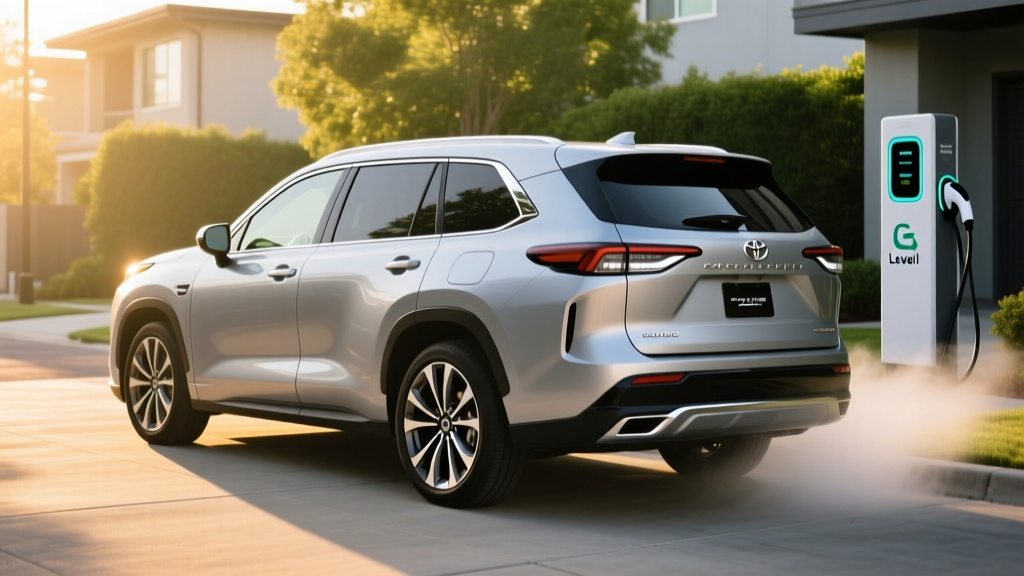
Toyota's three-row family hauler has carved out a distinct niche: full-size SUV space with mid-size fuel consumption. The 2026 Toyota Grand Highlander Hybrid configurations span two fundamentally different powertrains — a standard hybrid system focused on efficiency and the Hybrid MAX performance variant — across multiple trim levels. If you're cross-shopping against the Kia Sorento Hybrid, Mazda CX-90 PHEV, or a full EV like the Rivian R1S, this guide gives you the exact numbers you need to decide.
Before we dig into trim-by-trim specs, one clarification that trips up many buyers: the Grand Highlander Hybrid is a conventional hybrid (HEV). It does not plug in. It has no electric-only driving range. If you need plug-in capability, you'll want to look at the Mazda CX-90 PHEV or Toyota's own RAV4 Prime — but neither offers three full rows. That trade-off is central to the Grand Highlander's value proposition.
HEV vs PHEV: Where the Grand Highlander Fits
Conventional Hybrid (HEV) — Grand Highlander Hybrid: The gasoline engine and electric motor work together, with a small battery recharged by regenerative braking and the engine. You never plug it in. The benefit is simplicity and strong city MPG. The trade-off: no electric-only miles.
Plug-In Hybrid (PHEV) — not available on Grand Highlander: A PHEV has a larger battery (typically 15–25 kWh) that charges from a wall outlet, giving 25–40 miles of electric-only driving before the gas engine kicks in. If your daily commute is under 30 miles and you have home charging, a PHEV can operate as an EV most days. Toyota does not currently offer the Grand Highlander as a PHEV.
This distinction matters because some buyers assume "hybrid" always means plug-in. It doesn't. The Grand Highlander Hybrid operates exactly like a conventional car at the fuel pump — you just visit it less often.
Powertrain Breakdown: Standard Hybrid vs Hybrid MAX
Toyota offers two hybrid powertrains in the 2026 Grand Highlander, and they serve very different priorities:
| Specification | Standard Hybrid (HEV) | Hybrid MAX |
|---|---|---|
| Engine | 2.5L 4-cylinder + 2 electric motors | 2.4L turbo 4-cylinder + electric motor |
| Combined Horsepower | 245 hp | 362 hp |
| Drivetrain | AWD (electronic rear motor) | AWD (Direct4 electronic) |
| Transmission | eCVT | 6-speed automatic |
| 0–60 mph (est.) | ~7.8 sec | ~6.3 sec |
| Towing Capacity | 3,500 lbs | 5,000 lbs |
| Battery Type | Nickel-metal hydride / Li-ion | Lithium-ion |
The standard hybrid uses Toyota's well-proven series-parallel architecture: the engine can drive the wheels directly, generate electricity, or shut off entirely at low speeds while the electric motor propels the vehicle. The Hybrid MAX pairs a turbocharged engine with a more powerful electric motor and a traditional geared transmission, trading some efficiency for substantially more passing power and an extra 1,500 pounds of towing capacity.
EPA Fuel Economy: Every Configuration Ranked
Fuel economy varies by powertrain and trim. Here's the official EPA data as published on fueleconomy.gov:
| Configuration | City MPG | Highway MPG | Combined MPG |
|---|---|---|---|
| Hybrid AWD (standard) | 36 | 32 | 34 |
| Hybrid MAX AWD | 26 | 27 | 27 |
| Gas 2.4T AWD (non-hybrid baseline) | 21 | 27 | 24 |
The standard hybrid's 36 city MPG is the headline figure. Because hybrids recapture energy during braking and can run on electric power at low speeds, they typically exceed their EPA city rating in real-world stop-and-go driving. Owners frequently report 37–39 MPG in suburban and urban cycles. Highway driving is where the advantage narrows — at sustained 75+ mph speeds, the engine is doing most of the work, and expect 30–32 MPG in practice.
Real-World Expectations: The standard hybrid's EPA combined 34 MPG assumes a 55/45 city/highway mix. If your driving is mostly highway, plan on 30–32 MPG combined. If it's mostly city and suburban, 36–38 MPG is achievable. Cold weather (below 35°F) typically reduces hybrid efficiency by 5–10% due to engine warm-up cycles and cabin heating demand.
The Hybrid MAX sacrifices about 7 combined MPG for 117 additional horsepower and a proper geared transmission that feels more natural under hard acceleration. For buyers who tow boats or trailers regularly, the 5,000-lb capacity and the turbo's torque at low RPM justify the fuel-economy penalty.
2026 Grand Highlander Hybrid Pricing by Trim
Here's the MSRP breakdown for hybrid-equipped configurations, including destination charges:
| Trim | Powertrain | MSRP (incl. destination) |
|---|---|---|
| XLE | Standard Hybrid AWD | $47,690 |
| Limited | Standard Hybrid AWD | $52,185 |
| Nightshade | Standard Hybrid AWD | $53,375 |
| Platinum | Hybrid MAX AWD | $59,560 |
The entry point for the hybrid is the XLE at roughly $47,700 — about $3,000 more than the base gas-only LE AWD. Given the 10-MPG combined advantage, the hybrid premium pays for itself in roughly 3–4 years for a driver covering 15,000 miles annually at $3.50/gallon.
Federal and State Tax Credit Eligibility
The Grand Highlander Hybrid does not qualify for the federal §30D clean vehicle tax credit. Under current IRS rules, only battery electric vehicles (BEVs) and plug-in hybrids (PHEVs) with sufficient battery capacity and compliant battery sourcing are eligible for the up-to-$7,500 credit. Conventional hybrids like this one are excluded. You can verify the latest eligible vehicle list at irs.gov.
Some states offer their own hybrid purchase incentives or HOV lane access for hybrid vehicles — check your state's energy office or DMV for current programs. These vary widely and change frequently.
Battery Warranty, Lifespan, and Replacement Cost
Toyota Hybrid Battery Warranty: 10 years / 150,000 miles (whichever comes first), transferable to subsequent owners. This covers the hybrid traction battery against defects and excessive capacity loss.
Hybrid System Components: The inverter, converter, and electric motors are covered under the same hybrid system warranty.
Toyota's hybrid battery track record is among the best in the industry. Data from fleet operators and long-term owners of the Prius, Camry Hybrid, and Highlander Hybrid shows most hybrid batteries retain sufficient capacity well past 150,000 miles. Failures before 100,000 miles are uncommon.
If a replacement is needed out of warranty, a new OEM hybrid battery for the Grand Highlander Hybrid is estimated at $3,000–$4,500 including labor, depending on whether the standard hybrid or Hybrid MAX system is involved. Third-party remanufactured batteries are available for roughly $1,500–$2,500. This is a fraction of a full EV battery replacement because hybrid batteries are much smaller (typically 1–2 kWh usable capacity vs. 60–100+ kWh in a BEV).
Unlike EVs, there is no meaningful "degradation anxiety" with a conventional hybrid. The battery assists the engine — it doesn't define your driving range. Even with some capacity loss over 15 years, the vehicle remains fully functional.
Hybrid vs PHEV vs Full EV: Which Powertrain Fits You?
Choose the Grand Highlander Hybrid (HEV) if:
- You need three full rows of seating and can't compromise on cargo space
- You don't have reliable access to home or workplace charging
- Your driving includes frequent long road trips where charging infrastructure is sparse
- You want EV-like city efficiency without changing your fueling habits
- Towing (up to 5,000 lbs with MAX) is a priority
Choose a PHEV (like the Mazda CX-90 PHEV or Volvo XC90 Recharge) if:
- You can charge at home nightly
- Your daily commute is under 30 miles and you want electric-only weekday driving
- You still need gas-engine range for weekend trips
- You qualify for the §30D federal tax credit (up to $7,500), which can offset the PHEV price premium
Choose a full EV (like the Rivian R1S or Kia EV9) if:
- You have Level 2 home charging installed
- You want zero tailpipe emissions and the lowest per-mile fuel cost
- Your typical trips fall within 250–300 miles or you're comfortable with DC fast-charging stops
- You want the maximum available federal tax credit and state incentives
The honest calculus: if you have home charging and mostly drive under 40 miles daily, a PHEV or BEV will save you more money over five years. But the Grand Highlander Hybrid occupies a unique space — it's the only three-row vehicle that delivers mid-30s MPG without requiring any infrastructure or behavioral change. That matters enormously for apartment dwellers, street parkers, and families who road-trip 2,000+ miles each summer.
Five-Year Total Cost of Ownership Snapshot
| Cost Factor | Grand Highlander Hybrid XLE | Grand Highlander Gas 2.4T (non-hybrid) |
|---|---|---|
| Purchase Price (MSRP) | $47,690 | $44,690 |
| Fuel (75,000 mi @ $3.50/gal) | $7,720 (34 MPG) | $10,938 (24 MPG) |
| Federal Tax Credit | $0 | $0 |
| Estimated Insurance (5 yr) | $9,500 | $9,200 |
| Maintenance (5 yr) | $2,800 | $3,200 |
| 5-Year Total (est.) | $67,710 | $68,028 |
At typical mileage and current fuel prices, the hybrid's fuel savings nearly erase its higher purchase price within five years — and that's before accounting for the hybrid's historically stronger resale value. Toyota hybrids tend to depreciate more slowly than their gas-only counterparts, according to industry data from sources like Kelley Blue Book.
Pros and Cons at a Glance
Pros
- 36 city MPG in a genuine three-row SUV — class-leading
- No plug-in required; works with existing fueling habits
- 10-year/150,000-mile hybrid battery warranty
- Hybrid MAX offers 362 hp and 5,000-lb towing for performance-oriented buyers
- Strong Toyota reliability and resale value track record
- Standard Toyota Safety Sense 3.0 ADAS suite
Cons
- No PHEV option — can't drive on electric-only power
- No federal tax credit eligibility for conventional hybrids
- Hybrid MAX drops to 27 MPG combined — modest gain over gas-only for the price premium
- eCVT in the standard hybrid can drone under hard acceleration
- Third row is usable for adults on short trips but tight for long hauls
Frequently Asked Questions
How many MPG does the 2026 Grand Highlander Hybrid get?
The standard hybrid AWD achieves an EPA-estimated 36 city / 32 highway / 34 combined MPG. The Hybrid MAX AWD is rated at 26 city / 27 highway / 27 combined. In real-world driving, city-heavy commuters often see 37–39 MPG from the standard hybrid, while highway-dominant driving yields 30–32 MPG.
Can the Grand Highlander Hybrid drive on electric power alone?
Only at very low speeds for very short distances (under a mile, typically in parking lots or stop-and-go traffic). It is not a plug-in hybrid and has no meaningful electric-only range. The electric motor assists the gasoline engine; it does not replace it.
Does the Grand Highlander Hybrid qualify for any tax credit?
No. The federal §30D clean vehicle credit applies only to BEVs and PHEVs that meet battery sourcing, MSRP, and buyer income requirements. Conventional hybrids are not eligible. Some states may offer separate hybrid incentives — check your state energy office.
Is the hybrid battery reliable, and what does replacement cost?
Toyota's hybrid batteries have an industry-leading reliability record, with most lasting well beyond 150,000 miles. The battery is warranted for 10 years / 150,000 miles. Out-of-warranty replacement runs $3,000–$4,500 for an OEM unit, or $1,500–$2,500 for a remanufactured battery.
How does the Grand Highlander Hybrid compare to a full EV three-row SUV?
Compared to the Kia EV9 or Rivian R1S, the Grand Highlander Hybrid costs less upfront, has no range anxiety on long trips, and doesn't require home charging installation. However, EVs offer lower per-mile fuel costs (roughly 4–5 cents/mile vs. 10–12 cents/mile for the hybrid), zero tailpipe emissions, stronger acceleration, and eligibility for the $7,500 federal tax credit. The right choice depends on your charging access and trip patterns.
Which Grand Highlander Hybrid configuration is the best value?
The XLE Hybrid AWD at $47,690 delivers the best fuel economy (34 MPG combined) at the lowest hybrid entry price. If you need the premium features of the Limited trim, it adds roughly $4,500 for leather, a panoramic roof, and upgraded infotainment. The Hybrid MAX Platinum is the performance play — 362 hp, 5,000-lb towing — but you'll pay $59,560 and sacrifice 7 combined MPG to get there.
The 2026 Grand Highlander Hybrid remains the pragmatic choice for families who need maximum interior volume without maximum fuel bills. It won't qualify for federal incentives and it won't drive on electricity alone, but 36 MPG in a vehicle that fits seven adults is a compelling proposition — especially when the nearest charger is 200 miles away.