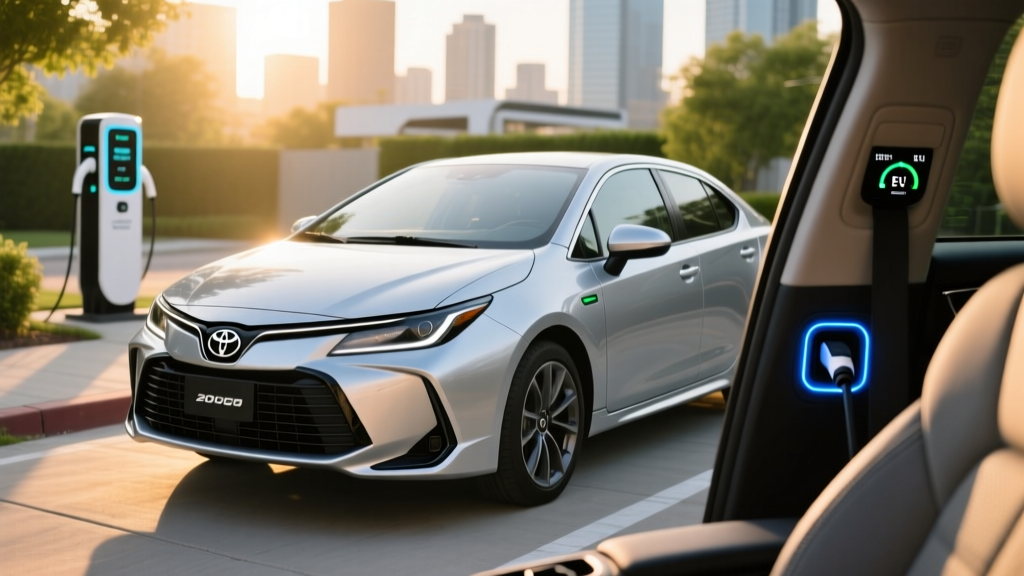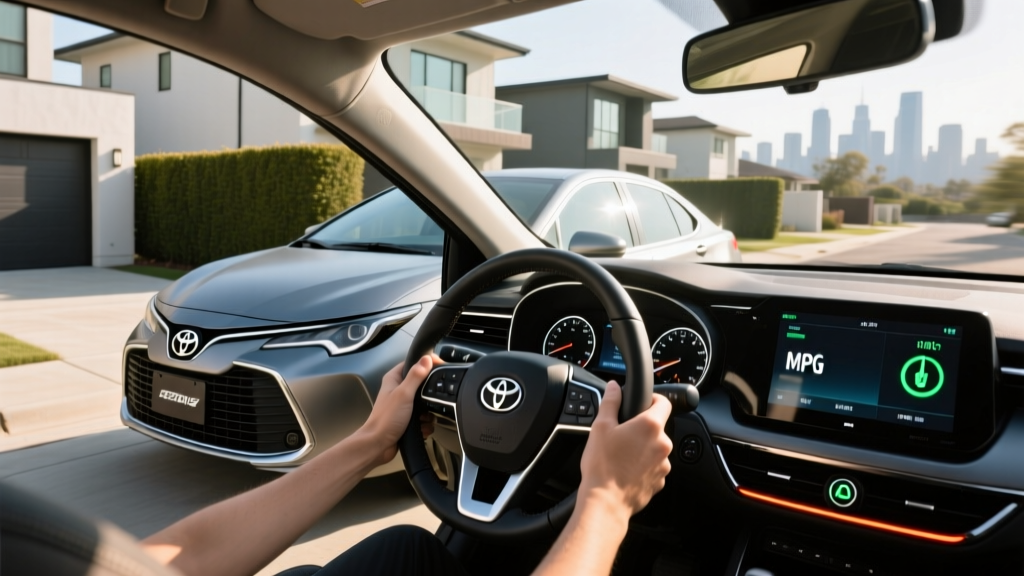
The 2026 Toyota Corolla Hybrid XLE occupies a specific niche: a fuel-sipping conventional hybrid (HEV) that requires no plug, no lifestyle change, and no range anxiety. For buyers who want EV-like city efficiency without altering their fueling habits, this compact sedan remains one of the most pragmatic choices on the market. Here's a data-driven look at what the XLE trim delivers, where it falls short, and who should actually buy it.
2026 Toyota Corolla Hybrid XLE: Quick Verdict
The Corolla Hybrid XLE pairs a 1.8-liter Atkinson-cycle four-cylinder engine with dual electric motors through Toyota's fifth-generation hybrid system. The result is an EPA-estimated 50 MPG combined — a figure that holds up remarkably well in real-world city driving and only dips meaningfully on sustained highway runs. The XLE trim adds premium touches like SofTex-trimmed seats, a 7-inch digital instrument cluster, and wireless Apple CarPlay/Android Auto over the base LE, while staying well under $30,000 MSRP. It is a conventional hybrid — it charges itself through regenerative braking and the gasoline engine. You never plug it in.
2026 Toyota Corolla Hybrid XLE — Key Specifications
| Specification | Value |
|---|---|
| Powertrain | 1.8L 4-cyl Atkinson + dual electric motors (5th-gen hybrid) |
| Combined Horsepower | 138 hp |
| Drivetrain | AWD (electronic rear motor) standard on XLE |
| EPA MPG (City / Hwy / Combined) | 53 / 46 / 50 MPG |
| Fuel Tank Capacity | 11.4 gallons |
| Total Range | ~570 miles (EPA combined) |
| 0-60 mph | ~9.1 seconds (est.) |
| Hybrid Battery | ~1.3 kWh lithium-ion (self-charging, no plug) |
| Base MSRP (XLE AWD) | ~$27,350 (est.) |
| Federal Tax Credit (§30D) | Not eligible (conventional HEV) |
| Hybrid Battery Warranty | 10 years / 150,000 miles |
Fuel Economy: EPA Estimates vs. Real-World MPG
The EPA rates the 2026 Corolla Hybrid XLE AWD at 53 MPG city, 46 MPG highway, and 50 MPG combined (source: fueleconomy.gov). These numbers reflect the inherent advantage of Toyota's hybrid system: in stop-and-go traffic, the electric motors handle low-speed propulsion and regenerative braking recaptures energy that a gas-only car wastes as heat.
2026 Corolla Hybrid XLE — EPA Fuel Economy Breakdown
| Driving Condition | EPA MPG | Real-World Expectation |
|---|---|---|
| City | 53 MPG | 50–58 MPG (hybrids often beat EPA in city) |
| Highway | 46 MPG | 42–47 MPG (aerodynamic drag limits regen benefit) |
| Combined | 50 MPG | 47–53 MPG (depends on driving mix) |
| Cold Weather (below 30°F) | — | 40–45 MPG combined (engine runs more for cabin heat) |
Real-world note: Conventional hybrids like the Corolla frequently exceed their EPA city rating because regenerative braking is maximized at low speeds. On a suburban commute with frequent stops, owners regularly report 54–58 MPG. Highway efficiency is the opposite story — at 75 mph, the gasoline engine does most of the work and the hybrid advantage shrinks. Expect 42–47 MPG on flat interstate runs, dropping further into the high 30s in mountainous terrain or with heavy cargo.
Cold weather impacts all hybrids. Below 30°F, the engine runs more frequently to maintain cabin heat and keep the catalytic converter at operating temperature. Plan on 40–45 MPG combined in winter months, recovering as temperatures rise.
HEV vs. PHEV vs. EV: Which Corolla Powertrain Fits You?
Toyota offers the Corolla in gas, hybrid (HEV), and — depending on the market and model year — plug-in hybrid variants. Understanding the distinction is essential before shopping.
Hybrid (HEV) vs. Plug-In Hybrid (PHEV) vs. Battery EV
| Factor | HEV (Corolla Hybrid) | PHEV (e.g., Prius Prime) | BEV (e.g., Tesla Model 3) |
|---|---|---|---|
| Plug-in Required? | No — self-charging | Yes — plug in for EV range | Yes — must plug in |
| Electric-Only Range | ~1 mile at low speed | 35–44 miles (typical) | 250–360+ miles |
| Total Range | ~570 miles | ~550–600 miles | 250–360+ miles |
| City MPG / MPGe | 53 MPG | 52 MPG + 127 MPGe (EV mode) | 132–140 MPGe |
| Fuel Cost (per mile) | ~$0.07/mi at $3.50/gal | ~$0.04/mi (EV mode, $0.15/kWh) | ~$0.04/mi (home charging) |
| Federal Tax Credit | Not eligible | Up to $7,500 (§30D) | Up to $7,500 (§30D) |
| Upfront Price (typical) | ~$27K | ~$33K | ~$39K+ |
| Home Charging Needed? | No | Recommended for EV benefit | Essential |
The Corolla Hybrid (HEV) is the right call if: you have no access to home or workplace charging, want maximum simplicity, drive a mix of city and highway miles, and want to spend under $30,000. You will never think about charging — the car manages everything.
A PHEV (like the Prius Prime) makes more sense if: you can install a Level 2 charger at home, your daily commute is under 40 miles round-trip (covering most trips on electricity alone), and you still want a gas engine for road trips. The federal tax credit under IRS §30D can offset the higher purchase price — up to $7,500 depending on battery sourcing, buyer income, and MSRP caps.
A full BEV fits if: you have reliable home charging, your daily driving is within the vehicle's range, you want the lowest per-mile fuel cost, and you're ready to plan road trips around DC fast-charging infrastructure.
Powertrain and Performance
The 2026 Corolla Hybrid XLE uses Toyota's fifth-generation hybrid transaxle. The 1.8-liter Atkinson-cycle engine produces approximately 96 hp on its own, supplemented by a front electric motor and an electronic AWD system that engages a rear-mounted electric motor when slip is detected or during hard acceleration. Combined system output is 138 hp.
This is not a performance-oriented vehicle. The 0-60 mph time sits in the low 9-second range, which is adequate for merging and city driving but noticeably relaxed compared to turbocharged competitors or any EV. The CVT (continuously variable transmission) keeps the engine in its most efficient range, which means acceleration feels linear rather than punchy. Passing maneuvers at highway speed require planning.
The AWD system is worth noting for the XLE trim. Unlike mechanical AWD with a driveshaft, Toyota's electronic AWD uses a small independent rear motor that activates only when needed — during wet launches, light snow, or hard cornering. It adds approximately 150 lbs but costs only about 1–2 MPG versus the FWD Corolla Hybrid LE. For buyers in northern climates, the traction insurance is worth the small efficiency trade.
Pricing, Trims, and Tax Credit Eligibility
The 2026 Corolla Hybrid XLE AWD carries an estimated base MSRP of $27,350, including destination. Key standard features on the XLE include:
- SofTex-trimmed heated front seats
- 7-inch digital instrument cluster
- 8-inch touchscreen with wireless Apple CarPlay and Android Auto
- Toyota Safety Sense 3.0 (pre-collision, lane tracing, adaptive cruise, blind-spot monitor)
- Electronic AWD with rear electric motor
- 16-inch alloy wheels
- Automatic climate control with rear vents
Options that push the price higher include the Premium Package (JBL audio, wireless charging pad, premium paint) and the Advanced Technology Package (head-up display, panoramic view monitor). Fully loaded, expect approximately $30,500–$31,500.
Federal Tax Credit: Not Eligible
The Corolla Hybrid is a conventional HEV — it has no plug and a battery too small to qualify for the IRS §30D Clean Vehicle Credit. Only plug-in hybrids (PHEVs) with ≥4 kWh of battery capacity and qualifying battery-electric vehicles are eligible, subject to MSRP caps ($55,000 for sedans), buyer income limits ($150K single / $300K joint), and critical-mineral/battery-sourcing requirements. Some states offer separate hybrid rebates — check your state energy office for current programs.
Hybrid Battery: Warranty, Lifespan, and Replacement Cost
Hybrid battery longevity is the single most common concern among first-time hybrid buyers. The 2026 Corolla Hybrid uses a compact lithium-ion battery pack (approximately 1.3 kWh) positioned under the rear seats. Because it is a conventional HEV, this battery is never deeply discharged — the hybrid system keeps it within a narrow state-of-charge window (typically 40–80%) to maximize cycle life.
Toyota Hybrid Battery Warranty
| Coverage | Term |
|---|---|
| Hybrid Battery | 10 years / 150,000 miles (whichever comes first) |
| Hybrid System Components | 8 years / 100,000 miles |
| Basic Warranty | 3 years / 36,000 miles |
| Powertrain | 5 years / 60,000 miles |
Toyota covers the hybrid battery for 10 years or 150,000 miles nationwide — one of the longest hybrid warranties in the industry. The battery must retain sufficient capacity to power the hybrid system; if it degrades below Toyota's threshold, replacement is covered.
Real-world lifespan data: Toyota's hybrid battery packs have a strong track record of lasting 150,000–200,000+ miles before meaningful degradation. Prius taxis routinely exceed 300,000 miles on original batteries. The Corolla Hybrid's smaller, less-stressed pack should follow the same pattern. Shallow charge-discharge cycles and Toyota's conservative thermal management minimize wear.
Replacement cost (out of warranty): If the hybrid battery does fail after the warranty period, a replacement pack from Toyota typically costs $2,000–$3,500 including labor at a dealership. Independent hybrid specialists and refurbished battery options can bring the cost down to $1,000–$2,000. This is dramatically cheaper than a full EV battery replacement ($5,000–$20,000+), reflecting the Corolla Hybrid's much smaller pack.
Reliability and Ownership Costs
Toyota's hybrid powertrains have consistently ranked among the most reliable in the industry. The Corolla Hybrid inherits the simplicity advantages of the system: no traditional starter motor, no alternator, no conventional transmission with clutch packs or torque converters, and regenerative braking that significantly reduces wear on the friction brake pads and rotors.
Maintenance advantages vs. gas-only cars:
- Brake pads last 80,000–100,000+ miles (regen handles most deceleration)
- No starter or alternator to replace
- CVT has no conventional transmission fluid flush interval in most conditions
- Engine runs less overall, reducing oil degradation
Estimated 5-year cost of ownership: At 15,000 miles/year and $3.50/gallon fuel, the Corolla Hybrid XLE burns approximately 300 gallons annually — about $1,050/year in fuel. A comparable gas-only Corolla LE (35 MPG combined) would consume ~429 gallons, costing ~$1,500/year. That's roughly $2,250 in fuel savings over five years, partially offset by the XLE's higher MSRP.
Insurance rates for the Corolla Hybrid are typically in line with or slightly below the gas Corolla, as the vehicle's low power output and strong safety ratings (IIHS Top Safety Pick expected) keep premiums moderate. Always get a personalized quote before purchasing.
Pros
- 50 MPG combined — real-world city MPG often exceeds 53
- No plug-in required — zero behavior change from a gas car
- AWD standard on XLE — electronic rear motor for all-weather traction
- 10-year / 150,000-mile hybrid battery warranty
- Under $28K base MSRP with strong standard safety tech
- Proven, mature hybrid technology with minimal maintenance
- ~570 miles of total range — fewer fuel stops
Cons
- Modest 138 hp — relaxed acceleration, not a highway cruiser's choice
- No federal tax credit (HEV, not a PHEV or BEV)
- Highway MPG drops to low 40s — less advantage vs. efficient gas cars on long trips
- Small trunk (13.1 cu ft) due to battery placement
- Infotainment screen is 8-inch — smaller than many competitors
- No EV-only driving mode beyond very low-speed creep
Who Should Buy the 2026 Corolla Hybrid XLE?
This car solves a specific problem: you want dramatically lower fuel costs, you cannot or do not want to install a home charger, and you need a dependable daily driver under $30,000. It's ideal for apartment dwellers, street-parkers, commuters with heavy stop-and-go segments, and second-car households that want maximum efficiency without infrastructure investment.
It is not the right choice if you need quick acceleration, want to drive on electricity alone, or are seeking the lowest possible per-mile fuel cost (a home-charged EV at $0.15/kWh achieves roughly $0.04/mile vs. the Corolla Hybrid's ~$0.07/mile at current gas prices). If you have a garage and can install a 240V outlet, a PHEV like the Prius Prime or a BEV like the Chevrolet Equinox EV may deliver better economics after the federal tax credit.
Frequently Asked Questions
How many MPG does the 2026 Toyota Corolla Hybrid XLE get?
The EPA rates it at 53 city / 46 highway / 50 combined MPG. In real-world city driving with frequent stops, owners commonly see 54–58 MPG thanks to regenerative braking. Highway driving at 70–80 mph typically returns 42–47 MPG. Cold weather below 30°F can drop combined MPG to the low 40s.
Does the Corolla Hybrid need to be plugged in?
No. The Corolla Hybrid is a conventional hybrid (HEV). Its small battery recharges through regenerative braking and the gasoline engine. You fuel it exactly like any other gas car — at a gas station. There is no plug, no charging cable, and no electric-only driving range to manage.
Is the Corolla Hybrid reliable, and what does a battery replacement cost?
Toyota's hybrid systems are among the most reliable powertrains on the market, with a proven track record across millions of vehicles. The hybrid battery is warrantied for 10 years / 150,000 miles. Real-world lifespan often exceeds 200,000 miles. Out-of-warranty replacement typically costs $2,000–$3,500 at a dealer, or $1,000–$2,000 through independent hybrid specialists with refurbished packs.
Does the 2026 Corolla Hybrid qualify for any tax credit?
No. The federal IRS §30D Clean Vehicle Credit applies only to plug-in hybrids (PHEVs) and battery-electric vehicles (BEVs) that meet battery-sourcing, MSRP, and buyer-income requirements. The Corolla Hybrid is a conventional HEV and does not qualify. Check your state's energy office for any local hybrid incentives, which vary by jurisdiction.
Corolla Hybrid vs. Prius: which is the better buy?
The Prius offers slightly higher combined MPG (up to 57 on FWD trims), more cargo space (hatchback design), and an available PHEV variant (Prius Prime) with ~44 miles of electric-only range and federal tax credit eligibility. The Corolla Hybrid XLE counters with a more traditional sedan trunk, AWD availability, and a lower entry price. If cargo versatility and maximum efficiency matter most, the Prius wins. If you prefer a conventional sedan shape and want AWD under $28K, the Corolla Hybrid XLE is the stronger value.
How does the AWD system work on the Corolla Hybrid?
Toyota's electronic AWD uses a small, independent electric motor on the rear axle. It engages automatically during acceleration from a stop, when front-wheel slip is detected (rain, snow, gravel), or during spirited cornering. Unlike mechanical AWD, there is no driveshaft or center differential — the rear motor activates only when needed, minimizing the efficiency penalty to approximately 1–2 MPG versus the FWD configuration.