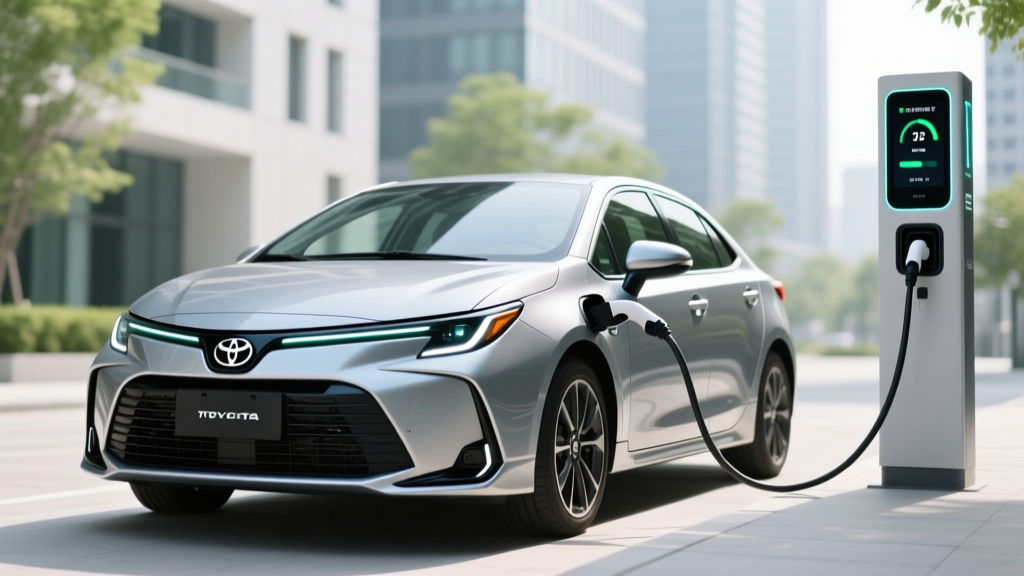
The Toyota Corolla has been the world's best-selling nameplate for decades, and its hybrid variant has quietly become one of the smartest fuel-economy plays on the market. The 2026 Toyota Corolla Hybrid carries forward a proven fifth-generation Toyota Hybrid System (THS) with standard all-wheel drive, a sub-$25,000 starting price, and EPA ratings that crest 50 MPG in city driving. For buyers who want dramatic fuel savings without plugging in, changing habits, or paying an EV premium, the new Corolla Hybrid makes a compelling, data-backed case.
This guide covers everything a research-heavy buyer needs: exact EPA MPG by trim, real-world fuel economy expectations, powertrain specs, pricing across the lineup, battery warranty details, and how the Corolla Hybrid stacks up against plug-in hybrids and full battery-electric vehicles.
HEV vs PHEV: What the Corolla Hybrid Actually Is
Before examining the numbers, it is critical to understand what the Corolla Hybrid is — and what it is not. The Corolla Hybrid is a conventional hybrid electric vehicle (HEV). It pairs a gasoline engine with one or more electric motors and a small battery pack that recharges through regenerative braking and the engine itself. You never plug it in. There is no charging port, no electric-only driving range to manage, and no home charger to install.
| Feature | HEV (Corolla Hybrid) | PHEV (e.g., Prius Prime) | BEV (e.g., Tesla Model 3) |
|---|---|---|---|
| Plug-in required? | No | Yes (optional) | Yes (mandatory) |
| Electric-only range | None (EV assist only) | ~40-45 mi | 250-360+ mi |
| Battery size | ~1.0 kWh (NiMH/small Li-ion) | ~13.6 kWh (Li-ion) | 50-82 kWh (Li-ion) |
| Home charger needed? | No | Recommended (Level 2) | Essential (Level 2) |
| Federal tax credit (§30D) | Not eligible | Up to $7,500* | Up to $7,500* |
| Starting price range | ~$24,000 | ~$33,000 | ~$39,000+ |
*§30D credit subject to MSRP caps, buyer income limits, and battery sourcing requirements per IRS guidelines. Verify eligibility with a tax professional.
The Corolla Hybrid is purely an HEV. Toyota does not currently offer a Corolla Plug-In Hybrid in the United States. If plug-in electric range is a priority, the Toyota Prius Prime is the closest in-brand PHEV alternative.
Fuel Economy: EPA MPG and Real-World Results
Fuel economy is the headline number for any hybrid buyer, and the new Corolla Hybrid delivers across the board. Here is the EPA-estimated breakdown for the 2026 model year:
| Trim | Drivetrain | City MPG | Highway MPG | Combined MPG |
|---|---|---|---|---|
| LE Hybrid | AWD (eAWD) | 50 | 43 | 47 |
| SE Hybrid | AWD (eAWD) | 47 | 41 | 44 |
| XLE Hybrid | AWD (eAWD) | 47 | 41 | 44 |
Source: fueleconomy.gov — EPA estimates. Actual mileage will vary.
Real-World MPG vs EPA Sticker
The Corolla Hybrid's EPA city rating of 50 MPG (LE trim) is one area where real-world driving often meets or exceeds the sticker. Hybrids thrive in stop-and-go traffic, where regenerative braking recaptures energy that a gas car wastes as heat. In mixed suburban driving with moderate stoplights, owners routinely report 48-52 MPG.
However, sustained highway driving at 75+ MPH will pull fuel economy closer to 40-42 MPG, slightly below the EPA highway estimate. Cold weather (below freezing) can reduce city MPG by 5-10% due to the engine running more frequently for cabin heat before the hybrid system can optimize. In short: city-heavy commuters will see the best results; road warriors should expect numbers closer to the combined rating.
Powertrain and Performance Specs
The 2026 Corolla Hybrid uses Toyota's fifth-generation hybrid system, pairing a 1.8-liter four-cylinder Atkinson-cycle engine with electric motor-generators and an electronically controlled CVT (eCVT). A rear-mounted electric motor provides electronic on-demand all-wheel drive (eAWD) across all trims.
| Engine | 1.8L 4-cylinder Atkinson-cycle |
| Combined net horsepower | 138 hp |
| Front motor | Permanent magnet AC synchronous |
| Rear motor (eAWD) | Electric AWD motor (low-speed assist) |
| Transmission | eCVT (electronically controlled) |
| Drivetrain | AWD (standard all trims) |
| 0-60 mph (est.) | ~9.0 seconds |
| Hybrid battery | Lithium-ion (~1.0 kWh usable) |
| Fuel tank capacity | 11.4 gallons |
| Total driving range (est.) | ~535 miles (LE at 47 combined) |
With 138 combined horsepower, the Corolla Hybrid is not a performance car. The 0-60 mph time of roughly 9.0 seconds is adequate for merging and passing but noticeably slower than the turbocharged competitors in the compact segment. The eAWD system engages the rear motor primarily during acceleration from a stop and in low-traction conditions — it is not a full-time AWD system and will not satisfy off-road enthusiasts, but it provides genuine confidence in rain and light snow.
Pricing, Trims, and Tax Credit Eligibility
The Corolla Hybrid's affordability is a core part of its appeal. Here is the 2026 MSRP breakdown by trim (destination charge included):
| Trim | MSRP (incl. destination) | Key Features |
|---|---|---|
| LE Hybrid | $24,225 | 8" touchscreen, wireless CarPlay/Android Auto, TSS 3.0, 16" alloy wheels |
| SE Hybrid | $26,725 | Sport-tuned suspension, 18" wheels, paddle shifters, sport seats |
| XLE Hybrid | $28,425 | SofTex seats, 10.5" display, wireless charging, heated front seats |
Does the Corolla Hybrid Qualify for a Federal Tax Credit?
No. The IRS §30D Clean Vehicle Credit applies only to plug-in electric vehicles (PHEVs and BEVs) with a minimum battery capacity of 7 kWh. The Corolla Hybrid's battery is approximately 1.0 kWh — far below the threshold. Conventional HEVs do not qualify for the federal purchase credit.
- §30D credit: Not eligible (HEV, not plug-in)
- State/local incentives: Some states offer rebates for high-MPG hybrids — check your state energy office
- Employer or utility rebates: Occasionally available for hybrids; check with your provider
For current federal incentive rules, consult IRS.gov §30D.
Even without a tax credit, the Corolla Hybrid's low starting price and exceptional fuel economy produce strong ownership economics. At $24,225 for the LE trim and 47 MPG combined, a driver covering 15,000 miles per year at $3.40/gallon gasoline spends roughly $1,085 annually on fuel. A comparable gas-only compact averaging 33 MPG combined would cost approximately $1,545 — a savings of about $460 per year, or $2,300 over five years, just from the hybrid powertrain.
Hybrid Battery Warranty and Longevity
Battery replacement cost is the single most common concern among first-time hybrid buyers. Here are the facts specific to the Corolla Hybrid:
Toyota Hybrid Battery Warranty
- Coverage: 10 years / 150,000 miles (whichever comes first)
- Applies to: Hybrid battery pack, hybrid control module, and related hybrid system components
- Transferable: Yes — warranty transfers to subsequent owners at no cost
- Capacity threshold: Toyota warrants against defects and abnormal loss of capacity
In practice, Toyota's hybrid batteries have demonstrated exceptional longevity. The Prius, which shares the same THS architecture, has documented cases of original batteries lasting 200,000+ miles. The Corolla Hybrid uses a relatively small lithium-ion hybrid battery (~1.0 kWh usable), which undergoes far shallower charge-discharge cycles than a full EV battery — this is a major factor in its longevity.
Replacement cost if out of warranty: A hybrid battery replacement for the Corolla Hybrid typically ranges from $2,000 to $3,500 including labor at a Toyota dealership. Independent hybrid specialists may offer refurbished packs for $1,500-$2,500. Given the 10-year/150,000-mile warranty and the proven track record of Toyota hybrid systems, this is a low-probability expense for most owners.
Reliability, Safety, and Ownership Costs
Toyota consistently ranks at or near the top of long-term reliability surveys, and the Corolla Hybrid benefits from the brand's deepest hybrid expertise. The THS powertrain has been in continuous production since 1997, with over 25 million Toyota hybrids sold globally. There are no new, unproven components in the 2026 Corolla Hybrid — every major system is a refined iteration of existing technology.
On the safety front, the 2026 Corolla Hybrid comes standard with Toyota Safety Sense 3.0 (TSS 3.0), which includes:
- Pre-Collision System with Pedestrian Detection
- Full-Speed Range Dynamic Radar Cruise Control
- Lane Departure Alert with Steering Assist
- Lane Tracing Assist
- Automatic High Beams
- Road Sign Assist
Note that TSS 3.0 is a Level 1-2 driver-assistance suite per SAE automation standards. The driver must remain fully engaged, hands on the wheel, and eyes on the road at all times. This is not autonomous driving — it is a well-executed assist system that reduces fatigue on long trips and provides active safety intervention in emergencies.
Corolla Hybrid vs PHEV vs EV: Which Should You Choose?
Choose the Corolla Hybrid (HEV) if:
- You want maximum MPG without plugging in or changing your routine
- You live in an apartment or lack access to home/workplace charging
- Your budget is under $30,000 and you want AWD standard
- You drive 10,000-20,000 miles/year in mixed city/highway conditions
- You plan to own the car 8-10+ years (maximizing reliability and fuel savings)
Choose a PHEV (e.g., Prius Prime) if:
- You can install a Level 2 home charger and want 40+ miles of electric-only commuting
- Your daily commute is under 40 miles round-trip (you could rarely visit a gas station)
- You want to qualify for the §30D federal tax credit (up to $7,500, income/MSRP limits apply)
- You want to reduce gasoline use dramatically but still need road-trip range flexibility
Choose a full BEV (e.g., Tesla Model 3, Hyundai Ioniq 6) if:
- You have reliable home Level 2 charging and access to DC fast charging on road trips
- You want zero tailpipe emissions and the lowest per-mile "fuel" cost
- You are eligible for the full §30D credit and can absorb a higher purchase price
- You want instant torque, one-pedal driving, and minimal powertrain maintenance
Corolla Hybrid Pros
- 50 MPG city (LE) — among the best of any non-plug-in vehicle
- Standard AWD at a sub-$25K starting price
- 10-year/150,000-mile hybrid battery warranty
- Proven, mature THS technology — low risk of expensive repairs
- No charging infrastructure needed — just fill up with gas
- Strong resale value and Toyota reliability reputation
Corolla Hybrid Cons
- Modest 138 hp — slow acceleration vs turbocharged rivals
- No plug-in option — cannot drive on electric-only power
- No federal tax credit eligibility
- Highway MPG drops at sustained 75+ MPH speeds
- CVT drone under hard acceleration (common to all eCVTs)
- Rear seat and cargo space tighter than some compact competitors
Frequently Asked Questions
How many MPG does the 2026 Corolla Hybrid get?
The EPA rates the Corolla Hybrid LE at 50 city / 43 highway / 47 combined MPG. The SE and XLE trims are rated at 47 city / 41 highway / 44 combined due to larger wheels and sport-tuned suspension. In real-world city and suburban driving, many owners report meeting or slightly exceeding the EPA city figure, while sustained high-speed highway driving yields closer to 40-42 MPG.
Does the Corolla Hybrid need to be plugged in?
No. The Corolla Hybrid is a conventional HEV. Its small hybrid battery recharges through regenerative braking and the gasoline engine. There is no charging port and no plug-in capability.
How far can the Corolla Hybrid drive on electric power alone?
The Corolla Hybrid cannot drive on electric power alone for any meaningful distance. The electric motor assists the gasoline engine during acceleration and enables brief low-speed EV-mode coasting (typically under 1 mile at very low speeds), but it is not designed for electric-only commuting. If electric-only range is your priority, look at a PHEV like the Prius Prime (44 miles electric-only).
Is the Corolla Hybrid reliable, and what does battery replacement cost?
Toyota's hybrid system is among the most proven in the automotive industry, with over 25 million units sold globally since 1997. The hybrid battery carries a 10-year/150,000-mile warranty. Out-of-warranty replacement typically costs $2,000-$3,500 at a dealership, though real-world battery failures before 200,000 miles are rare based on historical Toyota hybrid data.
Does the new Corolla Hybrid qualify for any tax credit?
The Corolla Hybrid does not qualify for the federal §30D Clean Vehicle Credit, which requires a plug-in vehicle with at least 7 kWh of battery capacity. Some states or utilities may offer small incentives for high-efficiency hybrids — check your state energy office or utility provider. For federal credit eligibility, consult the IRS Clean Vehicle Credit page.
How does the Corolla Hybrid compare to the Prius?
The 2026 Prius offers more power (196 hp combined), slightly better fuel economy (up to 57 MPG combined for the LE FWD), and a more modern interior — but starts about $3,000-$4,000 higher and does not offer AWD in its base configuration. The Corolla Hybrid trades some efficiency and refinement for a lower entry price and standard AWD. Both share the same proven THS architecture and 10-year hybrid warranty.
Is the eAWD system full-time all-wheel drive?
No. The Corolla Hybrid's electronic AWD (eAWD) uses a rear electric motor that engages primarily during initial acceleration (0-25 mph) and when front-wheel slip is detected. It is designed for traction enhancement in rain, snow, and loose surfaces — not for off-road use or performance driving. At highway cruising speeds, the car operates in front-wheel drive for maximum efficiency.
The 2026 Toyota Corolla Hybrid occupies a narrow but valuable lane in the market: it is the most affordable way to get 50 MPG, standard AWD, and a decade-long hybrid battery warranty in a single package. It will not win stoplight races, it will not drive itself, and it will not eliminate your gasoline use entirely. What it will do is reliably cut your fuel bill by 30-40% versus a gas compact, start confidently in winter weather, and do it all without requiring a single change to how you refuel. For the price-conscious, charging-averse buyer, the math is difficult to beat.