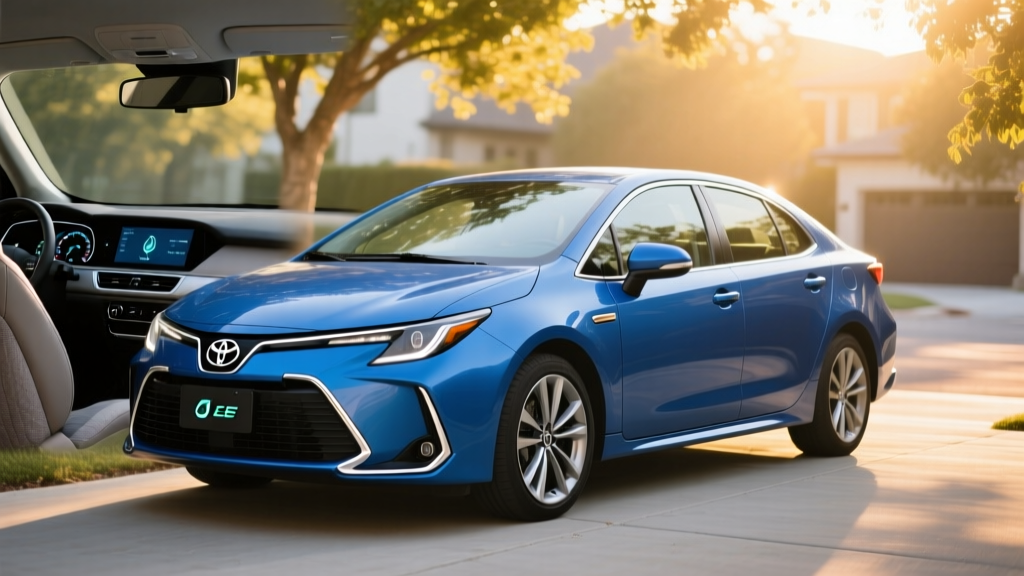
The 2026 Toyota Corolla Hybrid LE occupies a rare sweet spot in the compact sedan market: genuine 50+ MPG efficiency, standard all-wheel drive, and a starting price that undercuts most competitors — all without requiring a single plug or lifestyle adjustment. For buyers weighing their options between a conventional gas car, a full battery-electric vehicle, and a hybrid, the Corolla Hybrid LE makes a compelling case for the no-compromise middle ground.
In this guide, we break down the exact EPA fuel economy figures, real-world MPG observations, powertrain specifications, battery warranty coverage, and total ownership economics you need to make an informed decision about the 2026 Toyota Corolla Hybrid LE.
2026 Toyota Corolla Hybrid LE: Quick Specs at a Glance
| Spec | Value |
|---|---|
| Powertrain Type | Conventional Hybrid (HEV) — no plug-in required |
| Combined Horsepower | 138 hp (net system) |
| Engine | 1.8L 4-cylinder Atkinson-cycle + dual electric motor-generators |
| EPA Fuel Economy (AWD) | 51 city / 49 highway / 50 combined MPG |
| Fuel Tank Capacity | 11.4 gallons |
| Estimated Total Range | ~570 miles per tank |
| Drivetrain | Electronic On-Demand AWD (standard) |
| 0–60 mph | ~9.0 seconds (est.) |
| Hybrid Battery Warranty | 10 years / 150,000 miles |
| Starting MSRP (2026 LE AWD) | ~$24,050 (est., incl. destination) |
| Federal Tax Credit Eligibility | Not eligible (§30D applies to PHEVs/BEVs only) |
Fuel Economy: EPA Numbers vs. Real-World MPG
The 2026 Corolla Hybrid LE carries over Toyota's fifth-generation hybrid system, which pairs a 1.8-liter Atkinson-cycle four-cylinder engine with two motor-generators through a planetary gearset eCVT. The result is an EPA-rated 51 MPG city / 49 MPG highway / 50 MPG combined for the AWD LE trim, according to fueleconomy.gov.
Why Hybrids Often Beat EPA City Estimates
Hybrid vehicles like the Corolla Hybrid LE frequently exceed their EPA city ratings in real-world stop-and-go driving. The electric motors handle low-speed propulsion and recapture energy through regenerative braking, meaning the gas engine shuts off frequently at lights and in traffic. In dense urban commuting, owners regularly report 52–55 MPG in warm weather.
Highway driving tells a different story. At sustained 70–80 mph speeds, the gasoline engine does most of the work, and aerodynamic drag reduces efficiency. Expect 45–48 MPG on the highway during extended interstate trips. Cold weather (below freezing) can reduce overall fuel economy by 5–10% due to increased engine warm-up time and cabin heating demands — a pattern consistent across all hybrids.
| Driving Scenario | EPA Rating | Expected Real-World |
|---|---|---|
| City (stop-and-go) | 51 MPG | 50–55 MPG |
| Highway (70–80 mph) | 49 MPG | 45–48 MPG |
| Combined (mixed) | 50 MPG | 47–52 MPG |
| Cold weather (combined) | — | 43–48 MPG |
Hybrid (HEV) vs. Plug-In Hybrid (PHEV): What's the Difference?
A common source of confusion is the distinction between a conventional hybrid like the Corolla Hybrid LE and a plug-in hybrid (PHEV). The Corolla Hybrid LE is a conventional hybrid (HEV) — it never needs to be plugged in. A small nickel-metal hydride (NiMH) traction battery stores energy captured from regenerative braking and excess engine output, but it's too small for meaningful electric-only driving.
Toyota does not currently offer a Corolla PHEV in the US market. If you want a Toyota plug-in hybrid with electric-only range, you'd look at the RAV4 Prime (42 miles electric-only, 94 MPGe) or the Prius Prime (44 miles electric-only, 127 MPGe). Both qualify for partial federal tax credits under current IRS §30D rules, subject to MSRP caps, buyer income limits, and battery-sourcing requirements.
- HEV (Corolla Hybrid LE): No plug needed. Small battery (~1.3 kWh). Regenerative braking recharges it. 50 MPG combined. No federal tax credit.
- PHEV (e.g., Prius Prime): Plug in to charge. Larger battery (~13.6 kWh). 40+ miles electric-only, then operates as a hybrid. May qualify for up to $7,500 federal credit (eligibility varies).
- BEV (e.g., Tesla Model 3): Plug-in only. Large battery (50–80+ kWh). 250–350+ miles electric range. May qualify for up to $7,500 federal credit.
Powertrain Deep Dive: 138 HP and the eCVT Advantage
The 2026 Corolla Hybrid LE uses Toyota's fifth-generation hybrid synergy drive. The 1.8L Atkinson-cycle engine produces roughly 96 hp on its own, while the electric motor-generators contribute additional power for a net system output of 138 horsepower. This isn't a simple addition of engine and motor figures — the planetary gearset blends power sources dynamically based on throttle input, speed, and battery state of charge.
The AWD system adds a separate rear-mounted electric motor (roughly 40 hp) that engages the rear wheels during acceleration and slippery conditions. Unlike mechanical AWD systems with driveshafts and differentials, Toyota's electronic on-demand AWD adds minimal weight and only draws power when needed, preserving fuel economy.
Acceleration to 60 mph takes approximately 9.0 seconds. That's adequate for merging and passing but not sporty. The eCVT (electronically controlled continuously variable transmission) delivers smooth, stepless acceleration without the gear hunting of a conventional automatic. Some drivers find the eCVT's drone under hard acceleration noticeable, but in normal driving it's unobtrusive.
Hybrid Battery Longevity, Warranty, and Replacement Cost
Battery lifespan remains the top concern for hybrid buyers, and it's worth addressing directly. The Corolla Hybrid LE uses a relatively small ~1.3 kWh NiMH (nickel-metal hydride) traction battery — far smaller and less stressed than the large lithium-ion packs in full EVs.
Toyota covers the Corolla Hybrid LE's hybrid battery for 10 years or 150,000 miles (whichever comes first) in all 50 states. This warranty covers battery capacity loss below a defined threshold and any manufacturing defects. The hybrid system components (inverter, motor-generators, eCVT) carry the same 10-year/150,000-mile coverage.
Real-World Battery Durability
Toyota's hybrid batteries have an exceptional longevity track record. The Prius, which uses a similar NiMH system, routinely sees original batteries lasting 200,000+ miles. Because the Corolla Hybrid's battery is small and the system never fully depletes or fully charges it (the computer maintains a narrow state-of-charge window), degradation is minimal.
If replacement is needed out of warranty, expect to pay $2,000–$4,000 for a new OEM hybrid battery pack, including labor. Refurbished or reconditioned packs are available for $1,000–$2,000. For context, this is a fraction of the $8,000–$20,000+ cost of replacing a full EV lithium-ion traction battery.
Pricing, Trims, and Tax Credit Eligibility
The 2026 Toyota Corolla Hybrid LE carries an estimated starting MSRP of approximately $24,050 (including destination charge). This positions it as one of the most affordable AWD hybrid sedans available. Higher trims (SE, XLE) add features like sport-tuned suspension, larger wheels, premium audio, and heated seats, pushing prices toward $28,000–$30,000.
Federal Tax Credit Status
The Corolla Hybrid LE does not qualify for the federal §30D Clean Vehicle Credit. That credit (up to $7,500) applies only to plug-in electric vehicles — battery-electric vehicles (BEVs) and plug-in hybrids (PHEVs) with a minimum battery capacity of 7 kWh. Since the Corolla Hybrid LE is a conventional HEV with a ~1.3 kWh battery, it falls outside the program's scope.
This is an important consideration if you're comparing the Corolla Hybrid LE to a PHEV like the Prius Prime (~$33,000 MSRP, potentially eligible for partial or full credit). The Corolla Hybrid LE's lower purchase price and strong fuel economy can still deliver a lower total cost of ownership over five years, especially for buyers who don't have home charging access for a PHEV or BEV.
Who Should Buy the 2026 Corolla Hybrid LE?
- You want 50 MPG without plugging in or changing habits
- You need AWD for snow/rain but don't want an SUV
- Your budget is under $26,000 for a new efficient sedan
- You drive mostly city/suburban miles where hybrids shine
- You don't have reliable access to home or workplace EV charging
- You want Toyota's proven hybrid reliability track record
- You want electric-only driving for short commutes (consider a PHEV)
- You want zero tailpipe emissions (consider a BEV)
- You need more than 138 hp for spirited driving
- You want to claim the $7,500 federal tax credit
- You prefer a hatchback or crossover body style
- You drive mostly long highway miles (a diesel or efficient gas car may close the MPG gap)
Corolla Hybrid LE vs. the Competition
The Corolla Hybrid LE's direct competitors include the Honda Civic Hybrid (50/47/49 MPG city/highway/combined, 200 hp, ~$29,000) and the Hyundai Elantra Hybrid (51/58/54 MPG, 139 hp, ~$25,000). The Honda offers significantly more power but at a higher price point. The Hyundai edges out the Toyota on highway MPG thanks to its dual-clutch transmission but lacks AWD availability.
The Corolla Hybrid LE's combination of AWD, sub-$25,000 pricing, and proven reliability remains distinctive in this segment. If AWD isn't a priority, the Elantra Hybrid Blue's 54 MPG combined is worth considering.
Frequently Asked Questions
How many MPG does the 2026 Toyota Corolla Hybrid LE get?
The EPA rates the 2026 Corolla Hybrid LE (AWD) at 51 MPG city, 49 MPG highway, and 50 MPG combined. In real-world driving, expect 47–52 MPG combined depending on conditions. City-heavy driving often yields results above the EPA rating, while sustained highway speeds and cold weather reduce efficiency.
Does the Corolla Hybrid need to be plugged in?
No. The Corolla Hybrid LE is a conventional hybrid (HEV). Its small battery recharges through regenerative braking and the gasoline engine. You simply fill it with gas like any other car — there is no plug, no charging cable, and no electric-only range to manage.
Is the Corolla Hybrid LE reliable?
Toyota's hybrid system is among the most proven in the industry, with over 25 years of real-world deployment since the original Prius. The fifth-generation system in the 2026 Corolla Hybrid uses well-understood NiMH battery chemistry and a simple planetary gearset with no traditional transmission bands or clutches to wear out. Toyota backs the hybrid battery and system components with a 10-year/150,000-mile warranty.
What does it cost to replace the hybrid battery?
Out-of-warranty replacement for the Corolla Hybrid LE's NiMH traction battery typically runs $2,000–$4,000 (OEM new, including labor). Refurbished packs cost $1,000–$2,000. However, Toyota hybrid batteries routinely last 200,000+ miles, making replacement uncommon within the typical ownership period.
Does the 2026 Corolla Hybrid LE qualify for a tax credit?
No. The federal §30D Clean Vehicle Credit applies only to plug-in vehicles (BEVs and PHEVs). The Corolla Hybrid LE is a conventional hybrid and does not qualify. Some states or utilities may offer small rebates for hybrid purchases — check your local programs — but there is no federal incentive. For current federal credit rules, see the IRS Clean Vehicle Tax Credits page.
Corolla Hybrid vs. a full EV — which should I choose?
If you have reliable home charging (Level 2), drive under 250 miles daily, and want the lowest per-mile fuel cost, a BEV like the Chevrolet Equinox EV or Tesla Model 3 offers lower operating costs and zero tailpipe emissions. If you lack home charging, take frequent long road trips, live in an area with sparse public charging infrastructure, or simply want the lowest upfront cost with no behavioral changes, the Corolla Hybrid LE delivers excellent efficiency with zero range anxiety.
Is AWD standard on the 2026 Corolla Hybrid LE?
Yes. For the 2026 model year, the Corolla Hybrid LE comes with Toyota's electronic on-demand AWD as standard equipment. A separate rear electric motor engages the rear wheels during acceleration from a stop and when the system detects front-wheel slip. This adds roughly 1 MPG of penalty compared to a hypothetical FWD-only version but provides meaningful traction benefits in rain and light snow.