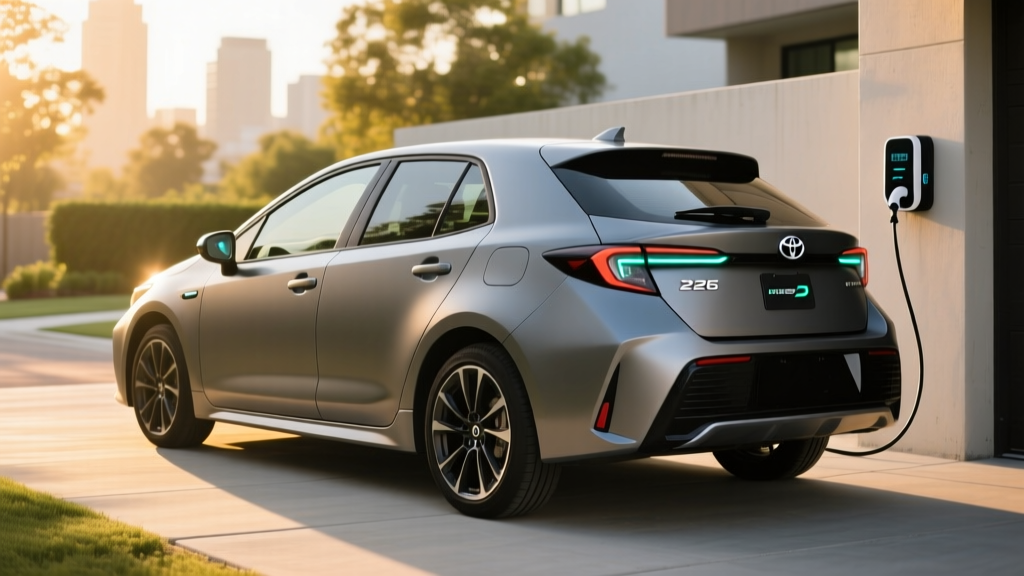
The 2026 Toyota Corolla Hatchback Hybrid occupies a specific niche: a compact hatchback that sips fuel without asking you to plug in, compromise on cargo space, or pay a premium for electrification. With an EPA-estimated 50 MPG combined and a starting MSRP under $26,000, it's one of the most accessible hybrid vehicles on the market. But does it make sense in a world increasingly focused on plug-in hybrids and full EVs? Here's the data-driven breakdown.
Quick Verdict: Who the Corolla Hatchback Hybrid Is For
The 2026 Corolla Hatchback Hybrid is built for buyers who want maximum fuel economy with zero lifestyle change. No plug, no range anxiety, no charging apps. You fill up at a gas station and drive. The fifth-generation Toyota Hybrid System (THS) delivers genuinely impressive city MPG, adequate highway cruising, and a hatchback cargo area that adds practicality over the sedan. It's not fast, it's not flashy, and the infotainment won't win awards — but at ~$25,750 to start, it's a rational ownership decision that pays dividends at the pump.
- You want 50+ MPG without plugging in or changing habits
- You lack home charging access (apartment, street parking)
- Your budget is under $30,000 and you want proven reliability
- You value hatchback versatility (up to 23.8 cu ft cargo) over sedan trunks
- You want electric-only driving or a plug-in hybrid (consider the Prius Prime)
- You need strong passing power or sporty dynamics (138 hp is modest)
- You want a full EV with zero tailpipe emissions (consider the Chevy Bolt or Nissan Leaf)
HEV vs PHEV vs EV: Where Does the Corolla Hybrid Fit?
Before diving into specs, it's critical to understand what the Corolla Hatchback Hybrid is — and what it isn't. It is a conventional hybrid (HEV), not a plug-in hybrid (PHEV). You cannot plug it in, and it has no meaningful electric-only range. The small traction battery charges exclusively through regenerative braking and the gasoline engine.
| Feature | HEV (Corolla Hybrid) | PHEV (e.g., Prius Prime) | BEV (e.g., Chevy Bolt) |
|---|---|---|---|
| Plug-in charging | No | Yes | Yes |
| Electric-only range | ~1 mile (low speed) | 39–44 mi | 259 mi |
| Needs gas | Yes | Yes (after EV range) | No |
| Federal tax credit (§30D) | No | Up to $7,500* | Up to $7,500* |
| Home charging required | No | Recommended | Essential |
| Typical starting MSRP | ~$25,750 | ~$33,445 | ~$28,000 |
*§30D credit eligibility depends on MSRP caps, buyer income limits, battery sourcing, and critical mineral requirements. See IRS guidance for current rules.
The Corolla Hybrid is the lowest-barrier entry to electrified driving. If you can't charge at home, don't want to think about charging infrastructure, or simply want to minimize fuel cost with zero behavior change, this is the category for you.
Fuel Economy: EPA Ratings and Real-World MPG
The headline number is strong. According to fueleconomy.gov, the 2026 Toyota Corolla Hatchback Hybrid achieves:
| Trim / Drivetrain | City MPG | Highway MPG | Combined MPG |
|---|---|---|---|
| SE Hybrid (FWD) | 50 | 47 | 50 |
| XSE Hybrid (FWD) | 50 | 46 | 48 |
| SE Hybrid (AWD-e) | 47 | 44 | 46 |
Toyota's hybrid system excels in city driving, where regenerative braking and electric motor assist dominate. Expect to match or slightly exceed EPA city figures in stop-and-go traffic — many owners report 52–55 MPG in urban conditions. Highway driving is a different story: sustained 75+ MPH cruising reduces the hybrid advantage, and you'll likely see 42–45 MPG on the XSE with larger 18-inch wheels. In cold weather (below 35°F), expect a 5–10% drop as the engine runs more frequently for cabin heat and battery warm-up.
With a 10.6-gallon fuel tank, the FWD SE Hybrid delivers a total range of approximately 530 miles on a single tank under combined driving — enough to stretch fill-ups to once every two weeks for most commuters.
Powertrain Specs: The Fifth-Gen Hybrid System
The 2026 Corolla Hatchback Hybrid pairs a 1.8-liter four-cylinder Atkinson-cycle engine with Toyota's latest hybrid transaxle. Here's the full breakdown:
| Specification | Detail |
|---|---|
| Engine | 1.8L 4-cylinder Atkinson-cycle |
| Engine output | 96 hp / 105 lb-ft torque |
| Electric motor (front) | AC synchronous, integrated in transaxle |
| Combined net horsepower | 138 hp |
| AWD-e rear motor | 30 kW (40 hp), engages below 43 mph |
| Transmission | eCVT (planetary gearset, not belt-driven) |
| 0–60 mph | ~7.5 seconds (FWD) |
| Hybrid battery | Lithium-ion, ~1.0 kWh (sealed, non-pluggable) |
| Drivetrain | FWD standard; electronic AWD (AWD-e) available |
| Towing capacity | Not rated for towing |
The 138 combined horsepower is a meaningful step up from the prior-generation 121 hp figure. It makes highway merging and passing adequate rather than anxiety-inducing, though this is still a car optimized for efficiency, not acceleration. The eCVT operates via a planetary gearset rather than a traditional belt-and-pulley CVT, which eliminates the "rubber band" feeling and provides smoother power delivery.
The AWD-e system adds a dedicated rear electric motor that engages automatically from a stop and at low speeds (up to ~43 mph) when slip is detected. It adds roughly 2–3 MPG penalty versus FWD but provides genuine traction benefits in rain and light snow without a mechanical driveshaft.
Hybrid Battery Warranty, Lifespan, and Replacement Cost
Battery longevity remains the top concern among hybrid shoppers. Toyota addresses this with one of the strongest hybrid battery warranties in the industry.
- Coverage: 10 years / 150,000 miles (whichever comes first)
- What's covered: Hybrid battery pack, hybrid control module, inverter
- Capacity threshold: Warranty applies if battery fails or degrades below functional performance standards
- Transferable: Yes, fully transferable to subsequent owners
In practice, Toyota's hybrid batteries have demonstrated exceptional longevity. Real-world data from fleet operators and long-term owners shows that the 1.0 kWh lithium-ion pack in Toyota hybrids typically retains 85–90% of its original capacity after 150,000 miles. Because the battery is small and the hybrid system never deeply cycles it (Toyota maintains a roughly 40–80% state-of-charge buffer), degradation is minimal compared to full EV batteries.
Replacement cost: If the hybrid battery does eventually need replacement outside of warranty, a new OEM battery pack for the Corolla Hybrid runs approximately $2,500–$3,500 including labor. Independent hybrid specialists often offer refurbished packs for $1,500–$2,200. This is dramatically less than EV battery replacement ($10,000–$20,000+), and the 10-year/150,000-mile warranty means most original owners will never face this cost.
Pricing, Trims, and Tax Credit Eligibility
The 2026 Corolla Hatchback Hybrid is available in two trims, with an optional AWD-e package:
| Trim | MSRP | Key Features |
|---|---|---|
| SE Hybrid (FWD) | $25,750 | 16-inch alloy wheels, 8-inch touchscreen, wireless Apple CarPlay/Android Auto, TSS 3.0 safety suite, Smart Key |
| SE Hybrid (AWD-e) | $27,150 | Adds electronic all-wheel drive |
| XSE Hybrid (FWD) | $28,350 | 18-inch wheels, SofTex seats, 12.3-inch digital cluster, JBL 8-speaker audio, wireless charging pad |
Federal tax credit: The Corolla Hatchback Hybrid does not qualify for the federal §30D clean vehicle credit. That credit applies only to plug-in electric vehicles (PHEVs and BEVs) meeting specific battery sourcing, critical mineral, MSRP, and buyer income requirements. As a conventional HEV, the Corolla Hybrid is ineligible regardless of price or buyer income.
State incentives: Some states offer modest rebates or HOV lane access for conventional hybrids, but these programs are increasingly focused on PHEVs and BEVs. Check your state's energy office or AFDC state incentive database for current local programs.
Reliability, Safety, and Ownership Costs
Toyota's hybrid powertrain is among the most proven in the automotive industry, with over 25 years of continuous production since the original 1997 Prius. The Corolla nameplate carries strong reliability ratings across both NHTSA and IIHS evaluations.
Safety: The 2026 model comes standard with Toyota Safety Sense 3.0, which includes:
- Pre-Collision System with Pedestrian Detection
- Full-Speed Range Dynamic Radar Cruise Control
- Lane Departure Alert with Steering Assist
- Lane Tracing Assist
- Automatic High Beams
- Road Sign Assist
Note on driver assist: TSS 3.0 is an SAE Level 2 driver-assistance system. It supports steering and speed control but requires continuous driver attention and hands-on-wheel engagement. It is not autonomous or "self-driving."
Maintenance costs: Hybrid Corollas have lower maintenance costs than their gas-only counterparts in several areas. The regenerative braking system significantly reduces brake pad wear (many owners report 80,000+ miles on original pads). There's no conventional starter motor, no alternator, and no accessory belt to replace. Toyota recommends standard 10,000-mile oil change intervals.
Insurance: Hybrid Corolla insurance premiums are generally comparable to the gas-only version — typically within $5–$15/month depending on carrier and region. This contrasts with many EVs, which often carry 15–25% higher premiums due to repair costs.
Hybrid vs PHEV vs EV: Which Should You Actually Buy?
This is the decision that matters most. Here's a practical framework based on your living situation and driving pattern:
- You rent or live in an apartment without charging access
- Your daily commute is under 40 miles but you take occasional road trips
- You want the lowest upfront cost of any electrified vehicle
- You don't want to think about charging — ever
- You drive 12,000+ miles/year and want real fuel savings (~$800–$1,100/year vs a 30 MPG gas car)
- You can install a Level 2 charger at home
- Your daily commute is under 40 miles (coverable on electric-only)
- You want to drive mostly electric but need gas for road trips
- You can qualify for the up-to-$7,500 federal tax credit
- You have reliable home charging (Level 2 strongly recommended)
- Your daily driving is under 200 miles
- You want zero tailpipe emissions and the lowest per-mile fuel cost
- You can access the federal tax credit and your state offers EV incentives
Frequently Asked Questions
How many MPG does the 2026 Corolla Hatchback Hybrid get?
The SE Hybrid FWD achieves an EPA-estimated 50 city / 47 highway / 50 combined MPG. The XSE Hybrid drops slightly to 50/46/48 due to larger 18-inch wheels and added weight. The AWD-e version rates at 47/44/46 combined. In real-world city driving, many owners report matching or slightly exceeding EPA estimates, while highway driving at 75+ MPH typically yields 42–45 MPG.
Can I plug in the Corolla Hatchback Hybrid to charge?
No. The Corolla Hatchback Hybrid is a conventional hybrid (HEV), not a plug-in hybrid (PHEV). It has no charging port. The small lithium-ion hybrid battery charges exclusively through regenerative braking and the gasoline engine. If you want a Toyota hybrid you can plug in for electric-only driving, look at the Prius Prime PHEV.
How far can the Corolla Hybrid drive on electric power alone?
Essentially zero miles in any practical sense. The hybrid system can propel the car on electric power alone for roughly 0.5–1 mile at very low speeds (under 25 mph), such as creeping through a parking lot. This is not a usable electric-only range — it's part of the hybrid system's seamless blending of gas and electric power. For meaningful electric-only driving (39–44 miles), you need a PHEV like the Prius Prime.
Is the Corolla Hybrid battery reliable, and what does replacement cost?
Toyota's hybrid batteries are among the most reliable in the industry. The 2026 model carries a 10-year/150,000-mile hybrid battery warranty. Real-world data shows these batteries typically retain 85–90% capacity after 150,000 miles due to the conservative charge buffer Toyota maintains. If replacement is ever needed out of warranty, expect $2,500–$3,500 for a new OEM pack, or $1,500–$2,200 for a refurbished unit from an independent hybrid specialist.
Does the 2026 Corolla Hatchback Hybrid qualify for any tax credit?
No. The federal §30D clean vehicle tax credit applies only to plug-in vehicles (PHEVs and BEVs) that meet battery sourcing, critical mineral, MSRP cap, and buyer income requirements. As a conventional hybrid with no plug, the Corolla Hybrid is not eligible. Some states may offer minor incentives for hybrids — check the AFDC state incentive database for local programs.
How does the Corolla Hybrid compare to the Prius?
The 2026 Prius offers slightly better fuel economy (up to 57 MPG combined on the LE trim), more horsepower (194 hp FWD / 196 hp AWD), and a more modern interior — but starts around $28,550, roughly $2,800 more than the Corolla Hatchback Hybrid SE. The Corolla Hybrid gives you hatchback cargo versatility and strong MPG at a lower entry price, while the Prius delivers more power and efficiency if your budget allows.
Is AWD-e worth it on the Corolla Hybrid?
It depends on your climate. The AWD-e system adds a 30 kW rear electric motor that engages at low speeds and when slip is detected, improving traction in rain and light snow. The trade-off is a ~$1,400 price increase and a 4 MPG combined drop (46 vs 50). If you live in a mild climate and rarely see snow, the FWD model is the better value. If you deal with snowy winters or frequently drive on wet roads, the AWD-e provides genuine peace of mind without the fuel penalty of a mechanical AWD system.