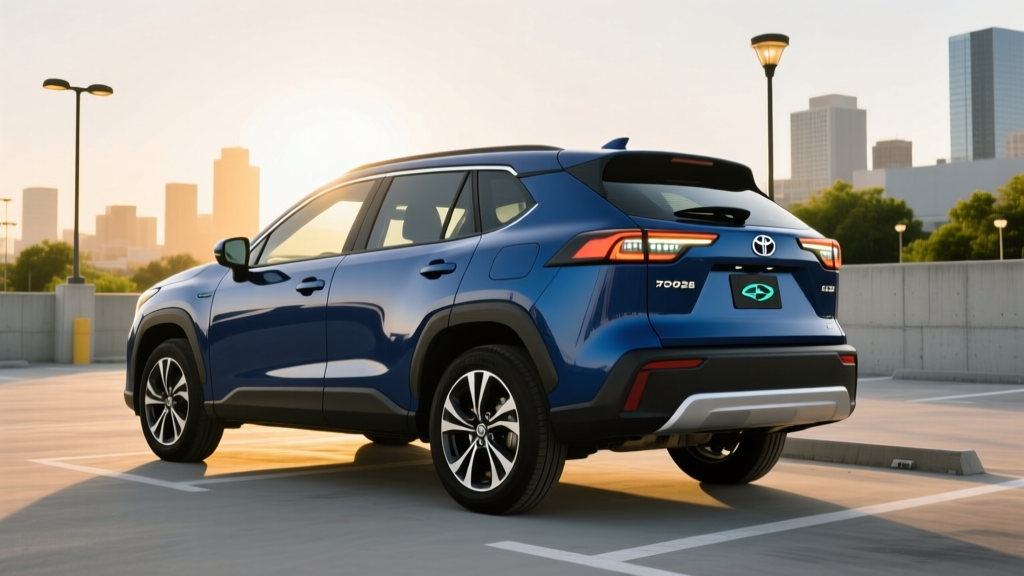
The Toyota Corolla Cross Hybrid occupies a narrow but valuable lane in the compact crossover market: it delivers all-wheel drive, strong fuel economy, and Toyota's hybrid reliability without requiring a plug, a charging routine, or a lifestyle change. For 2026, the Corolla Cross Hybrid carries over the fifth-generation Toyota Hybrid System (THS) introduced for the 2023 model year, pairing a 2.0-liter four-cylinder engine with front and rear electric motors for a combined 196 horsepower.
This guide breaks down every spec that matters — EPA fuel economy, real-world MPG expectations, powertrain details, battery warranty coverage, pricing by trim, and how the Corolla Cross Hybrid stacks up against plug-in hybrids and full EVs in its class. If you're researching the 2026 Toyota Corolla Cross Hybrid specs, this is the data-driven reference you need.
HEV vs PHEV: What the Corolla Cross Hybrid Actually Is
Before diving into numbers, it's critical to clarify what the Corolla Cross Hybrid is — and what it isn't. Toyota sells two distinct types of electrified vehicles, and buyers frequently confuse them:
| Feature | Conventional Hybrid (HEV) | Plug-In Hybrid (PHEV) |
|---|---|---|
| Plug-in charging? | No — charges via regenerative braking and engine | Yes — plug into Level 1 or Level 2 charger |
| Electric-only range | Less than 1 mile at low speeds | Typically 20–45 miles on battery alone |
| Battery size | ~1.0–1.6 kWh (small buffer) | 13–20+ kWh usable |
| Federal tax credit (§30D) | Not eligible | Up to $7,500 if criteria met |
| Example | Corolla Cross Hybrid | Toyota RAV4 Prime |
The 2026 Corolla Cross Hybrid is a conventional HEV. It has no plug, no electric-only driving range to speak of, and no eligibility for the federal §30D EV tax credit. It operates like a standard gasoline car at the pump — you fill it with regular unleaded — but its hybrid system recovers braking energy, assists acceleration with electric motors, and allows the engine to shut off at stops and during low-load cruising. The result is substantially better fuel economy than a gas-only equivalent, with zero change to your refueling habits.
Fuel Economy: EPA Ratings and Real-World MPG
The headline number for the 2026 Corolla Cross Hybrid is its EPA-estimated combined fuel economy. Here is the full breakdown by driving cycle, per fueleconomy.gov:
| Driving Cycle | EPA Estimated MPG |
|---|---|
| City | 45 MPG |
| Highway | 38 MPG |
| Combined | 42 MPG |
These figures apply to all three trims (S, SE, and XSE), as the powertrain and AWD system are standard across the lineup. There is no FWD-only hybrid variant.
Real-World MPG: What Owners Actually See
Hybrid fuel economy behaves differently from gas-only vehicles in practice. The Corolla Cross Hybrid's electric motors do the heaviest lifting at low speeds and in stop-and-go traffic, where a conventional engine is least efficient. This means:
- City driving: Many owners report matching or slightly exceeding the 45 MPG EPA city estimate, particularly in warm weather and moderate traffic. The hybrid system thrives here.
- Highway driving: Expect 35–38 MPG at 70–75 mph. Aerodynamic drag dominates at highway speeds, and the small battery provides minimal assist. This is consistent with the EPA highway rating.
- Cold weather: In freezing temperatures (below 32°F), expect a 5–12% reduction in fuel economy. The engine runs more frequently to generate cabin heat and warm the catalytic converter. Real-world winter combined MPG may drop to 36–38.
- Mountainous terrain: Steep grades will lower MPG on the climb, though regenerative braking recovers meaningful energy on descents.
For a driver covering 12,000 miles per year at the 42 MPG combined rate, annual fuel consumption is approximately 286 gallons. At $3.40 per gallon (national average), that's roughly $972 per year in fuel — compared to about $1,450 for a 25 MPG gas-only compact crossover at the same mileage and fuel price.
Powertrain Specs: 196 HP with Standard AWD
The 2026 Corolla Cross Hybrid uses Toyota's fifth-generation hybrid architecture with a 2.0-liter Dynamic Force inline-four engine and two electric motor-generators — one on each axle. This is a series-parallel full hybrid system, meaning the vehicle can operate on engine power alone, electric motor power alone (briefly, at low speed), or a combination of both.
| Specification | 2026 Corolla Cross Hybrid |
|---|---|
| Engine | 2.0L 4-cylinder Dynamic Force (Atkinson cycle) |
| Engine horsepower | 150 hp @ 6,000 rpm |
| Engine torque | 138 lb-ft @ 4,400 rpm |
| Front electric motor | 83 kW (111 hp) |
| Rear electric motor | 30 kW (40 hp) |
| Net combined system output | 196 hp |
| Drivetrain | Electronic AWD (eAWD) — standard |
| Transmission | Continuously Variable (eCVT) |
| 0–60 mph | ~7.5 seconds (est.) |
| Fuel type | Regular unleaded (87 octane) |
| Fuel tank capacity | 10.6 gallons |
| Total driving range | ~445 miles (at combined EPA) |
The rear electric motor provides on-demand AWD traction without a mechanical driveshaft, reducing weight and parasitic loss. The system automatically sends up to 60% of available torque to the rear axle during acceleration or when front-wheel slip is detected. In normal cruising, the Corolla Cross Hybrid operates primarily in front-wheel drive for efficiency.
The eCVT is not a belt-and-cone CVT like those in some competitors. Toyota's eCVT uses a planetary gearset to blend engine and motor power, which eliminates the rubber-band acceleration feel and is mechanically simpler — contributing to the system's strong reliability record.
Hybrid Battery: Size, Warranty, and Replacement Cost
The Corolla Cross Hybrid uses a compact lithium-ion hybrid battery pack mounted under the rear seats. The pack is small — approximately 1.0 kWh total capacity — because it doesn't need to store energy for electric-only driving. Its job is to buffer energy recovered from regenerative braking and deliver short bursts of electric assist.
Toyota Hybrid Battery Warranty
| Hybrid battery coverage | 10 years / 150,000 miles (whichever comes first) |
| Hybrid system components | 8 years / 100,000 miles |
| Capacity retention guarantee | Toyota warrants the battery against defects and abnormal loss of capacity |
| Transferability | Fully transferable to subsequent owners at no cost |
How Long Will the Hybrid Battery Last?
Toyota's hybrid battery track record is among the best in the industry. Data from the Prius and RAV4 Hybrid fleets shows that Toyota's lithium-ion hybrid packs routinely exceed 150,000 miles with minimal degradation. Because the pack is small and the system never fully charges or fully depletes it (operating in a narrow state-of-charge window of roughly 40–80%), the cells experience far less stress than a full EV battery.
Real-world failures before 100,000 miles are uncommon. Most reported hybrid battery replacements occur between 150,000 and 200,000 miles, and many original packs exceed 200,000 miles.
Battery Replacement Cost
If the hybrid battery does require replacement outside of warranty:
- New OEM battery from Toyota: $2,500–$4,000 (parts and labor at a dealership)
- Refurbished/remanufactured pack: $1,500–$2,500
- Individual cell module replacement: $500–$1,200 (specialist hybrid shops can replace failed modules rather than the entire pack)
These costs are substantially lower than EV traction battery replacements ($8,000–$20,000+) because the hybrid pack is small and less complex.
2026 Pricing by Trim and Tax Credit Status
The 2026 Corolla Cross Hybrid is offered in three trims. Pricing below includes the mandatory destination charge:
| Trim | MSRP (incl. destination) | Key Features |
|---|---|---|
| S | $29,350 | 8" touchscreen, wireless Apple CarPlay/Android Auto, TSS 3.0, LED headlights |
| SE | $31,050 | SofTex seats, heated front seats, 18" alloy wheels, smart key system |
| XSE | $33,550 | 9" JBL premium audio, power liftgate, panoramic moonroof, ambient lighting |
Federal Tax Credit Eligibility
The Corolla Cross Hybrid does not qualify for the federal §30D clean vehicle tax credit. Under current IRS rules, the §30D credit applies only to plug-in electric vehicles (BEVs and PHEVs) with a battery capacity of at least 7 kWh. The Corolla Cross Hybrid's ~1.0 kWh pack and lack of plug-in capability make it ineligible.
However, some states and local utilities offer rebates or incentives for conventional hybrids. Check your state energy office or utility provider for current programs — these vary widely by jurisdiction and change frequently.
Who Should Buy the Corolla Cross Hybrid — and Who Shouldn't
The Corolla Cross Hybrid isn't the right choice for every buyer. Here's a practical decision framework:
Choose the Corolla Cross Hybrid if:
- You want AWD and strong fuel economy without changing your refueling routine
- You live in an apartment or lack access to home charging (making a PHEV or EV impractical)
- You prioritize low long-term maintenance costs and proven reliability
- Your daily commute is under 50 miles and you want to minimize fuel spend
- You want a compact crossover under $35,000 with standard safety tech
Consider a PHEV (like the RAV4 Prime) if:
- You have home charging and want 30–42 miles of electric-only commuting
- You want to qualify for the $7,500 federal tax credit (subject to income and sourcing rules)
- You're willing to pay a $10,000+ premium for plug-in capability
Consider a full EV (like the Hyundai Kona Electric) if:
- You have reliable home Level 2 charging
- You want zero tailpipe emissions and the lowest per-mile fuel cost
- You're eligible for the federal tax credit and can absorb higher upfront cost
Pros
- 42 MPG combined with standard AWD — best in its compact crossover class
- 196 hp provides confident highway merging (vs. 169 hp gas-only Corolla Cross)
- No plug, no charging anxiety — fill up at any gas station
- 10-year/150,000-mile hybrid battery warranty
- Toyota Safety Sense 3.0 standard on all trims
- Strong resale value and reliability reputation
Cons
- No federal tax credit eligibility
- Cargo space slightly reduced vs. gas-only model (battery packaging)
- No plug-in hybrid variant available — if you want EV commute miles, look at RAV4 Prime
- Ride quality is firm; road noise is noticeable at highway speeds
- Infotainment system is functional but not class-leading in responsiveness
How the Corolla Cross Hybrid Compares
The Corolla Cross Hybrid's closest competitors are other hybrid compact crossovers. Here's how the key numbers stack up:
| Vehicle | EPA Combined MPG | Horsepower | AWD? | Starting MSRP |
|---|---|---|---|---|
| 2026 Toyota Corolla Cross Hybrid | 42 | 196 | Standard | $29,350 |
| 2026 Honda CR-V Hybrid | 40 | 204 | Standard (Sport trims) | $35,850 |
| 2026 Kia Niro Hybrid | 49 | 139 | No (FWD only) | $28,315 |
| 2026 Subaru Crosstrek Hybrid | 35 | 148 | Standard | $31,995 |
The Corolla Cross Hybrid's advantage is its combination of AWD, competitive power, and a starting price under $30,000. The Kia Niro Hybrid achieves better MPG but lacks AWD. The Honda CR-V Hybrid offers more interior space but starts over $6,000 higher. The Subaru Crosstrek Hybrid trails in both efficiency and power.
Safety and Driver-Assistance Technology
Every 2026 Corolla Cross Hybrid comes standard with Toyota Safety Sense 3.0 (TSS 3.0), which includes:
- Pre-Collision System with Pedestrian Detection
- Lane Departure Alert with Steering Assist
- Lane Tracing Assist
- Dynamic Radar Cruise Control (full-speed)
- Automatic High Beams
- Road Sign Assist
- Proactive Driving Assist (gentle braking/deceleration support)
It is important to note that TSS 3.0 is an SAE Level 2 driver-assistance system. This means the system can manage steering and speed simultaneously under certain conditions, but the driver must remain fully engaged, hands on the wheel, and eyes on the road at all times. This is not autonomous or self-driving technology. For a detailed explanation of automation levels, see NHTSA's guide to vehicle automation.
Frequently Asked Questions
How many MPG does the 2026 Corolla Cross Hybrid get?
The EPA rates the 2026 Corolla Cross Hybrid at 45 MPG city, 38 MPG highway, and 42 MPG combined. Real-world city driving often matches or slightly exceeds the EPA city figure thanks to the hybrid system's regenerative braking efficiency. Highway and cold-weather driving will reduce these numbers.
Does the Corolla Cross Hybrid need to be plugged in?
No. The Corolla Cross Hybrid is a conventional (self-charging) hybrid. It charges its small battery through regenerative braking and the gasoline engine. You refuel it at a gas station like any other car. There is no plug, no charging cable, and no electric-only driving range.
Is there a plug-in hybrid (PHEV) version of the Corolla Cross?
As of the 2026 model year, Toyota does not offer a Corolla Cross PHEV in the United States. If you want a Toyota plug-in hybrid crossover, the RAV4 Prime (42 miles electric-only, eligible for the $7,500 federal credit) is the closest option, though it starts above $44,000.
Does the 2026 Corolla Cross Hybrid qualify for a tax credit?
It does not qualify for the federal §30D clean vehicle tax credit, which is reserved for plug-in vehicles with at least 7 kWh of battery capacity. Some state or utility incentives may apply to conventional hybrids — check your local programs.
Is the Corolla Cross Hybrid reliable? What about battery replacement cost?
Toyota's hybrid systems have an industry-leading reliability record, with the Prius fleet accumulating billions of real-world miles. The hybrid battery is warranted for 10 years/150,000 miles. If replacement is needed out of warranty, expect $2,500–$4,000 for a new OEM pack, or $1,500–$2,500 for a refurbished unit. Most Toyota hybrid batteries exceed 150,000 miles before requiring service.
How does the Corolla Cross Hybrid compare to the gas-only version?
The gas-only 2026 Corolla Cross (2.0L, 169 hp, FWD or AWD) is rated at 29–32 MPG combined depending on drivetrain. The Hybrid delivers 42 MPG combined with 196 hp and standard AWD — a substantial improvement in both efficiency and power for approximately $3,000 more at the base trim. The fuel savings typically pay back the price premium within 3–5 years at average mileage.
What is the towing capacity?
The 2026 Corolla Cross Hybrid has a maximum towing capacity of 1,500 pounds when properly equipped. This is adequate for a small utility trailer or a pair of dirt bikes, but not suitable for boat or camper towing.
The 2026 Corolla Cross Hybrid makes a compelling case for buyers who want electrified efficiency without the complexity, cost, or charging dependency of a PHEV or EV. At 42 MPG combined with standard AWD and a sub-$30,000 starting price, it's one of the most practical compact crossovers on the market — and one of the few that genuinely delivers on its EPA sticker in everyday driving.