Quick Verdict: The 2026 Toyota C-HR Hybrid at a Glance
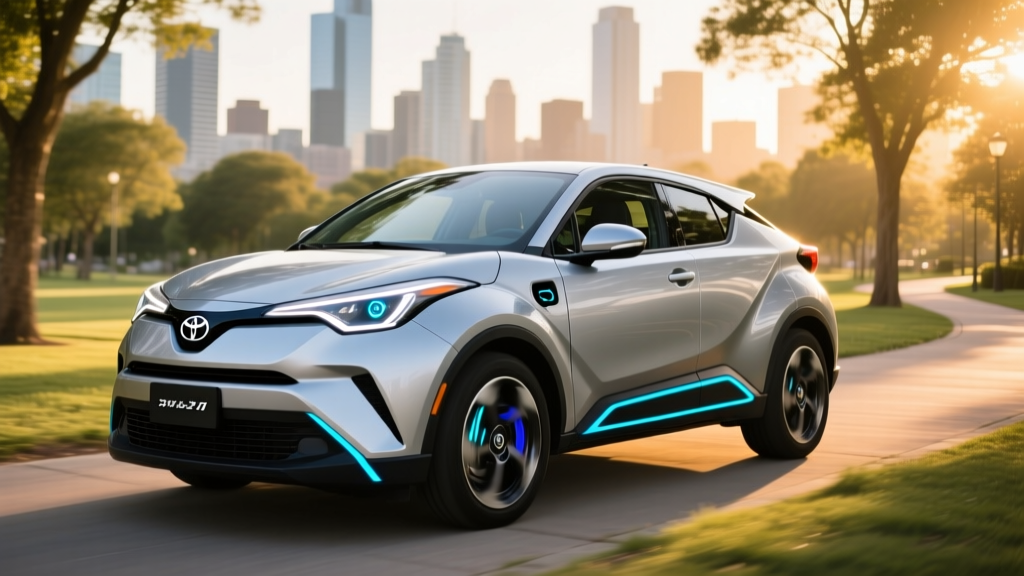
The Toyota C-HR Hybrid returns for 2026 as a subcompact crossover aimed at urban commuters who want hybrid efficiency without plugging in. Built on Toyota's fifth-generation hybrid system, it delivers an EPA-estimated 42 MPG combined — putting it among the most fuel-efficient crossovers in its class. Unlike a plug-in hybrid (PHEV) or full battery-electric vehicle (BEV), the C-HR Hybrid is a conventional hybrid electric vehicle (HEV): it charges its own small battery through regenerative braking and the gasoline engine. No plug, no range anxiety, no charging infrastructure required.
This matters because buyers searching for a "CHR hybrid" often encounter confusion between HEV and PHEV configurations. The 2026 C-HR Hybrid is strictly an HEV. If you need electric-only driving or federal tax credit eligibility, you'll want to look at Toyota's PHEV lineup (like the RAV4 Prime) or a full BEV instead.
Powertrain and Performance Specs
The 2026 C-HR Hybrid pairs a 1.8-liter four-cylinder Atkinson-cycle engine with Toyota's latest hybrid transaxle and a lithium-ion hybrid battery pack. The combined system output is 138 horsepower — adequate for city merging and highway cruising, though not sporty by any measure.
| Specification | Value |
|---|---|
| Engine | 1.8L 4-cylinder Atkinson-cycle |
| Engine Horsepower | 97 hp @ 5,200 rpm |
| Electric Motor Output | 94 hp (front-mounted) |
| Combined System Horsepower | 138 hp |
| Hybrid Battery Chemistry | Lithium-ion (Li-ion) |
| Hybrid Battery Capacity | ~1.3 kWh (gross) |
| Transmission | eCVT (planetary gearset) |
| Drivetrain | Front-wheel drive (FWD) |
| 0–60 mph (estimated) | ~9.8 seconds |
| Curb Weight | ~3,350 lbs |
The eCVT is not a traditional belt-driven continuously variable transmission. Toyota's hybrid synergy drive uses a planetary gearset that seamlessly blends engine and motor torque without the rubber-band effect common in older CVTs. Acceleration from a stop is brisk thanks to instant electric motor torque, but highway passing requires planning — the 138 hp combined output shows its limits above 65 mph on inclines.
Fuel Economy: EPA Ratings vs. Real-World MPG
The headline number for the C-HR Hybrid is its EPA-estimated fuel economy. Toyota's fifth-generation hybrid system is remarkably efficient in stop-and-go driving, where regenerative braking recaptures energy that a conventional gas car wastes as heat.
| Driving Cycle | EPA Estimate |
|---|---|
| City | 44 MPG |
| Highway | 40 MPG |
| Combined | 42 MPG |
Source: fueleconomy.gov
Real-World MPG: What to Actually Expect
Toyota hybrids consistently match or exceed their EPA city estimates in real-world urban driving. The electric motor handles low-speed propulsion almost entirely, and the Atkinson-cycle engine operates in its most efficient range. In mixed suburban and city driving, owners frequently report 43–47 MPG — slightly above the EPA combined figure.
Highway driving tells a different story. At sustained speeds above 70 mph, aerodynamic drag dominates and the hybrid system's regenerative advantage diminishes. Expect 36–39 MPG on long highway trips, particularly with headwinds or elevation changes. Cold weather (below 30°F) reduces fuel economy by 5–10% as the engine runs longer to heat the cabin and bring the catalytic converter to operating temperature.
Pricing, Trims, and Tax Credit Eligibility
The 2026 Toyota C-HR Hybrid is offered in three trims, all with the same hybrid powertrain. Pricing starts at $29,500 for the base LE and tops out around $34,200 for the XSE with available technology packages.
| Trim | MSRP | Key Features |
|---|---|---|
| LE | $29,500 | Toyota Safety Sense 3.0, 8" touchscreen, wireless CarPlay/Android Auto |
| XLE | $31,800 | SofTex seats, 10.5" display, heated front seats, wireless charging pad |
| XSE | $34,200 | Sport-tuned suspension, 18" alloy wheels, JBL 9-speaker audio, panoramic roof |
Federal Tax Credit: Does the C-HR Hybrid Qualify?
The short answer is no. Under current IRS §30D rules, the federal clean vehicle credit applies only to plug-in electric vehicles (BEVs and PHEVs) with a minimum battery capacity of 7 kWh. The C-HR Hybrid's ~1.3 kWh battery disqualifies it entirely from the federal EV tax credit.
Some states and municipalities offer incentives for conventional hybrids, though these are far less common than EV incentives. Check your state's energy office or the Alternative Fuels Data Center for local hybrid rebate programs. A few states historically offered hybrid incentives that have since been phased out in favor of EV-focused programs.
- ❌ Vehicle must be a plug-in BEV or PHEV (C-HR Hybrid is HEV — does not qualify)
- ❌ Minimum 7 kWh battery capacity (C-HR Hybrid: ~1.3 kWh)
- ✅ MSRP cap: $80,000 SUVs / $55,000 sedans (C-HR Hybrid is well under either)
- N/A Income caps: $150K single / $300K joint filer (irrelevant for non-qualifying vehicle)
- N/A Battery sourcing & critical minerals requirements (irrelevant for non-qualifying vehicle)
Hybrid Battery Warranty and Reliability
Battery longevity is the single most common concern among first-time hybrid buyers. Toyota addresses this with one of the industry's strongest hybrid battery warranties.
- Duration: 10 years / 150,000 miles (whichever comes first)
- Coverage: Hybrid battery pack and hybrid system components (inverter, transaxle motor)
- Threshold: Warranty covers battery capacity loss that causes the vehicle to fail emissions or performance standards
- Transferable: Yes, transfers to subsequent owners automatically
Real-World Battery Degradation
Toyota's hybrid batteries are deliberately small and operate in a narrow state-of-charge window (roughly 40–80% SoC). The vehicle's battery management system never allows full discharge or full charge, which dramatically extends cycle life. Real-world data from Toyota's global hybrid fleet — over 20 million vehicles sold — shows that the vast majority of hybrid batteries last the lifetime of the vehicle without replacement.
When replacement is needed (typically beyond the warranty period at 12–15+ years), a refurbished Toyota hybrid battery costs between $2,000 and $3,500 including installation. New OEM replacements run $3,500–$5,000. Independent hybrid shops often offer reconditioned units for $1,500–$2,500.
Toyota's hybrid system reliability is well-documented. The eCVT planetary gearset has no belts, clutches, or friction bands to wear out — it is fundamentally simpler than a conventional automatic transmission. The 1.8L Atkinson-cycle engine runs lower stress than conventional engines, contributing to long-term durability. Toyota's hybrid components have consistently earned top marks in long-term reliability surveys.
HEV vs. PHEV vs. BEV: Which Powertrain Fits You?
The C-HR Hybrid occupies a specific niche. Here's how it compares to the alternatives a cross-shopping buyer should consider:
| Factor | C-HR Hybrid (HEV) | PHEV (e.g., RAV4 Prime) | Full BEV (e.g., bZ4X) |
|---|---|---|---|
| Plug-in Required? | No | Yes (for EV range) | Yes |
| Electric-Only Range | ~1 mile (low speed) | 35–42 miles | 220–252 miles (EPA) |
| Total Range | ~550 miles | ~600 miles | 220–252 miles |
| Fuel/Charging Cost | Gas only (~$0.12/mi) | Electric + gas (~$0.06–0.12/mi) | Electric only (~$0.04–0.08/mi) |
| Federal Tax Credit | $0 | Up to $7,500* | Up to $7,500* |
| Home Charging Needed? | No | Recommended (Level 2) | Essential (Level 2) |
| Best For | No-plug commuters, apartments | Home chargers, short commutes | Home chargers, daily driving |
* §30D credit eligibility depends on MSRP caps, buyer income limits, battery sourcing, and critical mineral requirements. Verify current-year rules at IRS.gov.
- Choose the C-HR Hybrid (HEV) if: You live in an apartment or lack home charging access, want maximum simplicity, commute in stop-and-go traffic, and prioritize lowest upfront cost with no behavioral change from a gas car.
- Choose a PHEV if: You can install a Level 2 charger at home, your daily commute is under 40 miles (covering most trips on electricity), and you want the option of gas-powered road trips without range anxiety.
- Choose a full BEV if: You have reliable home charging, want the lowest per-mile operating cost, qualify for the full federal tax credit, and are comfortable planning around public DC fast charging for road trips.
Pros and Cons: The Honest Assessment
✅ Pros
- 42 MPG combined EPA — best-in-class for subcompact crossovers
- No plug-in required — works with any lifestyle or housing situation
- 10-year / 150,000-mile hybrid battery warranty
- Toyota Safety Sense 3.0 standard (pre-collision, lane tracing, adaptive cruise)
- Strong resale value — Toyota hybrids hold value well
- Proven hybrid system with 25+ years of real-world reliability data
- 540+ mile total range per tank
❌ Cons
- No federal tax credit eligibility (HEV, not PHEV/BEV)
- 138 hp combined — modest acceleration, especially for highway merging
- FWD only — no AWD option for snow-belt buyers
- Cargo space limited vs. RAV4 Hybrid (21.5 cu ft vs. 37.6 cu ft)
- Highway MPG drops to 36–39 in real-world driving above 70 mph
- Rear seat space is tight for taller passengers
- No DC fast charging capability (not applicable to HEVs)
Frequently Asked Questions
How many MPG does the Toyota C-HR Hybrid get?
The 2026 C-HR Hybrid earns an EPA-estimated 44 MPG city, 40 MPG highway, and 42 MPG combined. Real-world city driving often yields 43–47 MPG thanks to regenerative braking efficiency. Highway driving at 70+ mph typically returns 36–39 MPG.
How far can the C-HR Hybrid go on electric only?
Effectively about one mile at very low speeds (under 25 mph) in EV mode. The C-HR Hybrid is a conventional HEV, not a plug-in hybrid — its ~1.3 kWh battery is too small for meaningful electric-only driving. The electric motor assists the gasoline engine continuously rather than powering the car independently for extended distances.
Is the Toyota C-HR Hybrid reliable, and what does battery replacement cost?
Toyota's hybrid system is among the most reliable powertrains in the automotive industry, backed by 25+ years of production data and over 20 million hybrid vehicles sold globally. The hybrid battery is covered by a 10-year / 150,000-mile warranty. Out-of-warranty replacement costs $2,000–$5,000 depending on whether you choose refurbished or new OEM. Most hybrid batteries outlast the vehicle itself.
Does the C-HR Hybrid qualify for any federal tax credit?
No. The IRS §30D clean vehicle credit applies only to plug-in vehicles (BEVs and PHEVs) with at least 7 kWh of battery capacity. The C-HR Hybrid's ~1.3 kWh battery makes it ineligible. Some states may offer minor hybrid incentives — check the Alternative Fuels Data Center for local programs.
Should I buy the C-HR Hybrid or step up to a RAV4 Hybrid?
If cargo space and rear-seat room are priorities, the RAV4 Hybrid (EPA 41 MPG combined, 37.6 cu ft cargo) is the more practical choice at roughly $4,000 more. The C-HR Hybrid wins on city fuel economy (44 vs. 41 MPG city), lower starting price, and easier parking in tight urban environments. For solo commuters or couples without child-seat needs, the C-HR Hybrid offers excellent value.
Does the C-HR Hybrid require premium fuel?
No. The 2026 C-HR Hybrid runs on regular 87-octane unleaded gasoline, keeping operating costs low. Toyota's Atkinson-cycle engine is designed for efficiency on regular fuel.