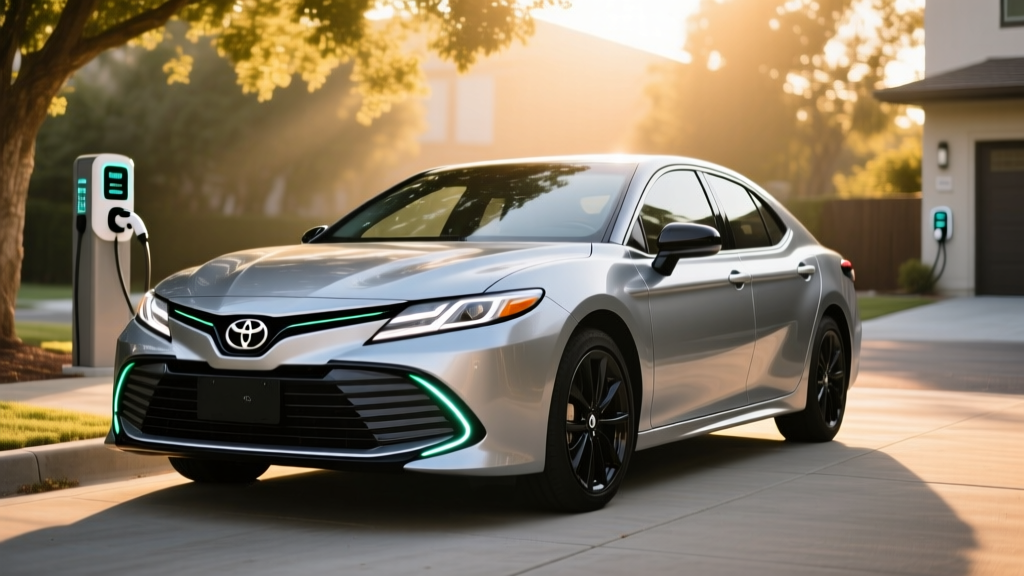
The 2026 Toyota Camry SE Hybrid occupies a specific lane in the midsize sedan market: sport-tuned styling and suspension without sacrificing the fuel-sipping efficiency Toyota's hybrid system is known for. Now in its second model year of the ninth-generation redesign, the Camry is offered exclusively as a hybrid — meaning every trim, including the SE, uses Toyota's fifth-generation hybrid powertrain. There is no plug-in variant, no gas-only option, and no V6. For buyers cross-shopping the Honda Accord Hybrid, Hyundai Sonata Hybrid, or even considering a full EV, the Camry SE Hybrid presents a compelling case — but only if its trade-offs align with your driving life.
In this guide, we break down the exact EPA numbers, real-world efficiency expectations, powertrain specs, pricing, battery longevity, and the tax-credit reality so you can decide whether the 2026 Toyota Camry SE Hybrid belongs in your driveway.
2026 Toyota Camry SE Hybrid: Core Specifications
| Specification | Value |
|---|---|
| Powertrain | 2.5L 4-cyl + electric motor (5th-gen hybrid) |
| Combined Horsepower | 225 hp (FWD) / 232 hp (AWD) |
| EPA City MPG | 48 mpg (FWD) |
| EPA Highway MPG | 47 mpg (FWD) |
| EPA Combined MPG | 47 mpg (FWD) |
| Fuel Tank Capacity | 13.2 gallons |
| Estimated Total Range | ~620 miles |
| 0–60 mph | ~7.2 seconds (est.) |
| Drivetrain | FWD standard; AWD available |
| Hybrid Battery | Lithium-ion, ~1.6 kWh (self-charging HEV) |
| Starting MSRP (SE FWD) | ~$31,495 |
| Battery Warranty | 10 years / 150,000 miles |
Note: The SE trim's sport-tuned suspension and 19-inch alloy wheels carry a slight efficiency penalty versus the LE Hybrid. AWD models drop approximately 2–3 MPG across the board. Always verify exact figures on fueleconomy.gov before purchasing.
Fuel Economy: EPA Numbers vs. Real-World MPG
| Driving Scenario | FWD MPG | AWD MPG |
|---|---|---|
| EPA City | 48 | 46 |
| EPA Highway | 47 | 44 |
| EPA Combined | 47 | 45 |
| Real-World City (observed) | 49–53 | 46–50 |
| Real-World Highway (70+ mph) | 41–44 | 39–42 |
| Real-World Combined (mixed) | 44–48 | 42–45 |
Toyota's hybrid system excels in stop-and-go traffic, where the electric motor handles low-speed propulsion and regenerative braking recaptures energy. In real-world city driving, many owners report exceeding the EPA city estimate — a rarity among conventional vehicles. Highway driving tells a different story: at sustained 75–80 mph speeds, the gasoline engine carries most of the load, and the SE's larger 19-inch wheels with lower-profile tires add rolling resistance.
Cold weather impacts hybrid efficiency too. Expect a 5–10% MPG drop in sub-40°F conditions as the engine runs more frequently to maintain cabin heat and battery temperature. This is far less severe than the 20–30% range loss a battery-electric vehicle experiences in winter, but it's worth factoring into annual fuel-cost projections.
How the Fifth-Generation Hybrid Powertrain Works
The 2026 Camry SE Hybrid pairs a 2.5-liter Dynamic Force four-cylinder engine (running the efficient Atkinson cycle) with one or two electric motor-generators, depending on drivetrain. The FWD model uses a single front motor; the AWD variant adds a second, independent rear motor that engages when traction is needed — there is no mechanical driveshaft connecting front and rear axles.
Combined system output is 225 horsepower for FWD and 232 horsepower for AWD. That's a meaningful step up from the previous-generation Camry Hybrid's 208 hp and puts the SE Hybrid in the same performance ballpark as turbocharged rivals. The eCVT (electronically controlled continuously variable transmission) delivers seamless power without the rubber-band sensation of older CVTs.
The lithium-ion hybrid battery pack stores approximately 1.6 kWh of energy — far smaller than a PHEV or BEV battery. This pack is never plugged in. It charges through regenerative braking and the gasoline engine, acting as a buffer that enables electric-only driving at low speeds (typically under 25 mph for short distances) and smooths out the engine's stop-start transitions.
HEV vs. PHEV: What the Camry Is (and Isn't)
The 2026 Camry Hybrid is a conventional hybrid (HEV), not a plug-in hybrid (PHEV). Here's the practical difference:
- No plug, no charging cable. You fuel it like any gas car. The battery self-charges through regenerative braking and the engine.
- No electric-only range to speak of. The small 1.6 kWh battery enables brief low-speed EV mode, not the 25–40 mile electric-only commutes a PHEV offers.
- No federal tax credit. The IRS §30D credit applies only to plug-in vehicles (PHEVs and BEVs) with qualifying battery sourcing. Conventional hybrids are ineligible.
- Lower upfront cost. HEVs typically cost $3,000–$7,000 less than comparable PHEVs and carry no home-charging installation requirement.
If you need electric-only commuting, look at the Toyota Prius Prime (PHEV, ~44 miles electric-only) or a full EV. The Camry Hybrid is optimized for drivers who want maximum MPG without altering their fueling habits.
Pricing, Trims, and Tax Credit Eligibility
The 2026 Toyota Camry SE Hybrid starts at approximately $31,495 for the FWD model, including destination charge. Adding AWD raises the price by roughly $1,500. The SE sits in the middle of the Camry Hybrid lineup — above the LE (the efficiency champion with smaller wheels) and below the XSE and XLE trims.
Federal tax credit: The Camry Hybrid does not qualify for the IRS §30D Clean Vehicle Credit. That credit — up to $7,500 for new plug-in vehicles — requires a minimum battery capacity of 7 kWh and applies only to PHEVs and BEVs that meet critical-mineral and battery-component sourcing requirements, buyer income caps, and MSRP limits. Since the Camry HEV's battery is approximately 1.6 kWh and it cannot be plugged in, it falls outside the program entirely. Details on qualifying vehicles are published at IRS.gov.
State incentives: A handful of states offer modest rebates or HOV-lane access for conventional hybrids, but these programs are increasingly rare as policy shifts toward plug-in vehicles. Check your state's energy office or DMV for current offerings.
Battery Longevity, Warranty, and Replacement Cost
Hybrid Battery Warranty & Lifespan
Warranty: 10 years / 150,000 miles (whichever comes first) in all 50 states. This covers the hybrid battery pack, hybrid control module, and related powertrain components against defects and abnormal capacity loss.
Expected lifespan: Toyota's modern lithium-ion hybrid batteries routinely last 150,000–200,000+ miles before significant degradation. Many first-generation Prius packs exceeded 200,000 miles. The smaller charge cycles of an HEV (never fully depleted, never fully charged) are gentler on cell chemistry than the deep cycles of a BEV.
Replacement cost (out of warranty): A new OEM hybrid battery pack for the Camry Hybrid typically runs $2,500–$4,000 including labor. Refurbished packs are available for $1,500–$2,500. Individual module replacement (if only a few cells fail) can cost $500–$1,200 at a hybrid specialist.
Hybrid battery anxiety is largely a legacy concern. Toyota has refined this system over 25+ years and millions of vehicles on the road. The battery management system keeps the pack in a narrow state-of-charge window (roughly 40–80%), which dramatically extends cycle life. For the vast majority of owners, the hybrid battery will outlast the vehicle's economic life.
Driving Impressions: SE Trim Specifics
The SE trim distinguishes itself from the LE and XLE with a sport-tuned suspension, 19-inch black alloy wheels, a rear spoiler, and paddle shifters. The firmer damping gives the Camry SE Hybrid noticeably better body control through corners than its comfort-oriented siblings, at the cost of some ride compliance over rough pavement.
The 225-hp combined output delivers confident highway merging and passing. The eCVT's linear torque delivery — with the electric motor's instant response filling in before the gasoline engine reaches peak torque — makes the Camry SE Hybrid feel quicker than its 7.2-second 0–60 time suggests in everyday driving. Toyota Safety Sense 3.0 is standard across all trims, including adaptive cruise control, lane-keeping assist, pre-collision braking, and road-sign assist. This is a Level 2 SAE driver-assistance system — it supports the driver but requires continuous hands-on-wheel attention and does not enable autonomous driving.
Who Should Buy the Camry SE Hybrid — And Who Shouldn't
Choose the Camry SE Hybrid If:
- You drive 12,000–20,000+ miles per year and want to minimize fuel costs without changing your fueling routine
- You lack access to home or workplace charging (apartment, street parking, no 240V outlet)
- You want proven reliability with a 10-year/150,000-mile battery warranty
- You prefer a sport-tuned ride over a purely comfort-oriented sedan
- You need 600+ miles of total range for road trips without charging-stop planning
Consider a PHEV Instead If:
- You have home charging and a short commute (under 30 miles) — a PHEV like the Prius Prime lets you drive mostly on electricity
- You want to qualify for the $7,500 federal tax credit (income and sourcing rules apply)
Consider a Full EV Instead If:
- You have reliable home Level 2 charging and want zero tailpipe emissions with minimal maintenance
- Your daily driving is under 250 miles and you want the lowest per-mile energy cost (~$0.04–$0.06/mile vs. ~$0.09–$0.11/mile in the Camry Hybrid at 47 MPG and $3.50/gal)
Pros and Cons at a Glance
Pros
- 47 MPG combined EPA — among the best in the midsize sedan class
- Real-world city MPG often exceeds EPA estimate
- 225–232 hp provides confident acceleration
- No plug-in charging required — zero lifestyle adjustment
- 10-year / 150,000-mile hybrid battery warranty
- 620+ mile total range eliminates refueling stops on most road trips
- Toyota Safety Sense 3.0 standard
Cons
- No federal tax credit eligibility (HEV, not PHEV)
- SE's 19-inch wheels reduce MPG vs. LE trim and firm up the ride
- Highway MPG drops noticeably above 75 mph
- No electric-only commuting capability
- eCVT lacks the engagement of a geared automatic for some drivers
- Cold-weather MPG penalty of 5–10%
Frequently Asked Questions
How many MPG does the 2026 Toyota Camry SE Hybrid get?
The EPA rates the FWD Camry SE Hybrid at 48 city / 47 highway / 47 combined MPG. The AWD model drops to 46/44/45. In real-world city driving, many owners report 49–53 MPG thanks to the hybrid system's regenerative braking advantage. Highway driving at 75+ mph typically yields 41–44 MPG.
Can I plug in the Camry Hybrid to charge?
No. The 2026 Camry Hybrid is a conventional hybrid (HEV), not a plug-in hybrid. Its ~1.6 kWh battery charges exclusively through regenerative braking and the gasoline engine. There is no charging port and no electric-only range beyond brief low-speed EV mode.
Does the 2026 Camry Hybrid qualify for any tax credit?
Not at the federal level. The IRS §30D Clean Vehicle Credit requires a plug-in vehicle with at least 7 kWh of battery capacity. The Camry HEV does not meet this threshold. Some states or municipalities may offer minor incentives for hybrids, but these are increasingly uncommon. Check your state energy office for specifics.
How long will the hybrid battery last, and what does replacement cost?
Toyota warranties the hybrid battery for 10 years or 150,000 miles. Based on decades of real-world data across millions of Toyota hybrids, these packs commonly last 150,000–200,000+ miles. If replacement is needed out of warranty, expect $2,500–$4,000 for a new OEM pack or $1,500–$2,500 for a refurbished unit.
Is the Camry SE Hybrid better than the LE Hybrid?
It depends on priorities. The LE Hybrid's smaller 17-inch wheels and comfort-tuned suspension deliver slightly higher MPG (up to 51/53/52 EPA) and a smoother ride. The SE Hybrid trades 4–5 MPG for sharper handling, sport styling, and 19-inch wheels. If maximum efficiency is your goal, the LE is the pick. If driving engagement matters, the SE justifies the trade-off.
How does the Camry Hybrid compare to a full EV in running costs?
At 47 MPG and $3.50/gallon, the Camry Hybrid costs roughly $0.07–$0.08 per mile in fuel. A comparable EV charged at home at $0.14/kWh and averaging 3.5 miles/kWh costs about $0.04 per mile — roughly half. However, the EV requires home charging infrastructure ($500–$2,000 for Level 2 installation) and may not suit apartment dwellers or high-mileage road-trippers. The Camry Hybrid offers a strong middle ground with zero infrastructure changes.
Sources: EPA Fuel Economy, Toyota Motor Corporation, IRS Clean Vehicle Credits