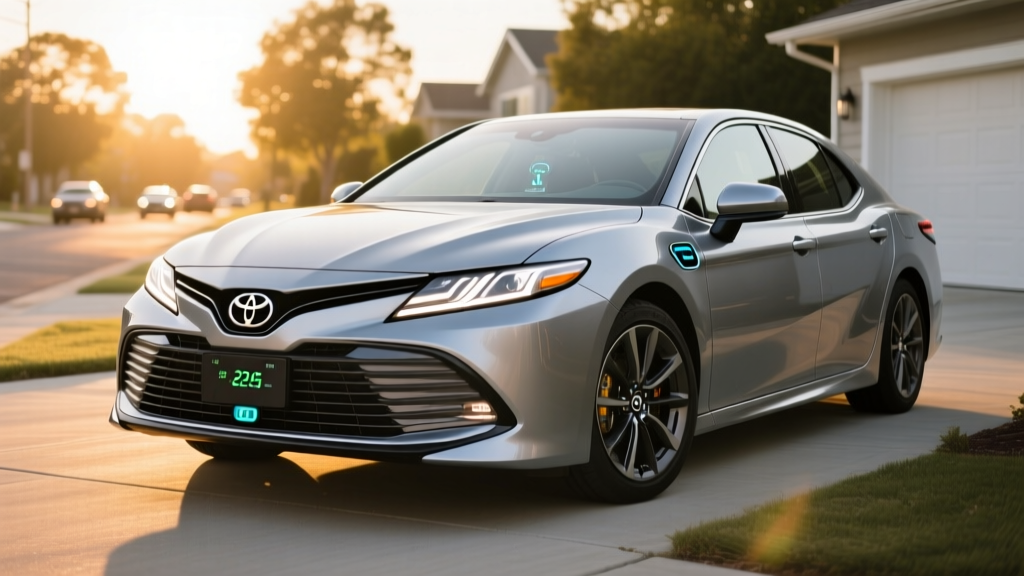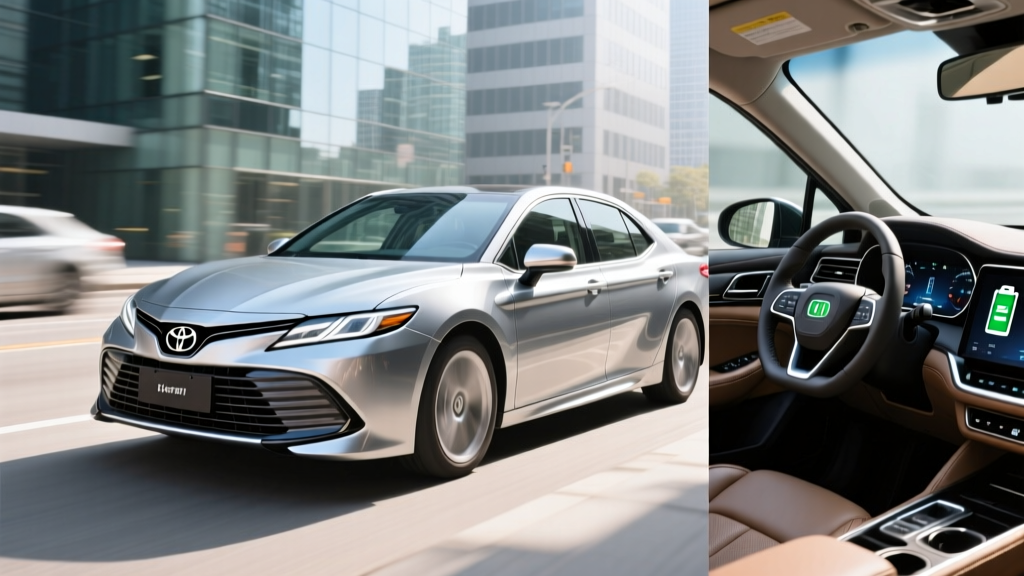
The 2026 Toyota Camry LE Hybrid occupies a rare sweet spot in the midsize sedan market: it's a conventional hybrid (HEV) that requires no plug, no behavior change, and no charging infrastructure — yet returns fuel economy that rivals many plug-in hybrids in daily commuting. With a starting MSRP around $29,990 and an EPA-estimated 51 MPG combined, the Camry LE Hybrid is engineered for buyers who want maximum efficiency without the complexity of a plug-in powertrain or a full battery-electric vehicle.
This guide breaks down exactly what the LE trim delivers for 2026, how its real-world MPG stacks up against the EPA sticker, what the hybrid battery warranty covers, and whether this HEV is the right choice versus a PHEV or full EV for your driving profile.
HEV vs PHEV: What the Camry LE Hybrid Actually Is
Conventional Hybrid (HEV) — The 2026 Camry LE is a self-charging hybrid. It uses a small lithium-ion battery pack (approximately 1.6 kWh usable) that recharges through regenerative braking and the gasoline engine. You never plug it in. You simply fuel up at any gas station and drive. The electric motor assists the engine during acceleration and can propel the car at low speeds for very short distances, but there is no meaningful electric-only range.
Plug-In Hybrid (PHEV) — Toyota does not currently offer a Camry PHEV in the U.S. market. If you want a Toyota PHEV sedan, the closest equivalent is the Prius Prime, which offers roughly 44 miles of electric-only range on a larger battery (about 13.6 kWh usable) that you plug in to recharge. PHEVs bridge the gap between HEVs and full EVs but cost more upfront and require home charging access to realize their efficiency advantage.
The distinction matters because conventional hybrids like the Camry LE are often confused with plug-in hybrids. The Camry LE Hybrid has no charging port. Its efficiency gains come entirely from the hybrid system's ability to recapture braking energy, optimize engine load, and shut off the engine at stops and low-speed coasting.
Fuel Economy: EPA Ratings and Real-World MPG
| Metric | EPA Estimate | Real-World Expectation |
|---|---|---|
| City MPG | 53 MPG | 50–56 MPG (hybrids often beat EPA in city) |
| Highway MPG | 50 MPG | 45–50 MPG (sustained high-speed reduces regen benefit) |
| Combined MPG | 51 MPG | 48–53 MPG depending on driving mix |
| Fuel Tank Capacity | 13.2 gallons | — |
| Total Range | ~673 miles | ~620–700 miles per tank |
Source: EPA Fuel Economy
Toyota's fifth-generation hybrid system excels in stop-and-go traffic, where the electric motor handles initial acceleration and regenerative braking constantly recaptures energy. In real-world city driving, many Camry Hybrid owners report matching or slightly exceeding the 53 MPG city estimate. Highway driving is where the gap narrows: at sustained 75–80 MPH, the gasoline engine does most of the work, and you'll see figures closer to 45–48 MPG.
Cold weather impacts hybrid efficiency less dramatically than it affects full EVs, but expect a 5–10% MPG reduction in freezing temperatures due to increased engine idling for cabin heat and reduced battery efficiency. Using seat heaters instead of cranking the cabin heat can recover some of that loss.
Powertrain Specs: Engine, Motor, and Combined Output
| Specification | 2026 Camry LE Hybrid |
|---|---|
| Engine | 2.5L 4-cylinder Dynamic Force (184 HP) |
| Electric Motor | Permanent magnet synchronous (134 HP) |
| Combined Net Horsepower | 225 HP |
| Drivetrain | Front-wheel drive (AWD optional on some trims) |
| Transmission | eCVT (electronically controlled continuously variable) |
| Hybrid Battery | Lithium-ion, ~1.6 kWh usable |
| 0–60 MPH | ~7.1 seconds |
| Curb Weight | ~3,570 lbs |
The 225 combined horsepower is a meaningful upgrade over the previous-generation Camry Hybrid's 208 HP. The eCVT is not a belt-driven CVT like those in some competitors — it uses a planetary gearset to blend engine and motor power, which Toyota calls the Hybrid Synergy Drive. This design eliminates the rubber-band acceleration feel associated with traditional CVTs and has proven exceptionally reliable over millions of Toyota hybrid vehicles.
The LE trim is front-wheel drive only. If you need all-wheel drive, Toyota offers an electronic AWD system on the SE and XLE Hybrid trims, which adds a rear-mounted electric motor for a combined 232 HP but reduces fuel economy slightly to approximately 49 MPG combined.
Pricing, Trims, and Tax Credit Eligibility
The 2026 Toyota Camry LE Hybrid starts at an MSRP of approximately $29,990, including destination charge. This positions it competitively against the Honda Accord Hybrid (starting around $34,000) and the Hyundai Sonata Hybrid (starting around $31,000).
| Cost Factor | Amount |
|---|---|
| Base MSRP (LE Hybrid) | $29,990 |
| Federal §30D Tax Credit | $0 — HEVs do not qualify |
| State Hybrid Incentives | Varies — some states offer rebates for HEVs |
| Estimated Insurance (annual) | $1,400–$1,800 |
| Annual Fuel Cost (15K mi/yr) | ~$1,030 (at $3.50/gal) |
Federal tax credit: Conventional hybrids like the Camry LE Hybrid do not qualify for the IRS §30D Clean Vehicle Credit. That credit applies only to plug-in electric vehicles (BEVs and PHEVs) with sufficient battery capacity and compliant battery sourcing. See the IRS §30D guidelines for full eligibility details.
Some states offer their own incentives for efficient hybrids, though these are less common than EV incentives. Check your state's energy or environmental agency for current programs.
Hybrid Battery Warranty, Lifespan, and Replacement Cost
Toyota Hybrid Battery Warranty: 10 years / 150,000 miles (whichever comes first) for 2020 and newer model years. This applies to all 50 states. Prior to 2020, the warranty was 8 years / 100,000 miles in most states and 10 years / 150,000 miles in CARB states (California and states that follow California emissions standards).
Expected Battery Lifespan: Toyota's lithium-ion hybrid batteries are designed to last the life of the vehicle. Real-world data from millions of Prius and Camry Hybrid vehicles shows most original hybrid batteries exceed 150,000 miles before significant degradation. The hybrid battery is much smaller than an EV battery and operates in a narrow state-of-charge window (typically 40–80%), which dramatically reduces cell stress and extends cycle life.
Replacement cost if out of warranty: A new OEM hybrid battery for the Camry Hybrid typically costs between $2,500 and $4,000 installed, depending on the dealership and model year. Refurbished or reconditioned battery packs are available from third-party suppliers for $1,500–$2,500 installed. This is substantially less than EV battery replacement costs, which can exceed $10,000–$20,000.
The hybrid battery is not the only hybrid-specific component under warranty. The hybrid control module, inverter, and other hybrid system parts are also covered under the 10-year / 150,000-mile hybrid system warranty. Toyota's hybrid reliability record is among the strongest in the industry — the hybrid system actually has fewer wear components than a conventional gasoline powertrain (no starter motor, no alternator, no traditional transmission, and regenerative braking extends brake pad life significantly).
Who Should Buy the Camry LE Hybrid vs a PHEV or Full EV
Choose the 2026 Camry LE Hybrid if:
- You don't have access to home charging (apartment, street parking, no garage)
- You want maximum MPG without changing any driving or fueling habits
- Your budget is under $32,000 and you want a proven, reliable midsize sedan
- You drive a mix of city and highway and want 600+ miles between fill-ups
- You plan to own the car 8–12 years and value long-term reliability data
Choose a PHEV (like the Prius Prime) instead if:
- You have home Level 2 charging and a commute under 40 miles round-trip
- You want to drive mostly on electricity daily but need gas for road trips
- You qualify for the §30D federal tax credit (up to $7,500 for eligible PHEVs)
Choose a full EV (like the Tesla Model 3 or Hyundai Ioniq 6) instead if:
- You have reliable home charging and your daily driving is under 250 miles
- You want zero tailpipe emissions and the lowest per-mile energy cost
- You want access to HOV lane incentives and the full §30D tax credit
- You're willing to plan around charging infrastructure on road trips
The Camry LE Hybrid's strongest argument is simplicity. There is no plug, no range estimation, no charging app, no preconditioning, and no charging-curve taper to manage. You fill up at any gas station in two minutes and drive 650+ miles. For the roughly 60% of U.S. drivers who cannot charge at home, a conventional hybrid remains the most practical path to dramatically lower fuel consumption.
5-Year Total Cost of Ownership Comparison
| Cost Factor (5 Years / 75K Miles) | Camry LE Hybrid | Camry LE (Gas) | Avg. Midsize EV |
|---|---|---|---|
| Purchase Price | $29,990 | $27,490 | $42,000 |
| Federal Tax Credit | $0 | $0 | Up to $7,500* |
| Fuel / Energy Cost | $5,150 | $8,570 | $3,200 |
| Maintenance | $2,100 | $2,800 | $1,500 |
| Insurance | $8,000 | $7,500 | $9,000 |
| Estimated Depreciation | $12,500 | $13,000 | $18,000 |
| 5-Year Total | ~$57,740 | ~$59,360 | ~$61,200 |
*EV tax credit eligibility depends on MSRP caps, buyer income limits, battery sourcing, and point-of-sale transfer rules. Verify at IRS.gov.
The Camry LE Hybrid's total cost of ownership advantage over the gas-only Camry is roughly $1,600 over five years, driven primarily by fuel savings. Against a midsize EV, the Camry Hybrid wins on upfront cost and avoids charging infrastructure dependency, though the EV may pull ahead over a longer ownership horizon if electricity rates stay low and the buyer qualifies for the full federal credit.
Pros and Cons at a Glance
Pros
- 51 MPG combined — among the best of any non-plug-in midsize sedan
- No plug required — zero lifestyle change from a gas car
- 670+ mile total range per tank eliminates fuel stops on road trips
- 225 HP provides confident merging and passing power
- 10-year / 150,000-mile hybrid battery warranty
- Sub-$30,000 starting MSRP with strong resale value
- Regenerative braking extends brake pad life (often 80K+ miles)
Cons
- Does not qualify for the federal §30D tax credit
- No electric-only driving mode — always uses some gasoline
- LE trim lacks premium features (heated seats, larger touchscreen)
- eCVT engine drone under hard acceleration (common to all hybrid CVTs)
- AWD not available on LE trim (requires SE or XLE)
- Slightly higher upfront cost than the gas-only Camry LE
Frequently Asked Questions
How many MPG does the 2026 Camry LE Hybrid get?
The EPA rates the 2026 Camry LE Hybrid at 53 MPG city, 50 MPG highway, and 51 MPG combined. In real-world driving, city-heavy commuters often match or slightly exceed these numbers thanks to regenerative braking. Highway-heavy drivers should expect 45–48 MPG at sustained speeds above 70 MPH.
Does the Camry LE Hybrid need to be plugged in?
No. The Camry LE Hybrid is a conventional hybrid (HEV). It charges its small battery entirely through regenerative braking and the gasoline engine. There is no charging port and no plug-in capability.
Is the hybrid system reliable and what does battery replacement cost?
Toyota's hybrid system has one of the strongest reliability records in the automotive industry, with millions of vehicles exceeding 200,000 miles on the original hybrid battery. The battery is warranted for 10 years / 150,000 miles. If replacement is needed out of warranty, expect $2,500–$4,000 for a new OEM battery installed, or $1,500–$2,500 for a refurbished unit.
Does the 2026 Camry LE Hybrid qualify for any tax credit?
No federal tax credit applies. The IRS §30D Clean Vehicle Credit is available only for plug-in vehicles (BEVs and PHEVs) with qualifying battery sourcing. The Camry LE Hybrid is a conventional HEV and does not meet the plug-in requirement. Some states may offer separate incentives for high-efficiency hybrids — check your state's energy office.
How does the Camry Hybrid compare to a full EV for daily commuting?
If you can charge at home and your commute is under 250 miles round-trip, a full EV will have lower per-mile energy costs and zero tailpipe emissions. However, the Camry Hybrid costs $10,000–$15,000 less upfront, requires no charging infrastructure, and offers 670+ miles of range without stopping. For apartment dwellers, street parkers, or frequent road-trippers, the hybrid's convenience advantage is substantial.
What's the difference between the Camry LE and SE Hybrid trims?
The LE is the value-oriented base hybrid trim with 17-inch alloy wheels, an 8-inch touchscreen, and cloth seats. The SE Hybrid adds sport-tuned suspension, 18-inch wheels, a leatherette-trimmed interior, and available AWD. Both use the same 225 HP hybrid powertrain and achieve similar MPG (the SE is rated 1–2 MPG lower due to larger wheels and weight).