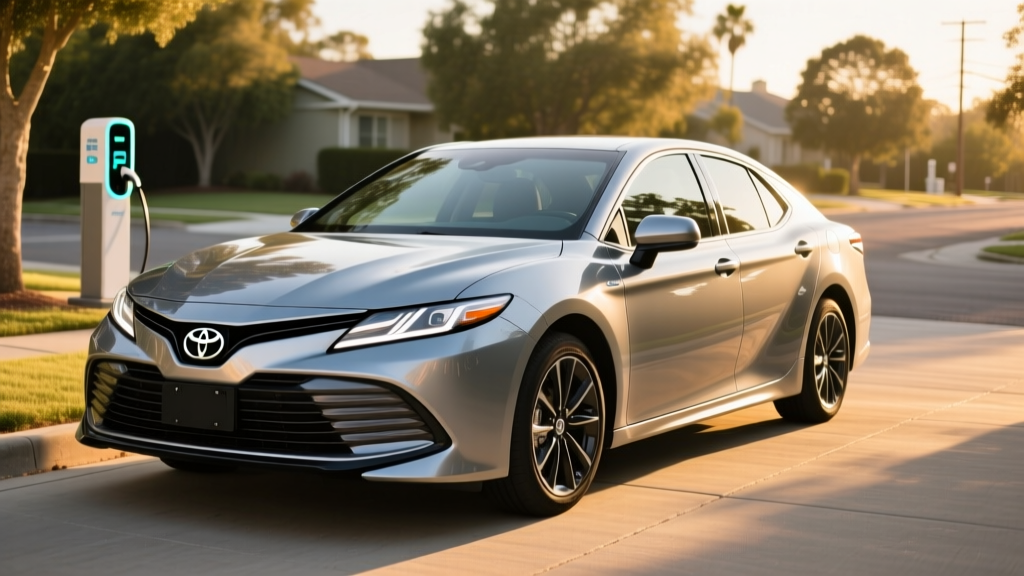
The 2026 Toyota Camry Hybrid XLE sits in a narrow but important lane: it's a midsize sedan that delivers genuine hybrid fuel economy without requiring you to plug in, change your driving habits, or worry about charging infrastructure. For buyers weighing a transition away from a conventional gas car but not yet ready for a full battery-electric vehicle (BEV), the Camry Hybrid XLE is one of the most practical stepping stones available in 2026.
This guide breaks down the exact specs, real-world MPG expectations, ownership economics, and battery longevity for the XLE trim — the more comfort-oriented of the two Camry Hybrid trims (the other being the sportier SE). We'll also clarify where this conventional hybrid (HEV) fits compared to a plug-in hybrid (PHEV) or a full EV.
2026 Toyota Camry Hybrid XLE: Key Specifications
| Attribute | Value |
|---|---|
| Powertrain Type | Conventional Hybrid (HEV) — no plug-in required |
| Engine | 2.5L 4-cylinder Dynamic Force + electric motor |
| Combined Horsepower | 225 hp (FWD) / 232 hp (AWD) |
| Transmission | eCVT (electronically controlled continuously variable) |
| Drivetrain | FWD standard; electronic AWD available |
| EPA Fuel Economy (FWD) | 51 city / 49 highway / 50 combined MPG |
| EPA Fuel Economy (AWD) | 49 city / 47 highway / 48 combined MPG |
| Fuel Tank Capacity | 13.2 gallons |
| Total Driving Range (FWD) | ~660 miles |
| Hybrid Battery | Lithium-ion, ~1.6 kWh (self-charging, no plug) |
| 0–60 mph (est.) | ~7.2 seconds |
| Base MSRP (XLE FWD) | $33,995 |
| AWD Upgrade | +$1,525 |
| Hybrid Battery Warranty | 10 years / 150,000 miles |
| Powertrain Warranty | 5 years / 60,000 miles |
Fuel Economy: EPA Ratings vs. Real-World MPG
The EPA rates the 2026 Camry Hybrid XLE FWD at 51 city / 49 highway / 50 combined MPG. AWD drops those figures slightly to 49/47/48. These numbers come from fueleconomy.gov, the official EPA source.
| Drivetrain | City MPG | Highway MPG | Combined MPG |
|---|---|---|---|
| FWD | 51 | 49 | 50 |
| AWD | 49 | 47 | 48 |
Real-World Expectations
Toyota's hybrid system excels in city driving, where regenerative braking and low-speed electric-only operation do the heavy lifting. In real-world mixed driving, owners consistently report meeting or slightly exceeding the EPA combined figure — especially those with commute-heavy, stop-and-go routes. Expect 48–54 MPG in practice depending on your driving profile.
Highway-only driving at sustained speeds above 70 mph is where hybrids lose their advantage relative to the EPA sticker. The gasoline engine does most of the work at highway speeds, and aerodynamic drag dominates. Plan for 44–48 MPG on long interstate trips. Cold weather (below 35°F) will reduce fuel economy by roughly 5–10% due to engine warm-up cycles and reduced battery efficiency — a factor that applies to all hybrids, not just Toyota.
HEV vs. PHEV vs. EV: Which Powertrain Fits You?
The Camry Hybrid XLE is a conventional hybrid (HEV). It charges its small battery through regenerative braking and the gasoline engine. You never plug it in. This is fundamentally different from a plug-in hybrid (PHEV) like the Toyota RAV4 Prime or a full battery-electric vehicle (BEV) like the Tesla Model 3.
Conventional Hybrid (HEV) — Camry Hybrid XLE
- No plug-in charging needed
- Small battery (~1.6 kWh) charged by regen and engine
- 50 MPG combined; ~660-mile total range
- No electric-only driving range to speak of (brief low-speed EV mode only)
- No federal tax credit (§30D requires plug-in capability)
Plug-In Hybrid (PHEV) — e.g., Toyota RAV4 Prime
- Must be plugged in to access full benefits
- Larger battery (~18.1 kWh) providing ~42 miles electric-only range
- After electric range depletes, operates as a conventional hybrid
- May qualify for up to $7,500 federal tax credit under IRS §30D, subject to income, MSRP caps, and battery sourcing rules
Full Battery Electric (BEV) — e.g., Tesla Model 3, Hyundai Ioniq 6
- No gasoline engine; 100% electric
- Large battery (60–80+ kWh); 250–360+ mile EPA range
- Requires home Level 2 charging setup or reliable public charging access
- Eligible for up to $7,500 federal tax credit (new) or $4,000 (used), subject to eligibility rules
- Lowest per-mile energy cost but highest upfront price
The Camry Hybrid XLE is the right choice if you want dramatically better fuel economy than a gas car, cannot charge at home (apartment, street parking, no garage), drive long distances frequently where charging infrastructure is sparse, or simply don't want to think about plugging in. It's also the lowest-risk electrified option — no range anxiety, no charging logistics, no new habits required.
Powertrain and Driving Character
The 2026 Camry Hybrid pairs a 2.5-liter Dynamic Force four-cylinder engine with Toyota's fifth-generation hybrid system. The FWD model produces 225 combined horsepower; opting for electronic AWD adds a rear-mounted electric motor and bumps the total to 232 hp.
The eCVT transmission is smooth and linear — there are no gear shifts to feel. Acceleration is adequate for merging and passing (0–60 in roughly 7.2 seconds), though this is a comfort-tuned sedan, not a performance car. The XLE trim rides on a tuned suspension with 17-inch alloy wheels and prioritizes ride quality over sportiness. Road noise is well-suppressed, and the electric-only low-speed operation makes city driving nearly silent.
The AWD system is worth considering if you face snow or rain regularly. It uses a separate 40-hp rear electric motor (not a mechanical driveshaft) that engages automatically when front-wheel slip is detected. The fuel economy penalty is modest — just 2 MPG combined.
Pricing, Tax Credits, and Total Cost of Ownership
The 2026 Toyota Camry Hybrid XLE starts at $33,995 MSRP (including destination) for FWD. Adding AWD brings it to $35,520. A fully loaded XLE with options like the panoramic roof, premium audio, and advanced parking assist can push toward $38,000–$39,000.
Federal Tax Credit Eligibility
The Camry Hybrid XLE does NOT qualify for the federal §30D tax credit. The IRS requires a vehicle to have a plug-in capable battery of at least 7 kWh to be eligible. The Camry Hybrid's ~1.6 kWh self-charging battery does not meet this threshold. This applies to all conventional hybrids (HEVs) — only PHEVs and BEVs are eligible.
Some states offer their own incentives for hybrid purchases, though these are far less common than EV incentives. Check your state's energy office or department of revenue for current programs.
5-Year Cost of Ownership Estimate
| Category | Estimated Cost |
|---|---|
| Purchase Price (MSRP) | $33,995 |
| Fuel (at $3.40/gal, 50 MPG avg) | $5,100 |
| Insurance (national avg) | $8,500 |
| Maintenance (hybrid — reduced brake wear, no oil changes as frequent) | $2,200 |
| Depreciation (est. 40% over 5 yr) | $13,600 |
| Total 5-Year Cost | ~$63,395 |
For comparison, a similarly equipped gas-only midsize sedan getting 30 MPG combined would spend roughly $8,500 on fuel over the same period — a $3,400 fuel savings with the Camry Hybrid. Over 10 years of ownership, that gap widens significantly.
Battery Longevity, Warranty, and Replacement Cost
Toyota Hybrid Battery Warranty
10 years or 150,000 miles (whichever comes first) — this applies nationwide and covers capacity loss below a defined threshold. Toyota's hybrid battery warranty is among the strongest in the industry and reflects the company's deep experience with hybrid systems since the 1997 Prius.
The Camry Hybrid uses a relatively small lithium-ion hybrid battery pack (~1.6 kWh). Unlike EV batteries, hybrid batteries experience shallow charge/discharge cycles — the system never fully depletes or fully charges the pack, which significantly reduces degradation stress. Toyota's hybrid battery management system is conservative by design, keeping the battery in a narrow state-of-charge window (roughly 40–80%) to maximize lifespan.
Real-World Battery Longevity
Toyota hybrid batteries routinely last well beyond their warranty period. Data from fleet operators and long-term owners shows many Prius and Camry Hybrid batteries lasting 150,000–200,000+ miles before needing replacement. Failures before 100,000 miles are uncommon.
If replacement is needed out of warranty, a new OEM hybrid battery from Toyota currently costs between $2,500 and $3,500 including labor. Refurbished or reconditioned hybrid batteries are available for $1,000–$2,000. This is a fraction of EV traction battery replacement costs, which can exceed $10,000–$20,000.
Reliability and Safety
Toyota's hybrid system is one of the most proven powertrains in automotive history. The company has sold over 25 million hybrid vehicles globally since 1997, and the Camry nameplate consistently ranks at or near the top of reliability surveys from Consumer Reports and J.D. Power.
The 2026 Camry comes standard with Toyota Safety Sense 3.0, which includes:
- Pre-Collision System with Pedestrian Detection
- Lane Departure Alert with Steering Assist
- Lane Tracing Assist
- Dynamic Radar Cruise Control (full-speed adaptive cruise)
- Road Sign Assist
- Automatic High Beams
The Camry has historically earned top marks from both NHTSA (5-Star overall) and IIHS (Top Safety Pick+). These ratings apply to the current-generation platform, which the 2026 model continues.
XLE Interior, Tech, and Comfort
The XLE trim positions the Camry Hybrid as a comfort-first sedan. Standard features include:
- 8-inch Toyota Audio Multimedia touchscreen with wireless Apple CarPlay and Android Auto
- 7-inch digital driver information display
- Dual-zone automatic climate control
- Heated front seats (SofTex synthetic leather)
- Smart Key with push-button start
- LED headlights and taillights
- 17-inch alloy wheels
- 60/40 split-folding rear seat
- 15.1 cu-ft trunk volume
Available upgrades on the XLE include a 12.3-inch touchscreen, panoramic glass roof, 9-speaker JBL audio system, heated and ventilated front seats, heated steering wheel, and a wireless phone charger. The interior materials and noise isolation are a step above the base LE and the sport-tuned SE.
Pros and Cons: 2026 Camry Hybrid XLE
Pros
- 50 MPG combined — among the best of any midsize sedan
- No plug-in charging required; seamless ownership experience
- 660-mile total range eliminates any range anxiety
- Proven hybrid reliability with 10yr/150k-mile battery warranty
- Standard Toyota Safety Sense 3.0 ADAS suite
- Available AWD for all-weather confidence
- Comfortable, quiet XLE ride quality
Cons
- No federal tax credit (HEV, not eligible under §30D)
- No meaningful electric-only driving range
- eCVT can feel disconnected under hard acceleration
- AWD costs 2 MPG and $1,525 extra
- Rear seat headroom slightly limited with panoramic roof option
- Not as engaging to drive as sportier alternatives
Frequently Asked Questions
How many MPG does the 2026 Toyota Camry Hybrid XLE get?
The FWD model is EPA-rated at 51 city / 49 highway / 50 combined MPG. The AWD model rates at 49/47/48. In real-world driving, most owners report 48–54 MPG depending on driving style and conditions. City-heavy commutes tend to yield higher numbers thanks to regenerative braking.
Do I need to plug in the Camry Hybrid?
No. The 2026 Camry Hybrid XLE is a conventional hybrid (HEV). It charges its battery entirely through regenerative braking and the gasoline engine. There is no plug, no charging cable, and no need for any charging infrastructure. You fuel it like any other car at a gas station.
Does the Camry Hybrid qualify for any tax credit?
The Camry Hybrid XLE does not qualify for the federal §30D Clean Vehicle Credit because it is not a plug-in vehicle. The IRS requires a minimum 7 kWh plug-in battery. Some states may offer small incentives for hybrid purchases — check your state's energy or revenue department for details.
How long will the hybrid battery last and what does replacement cost?
Toyota covers the hybrid battery for 10 years or 150,000 miles. In practice, Toyota hybrid batteries commonly last 150,000–200,000+ miles. If replacement is needed out of warranty, expect to pay $2,500–$3,500 for a new OEM battery with labor, or $1,000–$2,000 for a refurbished unit.
Hybrid vs. PHEV vs. EV — which should I choose?
Choose the Camry Hybrid (HEV) if you can't charge at home, drive long distances often, or want zero lifestyle changes with much better fuel economy. Choose a PHEV if you have home charging, a short commute (under 30–40 miles), and want some electric-only driving plus a gas engine for road trips. Choose a full EV if you have reliable home charging, want the lowest per-mile cost, and are comfortable planning around charging on road trips.
Is the Camry Hybrid XLE AWD worth the extra cost?
If you regularly drive in snow, ice, or heavy rain, the $1,525 AWD upgrade is worthwhile for the added traction and confidence. The electronic AWD system uses a rear electric motor and engages seamlessly. You'll lose 2 MPG combined (48 vs. 50), which translates to roughly $40–$50 per year in additional fuel cost for a 15,000-mile driver.
How does the Camry Hybrid compare to a full EV on cost?
The Camry Hybrid XLE at ~$34,000 is significantly cheaper upfront than most EVs (which typically start at $38,000–$45,000 before incentives). However, EVs have lower per-mile energy costs (roughly $0.04–$0.06/mile on home electricity vs. $0.07–$0.09/mile for the Camry Hybrid at current gas prices) and lower maintenance costs. Over 5–10 years, an EV with home charging and a federal tax credit can break even or come out ahead — but only if charging logistics work for your situation.