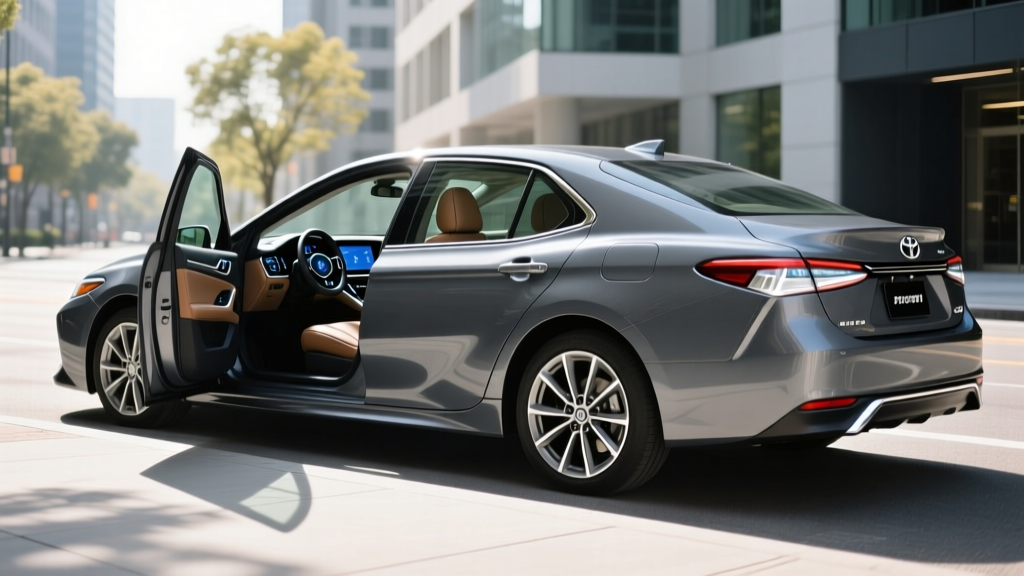
The 2026 Toyota Camry Hybrid SE sits in a sweet spot that few midsize sedans can match: genuine fuel efficiency without sacrificing the sporty styling and driving engagement that SE buyers demand. Now in its second model year on the all-hybrid ninth-generation platform, the Camry Hybrid SE pairs Toyota's fifth-generation hybrid system with a 2.5-liter four-cylinder engine and a tuned sport suspension. The result is a sedan that returns 44 MPG combined on the EPA cycle while offering all-wheel drive, modern safety tech, and a starting price that undercuts many gas-only rivals.
But how does that EPA number translate to real-world driving? Is the SE's sport tuning worth the slight efficiency trade versus the LE trim? And in a market increasingly crowded with plug-in hybrids and full EVs, does a conventional hybrid still make sense? We break down every number that matters.
2026 Camry Hybrid SE at a Glance: Key Specs
| Specification | 2026 Camry Hybrid SE (FWD) | 2026 Camry Hybrid SE (AWD) |
|---|---|---|
| Combined Horsepower | 225 hp | 232 hp |
| Engine | 2.5L 4-cyl + electric motor | 2.5L 4-cyl + dual electric motors |
| EPA City MPG | 48 | 46 |
| EPA Highway MPG | 41 | 39 |
| EPA Combined MPG | 44 | 42 |
| Drivetrain | Front-wheel drive | Electronic AWD (rear motor) |
| 0–60 mph (est.) | ~7.2 sec | ~6.9 sec |
| Hybrid Battery | Lithium-ion, ~1.6 kWh (self-charging) | |
| Base MSRP | $30,995 | $32,395 |
| Federal Tax Credit | Not eligible (HEV) | |
Hybrid (HEV) vs. Plug-In Hybrid (PHEV): What the Camry Actually Is
This is where buyer confusion runs rampant, so let's be precise. The 2026 Toyota Camry Hybrid SE is a conventional hybrid electric vehicle (HEV). It cannot be plugged in. There is no charging port. The small lithium-ion battery recharges exclusively through regenerative braking and the gasoline engine. You fuel it at a gas station like any other car, and the hybrid system seamlessly blends electric and gas power to maximize efficiency.
A plug-in hybrid (PHEV) — like the Toyota RAV4 Prime or the now-discontinued Prius Prime — has a much larger battery (typically 13–18 kWh), a charge port for Level 1 or Level 2 AC charging, and an electric-only driving range of 25–45 miles before the gas engine kicks in. The Camry lineup does not currently offer a PHEV variant.
HEV (Camry Hybrid): No plug. Small battery (~1.6 kWh). Gas-only fueling. 44 MPG combined. Lower upfront cost.
PHEV (e.g., RAV4 Prime): Plug-in capable. Larger battery (~18 kWh). 25–42 mi electric-only range, then operates as a hybrid. Higher upfront cost, may qualify for federal tax credit.
BEV (e.g., Tesla Model 3): Fully electric. No gas engine. 250–360 mi range. Requires home or public charging infrastructure.
Fuel Economy Breakdown: EPA vs. Real-World MPG
The EPA rates the 2026 Camry Hybrid SE FWD at 48 city / 41 highway / 44 combined MPG. The AWD variant drops slightly to 46 city / 39 highway / 42 combined due to the added weight and drag of the rear electric motor. These figures come from fueleconomy.gov and represent standardized laboratory testing.
| Driving Scenario | EPA Estimate (FWD) | Real-World Expectation |
|---|---|---|
| City / stop-and-go | 48 MPG | 47–52 MPG (hybrids excel here) |
| Highway (70–80 mph) | 41 MPG | 37–41 MPG (aero drag reduces gains) |
| Combined mixed driving | 44 MPG | 41–46 MPG |
| Cold weather (below 32°F) | — | 36–40 MPG (engine runs more for heat) |
The key insight for hybrid fuel economy: city driving is where the Camry Hybrid shines brightest. Regenerative braking recovers energy at every stoplight, and the electric motor handles low-speed acceleration where gas engines are least efficient. Many owners report exceeding the 48 MPG city estimate in warm-weather urban commuting. Highway efficiency is more modest because the gasoline engine does the majority of work at sustained speeds, and the sedan's aerodynamic profile faces the same physics as any other car.
In cold weather, expect a 10–15% efficiency drop. The engine runs longer to provide cabin heat and to warm the catalytic converter, reducing the hybrid system's ability to shut it off at stops. This is a characteristic of all hybrids, not a defect.
Powertrain Deep Dive: How 225 Horsepower Meets 44 MPG
The 2026 Camry Hybrid SE uses Toyota's fifth-generation Hybrid Synergy Drive. A 2.5-liter Dynamic Force four-cylinder engine produces 184 hp and 163 lb-ft of torque on its own, while a front-mounted electric motor adds supplemental power. Combined system output is 225 horsepower in FWD form.
Opt for the electronic AWD system and a second, independent electric motor on the rear axle provides up to 40 additional horsepower to the rear wheels when traction demands it — bringing combined output to 232 hp. This rear motor is not mechanically linked to the front powertrain; it engages automatically during acceleration, slippery conditions, or cornering to improve stability.
The SE trim specifically gets a sport-tuned suspension with stiffer spring rates and a unique calibration for the electric power steering. It doesn't change the hybrid system itself, but it makes the Camry feel more composed on back roads than the softer LE or XLE trims. The trade-off is a slightly firmer ride over rough pavement — noticeable but not harsh.
An electronically controlled continuously variable transmission (eCVT) routes power to the wheels. Unlike belt-driven CVTs in some competitors, Toyota's planetary-gear eCVT has no belts or pulleys to wear, contributing to the powertrain's reputation for longevity.
Pricing, Trims, and Tax Credit Reality
The 2026 Camry Hybrid SE starts at $30,995 for FWD and $32,395 for AWD, including destination charges. Standard equipment includes Toyota Safety Sense 3.0 (pre-collision braking, full-speed adaptive cruise, lane-keeping assist, blind-spot monitoring), an 8-inch touchscreen with wireless Apple CarPlay and Android Auto, wireless phone charging, a 7-inch digital gauge cluster, and 18-inch alloy wheels with a dark-gray finish.
Options are limited but meaningful: a $1,150 package adds a power moonroof and heated front seats. Navigation and a 12.3-inch upgrade screen are available through the Audio Plus package at approximately $1,400.
The 2026 Toyota Camry Hybrid SE is not eligible for the IRS §30D Clean Vehicle Credit ($7,500). That credit applies only to plug-in electric vehicles (BEVs and PHEVs) meeting battery-sourcing, MSRP, and buyer-income requirements. As a conventional HEV, the Camry Hybrid does not qualify. Some state or local utility rebates may apply to hybrids — check your state energy office or utility provider for current programs. Consult a tax professional for personal eligibility.
While the lack of a federal credit stings compared to a PHEV or BEV, the Camry Hybrid's lower base price often results in a lower total out-of-pocket cost. A comparably equipped PHEV sedan (if one existed in this segment) would typically start $8,000–$12,000 higher before any credit is applied.
Hybrid Battery Warranty and Long-Term Reliability
Toyota covers the hybrid battery in the 2026 Camry Hybrid with a 10-year / 150,000-mile warranty (whichever comes first) in all 50 states. This was upgraded from the previous 8-year/100,000-mile term starting with the 2020 model year and applies to all states, not just CARB-states as it once did.
Hybrid battery: 10 years / 150,000 miles
Hybrid system components (inverter, motor, control module): 8 years / 100,000 miles
Basic vehicle: 3 years / 36,000 miles
Powertrain (engine, transaxle): 5 years / 60,000 miles
Replacement cost if out of warranty: Approximately $3,000–$4,500 (dealer), $1,500–$2,500 (independent hybrid specialist, refurbished unit)
Toyota's hybrid battery track record is among the best in the industry. The Prius, now in its fifth generation, has demonstrated hybrid batteries lasting 150,000–250,000+ miles with minimal degradation in real-world fleet data. The Camry Hybrid's lithium-ion pack is smaller and less stressed than a PHEV or BEV battery because it operates within a narrow state-of-charge window (roughly 40–80% SoC), managed by the hybrid control system to prevent deep cycling — the primary cause of lithium-ion degradation.
If a replacement is eventually needed out of warranty, Toyota dealers typically quote $3,000–$4,500 for a new hybrid battery pack and installation. Independent hybrid specialists can often source refurbished or reconditioned packs for $1,500–$2,500 installed. Individual module replacement (rather than the full pack) is sometimes possible for $200–$500 per module at a specialist shop.
Who Should Buy the Camry Hybrid SE — And Who Shouldn't
- You want 40+ MPG without changing your fueling habits
- You drive 12,000–20,000 miles/year with a heavy city/commute mix
- You lack access to home or workplace EV charging
- You want a midsize sedan with strong resale value and proven reliability
- You prefer a sport-tuned ride over a plush, floaty one
- You want AWD availability in a fuel-efficient sedan
- You want electric-only driving for short commutes (consider a PHEV)
- You have reliable home Level 2 charging and want to eliminate gas entirely (consider a BEV)
- You prioritize the softest possible ride (choose the XLE trim or a Lexus ES Hybrid)
- You need more than 15.1 cu ft of trunk space (the hybrid battery slightly reduces cargo vs. some rivals)
- You're chasing a federal tax credit to offset purchase cost
Camry Hybrid SE vs. the Alternatives
The midsize hybrid sedan segment is competitive. Here's how the Camry Hybrid SE stacks up against its closest rivals:
| Model | EPA Combined MPG | Horsepower | Base MSRP |
|---|---|---|---|
| 2026 Toyota Camry Hybrid SE | 44 | 225 | $30,995 |
| 2026 Honda Accord Hybrid Sport | 43 | 204 | $33,990 |
| 2026 Hyundai Sonata Hybrid SEL | 47 | 192 | $31,250 |
| 2026 Kia K5 Hybrid (est.) | ~42 | ~195 | ~$30,500 |
The Sonata Hybrid edges out the Camry on EPA paper (47 vs. 44 combined) thanks to its solar roof panel contribution and slightly lighter weight, but the Camry offers more horsepower, available AWD, and Toyota's stronger long-term reliability data. The Accord Hybrid is the most refined to drive but commands a higher entry price. The Camry Hybrid SE's combination of efficiency, power, AWD availability, and pricing makes it the best-balanced pick in this group for most buyers.
Frequently Asked Questions
How many MPG does the 2026 Camry Hybrid SE actually get?
The EPA rates it at 48 city / 41 highway / 44 combined for FWD, and 46/39/42 for AWD. In real-world driving, expect 41–46 MPG combined depending on conditions. City-heavy routes often push past the EPA city estimate, while sustained highway driving at 75+ mph will pull the average toward the high 30s.
Can I plug in the Camry Hybrid to charge?
No. The 2026 Camry Hybrid is a conventional hybrid (HEV) with no plug and no charging port. The hybrid battery charges through regenerative braking and the gasoline engine. You fuel it exclusively at a gas station. If you want plug-in capability, you'd need to look at a PHEV like the Toyota Prius Prime or RAV4 Prime.
Does the 2026 Camry Hybrid qualify for any tax credit?
It does not qualify for the federal IRS §30D Clean Vehicle Credit, which is reserved for plug-in vehicles (BEVs and PHEVs). Some states and local utilities offer smaller rebates for hybrid purchases — check your state energy office or utility provider. Always consult a tax professional for personal guidance.
How long will the Camry Hybrid battery last?
Toyota warranties the hybrid battery for 10 years or 150,000 miles. Based on historical data from Toyota's hybrid fleet (Prius, Camry Hybrid, RAV4 Hybrid), these batteries commonly last 150,000–250,000 miles before needing replacement. The battery operates in a narrow charge window that minimizes degradation, and the system actively manages temperature to prevent heat damage.
Is the SE trim worth it over the LE?
If you value sharper handling, sport-tuned suspension, 18-inch wheels, and a more aggressive exterior appearance, yes. The SE sacrifices roughly 3 MPG combined versus the LE (44 vs. 47 combined for FWD) due to wider tires and stiffer tuning. For pure efficiency, the LE wins. For driving engagement, the SE is the clear pick.
Hybrid vs. PHEV vs. EV — which is right for me?
Choose a conventional hybrid (HEV) like the Camry Hybrid if you want maximum simplicity — no charging, no range anxiety, proven reliability, and strong MPG. Choose a PHEV if you have home charging and a short commute (under 35 miles) that could be done mostly on electricity, but you still want a gas engine for road trips. Choose a full EV (BEV) if you have reliable home Level 2 charging, want the lowest per-mile fuel cost, and your driving patterns fit within a 250–350 mile range. For a deeper breakdown, see our hybrid comparison tool on fueleconomy.gov.