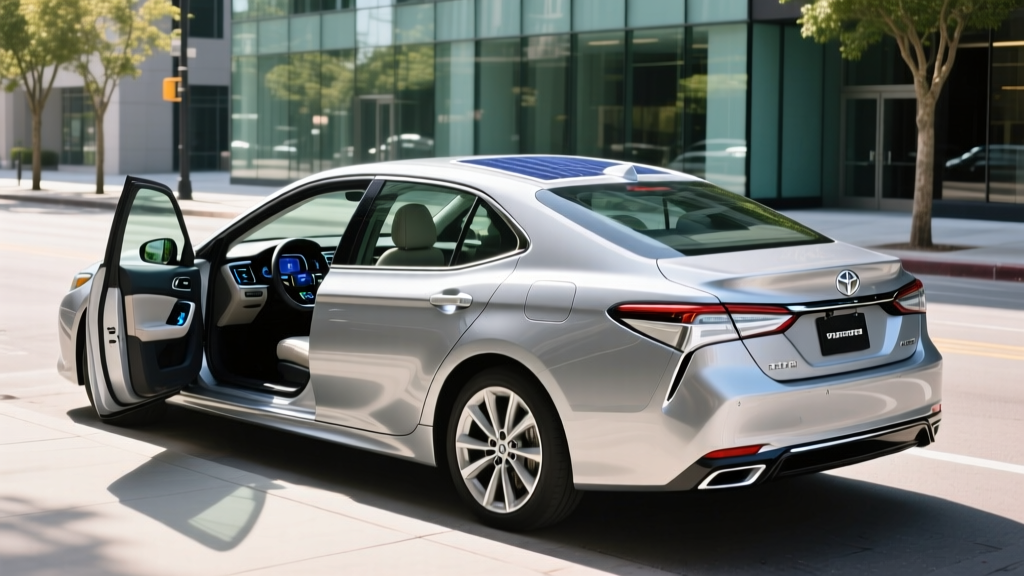
The 2026 Toyota Camry is now exclusively a hybrid. Toyota dropped the four-cylinder gas-only variant after the 2024 model year, betting entirely on its fifth-generation Toyota Hybrid System (THS) to power America's best-selling midsize sedan. For buyers researching the 2026 Toyota Camry Hybrid, the result is a lineup that delivers up to 51 MPG combined without ever needing a plug — and an available electronic all-wheel-drive system that doesn't sacrifice fuel economy the way traditional AWD sedans do.
This overview covers every trim's EPA fuel economy, the powertrain engineering underneath, real-world MPG expectations, battery longevity, pricing, and tax credit eligibility. If you're weighing the Camry Hybrid against a plug-in hybrid or a full battery-electric vehicle, we break down which powertrain actually fits your driving pattern.
HEV vs PHEV: The 2026 Camry Is a Conventional Hybrid
Key distinction: The 2026 Toyota Camry Hybrid is a conventional hybrid electric vehicle (HEV). It does not plug in. It has no electric-only driving range to speak of (the small battery assists the gas engine and enables brief low-speed electric creep, but you cannot charge it from a wall outlet). If you want plug-in capability from Toyota in this segment, the closest option is the Toyota Prius Prime (a PHEV with ~40 miles of electric-only range) or the RAV4 Prime SUV.
| Factor | HEV (Camry Hybrid) | PHEV (Prius Prime) | BEV (Tesla Model 3 / Hyundai Ioniq 6) |
|---|---|---|---|
| Plugs in? | No | Yes (Level 1/2) | Yes (Level 1/2/DC) |
| Electric-only range | ~0.5 mi (low-speed creep) | ~40 mi | 270–360 mi |
| Home charging needed? | No | Recommended for benefit | Essential |
| Fuel/energy cost per mile | ~$0.08–$0.10 | ~$0.04 electric / $0.09 gas | ~$0.03–$0.05 |
| Upfront price premium | Low | Moderate | High |
| Best for | No home charging access | Short commute + home plug | Home L2 + daily <250 mi |
The Camry Hybrid's appeal is simplicity: you fuel it like any gas car and the hybrid system handles the rest. No charging cables, no range planning, no dependency on public charging infrastructure.
2026 Camry Hybrid MPG: EPA Ratings by Trim
Every 2026 Camry Hybrid uses a 2.5-liter four-cylinder engine paired with one or two electric motors through Toyota's THS V hybrid transaxle. Front-wheel-drive (FWD) models use a single front motor; all-wheel-drive (AWD) trims add a second, independent rear motor for electronic AWD. Here's the EPA fuel economy breakdown, sourced from fueleconomy.gov:
| Trim | Drivetrain | City MPG | Highway MPG | Combined MPG |
|---|---|---|---|---|
| LE | FWD | 53 | 50 | 51 |
| LE | AWD | 51 | 49 | 50 |
| SE | FWD | 48 | 47 | 47 |
| SE | AWD | 46 | 46 | 46 |
| XLE | FWD | 48 | 47 | 47 |
| XLE | AWD | 46 | 46 | 46 |
| XSE | FWD | 48 | 47 | 47 |
| XSE | AWD | 46 | 46 | 46 |
The LE trim's 53/50/51 rating makes it one of the most fuel-efficient non-plug-in midsize sedans on the market. The SE, XLE, and XSE trims drop slightly due to larger 18- or 19-inch wheels, wider tires, and sport-tuned suspension tuning that increases rolling resistance.
Real-World MPG: What Owners Actually Report
Toyota hybrids tend to exceed their EPA city estimates in stop-and-go traffic because regenerative braking recaptures energy that a gas-only car wastes as heat. On the highway, where regen provides less benefit and aerodynamic drag dominates, real-world numbers often land 1–3 MPG below the EPA sticker.
Based on owner-reported data from fueleconomy.gov's My MPG tool and long-term fleet testing:
- City driving (LE FWD): Expect 50–56 MPG. Short trips with frequent stops maximize regen benefit.
- Highway driving (70–75 mph): Expect 45–49 MPG. The 2.5L Atkinson-cycle engine runs more often at sustained speed.
- Cold weather (below 32°F): Expect a 5–10% drop. The engine runs longer to heat the cabin and bring the catalytic converter to operating temperature.
- Combined real-world average: Most LE owners report 48–52 MPG over mixed driving.
The AWD penalty is minimal — roughly 1 MPG combined versus FWD — because the rear motor only engages when slip is detected or during hard acceleration.
Powertrain Specs: Fifth-Gen Toyota Hybrid System
| Specification | Detail |
|---|---|
| Engine | 2.5L 4-cylinder Atkinson-cycle (A25A-FXS) |
| Engine output | 184 hp / 163 lb-ft torque |
| Front electric motor | Permanent-magnet synchronous, 134 hp |
| Rear electric motor (AWD only) | 40 hp (independent, no mechanical driveshaft) |
| Net combined system horsepower | 225 hp (FWD) / 232 hp (AWD) |
| Transmission | eCVT (planetary gearset, no belt) |
| Hybrid battery | ~1.1 kWh lithium-ion (sealed NiMH on prior gens) |
| 0–60 mph | ~7.1 seconds (FWD) / ~6.9 seconds (AWD) |
| Fuel tank | 13.2 gallons |
| Total driving range (LE FWD) | ~673 miles (13.2 gal × 51 MPG) |
| Towing capacity | Not rated for towing |
The combined 225 hp (232 with AWD) is a meaningful step up from the outgoing fourth-generation Camry Hybrid's 208 hp. The AWD system uses a dedicated rear motor rather than a mechanical driveshaft, so there's no efficiency-robbing parasitic loss when AWD isn't needed. The rear motor engages automatically during acceleration from a stop, in low-traction conditions, and during certain cornering scenarios to improve stability.
The eCVT is Toyota's planetary-gear power-split device — not a belt-and-cone CVT like those found in some competitors. It has no slippage, no rubber band effect, and is widely regarded as one of the most durable transmissions in the industry.
Pricing, Trims & Tax Credit Eligibility
The 2026 Camry Hybrid lineup starts at approximately $29,490 for the LE FWD (including destination charge) and tops out around $37,500 for a fully optioned XSE AWD. Key trim pricing:
- LE FWD: ~$29,490
- LE AWD: ~$30,890
- SE FWD: ~$31,490
- SE AWD: ~$32,890
- XLE FWD: ~$34,190
- XLE AWD: ~$35,590
- XSE FWD: ~$34,790
- XSE AWD: ~$36,190
Does the 2026 Camry Hybrid Qualify for a Federal Tax Credit?
No. The conventional Camry Hybrid (HEV) does not qualify for the IRS §30D Clean Vehicle Credit. That credit — up to $7,500 — is reserved for plug-in electric vehicles (PHEVs and BEVs) that meet battery capacity, critical-mineral sourcing, MSRP cap, and buyer income requirements. Since the Camry Hybrid cannot be plugged in and has a battery far below the 7 kWh threshold, it is ineligible.
However, some states and utilities offer rebates for conventional hybrids. Check your state energy office and local utility for current programs. If you want a Toyota that qualifies for the federal credit, the RAV4 Prime (PHEV) may be eligible depending on current-year sourcing rules — verify on IRS.gov's qualified vehicle list before purchasing.
Battery Warranty, Reliability & Replacement Cost
2026 Camry Hybrid Battery Warranty: Toyota covers the hybrid battery assembly for 10 years or 150,000 miles (whichever comes first) in all 50 states. This applies to the traction (hybrid) battery, not the separate 12V auxiliary battery. The warranty covers capacity loss below a defined threshold and all internal component failures.
Toyota's hybrid battery track record is among the best in the industry. The Prius, which has used a similar THS architecture since 2001, has demonstrated hybrid battery lifespans routinely exceeding 200,000 miles with minimal degradation. The fifth-generation system uses a lithium-ion hybrid battery pack (replacing the older nickel-metal-hydride units), which offers better energy density and thermal stability.
Hybrid Battery Replacement Cost
If the hybrid battery fails outside warranty — uncommon but possible on very high-mileage vehicles — replacement costs typically range from $2,000 to $4,000 for a new OEM battery pack installed at a Toyota dealer. Refurbished/remanufactured packs are available from $1,000–$2,000. Individual modules can sometimes be replaced for $300–$600 if only a single cell group has degraded, though this is less common on the newer lithium-ion packs.
For context, the hybrid battery in the Camry is small (~1.1 kWh) compared to a full EV battery (60–100 kWh), which is why replacement costs are a fraction of what a BEV owner might face.
Overall Reliability
Toyota consistently ranks at or near the top of dependability studies from J.D. Power and Consumer Reports. The Camry Hybrid benefits from a powertrain with fewer wear items than a conventional gas car: no traditional starter motor, no alternator, no accessory drive belt, and regenerative braking that significantly extends brake pad life (many owners report 80,000+ miles on original brake pads).
Who Should Choose the Camry Hybrid vs a PHEV or Full EV?
Choose the Camry Hybrid (HEV) If:
- You don't have access to home or workplace charging
- You want maximum simplicity — fuel and go
- You regularly drive more than 400 miles between stops
- You live in an apartment or street-park with no outlet access
- You want AWD without the efficiency penalty of a gas AWD sedan
- You want a proven, low-risk powertrain with a 10-year battery warranty
Consider a PHEV or Full EV Instead If:
- You have home Level 2 charging and a commute under 40 miles (PHEV)
- You want the lowest possible per-mile fuel cost ($0.03–$0.05/mi on electricity)
- You want to qualify for the $7,500 federal tax credit (PHEV/BEV)
- You want zero tailpipe emissions for daily driving (BEV or PHEV in EV mode)
- You have a short daily commute and rarely road-trip more than 300 miles (BEV)
- You want one-pedal driving and instant torque (BEV)
The Camry Hybrid occupies a specific niche: drivers who want dramatically better fuel economy than a gas car without changing their refueling behavior. If you can plug in at home, a PHEV like the Prius Prime gives you 40 miles of electric commuting plus a gas engine for road trips — and may qualify for federal incentives. A full EV like the Tesla Model 3 or Hyundai Ioniq 6 offers the lowest operating cost and smoothest driving experience, but requires reliable home or workplace charging and acceptance of DC fast-charging logistics on long trips.
Ownership Costs: 5-Year Estimate
| Cost Category | Camry Hybrid LE (51 MPG) | Gas Sedan (28 MPG avg) |
|---|---|---|
| Fuel (at $3.40/gal avg) | ~$5,000 | ~$9,107 |
| Maintenance (oil, brakes, tires) | ~$2,200 | ~$3,100 |
| Insurance (avg) | ~$7,500 | ~$7,200 |
| Estimated depreciation | ~$11,000 | ~$12,500 |
| 5-year total (est.) | ~$25,700 | ~$31,907 |
The Camry Hybrid's fuel savings alone — roughly $4,100 over five years versus a 28 MPG gas sedan — largely offset its slightly higher purchase price. Toyota hybrids also tend to hold resale value well, further narrowing the total cost gap. Brake savings from regenerative braking add another $200–$400 over five years.
Frequently Asked Questions
How many MPG does the 2026 Toyota Camry Hybrid get?
The most efficient trim, the LE FWD, is EPA-rated at 53 city / 50 highway / 51 combined MPG. Sport-oriented SE, XLE, and XSE trims are rated at 47–48 combined. AWD reduces combined MPG by about 1 MPG across all trims. Real-world combined driving typically yields 48–52 MPG for the LE.
Does the 2026 Camry Hybrid need to be plugged in?
No. The Camry Hybrid is a conventional HEV — it charges its small hybrid battery through regenerative braking and the gas engine. There is no plug, no charging cable, and no electric-only driving range to manage.
Is AWD available on the 2026 Camry Hybrid?
Yes. AWD is available on every trim (LE, SE, XLE, XSE). It uses a separate 40 hp rear electric motor with no mechanical driveshaft. The AWD system costs approximately $1,400 extra and reduces combined fuel economy by only ~1 MPG.
How long will the Camry Hybrid battery last?
Toyota's hybrid batteries routinely last 150,000–200,000+ miles based on historical data from the Prius and prior Camry Hybrid generations. The battery is warranted for 10 years / 150,000 miles in all states. Out-of-warranty replacement runs $2,000–$4,000 for a new OEM pack.
Does the 2026 Camry Hybrid qualify for any tax credit?
Not the federal §30D Clean Vehicle Credit — that requires a plug-in vehicle with at least 7 kWh of battery capacity. Some state and utility programs offer hybrid rebates; check your local programs. If federal credit eligibility is a priority, look at the RAV4 Prime or Prius Prime (PHEVs) or a qualifying BEV.
How does the Camry Hybrid compare to the Honda Accord Hybrid?
The 2026 Accord Hybrid is rated at approximately 48 combined MPG (EX-L) to 44 combined (Sport), putting the Camry Hybrid LE's 51 combined slightly ahead on EPA paper. The Camry offers available AWD (the Accord Hybrid does not). Both are strong choices — the Accord tends toward a more engaging driving feel, while the Camry prioritizes efficiency and powertrain simplicity.
What is the 0–60 mph time for the 2026 Camry Hybrid?
Toyota rates the FWD Camry Hybrid at approximately 7.1 seconds to 60 mph, with AWD models slightly quicker at ~6.9 seconds thanks to the additional rear motor and 232 combined horsepower. That's competitive with turbocharged gas midsize sedans and noticeably quicker than the previous-generation Camry Hybrid.