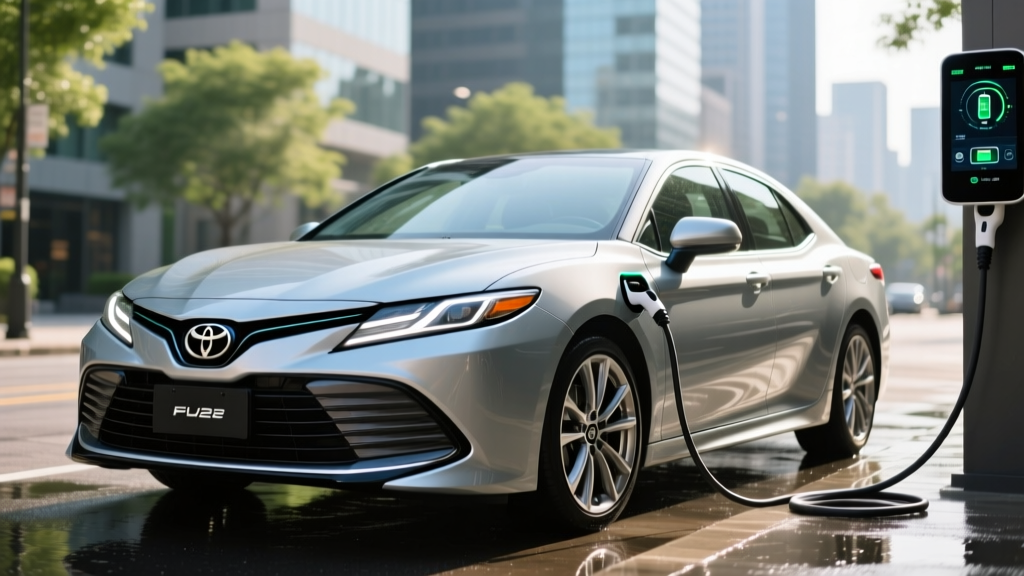
The Toyota Camry has been America's best-selling sedan for years, and for the 2026 model year, every Camry rolling off the line is a hybrid. Toyota dropped the conventional gas-only powertrain entirely, betting that the Toyota Camry hybrid vehicle delivers the efficiency buyers want without the range anxiety or charging logistics of a full EV. After spending time with the specs, the EPA data, and real-world ownership reports, that bet looks well-founded — though it comes with trade-offs worth understanding before you sign.
This guide breaks down the 2026 Camry Hybrid's fuel economy, powertrain, pricing, battery longevity, and how it stacks up against plug-in hybrids and battery-electric sedans. If you're cross-shopping this against a Hyundai Sonata Hybrid, Honda Accord Hybrid, or a Tesla Model 3, you'll find the data you need here.
HEV vs PHEV: Where the Camry Hybrid Fits
Before diving into numbers, let's establish what the Camry Hybrid actually is. It's a conventional hybrid electric vehicle (HEV), not a plug-in hybrid (PHEV). This distinction matters because it determines how you fuel it, what kind of efficiency you get, and whether you'll ever need to think about charging infrastructure.
HEV (Camry Hybrid) vs PHEV vs Full EV — At a Glance
| Feature | HEV (Camry Hybrid) | PHEV (e.g., Prius Prime) | BEV (e.g., Tesla Model 3) |
|---|---|---|---|
| Plugs in? | No — gas only | Yes — gas + plug | Yes — plug only |
| Electric-only range | N/A (motor assists engine) | 25–45 mi typical | 250–360 mi |
| Battery size | ~1.1 kWh (small NiMH/Li-ion) | 13–18 kWh | 50–82 kWh |
| Home charging needed? | No | Recommended | Essential |
| Federal tax credit | No | Up to $7,500 (§30D, if eligible) | Up to $7,500 (§30D, if eligible) |
| Best for | No charging access, long trips | Short commute + road trips | Home charging, lower fuel cost |
The Camry Hybrid captures energy through regenerative braking and the gasoline engine to charge its small battery pack. You never plug it in. You simply fill it with regular unleaded gasoline and drive. The electric motor assists the engine during acceleration, enables brief electric-only operation at low speeds, and allows the engine to shut off at stops — all of which cuts fuel consumption dramatically compared to a gas-only sedan.
If you can charge at home and want electric-only commuting, a PHEV like the Toyota Prius Prime gives you roughly 44 miles of EV range before the gas engine kicks in. If you want zero gasoline, a BEV is the answer. But if you live in an apartment, park on the street, or regularly drive 400+ mile stretches, the Camry HEV eliminates charging logistics entirely while still delivering outstanding efficiency.
Fuel Economy: EPA Ratings and Real-World MPG
The 2026 Camry Hybrid carries forward the fifth-generation Toyota Hybrid System (THS) introduced with the 2025 redesign. EPA fuel economy figures remain strong across the lineup, though all-wheel-drive trims carry a slight penalty.
| Trim / Drivetrain | City MPG | Highway MPG | Combined MPG |
|---|---|---|---|
| LE (FWD) | 53 | 50 | 51 |
| SE / XLE / XSE (FWD) | 48 | 47 | 47 |
| SE / XLE / XSE (AWD) | 46 | 46 | 46 |
Source: fueleconomy.gov (EPA estimates). Actual mileage will vary.
Real-World MPG vs. EPA Sticker
Toyota hybrids have a well-documented tendency to exceed their EPA city ratings in stop-and-go driving, because that's where regenerative braking and electric-motor assist work hardest. Owners in urban environments regularly report 54–58 MPG in the LE FWD trim during warm-weather city commuting.
Highway driving is a different story. At sustained 75–80 mph speeds, expect the LE to return roughly 44–48 MPG — somewhat below its 50 MPG highway sticker. The sportier SE/XSE trims with wider tires and a stiffer suspension tune typically see 42–45 MPG on the interstate.
Cold weather impact: In sub-freezing temperatures, the gasoline engine runs more frequently to maintain cabin heat and battery temperature. Expect a 5–10% fuel economy drop in winter, bringing a 51 MPG combined LE down to roughly 46–48 MPG until temperatures recover.
For context, a comparable gas-only midsize sedan averages around 30–32 MPG combined. The Camry Hybrid cuts fuel consumption by roughly 35–40%, which at 15,000 miles per year and $3.40/gallon gas translates to approximately $700–$900 in annual fuel savings over a non-hybrid competitor.
Powertrain: 232 Horsepower from Toyota's Fifth-Gen Hybrid System
The 2026 Camry Hybrid pairs a 2.5-liter four-cylinder Dynamic Force engine with one or two electric motors (FWD trims use one front motor; AWD trims add a rear-axle motor). Combined output is 225 horsepower for FWD and 232 horsepower for AWD trims.
| Specification | FWD Trims | AWD Trims |
|---|---|---|
| Engine | 2.5L 4-cyl Dynamic Force | 2.5L 4-cyl Dynamic Force |
| Combined net horsepower | 225 hp | 232 hp |
| Electric motor(s) | 1 front motor (100 kW) | 1 front (100 kW) + 1 rear (30 kW) |
| Transmission | eCVT (planetary gearset) | eCVT (planetary gearset) |
| 0–60 mph (est.) | ~7.1 sec | ~6.8 sec |
| Hybrid battery capacity | ~1.1 kWh (Li-ion) | ~1.1 kWh (Li-ion) |
| Fuel type | Regular unleaded (87 octane) | Regular unleaded (87 octane) |
The eCVT is not a belt-and-pulley continuously variable transmission like you'd find in a Subaru or Nissan. Toyota's system uses a planetary gearset that seamlessly blends engine and motor power with no belts to wear and no rubber-band acceleration feel. It's one of the most proven hybrid drivetrains on the road — the same architecture that has powered millions of Prius, RAV4 Hybrid, and Camry Hybrid vehicles since 1997.
Acceleration is adequate for merging and passing but won't thrill anyone coming from a turbocharged sport sedan. The AWD model's extra rear motor provides modest traction benefits in rain and light snow, though it's not a substitute for a dedicated AWD SUV in severe winter conditions.
Pricing, Trims, and Tax Credit Eligibility
The 2026 Camry Hybrid lineup spans four trims, all with the option of AWD on SE, XLE, and XSE grades.
| Trim | Drivetrain | MSRP (incl. destination) |
|---|---|---|
| LE | FWD only | $29,495 |
| SE | FWD or AWD (+$1,600) | $30,795 |
| XLE | FWD or AWD (+$1,600) | $34,495 |
| XSE | FWD or AWD (+$1,600) | $35,795 |
Does the Camry Hybrid Qualify for a Federal Tax Credit?
No. The federal §30D Clean Vehicle Credit applies only to plug-in electric vehicles (PHEVs and BEVs) with sufficient battery capacity and meeting critical-mineral and battery-component sourcing requirements. The Camry Hybrid is a conventional HEV with a ~1.1 kWh battery — far below the 4 kWh minimum threshold for any federal incentive.
Some states offer their own hybrid incentives or HOV lane access, but these vary widely by jurisdiction. Check your state's energy office or DMV for current programs. A tax professional can advise on any applicable local credits.
Source: IRS Clean Vehicle Tax Credits
The absence of a tax credit does sting when comparing against PHEVs that can knock $3,750–$7,500 off the effective purchase price. However, the Camry Hybrid's lower base price — often $5,000–$10,000 less than a comparable PHEV or BEV sedan — means the out-of-pocket cost can still be competitive even without incentives.
Battery Longevity, Warranty, and Replacement Cost
Hybrid battery anxiety is the single biggest concern we hear from first-time hybrid buyers. Here's the reality after two decades of Toyota hybrid data:
Toyota Hybrid Battery Warranty
- Coverage: 10 years / 150,000 miles (whichever comes first)
- What's covered: Hybrid battery pack and hybrid system components (inverter, control module)
- Capacity threshold: Toyota warrants the battery against defects and abnormal degradation; there is no published minimum capacity retention percentage as with BEVs
- Transferable: Yes — warranty transfers to subsequent owners, which supports resale value
Toyota's hybrid battery packs are deliberately small (~1.1 kWh) and are never fully charged or fully discharged during normal operation. The system maintains a state-of-charge window of roughly 40–80%, which dramatically reduces stress on the cells. This is why Toyota hybrid batteries routinely last 150,000–200,000+ miles with minimal degradation — the battery is barely working compared to a full EV pack that cycles through 80–100% of its capacity daily.
Replacement cost if out of warranty: A new OEM hybrid battery pack for the Camry Hybrid runs approximately $2,500–$4,000 including labor at a Toyota dealer. Independent hybrid specialists and refurbished packs can bring this down to $1,500–$2,500. For context, this is a fraction of the $8,000–$20,000+ that a full EV battery replacement can cost.
In practice, hybrid battery failure before 150,000 miles is rare. Data aggregated from owner forums and repair databases shows failure rates well under 5% within the warranty period for Toyota's fifth-generation system. The bigger maintenance items over 150,000 miles are conventional: brake fluid, coolant changes, and standard suspension wear — though regenerative braking significantly extends brake pad life, with many owners reporting 80,000+ miles on original pads.
Camry Hybrid vs. EV vs. PHEV: Which Powertrain Fits You?
Decision Framework: Which Powertrain Is Right for You?
Choose the Camry Hybrid (HEV) if:
- You don't have access to home or workplace charging
- You regularly drive 300+ miles in a single trip and don't want to plan around charging stops
- You want maximum fuel efficiency with zero behavior change — just gas up and go
- Your budget is under $36,000 and you don't qualify for EV tax credits (income too high, or need a lower MSRP)
- You live in an area with sparse DC fast-charging infrastructure
Choose a PHEV (Prius Prime, RAV4 Prime) if:
- You can charge at home (Level 1 or Level 2) and your daily commute is under 40 miles
- You want to drive mostly on electricity but still need gas flexibility for road trips
- You qualify for the federal §30D credit (income under $150K single / $300K joint, and the model meets sourcing rules)
Choose a full BEV (Model 3, Ioniq 6, Model Y) if:
- You have reliable home Level 2 charging
- You want the lowest per-mile fuel cost (electricity at ~$0.12/kWh ≈ $4/gallon equivalent)
- You want zero tailpipe emissions and minimal drivetrain maintenance (no oil changes, no spark plugs)
- Your daily driving is under 250 miles and you can plan road-trip charging
The Camry Hybrid occupies a specific and valuable niche: it's the most efficient option for drivers who cannot or do not want to plug in. If you're in a condo without charging, park on the street, or simply want the simplicity of a gas station stop every 550+ miles, the Camry HEV delivers near-diesel efficiency on regular unleaded with none of the charging logistics.
Pros and Cons at a Glance
✓ Pros
- 51 MPG combined (LE) — among the best of any non-plug-in sedan
- No charging required — zero infrastructure dependency
- 10-year/150,000-mile hybrid battery warranty
- Standard Toyota Safety Sense 3.0 (adaptive cruise, lane-keeping, auto emergency braking)
- Strong resale value — Camry Hybrids hold value well in the used market
- AWD available on SE/XLE/XSE trims
- Runs on regular 87-octane gasoline
✗ Cons
- No federal tax credit eligibility (HEV, not PHEV/BEV)
- AWD limited to LE trim is not available; LE is FWD only
- Modest 225–232 hp — adequate but not quick for a 3,500-lb sedan
- Rear battery packaging slightly reduces trunk pass-through vs. some rivals
- No plug-in variant offered — if you want electric-only commuting, look at the Prius Prime
- Sport trims (SE/XSE) drop to 47 MPG combined with wider tires
Ownership Costs: 5-Year Fuel Savings vs. Gas and EV
To put the Camry Hybrid's efficiency in financial perspective, here's a 5-year fuel cost comparison assuming 15,000 miles per year (45% city / 55% highway) and $3.40/gallon regular unleaded:
| Vehicle | Combined MPG / MPGe | 5-Year Fuel Cost |
|---|---|---|
| 2026 Camry Hybrid LE | 51 MPG | $4,990 |
| Gas midsize sedan (31 MPG avg.) | 31 MPG | $8,225 |
| Tesla Model 3 RWD (home charging, $0.13/kWh) | 132 MPGe | $2,925 |
The Camry Hybrid saves roughly $3,200 over a gas sedan across five years. A home-charged BEV saves another $2,000+ over the hybrid, but that comparison assumes you have Level 2 charging access and a model that qualifies for the §30D credit to offset its higher purchase price. Without those, the Camry Hybrid's lower sticker and zero-charging-hassle proposition often wins on total cost for apartment dwellers and high-mileage drivers.
Frequently Asked Questions
How many MPG does the 2026 Toyota Camry Hybrid get?
The EPA rates the Camry Hybrid LE (FWD) at 53 city / 50 highway / 51 combined MPG. Sport and luxury trims (SE, XLE, XSE) are rated at 48/47/47 MPG for FWD and 46/46/46 for AWD. In real-world city driving, many owners report exceeding the EPA city number by 3–7 MPG thanks to regenerative braking. Highway driving at 75+ mph typically returns 3–5 MPG below the sticker.
Does the Toyota Camry Hybrid need to be plugged in?
No. The Camry Hybrid is a conventional HEV. Its small lithium-ion battery charges exclusively through regenerative braking and the gasoline engine. You never plug it in — you simply refuel at any gas station with regular 87-octane unleaded.
Is there a plug-in hybrid (PHEV) version of the Camry?
Not for the US market. Toyota offers PHEV powertrains on the Prius Prime and RAV4 Prime, but the Camry is HEV-only. If you want Toyota hybrid efficiency with plug-in electric commuting, the Prius Prime offers 44 miles of electric-only range starting around $33,000.
How reliable is the Camry Hybrid, and what does battery replacement cost?
Toyota's hybrid system has an extensive track record spanning over 25 years. The hybrid battery is covered for 10 years / 150,000 miles, and real-world data shows failure rates well under 5% within the warranty period. Out-of-warranty replacement runs $2,500–$4,000 at a dealer, or $1,500–$2,500 through independent hybrid shops with refurbished packs. The eCVT transmission has no belts or clutches to wear, contributing to long-term reliability.
Does the 2026 Camry Hybrid qualify for any tax credits?
The Camry Hybrid does not qualify for the federal §30D Clean Vehicle Credit, which requires plug-in vehicles with at least 4 kWh of battery capacity and meeting sourcing requirements. Some states may offer hybrid-specific incentives or HOV lane access — check your state's energy office for details. Always consult a tax professional for personal eligibility.
How far can the Camry Hybrid drive on a full tank?
With a 13.2-gallon fuel tank and 51 MPG combined (LE trim), the Camry Hybrid can travel approximately 670 miles between fill-ups in mixed driving. Conservative highway driving could push this past 600 miles; city-heavy routes in warm weather could approach 700. That's one of the longest single-tank ranges of any sedan on the market.
Is the Camry Hybrid slower than a gas Camry would be?
Toyota discontinued the gas-only Camry after the 2024 model year, so there's no direct current comparison. The hybrid's 225–232 hp delivers 0–60 mph in roughly 6.8–7.1 seconds, which is competitive with the previous gas V6 Camry and quicker than the old 4-cylinder gas model. Electric motor torque fills in at low RPMs, making it feel responsive around town even if it's not a sport sedan.
Sources: EPA fuel economy data via fueleconomy.gov; Toyota Motor Corporation 2026 Camry Hybrid specifications; IRS Clean Vehicle Tax Credits. Pricing and specifications reflect 2026 model year as published; verify with your local dealer for current availability and incentives.