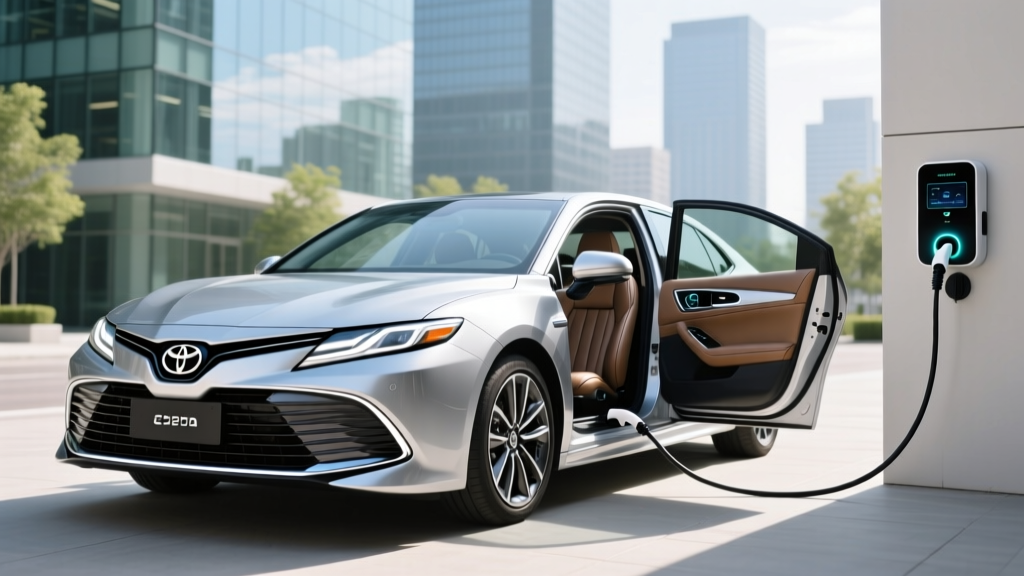
The 2026 Camry Hybrid: Why It's Still the Lease-Rational Choice
If you've searched for a 2026 Toyota Camry Hybrid lease, you're likely weighing fuel savings against monthly payments — and wondering whether a conventional hybrid (HEV) still makes sense as plug-in hybrids and full EVs proliferate. The 2026 Camry Hybrid answers with a compelling proposition: an EPA-estimated 51 MPG combined, no plug required, and a starting MSRP of $29,990 — all wrapped in a midsize sedan that continues to lead its segment in reliability.
As a hybrid-only model for 2026 (Toyota dropped the gas-only Camry after the 2024 model year), the Camry Hybrid is now the default rather than the eco-variant. That shift matters for lease shoppers: you're not paying a premium for hybrid technology; you're getting the standard Camry powertrain, which happens to be one of the most efficient in its class.
| Attribute | Specification |
|---|---|
| Powertrain Type | Conventional Hybrid (HEV) — no plug |
| Engine | 2.5L 4-cylinder + electric motor |
| Combined Horsepower | 225 hp (FWD) / 232 hp (AWD) |
| EPA MPG (FWD LE) | 53 city / 50 highway / 51 combined |
| EPA MPG (AWD) | 51 city / 49 highway / 50 combined |
| Fuel Tank | 13.2 gallons |
| Total Range | ~660 miles (FWD) |
| Hybrid Battery | Lithium-ion, ~1.6 kWh (not plug-in) |
| 0–60 mph | ~7.2 seconds |
| Starting MSRP | $29,990 (LE FWD) |
| Hybrid Battery Warranty | 10 years / 150,000 miles |
| Federal Tax Credit | Not eligible (§30D requires plug-in) |
HEV vs. PHEV: What the Camry Hybrid Is — and Isn't
Before evaluating lease economics, it's critical to understand what you're getting. The 2026 Camry Hybrid is a conventional hybrid (HEV), not a plug-in hybrid (PHEV). This distinction affects everything from daily driving to tax credit eligibility.
| Feature | HEV (Camry Hybrid) | PHEV (e.g., Prius Prime) | BEV (e.g., Tesla Model 3) |
|---|---|---|---|
| Plugs in? | No | Yes | Yes |
| Electric-only range | None (motor assists engine) | 25–44 miles typical | 250–400+ miles |
| Gas engine | Yes (primary power) | Yes (backup + highway) | No |
| Fueling | Gas only | Gas + electricity | Electricity only |
| Federal tax credit | None | Up to $7,500 (if eligible) | Up to $7,500 (if eligible) |
| Home charging needed | No | Recommended (Level 2) | Essential (Level 2) |
| Best for | No plug access, high-mileage drivers | Short commute + plug access | Home charging + EV-ready |
The Camry Hybrid's 1.6 kWh battery charges exclusively through regenerative braking and the gasoline engine. You never plug it in. This is its greatest advantage for apartment dwellers or those without garage access — and its greatest limitation for anyone who could benefit from electric-only commuting.
If you're considering a plug-in alternative within Toyota's lineup, the 2026 Prius Prime offers up to 44 miles of electric-only range and qualifies for a federal tax credit — but it's a compact hatchback, not a midsize sedan. The Camry Hybrid fills a specific niche: maximum efficiency in a traditional sedan format, with zero lifestyle changes required.
Fuel Economy: EPA Numbers vs. Real-World MPG
| Trim / Drivetrain | City MPG | Highway MPG | Combined MPG |
|---|---|---|---|
| LE (FWD) | 53 | 50 | 51 |
| SE / XLE / XSE (FWD) | 48 | 47 | 47 |
| LE (AWD) | 51 | 49 | 50 |
| SE / XLE / XSE (AWD) | 46 | 46 | 46 |
The LE trim's 51 MPG combined is the headline number, but real-world results depend heavily on your driving pattern. According to fueleconomy.gov, the Camry Hybrid LE achieves its best efficiency in city driving — where the electric motor handles low-speed propulsion and regenerative braking recovers energy at every stop. Many owners report exceeding the EPA city estimate in stop-and-go traffic, with 55–58 MPG achievable on flat urban routes in moderate temperatures.
Highway driving tells a different story. At sustained 70–80 mph speeds, the gasoline engine does most of the work, and aerodynamic drag reduces efficiency. Expect 44–48 MPG on the highway in real-world conditions — roughly 5–10% below the sticker. Cold weather (below 30°F) further reduces efficiency by 10–15% as the engine runs more frequently to heat the cabin and maintain battery temperature.
For a driver covering 15,000 miles annually with a 60/40 city/highway split, the Camry Hybrid LE would consume approximately 294 gallons of fuel per year — compared to 500 gallons for a typical 30 MPG midsize sedan. At $3.50 per gallon, that's a savings of roughly $720 annually, or $2,160 over a three-year lease term.
Powertrain and Performance: 225 hp Without the Penalty
The 2026 Camry Hybrid pairs a 2.5-liter four-cylinder engine with one or two electric motors (one for FWD, an additional rear motor for AWD). The combined output is 225 horsepower in front-wheel-drive trims and 232 hp with AWD. This is Toyota's fifth-generation hybrid system, which uses a lithium-ion battery pack mounted under the rear seats for optimal weight distribution.
The 0–60 mph time of approximately 7.2 seconds is adequate for daily driving but won't thrill enthusiasts. Where the powertrain excels is in seamless low-speed acceleration — the electric motor provides instant torque from a stop, making the Camry Hybrid feel more responsive in city driving than the horsepower figure suggests. The continuously variable transmission (CVT) operates without the rubber-band effect that plagued earlier hybrid CVTs, though it still drones under hard acceleration.
The available electronic on-demand AWD adds a rear-mounted electric motor that engages only when slippage is detected. Unlike mechanical AWD systems, it adds minimal weight and doesn't significantly reduce fuel economy — the AWD LE loses only 1 MPG combined versus FWD.
Lease Pricing and Tax Credit Reality
Lease pricing for the 2026 Camry Hybrid varies by region, dealer, and promotion, but here's what to expect based on current market data:
- LE FWD: MSRP $29,990; typical lease ~$329–$369/month with $2,500–$3,000 due at signing (36 months, 12,000 miles/year)
- SE FWD: MSRP $31,490; typical lease ~$359–$399/month
- XLE FWD: MSRP $34,990; typical lease ~$399–$449/month
- XSE AWD: MSRP $36,590; typical lease ~$429–$479/month
These estimates assume Tier 1+ credit (720+ FICO) and do not include taxes, registration, or dealer add-ons. Toyota Financial Services periodically offers lease cash incentives — typically $500–$1,000 — that can reduce monthly payments.
Federal tax credit: The Camry Hybrid does not qualify for the IRS §30D Clean Vehicle Credit. Per IRS guidelines, only plug-in electric vehicles (PHEVs and BEVs) with a minimum 7 kWh battery capacity are eligible. The Camry Hybrid's ~1.6 kWh pack falls far short. Some states offer hybrid-specific incentives — check your state's energy office — but these are increasingly rare as incentive budgets shift toward plug-in vehicles.
Hybrid Battery Warranty & Replacement Cost
Toyota covers the Camry Hybrid's battery pack for 10 years or 150,000 miles, whichever comes first. This warranty covers capacity loss below a defined threshold and any manufacturing defects. The powertrain (engine, transaxle, hybrid control module) is covered for 5 years / 60,000 miles.
Should the battery require replacement out of warranty — statistically rare before 150,000+ miles based on Toyota's track record with Prius and Camry Hybrid fleets — expect a cost of $2,000–$3,500 for a new OEM pack, or $1,000–$1,800 for a refurbished unit. Independent hybrid shops in major metros increasingly offer refurbishment services at lower cost.
Reliability: What Two Decades of Hybrid Data Tell Us
The Camry Hybrid benefits from Toyota's longest-running hybrid architecture. The current generation uses the same fundamental hybrid synergy drive principles proven across millions of Prius, Camry, RAV4, and Highlander hybrids since 2000. Key reliability factors:
- Hybrid battery longevity: Real-world data from fleet operators and consumer reports suggests Toyota hybrid batteries routinely last 150,000–200,000+ miles before significant degradation. The lithium-ion chemistry in the 2026 model is more durable than the nickel-metal hydride packs in early Prius models.
- Brake wear: Regenerative braking significantly reduces friction brake usage. Camry Hybrid owners commonly report 80,000–100,000 miles on original brake pads.
- No plug-in complexity: Unlike PHEVs, the HEV system has no onboard charger, charge port, or high-voltage cable routing to the exterior — fewer failure points.
- IIHS safety: The 2026 Camry carries a TOP SAFETY PICK designation (when equipped with specific headlights), with standard Toyota Safety Sense 3.0 including automatic emergency braking, lane-keeping assist, and full-speed adaptive cruise control.
For lease holders, battery longevity is largely academic — the 10-year/150,000-mile warranty far exceeds any standard lease term. You will not face a battery replacement cost during a 36- or 48-month lease.
Who Should Lease the Camry Hybrid (and Who Shouldn't)
Lease the Camry Hybrid If:
- You drive 15,000+ miles/year and want maximum fuel savings without plugging in
- You live in an apartment or lack home charging access
- You want a midsize sedan with proven reliability and strong resale value
- Your commute is city-heavy (stop-and-go maximizes hybrid efficiency)
- You want low monthly payments without EV charging infrastructure concerns
Look Elsewhere If:
- You have a short commute and home charging — a PHEV (Prius Prime) could run mostly on electricity
- You want federal tax credit eligibility (requires PHEV or BEV)
- You want sporty driving dynamics (the CVT and 225 hp won't deliver)
- You want a fully electric driving experience with zero tailpipe emissions
- You prefer SUV/crossover packaging (consider RAV4 Hybrid or Venza)
The Decision: Camry Hybrid vs. PHEV vs. Full EV
The 2026 Camry Hybrid lease makes sense as a specific optimization: maximum fuel efficiency with minimum lifestyle disruption. Here's how to frame your decision:
Choose the Camry Hybrid (HEV) if you drive high annual mileage, lack reliable charging access, or simply want to fill up at any gas station and never think about electrons. It's the path-of-least-resistance efficiency play.
Choose a PHEV (like the Prius Prime) if your daily commute is under 40 miles round-trip, you have access to Level 2 charging at home or work, and you want to drive mostly on electricity while retaining gas-engine range for road trips. The $7,500 federal tax credit (if you meet income and sourcing requirements) can offset a higher purchase price — but doesn't apply to leases in most cases, since the credit goes to the lessor.
Choose a full EV (like the Tesla Model 3 or Hyundai Ioniq 6) if you have reliable home charging, want the lowest per-mile energy cost, and are ready to plan around public charging for road trips. EVs have fewer moving parts and lower maintenance costs, but higher upfront pricing and insurance premiums in many states.
How many MPG does the 2026 Camry Hybrid actually get?
The EPA rates the Camry Hybrid LE at 53 city / 50 highway / 51 combined. In real-world driving, expect 48–55 MPG in city conditions and 44–48 MPG at highway speeds. Cold weather and aggressive driving can reduce these figures by 10–15%.
Does the Camry Hybrid need to be plugged in?
No. The Camry Hybrid is a conventional HEV — its small battery charges through regenerative braking and the gasoline engine. There is no plug, no charge port, and no electric-only driving mode. You fuel it exclusively with gasoline.
Does the 2026 Camry Hybrid qualify for a federal tax credit?
No. The IRS §30D Clean Vehicle Credit applies only to plug-in vehicles (PHEVs and BEVs) with a minimum 7 kWh battery. The Camry Hybrid's ~1.6 kWh pack does not qualify. No federal incentive is available for conventional hybrids as of 2026.
How long will the Camry Hybrid battery last?
Toyota warranties the hybrid battery for 10 years or 150,000 miles. Real-world data from Toyota's hybrid fleet suggests these batteries commonly last 150,000–200,000+ miles before requiring replacement. Replacement cost (if needed out of warranty) ranges from $1,000 (refurbished) to $3,500 (new OEM).
Is the Camry Hybrid better than a PHEV for my commute?
If your commute is under 30 miles round-trip and you can charge at home, a PHEV like the Prius Prime will use far less gasoline — potentially zero on weekdays. If your commute is longer, you can't charge at home, or you drive high annual mileage, the Camry Hybrid's consistent 50+ MPG is the simpler, more practical choice.
What does a 2026 Camry Hybrid lease typically cost?
Expect $329–$369/month for the LE trim with $2,500–$3,000 due at signing on a 36-month, 12,000-mile/year lease. Higher trims (SE, XLE, XSE) range from $359–$479/month depending on drivetrain and options. Toyota Financial Services periodically offers lease cash incentives that can reduce payments.