Quick Verdict: The Efficiency Benchmark for Midsize Sedans
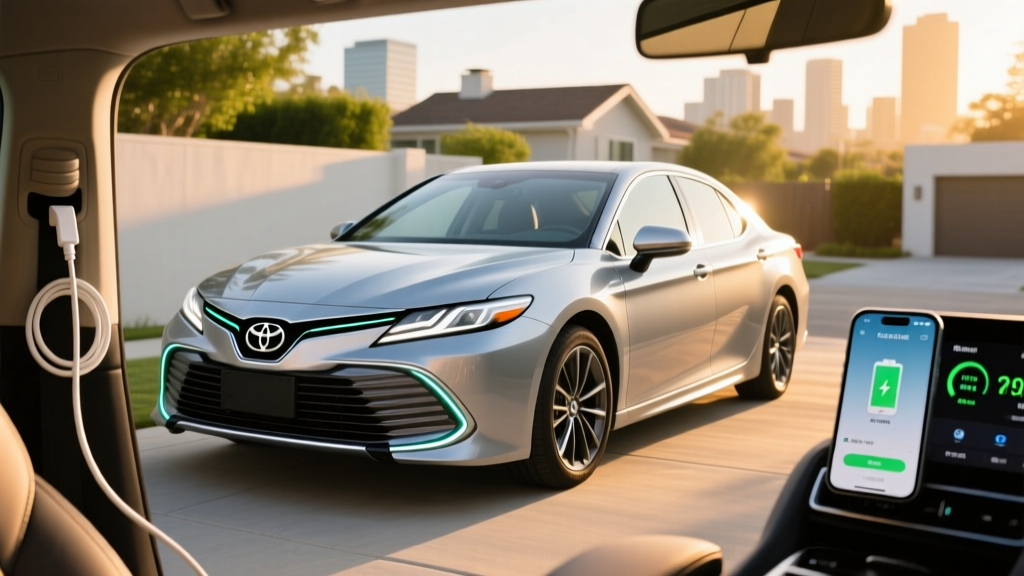
The 2026 Toyota Camry Hybrid LE is the fuel-economy king of the midsize sedan segment. With an EPA-estimated 51 MPG combined, a starting MSRP under $30,000, and Toyota's proven hybrid synergy drive system, it makes a compelling case for buyers who want dramatic fuel savings without plugging in, worrying about range, or paying an EV premium. This is a conventional hybrid (HEV) — no charging cord required — and it rewards owners most in stop-and-go city driving where regenerative braking does its best work.
For 2026, Toyota continues the Camry's all-hybrid lineup introduced for the 2025 model year, meaning every Camry now uses the fifth-generation Toyota Hybrid System. The LE trim sits at the base of the lineup and delivers the highest EPA ratings thanks to lighter weight and low-rolling-resistance tires.
How Many MPG Does the 2026 Camry Hybrid LE Get?
| Drivetrain | City MPG | Highway MPG | Combined MPG |
|---|---|---|---|
| FWD | 53 | 50 | 51 |
| AWD (Electronic) | 51 | 49 | 50 |
Source: fueleconomy.gov
Real-World MPG vs. EPA Sticker
Toyota hybrids historically meet or exceed their EPA estimates in real-world city driving. The regenerative braking system recovers kinetic energy during deceleration, meaning heavy-traffic commutes actually improve efficiency rather than tank it, as they would in a conventional gas car. In mixed driving with a heavy highway bias (70-80 mph sustained), expect the Camry Hybrid LE to return approximately 44–47 MPG — still outstanding, but below the EPA city figure because the electric motor assists less at sustained high speeds.
Cold weather reduces efficiency by roughly 5–8% as the gasoline engine runs longer to heat the cabin and bring the catalytic converter to operating temperature. In sub-freezing conditions, 45–48 MPG combined is a realistic expectation for the FWD model.
Powertrain and Performance Specs
| Specification | Detail |
|---|---|
| Engine | 2.5L 4-cylinder Dynamic Force (A25A-FXS) |
| Engine Output | 184 hp @ 5,700 rpm / 163 lb-ft torque |
| Electric Motor (FWD) | 134 hp / 155 lb-ft (front axle) |
| Electric Motor (AWD) | 134 hp front + 40 hp rear |
| Combined Net Horsepower | 225 hp (FWD) / 232 hp (AWD) |
| Transmission | eCVT (planetary gearset, no belts) |
| Hybrid Battery | 1.1 kWh lithium-ion (NiMH on prior gens) |
| 0–60 mph (est.) | ~7.1 seconds (FWD) |
| Drivetrain | FWD standard; AWD available |
The fifth-generation Toyota Hybrid System pairs a highly efficient 2.5-liter Atkinson-cycle engine with one or two electric motors through a planetary gearset that functions as a continuously variable transmission. Unlike belt-driven CVTs found in some competitors, Toyota's eCVT uses gears — meaning no belt wear concerns and excellent long-term durability.
The 1.1 kWh lithium-ion traction battery is compact, sitting beneath the rear seats. It is not designed for electric-only driving beyond very low-speed maneuvers (typically under 1 mile at speeds below 25 mph). Its role is to buffer regenerative energy and provide electric torque assist during acceleration. This battery charges itself through regenerative braking and engine-driven generation — you never plug it in.
Hybrid vs. PHEV vs. EV: Which Fits Your Driving Life?
The Camry Hybrid LE is a conventional hybrid (HEV). Toyota does not currently offer a Camry plug-in hybrid (PHEV) variant. If you need plug-in electric range, you'd look to the RAV4 Prime or consider a full battery-electric vehicle. Here's how the three powertrain types compare for a typical buyer:
| Factor | HEV (Camry Hybrid) | PHEV (e.g., RAV4 Prime) | BEV (e.g., Tesla Model 3) |
|---|---|---|---|
| Plug-in Required? | No | Yes, for EV range benefit | Yes, exclusively |
| Electric-Only Range | ~1 mi (low speed) | 35–42 mi typical | 250–360 mi typical |
| Home Charging Needed? | No | Recommended (Level 2) | Essential (Level 2) |
| Fuel Cost per Mile | ~$0.07 (at $3.50/gal) | ~$0.04 (electric) / $0.09 (gas) | ~$0.04 (home charging) |
| Upfront Price Premium | Low (~$1,500 over gas equivalent) | High (~$8,000+ over gas) | Highest (varies widely) |
| Federal Tax Credit (§30D) | Not eligible | Up to $7,500 if eligible | Up to $7,500 if eligible |
| Best For | No home charging; long highway miles; budget-conscious | Short commute + home charger; weekend road trips | Home charging; daily commuting; lowest operating cost |
Choose the Camry Hybrid LE if you lack reliable home charging access, drive more than 15,000 miles/year with a mix of city and highway, want minimal upfront cost, and prefer zero lifestyle change from your current gas car.
Look at a PHEV instead if you have a garage or driveway for a Level 2 charger, your daily commute is under 40 miles round-trip, and you want to drive mostly electric on weekdays while keeping gas flexibility for road trips.
Go full EV if you can install a home Level 2 charger, want the lowest per-mile fuel cost, qualify for the §30D federal tax credit, and your longest regular trip falls within fast-charger coverage.
2026 Camry Hybrid LE Pricing and Tax Credit Eligibility
| Trim | MSRP (FWD) | AWD Add-On |
|---|---|---|
| LE | $29,495 | +$1,525 |
| SE | $31,095 | +$1,525 |
| XLE | $34,495 | +$1,525 |
Prices include destination charge. Verify with your dealer as pricing may vary.
Federal Tax Credit: Does the Camry Hybrid Qualify?
The 2026 Toyota Camry Hybrid LE does not qualify for the IRS §30D Clean Vehicle Credit (up to $7,500). This credit applies only to plug-in electric vehicles — battery-electric vehicles (BEVs) and plug-in hybrids (PHEVs) with a minimum battery capacity. Conventional hybrids like the Camry are excluded under current IRS rules.
However, the Camry Hybrid's lower purchase price often makes the math work without incentives. At $29,495 and 51 MPG, annual fuel costs run approximately $850 for 15,000 miles of driving (at $3.50/gallon). A comparable gas-only midsize sedan getting 30 MPG combined would cost roughly $1,750 per year in fuel — meaning the Camry Hybrid saves approximately $900 annually in fuel alone, paying back any price premium within two years.
Some states and utilities offer separate rebates for hybrid vehicles. Check your state energy office or local utility for current programs, as these vary significantly by jurisdiction.
Battery Warranty, Reliability, and Replacement Cost
How Long Will the Battery Last?
Toyota's hybrid batteries have an exceptional track record for longevity. The Prius — which uses the same fundamental hybrid architecture — has demonstrated battery lifespans regularly exceeding 200,000 miles with minimal degradation. The key difference from a full EV battery is scale: the Camry Hybrid's 1.1 kWh battery undergoes shallow charge/discharge cycles (typically operating between 40% and 80% state of charge), which dramatically reduces wear compared to the deep cycling in a BEV.
The battery management system prevents full depletion and full charging, keeping the cells in their optimal longevity window. In practice, most Toyota hybrid batteries outlast the vehicle itself.
Battery Replacement Cost
If a replacement is needed outside warranty coverage, a new OEM hybrid battery for the Camry Hybrid costs approximately $2,500–$3,500 including labor. Third-party remanufactured units are available for $1,500–$2,200 installed. Individual module replacement (the battery pack contains multiple modules) can reduce costs further if only one or two modules have degraded. This is dramatically less expensive than a full EV battery replacement, which can exceed $10,000–$15,000.
Toyota's reliability record for hybrid systems is among the best in the industry. The eCVT planetary gearset has no belts or clutches to wear, and the electric motors have far fewer moving parts than a conventional automatic transmission. IIHS safety ratings and long-term dependability data from sources like Consumer Reports consistently rank the Camry Hybrid at or near the top of its class.
Daily Ownership: What Living With the Camry Hybrid LE Is Actually Like
The driving experience in the 2026 Camry Hybrid LE feels remarkably like a conventional sedan — which is exactly the point. There is no learning curve, no range monitoring, no charging logistics. You start it, drive it, and refuel at any gas station.
The electric motor's instant torque gives the Camry Hybrid surprisingly responsive acceleration from stops, even though the combined 225 hp isn't sporty by enthusiast standards. The transition between electric and gasoline power is nearly imperceptible in normal driving. Under light loads — neighborhood speeds, gentle acceleration — the car operates in EV mode silently. Press harder and the 2.5-liter engine engages smoothly.
The LE trim comes equipped with Toyota Safety Sense 3.0 (TSS 3.0), which includes:
- Pre-Collision System with Pedestrian Detection
- Full-Speed Range Dynamic Radar Cruise Control
- Lane Departure Alert with Steering Assist
- Lane Tracing Assist
- Automatic High Beams
- Road Sign Assist
This is a SAE Level 2 driver-assistance system — it provides steering and speed support, but the driver must remain fully engaged with hands on the wheel and eyes on the road at all times. It is not autonomous or self-driving.
Cargo, Comfort, and Practicality
The hybrid battery's placement beneath the rear seat preserves trunk space: the Camry Hybrid offers 15.1 cubic feet of cargo volume, competitive with the segment. Rear seat room is generous at 38.0 inches of legroom. The LE trim includes an 8-inch touchscreen with wireless Apple CarPlay and Android Auto, a 7-inch digital driver display, and six USB-C ports across both rows.
Pros and Cons at a Glance
Pros
- 51 MPG combined (FWD) — best in class
- No plug-in charging required
- Low starting price: $29,495
- 10-year/150,000-mile hybrid battery warranty
- Strong resale value and reliability record
- AWD available for snow-belt buyers
- TSS 3.0 safety suite standard
Cons
- No federal tax credit eligibility
- No plug-in electric range for zero-emission commuting
- LE trim uses cloth seats and basic 8-inch screen
- Highway MPG drops below city figure (unlike EVs)
- Modest 225 hp — adequate but not quick
- Rear-seat headroom slightly compromised by battery placement
Frequently Asked Questions
Do I need to plug in the 2026 Camry Hybrid LE?
No. The Camry Hybrid LE is a conventional hybrid (HEV). Its 1.1 kWh battery charges entirely through regenerative braking and the gasoline engine. There is no plug, no charging port, and no need for home charging infrastructure. You simply refuel at any gas station.
How does the Camry Hybrid compare to the old gas-only Camry?
Toyota made the Camry an all-hybrid lineup starting in 2025, discontinuing the purely gasoline powertrain. The previous gas-only 4-cylinder Camry achieved approximately 32 MPG combined. The Hybrid LE's 51 MPG combined represents a roughly 59% improvement in fuel economy — saving approximately $900 per year at 15,000 miles driven and $3.50/gallon.
Is the AWD system worth the $1,525 premium?
If you live in a region with regular snow or rain, yes. The electronic AWD system adds a rear-axle electric motor that engages automatically when front-wheel slip is detected, providing confident traction without the fuel-economy penalty of a mechanical AWD system. You lose only 1 MPG combined (50 vs. 51). For dry-climate buyers, the FWD model offers better fuel economy and a lower price.
Will the hybrid battery need to be replaced?
Statistically, it's unlikely during typical ownership. Toyota's hybrid batteries regularly last 200,000+ miles. The 10-year/150,000-mile warranty covers defects and significant capacity loss. If replacement is ever needed out of warranty, expect to pay $2,500–$3,500 for a new OEM unit — far less than an EV battery replacement.
Can I get a tax credit for buying the Camry Hybrid?
The federal §30D Clean Vehicle Credit does not apply to conventional hybrids — only to plug-in EVs and PHEVs. Check with your state revenue department or utility provider, as some local programs offer hybrid purchase incentives or reduced registration fees. Consult a tax professional for personal eligibility guidance.
What is the total cost of ownership over 5 years?
At $29,495 MSRP, 15,000 miles/year, $3.50/gallon, and typical insurance rates (~$1,400/year for the LE), the 5-year estimated ownership cost breaks down as follows: purchase price $29,495, fuel ~$4,250, insurance ~$7,000, maintenance ~$2,200 (hybrids require less maintenance — no transmission fluid changes, reduced brake wear from regen). Total: approximately $42,945 before depreciation. The Camry Hybrid's strong resale value (typically retaining 55–60% after 5 years per industry estimates) further reduces net cost of ownership.