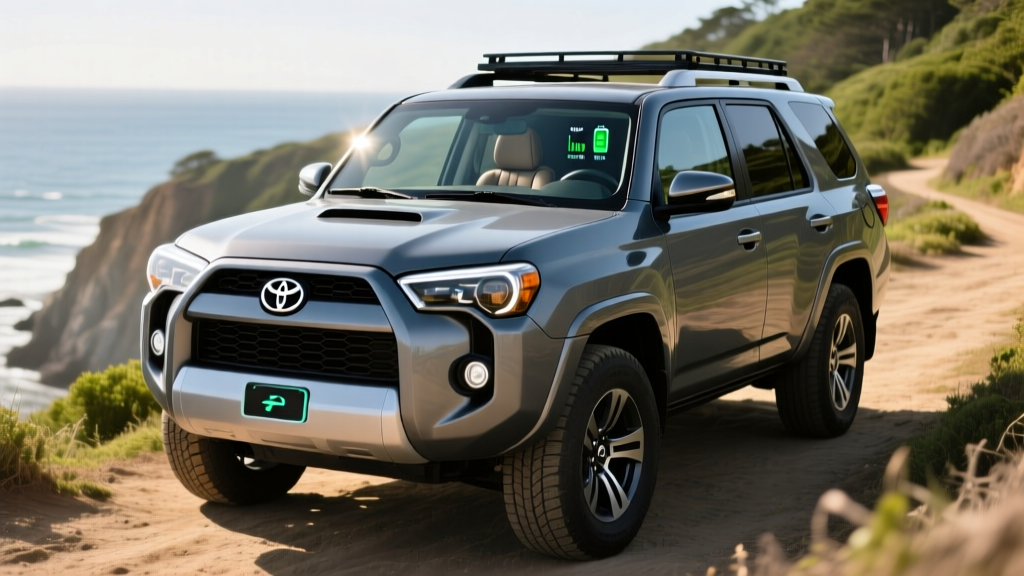
The Toyota 4Runner spent two decades as a body-on-frame relic — a capable off-roader with the fuel economy of a cargo van. For the 2025 model year, Toyota finally dragged it into the modern era on the TNGA-F platform with a turbocharged four-cylinder, and for 2026, the lineup expands to include the Toyota 4Runner Hybrid SUV variant: the i-FORCE MAX powertrain that pairs the 2.4-liter turbo with an electric motor integrated into the eight-speed automatic transmission. The result? A midsize body-on-frame SUV that makes 326 horsepower while returning meaningfully better fuel economy than its gas-only sibling.
This is a conventional hybrid (HEV), not a plug-in hybrid (PHEV). You never plug it in. The battery recharges through regenerative braking and the engine. If you're searching for electric-only commuting range, this isn't the vehicle — but if you need a rugged SUV that can tow 6,000 pounds and don't want to think about charging infrastructure, the 4Runner Hybrid makes a compelling case.
HEV vs PHEV: What the 4Runner Hybrid Actually Is
Before examining specs, it's critical to understand the distinction — because buyer confusion here leads to disappointment at the fuel pump or the charging station.
| Feature | 4Runner i-FORCE MAX (HEV) | Plug-In Hybrid (e.g., RAV4 Prime) | Full BEV (e.g., Tesla Model Y) |
|---|---|---|---|
| Plug in to charge? | No — self-charging | Yes — Level 1/2 | Yes — Level 1/2/DC |
| Electric-only range | ~1 mile (low-speed assist) | 30–42 miles typical | 250–330+ miles |
| Gas engine? | Yes — primary power | Yes — backup/generator | No |
| Fuel stops required? | Yes | Yes (after battery depletes) | No |
| Federal tax credit (§30D)? | No — HEVs excluded | Up to $7,500 (if eligible) | Up to $7,500 (if eligible) |
The 4Runner Hybrid is a full parallel hybrid in Toyota's i-FORCE MAX configuration. The electric motor provides torque fill at low RPMs, smooths out the turbo four-cylinder's power delivery, and recaptures energy during braking. It cannot meaningfully drive on electricity alone beyond very low-speed maneuvers. Think of it as a more efficient, more powerful gas 4Runner — not a stepping stone to electric driving.
Fuel Economy: EPA Ratings and Real-World MPG
The headline number for the 2026 4Runner Hybrid is a meaningful improvement over the standard i-FORCE turbo-four, though it won't be confused with a Prius.
| Powertrain | City MPG | Highway MPG | Combined MPG |
|---|---|---|---|
| 4Runner i-FORCE (gas, 4WD) | 20 | 24 | 21 |
| 4Runner i-FORCE MAX (hybrid, 4WD) | 23 | 24 | 23 |
Source: fueleconomy.gov (EPA estimates)
Real-world expectations: Toyota's hybrid system historically performs close to or slightly above EPA city estimates in stop-and-go traffic, where regenerative braking and electric torque assist do the most work. Highway driving is where the 4Runner's brick-like aerodynamics and 4,800-pound curb weight work against it. Expect highway MPG to dip to 21–22 in real-world 75 mph cruising, and potentially as low as 18–19 if you're towing or running aggressive all-terrain tires. City and mixed driving should track close to the 23 combined figure.
Over a 15,000-mile year, the 2 MPG combined improvement over the gas model saves roughly 15–18 gallons of fuel — about $50–$65 at current prices. The hybrid's real advantage isn't at the pump; it's in the driving experience. The electric motor's instant torque eliminates the turbo lag inherent to the gas-only 2.4T, making the 4Runner Hybrid feel noticeably more responsive around town and when merging onto highways.
Powertrain Specs: 326 HP and 465 lb-ft of Torque
| Specification | 2026 4Runner i-FORCE MAX Hybrid |
|---|---|
| Engine | 2.4L turbocharged inline-4 + electric motor |
| Combined Horsepower | 326 HP |
| Combined Torque | 465 lb-ft |
| Transmission | 8-speed automatic (motor integrated) |
| Drivetrain | 4WD (part-time or full-time depending on trim) |
| 0–60 mph (est.) | ~6.0 seconds |
| Towing Capacity | 6,000 lbs |
| Hybrid Battery | ~1.87 kWh (NiMH, sealed) |
| Plug-in Charging | Not required or available |
The i-FORCE MAX powertrain is shared with the Tacoma and Tundra hybrids, though tuned differently for the 4Runner's weight and use case. The 465 lb-ft figure is critical — it's available low in the rev range thanks to the electric motor, giving the 4Runner Hybrid the low-end grunt that body-on-frame SUVs need for off-road crawling and trailer launches. The gas-only i-FORCE makes 278 HP and 317 lb-ft, so the hybrid's advantage isn't subtle: it's 48 more horsepower and 148 more lb-ft of torque.
The ~1.87 kWh nickel-metal hydride battery pack is small by any standard. It's not designed for range — it's a power buffer that captures regen energy and deploys it for acceleration assist. Toyota has decades of NiMH hybrid battery experience (the Prius used this chemistry for over 20 years), and the packs are proven durable.
Pricing, Trims, and Tax Credit Reality
The 2026 Toyota 4Runner Hybrid is available across several trims, with the i-FORCE MAX powertrain offered on TRD Off-Road, Limited, TRD Pro, and Platinum grades.
| Trim (i-FORCE MAX Hybrid) | Approx. MSRP |
|---|---|
| TRD Off-Road | $53,500 |
| Limited | $57,800 |
| TRD Pro | $64,000 |
| Platinum | $61,500 |
Prices are approximate MSRP including destination; dealer markups vary by market.
Federal Tax Credit Eligibility
The 4Runner i-FORCE MAX is a conventional hybrid (HEV), not a plug-in hybrid. Under current IRS §30D rules, only plug-in electric vehicles (PHEVs and BEVs) with at least 7 kWh of battery capacity qualify for the federal clean vehicle credit. The 4Runner Hybrid's ~1.87 kWh battery does not meet this threshold. No federal tax credit applies to this vehicle.
Some states offer separate incentives for conventional hybrids, but these are uncommon and typically small ($250–$500). Check your state's energy office or department of environmental quality for current programs. Source: IRS §30D Clean Vehicle Credit.
The hybrid premium over the gas i-FORCE varies by trim but typically runs $1,500–$2,000. Given the modest fuel savings (~$60/year), the payback period on fuel alone is 25+ years. Buyers should view the hybrid upgrade as a performance and drivability improvement — 326 HP and instant torque — rather than a fuel-cost strategy.
Battery Warranty, Lifespan, and Replacement Cost
Hybrid battery longevity is consistently the top concern for first-time hybrid buyers, especially those coming from conventional gas vehicles. Here's what the data shows:
| Coverage | Terms |
|---|---|
| Hybrid Battery Warranty | 10 years / 150,000 miles (whichever comes first) |
| Hybrid System Components | 8 years / 100,000 miles |
| Powertrain Warranty | 5 years / 60,000 miles |
| Out-of-Warranty Battery Replacement | $2,500–$4,000 (dealer), $1,500–$2,500 (independent/reman) |
Toyota's 10-year/150,000-mile hybrid battery warranty is among the best in the industry and reflects the company's confidence in NiMH pack longevity. In practice, Toyota hybrid batteries from the Prius, Camry Hybrid, and Highlander Hybrid routinely exceed 200,000 miles before significant degradation. The 4Runner's pack is small, lightly stressed, and managed conservatively — it rarely cycles to full charge or full discharge, which is ideal for NiMH longevity.
If a replacement is eventually needed outside warranty, the 4Runner's NiMH pack is far cheaper than the large NMC lithium-ion packs in PHEVs and BEVs. A remanufactured unit from an independent hybrid specialist typically runs $1,500–$2,500 installed — a fraction of the $8,000–$20,000 that a BEV battery replacement might cost. This is a meaningful ownership-cost advantage for conventional hybrids.
Reliability and Long-Term Ownership Outlook
Toyota's hybrid systems have accumulated over 25 years of real-world data since the original 1997 Prius. The i-FORCE MAX is newer (introduced in the 2023 Tundra), but its hybrid components — the motor-generator, inverter, and NiMH pack — use proven architecture. Early Tundra and Tacoma i-FORCE MAX owners have not surfaced systemic hybrid-component failures as of early 2026.
The 4Runner's body-on-frame TNGA-F platform is shared with the Land Cruiser and Lexus GX, both of which are engineered for 200,000+ mile service lives. Combined with Toyota's hybrid reliability track record, the 4Runner Hybrid projects as one of the most durable vehicles in its class.
One ownership note: the turbocharged 2.4L engine requires synthetic oil and adheres to stricter maintenance intervals than Toyota's older naturally-aspirated V6. Budget $80–$120 per oil change at 10,000-mile intervals, and don't skip them — turbo longevity depends on clean oil.
Who Should Buy the 4Runner Hybrid vs. Alternatives
Choose the 4Runner Hybrid If:
- You need body-on-frame capability (true 4WD, locking diffs, 6,000-lb tow) with better drivability than the gas model
- You drive in hilly or mountainous terrain where the electric torque assist shines
- You want hybrid fuel savings without changing your fueling habits (no plugs, no apps, no charging stations)
- You plan to own the vehicle 10+ years and value Toyota's long-term reliability data
- You want 326 HP and 465 lb-ft without stepping to a V6 or larger engine
Look Elsewhere If:
- You want electric-only commuting — consider a PHEV like the Toyota RAV4 Prime (42 mi EV range) or a full BEV
- Fuel cost is your primary concern — the 2 MPG improvement won't offset the $53K+ price
- You don't need off-road capability — unibody SUVs (Highlander Hybrid, 36 MPG) are far more efficient on pavement
- You want a federal tax credit — only PHEVs and BEVs qualify under §30D
The decision framework is straightforward: If your lifestyle demands a body-on-frame SUV with serious off-road chops and towing capacity, the 4Runner Hybrid is the best version of the 4Runner Toyota currently builds. The electric motor doesn't transform the fuel economy — it transforms the driving feel. If you don't need body-on-frame capability, the efficiency penalty is steep compared to unibody alternatives.
Frequently Asked Questions
How many MPG does the 2026 Toyota 4Runner Hybrid get?
The EPA rates the 4Runner i-FORCE MAX Hybrid at 23 MPG city, 24 MPG highway, and 23 MPG combined. Real-world highway driving at sustained speeds typically yields 21–22 MPG; city and mixed driving track close to the 23 combined figure.
Does the 4Runner Hybrid need to be plugged in?
No. The 4Runner i-FORCE MAX is a conventional hybrid (HEV). The small battery charges through regenerative braking and the gasoline engine. There is no plug, no charging cable, and no electric-only driving range to manage.
Does the Toyota 4Runner Hybrid qualify for any federal tax credit?
No. Under IRS §30D, only plug-in electric vehicles (PHEVs and BEVs) with battery packs of at least 7 kWh qualify for the federal clean vehicle credit. The 4Runner Hybrid's ~1.87 kWh battery does not meet this threshold. No federal credit applies.
How long will the 4Runner Hybrid battery last?
Toyota warranties the hybrid battery for 10 years or 150,000 miles. Based on Toyota's extensive NiMH hybrid history (Prius, Camry, Highlander), these packs commonly exceed 200,000 miles. The small pack in the 4Runner is lightly cycled, which favors longevity.
What does it cost to replace the 4Runner Hybrid battery out of warranty?
Dealer replacement runs approximately $2,500–$4,000. Independent hybrid specialists offer remanufactured units for $1,500–$2,500 installed. This is significantly less than lithium-ion pack replacements in PHEVs and BEVs.
Is the 4Runner Hybrid faster than the gas model?
Yes. The i-FORCE MAX produces 326 HP and 465 lb-ft versus the gas i-FORCE's 278 HP and 317 lb-ft. The estimated 0–60 time drops from approximately 7.5 seconds (gas) to roughly 6.0 seconds (hybrid), and the electric torque fill makes everyday acceleration feel even more responsive than the numbers suggest.
Hybrid vs PHEV vs full EV — which should I choose?
If you need off-road and towing capability, have no home charging access, or regularly drive in remote areas, the 4Runner Hybrid (HEV) makes sense. If you have home charging and want electric-only commuting, a PHEV like the RAV4 Prime gives you 42 miles of EV range plus a gas backup. If your driving is mostly under 250 miles and you have reliable charging, a full BEV eliminates fuel stops entirely. Each option trades capability and convenience differently — there's no universally correct answer.