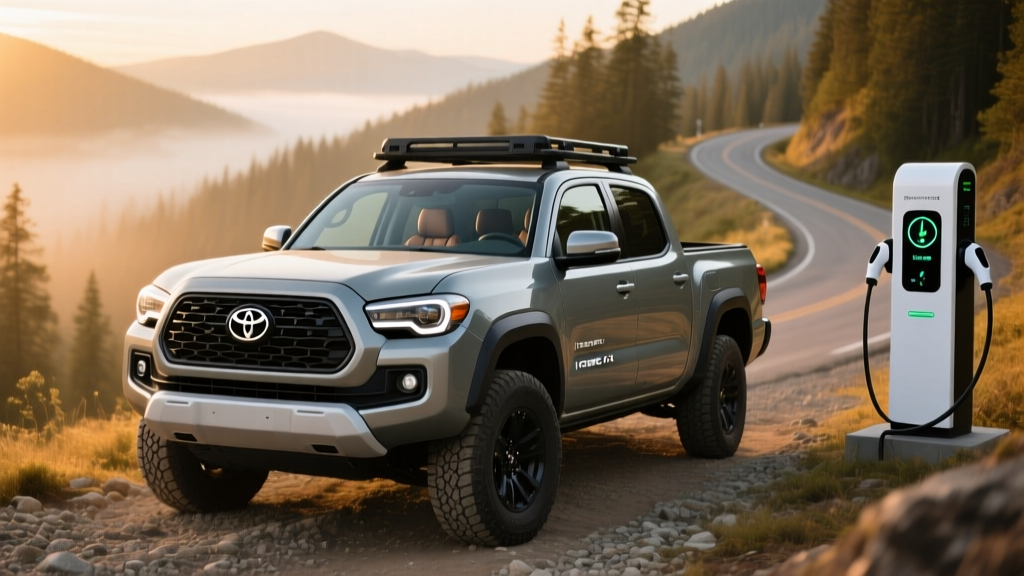
The Toyota Tacoma has been America's best-selling midsize pickup for years, and the 2026 Tacoma Hybrid — officially badged as the i-FORCE MAX — continues to prove that truck buyers don't have to sacrifice efficiency for capability. Unlike a plug-in hybrid or a full battery-electric pickup, the Tacoma i-FORCE MAX is a conventional hybrid (HEV). It requires no plug, no charging routine, and no range anxiety. It simply sips less fuel while delivering more torque than its non-hybrid sibling.
For the 2026 model year, Toyota has expanded i-FORCE MAX availability across more trims, refined the hybrid system's calibration, and kept the truck's body-on-frame bones intact. Here's everything you need to know — from real-world MPG to towing limits to battery longevity — before you spec yours.
2026 Tacoma Hybrid Powertrain: What i-FORCE MAX Actually Is
The i-FORCE MAX pairs a turbocharged 2.4-liter inline-four gasoline engine with an electric motor integrated between the engine and the 8-speed automatic transmission. This is Toyota's hybrid architecture adapted for truck duty, not a Prius-derived system stretched beyond its limits.
| Specification | Value |
|---|---|
| Engine | 2.4L turbocharged inline-4 |
| Electric Motor | Integrated motor-generator (48 hp / 184 lb-ft) |
| Combined Horsepower | 326 hp |
| Combined Torque | 465 lb-ft |
| Transmission | 8-speed automatic |
| Drivetrain | RWD or 4WD (part-time, available on select trims) |
| Hybrid Type | Conventional HEV (no plug required) |
| Towing Capacity (max) | 6,000 lbs |
| Payload Capacity (max) | ~1,709 lbs (varies by configuration) |
The key advantage over the standard i-FORCE turbo 2.4L (278 hp / 317 lb-ft) is torque delivery. The electric motor fills the low-RPM torque gap before the turbo spools fully, which is exactly where truck owners feel it — pulling away from a stop with a loaded bed or merging onto a highway with a trailer in tow. The 465 lb-ft combined figure puts the Tacoma Hybrid in territory that rivals some V6 competitors.
Fuel Economy: EPA Ratings vs. Real-World MPG
The headline question for any hybrid truck buyer: how many miles per gallon does it actually get? The 2026 Tacoma i-FORCE MAX earns EPA ratings that vary by cab configuration, bed length, and whether you choose 2WD or 4WD.
| Configuration | City MPG | Highway MPG | Combined MPG |
|---|---|---|---|
| 4x2 Double Cab (5-ft bed) | 24 | 27 | 26 |
| 4x4 Double Cab (5-ft bed) | 23 | 27 | 25 |
| 4x4 Double Cab (6-ft bed) | 23 | 26 | 24 |
Source: fueleconomy.gov (EPA estimates for 2025–2026 model-year i-FORCE MAX configurations).
Compared to the non-hybrid i-FORCE 4x4 (EPA 20 city / 26 hwy / 22 combined), the i-FORCE MAX's 2–3 MPG combined improvement may seem modest on paper. Over 15,000 miles per year at $3.50/gallon, that translates to roughly $200–$350 in annual fuel savings. The hybrid's real value proposition is the torque and responsiveness, not just the pump savings.
Hybrid vs. Plug-In Hybrid vs. Full EV: Which Truck Fits You?
Truck shoppers in 2026 face a growing menu of electrified options. The Tacoma i-FORCE MAX is a conventional hybrid (HEV), which is fundamentally different from a plug-in hybrid (PHEV) or a battery-electric vehicle (BEV). Here's the distinction:
| Factor | HEV (Tacoma i-FORCE MAX) | PHEV (e.g., Ford Maverick — if available) | BEV (e.g., Rivian R1T, Chevy Silverado EV) |
|---|---|---|---|
| Plug-in Required? | No | Yes (for electric range) | Yes |
| Electric-Only Range | N/A (motor assists only) | Typically 20–40 miles | 250–400+ miles |
| Gas Engine? | Yes | Yes | No |
| Home Charging Needed? | No | Recommended (Level 2) | Required (Level 2 or DC) |
| Federal Tax Credit (§30D) | Not eligible | Eligible (up to $7,500, rules apply) | Eligible (up to $7,500, rules apply) |
| Best For | No-plug convenience, towing, range | Short electric commutes + long trips | Low running costs, home charging access |
The Tacoma Hybrid is the right choice if you want better fuel economy and more torque than a gas-only truck without changing your fueling habits. You fill up at a gas station, exactly as before. There is no electric-only mode for commuting, no charging cable, and no need to install a 240V outlet in your garage.
If your commute is short (under 30 miles round-trip) and you have access to home charging, a PHEV truck like the Ford Maverick PHEV (availability varies by model year) could eliminate most of your gasoline use on weekdays while still offering a gas engine for weekend towing. A full BEV truck like the Rivian R1T or Chevrolet Silverado EV makes sense only if you can charge at home, rarely tow heavy loads (towing crushes EV range), and drive in areas with reliable charging infrastructure.
2026 Tacoma Hybrid Trims, Pricing, and Tax Credit Eligibility
For 2026, Toyota offers the i-FORCE MAX powertrain on several Tacoma trims. Pricing below reflects manufacturer MSRP before destination charges.
| Trim | Starting MSRP | Key Features |
|---|---|---|
| TRD Off-Road | ~$42,990 | Crawl Control, locking rear diff, Bilstein shocks |
| TRD Sport | ~$44,390 | Sport-tuned suspension, 20-inch wheels, hood scoop |
| Limited | ~$50,490 | Leather, panoramic roof, JBL audio, power tailgate |
| TRD Pro | ~$65,420 | FOX shocks, skid plates, IsoDynamic seats, 33-inch tires |
The i-FORCE MAX's pricing premium over the equivalent non-hybrid trim is typically $1,500–$2,000. Given the modest fuel savings, the payback period on fuel alone stretches to 5–7 years for most drivers. The hybrid's value lies in the torque upgrade (465 lb-ft vs. 317 lb-ft), smoother low-speed behavior, and the resale-value advantage that Toyota hybrids historically command.
Battery Warranty, Reliability, and Replacement Cost
Hybrid battery longevity is the number-one concern we hear from truck buyers considering their first HEV. Toyota's track record here is among the best in the industry, dating back to the original Prius in 2000.
The i-FORCE MAX uses a relatively compact nickel-metal hydride (NiMH) or lithium-ion hybrid battery pack (chemistry varies by model year and application) mounted under the rear seat. Unlike a full EV battery, this pack is small — typically under 2 kWh — because it only needs to store enough energy for low-speed assist and regenerative braking capture, not electric-only driving.
What does replacement cost? If the hybrid battery fails out of warranty, replacement typically runs $2,000–$4,000 including labor at a Toyota dealer. Independent hybrid specialists often offer refurbished packs for $1,200–$2,500. For context, Toyota's hybrid batteries in the Camry and RAV4 Hybrid have demonstrated failure rates well below 5% over 10+ years of operation, based on industry fleet data. The truck application may see slightly higher thermal stress, but Toyota has engineered the i-FORCE MAX system with active cooling.
On reliability broadly: the 2026 Tacoma carries over the TNGA-F platform introduced for the 2024 redesign. Early-model-year (2024) Tacomas experienced some transmission calibration complaints and turbo wastegate rattle that Toyota addressed through software updates and service campaigns. The 2026 model year benefits from those refinements. Always check NHTSA.gov for open recalls on any specific VIN before purchase.
Towing, Payload, and Off-Road Capability with the Hybrid
The i-FORCE MAX is available on the TRD Off-Road, TRD Sport, Limited, and TRD Pro trims. Towing capacity peaks at 6,000 pounds for properly equipped 4x2 configurations — identical to the non-hybrid i-FORCE. The hybrid system adds roughly 150–200 lbs of curb weight compared to the gas-only truck, which slightly reduces payload capacity but doesn't affect the tow rating.
Where the hybrid shines in towing is low-speed maneuvering and initial pull-away. The electric motor's instant torque means less turbo lag when pulling away from a stoplight with a trailer, and the regenerative braking system helps manage speed on descents — reducing brake wear on long downhill grades.
Off-road, the TRD Off-Road and TRD Pro i-FORCE MAX models retain full ground clearance, approach/departure angles, and Crawl Control functionality. The hybrid battery's under-seat packaging doesn't compromise breakover angle or water fording depth.
Who Should Buy the 2026 Tacoma Hybrid?
- You want more torque (465 lb-ft) than the gas-only Tacoma without stepping to a larger truck
- You tow 4,000–6,000 lbs regularly and want smoother low-speed pulling
- You don't have access to home charging and don't want a plug-in vehicle
- You value Toyota's hybrid reliability track record and 10-year battery warranty
- You want modest fuel savings (2–3 MPG combined) without behavioral changes
- You want electric-only commuting (you need a PHEV or BEV)
- You're chasing maximum fuel savings — a BEV truck will cost far less per mile
- You need a federal tax credit to make the math work (HEVs don't qualify for §30D)
- You tow over 6,000 lbs regularly (look at the Tundra or a ¾-ton truck)
- Budget is tight — the hybrid premium adds $1,500–$2,000 over gas trims
Frequently Asked Questions
How many MPG does the 2026 Tacoma Hybrid get?
The 2026 Tacoma i-FORCE MAX earns an EPA-estimated 23–24 city / 26–27 highway / 24–26 combined MPG depending on configuration (2WD vs. 4WD, bed length). In real-world mixed driving, expect 24–26 MPG combined. Highway-only driving at high speeds drops to roughly 22–23 MPG, and towing a mid-weight trailer yields approximately 13–15 MPG.
Does the 2026 Tacoma Hybrid need to be plugged in?
No. The Tacoma i-FORCE MAX is a conventional hybrid (HEV). It charges its small battery pack through regenerative braking and the gasoline engine. You never plug it in — you simply refuel at a gas station as you would with any other truck.
How far can the Tacoma Hybrid drive on electric power alone?
The i-FORCE MAX does not have a meaningful electric-only driving mode. The electric motor assists the gas engine at low speeds and during acceleration, but the truck cannot drive on electric power alone for any significant distance. If electric-only commuting is a priority, you need a plug-in hybrid (PHEV) like the Ford Maverick PHEV (when available) or a full BEV.
Is the Tacoma Hybrid reliable? What's the battery replacement cost?
Toyota's hybrid systems are among the most proven in the industry, with over two decades of real-world data. The hybrid battery is warranted for 10 years / 150,000 miles. Out-of-warranty replacement typically costs $2,000–$4,000 at a dealer, or $1,200–$2,500 through an independent hybrid specialist. Failure rates for Toyota hybrid batteries are historically low (well under 5% over 10+ years).
Does the 2026 Tacoma Hybrid qualify for a federal tax credit?
No. The federal §30D Clean Vehicle Credit applies only to plug-in electric vehicles (PHEVs and BEVs) with qualifying battery capacity and domestic sourcing. Conventional hybrids like the Tacoma i-FORCE MAX are not eligible. Check your state's environmental or energy agency for any state-level HEV incentives, and consult a tax professional for personalized guidance. See IRS.gov for current §30D rules.
How much more does the i-FORCE MAX cost over the gas-only Tacoma?
The hybrid premium is typically $1,500–$2,000 on equivalent trims. At current fuel prices, fuel savings alone will not offset this premium within a typical ownership period. The hybrid's value lies in the additional torque (465 lb-ft vs. 317 lb-ft), smoother acceleration, and historically strong resale value for Toyota hybrids.
Can I still tow 6,000 lbs with the hybrid Tacoma?
Yes. The i-FORCE MAX maintains the same 6,000-lb maximum tow rating as the non-hybrid i-FORCE (on properly equipped 4x2 models). The hybrid system's added weight (~150–200 lbs) slightly reduces payload but does not affect the tow rating. The electric motor's instant torque actually improves low-speed trailer pulling.