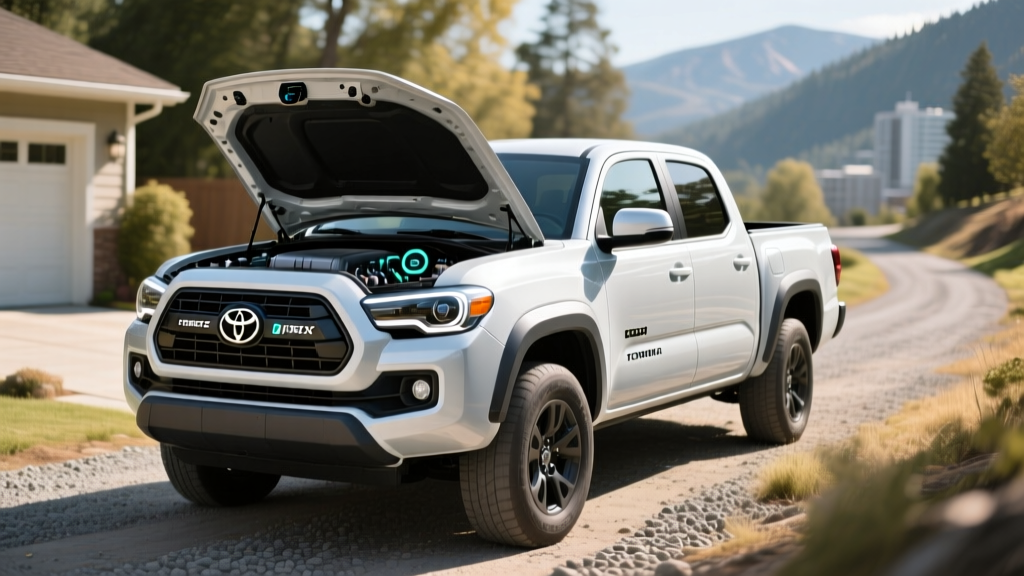
The Toyota Tacoma has long been the midsize truck benchmark, and the i-FORCE MAX hybrid powertrain has reshaped what buyers expect from a body-on-frame pickup. If you're searching for the 2026 Tacoma Hybrid MPG numbers, you've found the right deep-dive. We'll cover EPA ratings, real-world fuel economy observations, powertrain specs, battery warranty, and how this hybrid stacks up against full EVs and conventional gas trucks in total cost of ownership.
Before we get into the numbers, a critical clarification: the Tacoma i-FORCE MAX is a conventional hybrid (HEV), not a plug-in hybrid (PHEV). You never plug it in. The truck regenerates energy through braking and engine operation to charge its small battery pack. If you're looking for electric-only driving range, you'll need to look at PHEVs like the Ford Maverick PHEV or plug-in options in other segments.
2026 Tacoma Hybrid MPG: EPA Ratings by Configuration
Toyota offers the i-FORCE MAX hybrid across multiple Tacoma trims for 2026, and fuel economy varies depending on cab configuration, bed length, and drivetrain. Here are the official EPA figures as published on fueleconomy.gov:
| Configuration | City MPG | Highway MPG | Combined MPG |
|---|---|---|---|
| 4x2 Double Cab | 24 | 27 | 25 |
| 4x4 Double Cab | 23 | 26 | 24 |
| 4x4 Double Cab (TRD Off-Road/Pro) | 22 | 25 | 23 |
| 4x2 XtraCab (if available) | 24 | 27 | 25 |
These figures represent a meaningful improvement over the non-hybrid 2.4L turbo i-FORCE engine, which returns approximately 20-21 MPG combined depending on configuration. That's a 3-5 MPG gain — significant for a truck that might see 15,000 miles per year.
Real-World MPG: What Owners Actually See
EPA stickers are a starting point, not a guarantee. Hybrid trucks, like all hybrids, tend to exceed EPA city ratings in stop-and-go traffic because the electric motor handles low-speed propulsion where gasoline engines are least efficient. Highway driving, where the engine runs continuously, often yields numbers closer to or slightly below the EPA highway estimate.
- City / suburban driving: 24-27 MPG (frequent stops allow regen braking to recharge the battery)
- Highway (70-75 mph): 22-25 MPG (engine-dominant, aero drag hurts all trucks)
- Towing (5,000 lb trailer): 14-17 MPG (hybrid system offers minimal towing benefit)
- Cold weather (below 32°F): Expect a 1-2 MPG drop as the engine runs more to provide cabin heat and maintain battery temperature
- Off-road / low-range: MPG becomes irrelevant; hybrid system provides low-end torque benefit
The i-FORCE MAX's greatest efficiency advantage appears in mixed suburban driving with frequent stops. If your commute is mostly highway miles at steady speeds, the fuel-economy gap between the hybrid and non-hybrid Tacoma narrows to just 2-3 MPG.
i-FORCE MAX Powertrain: Specs and How It Works
| Specification | Detail |
|---|---|
| Engine | 2.4L turbocharged inline-4 |
| Electric Motor | Integrated between engine and transmission |
| Combined Horsepower | 326 hp |
| Combined Torque | 465 lb-ft |
| Transmission | 8-speed automatic |
| Battery Type | Nickel-metal hydride (NiMH), ~1.8 kWh |
| Max Towing Capacity | 6,000 lbs (properly equipped) |
| Max Payload | ~1,700 lbs (varies by config) |
| 0-60 mph (est.) | ~6.5 seconds |
The i-FORCE MAX pairs Toyota's 2.4L turbo four-cylinder with an electric motor sandwiched between the engine and the 8-speed automatic transmission. Unlike Toyota's traditional hybrid synergy drive (found in the Prius or RAV4 Hybrid), this setup uses the electric motor primarily for torque fill — eliminating turbo lag and providing instant low-end thrust. Peak torque of 465 lb-ft arrives at just 1,700 RPM, which makes the Tacoma feel surprisingly quick off the line.
The battery pack is small — approximately 1.8 kWh — because this is a conventional hybrid. It never drives the truck on electric power alone for meaningful distances. Instead, it stores regenerated braking energy and deploys it to assist acceleration. This is why you never plug it in.
HEV (Hybrid Electric Vehicle): Small battery (~1-2 kWh), charges via regenerative braking and engine, never plugs in, cannot drive on electric-only power for meaningful distance. Examples: Tacoma i-FORCE MAX, RAV4 Hybrid, Ford Maverick Hybrid.
PHEV (Plug-in Hybrid): Larger battery (12-20+ kWh), plugs into a wall outlet or charger, can drive 25-50 miles on electric-only power before the gas engine kicks in. Examples: Toyota RAV4 Prime, Jeep Wrangler 4xe, Ford Escape PHEV.
The Tacoma is currently offered only as an HEV. Toyota has not announced a Tacoma PHEV variant.
Pricing, Trims, and Tax Credit Eligibility
The i-FORCE MAX hybrid powertrain is available across several Tacoma trims for 2026. Pricing reflects the hybrid premium over the standard i-FORCE turbo engine:
| Trim | Starting MSRP (approx.) | Hybrid Premium Over Gas |
|---|---|---|
| TRD Off-Road | $44,500 | ~$2,500 |
| Limited | $51,000 | ~$2,500 |
| TRD Pro | $65,000 | Standard (hybrid only) |
| Trailhunter | $58,000 | Standard (hybrid only) |
Note: Prices are approximate based on Toyota's published MSRP and may vary by dealer and region. Always confirm with your local dealer.
Federal Tax Credit: Does the Tacoma Hybrid Qualify?
No. Under current IRS §30D rules, the federal Clean Vehicle Credit applies only to plug-in electric vehicles (BEVs and PHEVs) with a minimum battery capacity of 7 kWh. The Tacoma i-FORCE MAX's ~1.8 kWh NiMH battery does not meet this threshold. There is no federal tax credit for conventional hybrids as of 2026.
Some states offer their own incentives for hybrid vehicles, but these are generally modest ($500-$1,500) and vary widely. Check your state's energy or DMV website for current programs. For federal credit eligibility details, consult the IRS Clean Vehicle Tax Credits page.
Battery Warranty, Reliability, and Replacement Cost
Toyota's hybrid systems have an exceptional reliability track record. The Prius, RAV4 Hybrid, and Camry Hybrid have demonstrated that NiMH and lithium-ion hybrid batteries routinely last 150,000-200,000+ miles with minimal degradation. Unlike a full EV battery, the Tacoma's small hybrid pack undergoes shallow charge cycles — it never fully depletes or fully charges, which dramatically extends cell life.
If the hybrid battery does fail outside of warranty, replacement cost for the i-FORCE MAX battery pack is estimated at $3,000-$5,000 including labor. However, given Toyota's track record and the 10-year coverage, most original owners will never face this expense.
According to IIHS and long-term owner data, the broader Tacoma platform carries strong reliability ratings. The hybrid system adds complexity (electric motor, inverter, battery) but eliminates some traditional wear items — the regenerative braking system, for example, extends brake pad life significantly.
Tacoma Hybrid vs Full EV Trucks vs Gas Trucks
Where does the Tacoma i-FORCE MAX fit in the broader truck landscape? Here's a decision framework:
- You need a proven midsize truck with strong resale value
- You tow or haul regularly (hybrid torque helps, EV range doesn't crater)
- You drive off-road or in remote areas with no charging infrastructure
- You want better fuel economy without changing your driving habits
- You don't have access to home Level 2 charging
- You have reliable home Level 2 charging (240V)
- Your daily driving is under 250 miles round-trip
- You want near-zero maintenance and no gas station visits
- You want to qualify for the $7,500 federal tax credit (eligibility varies)
- You rarely tow heavy loads long distances
| Factor | Tacoma i-FORCE MAX (HEV) | Tacoma i-FORCE (Gas) | Rivian R1T / F-150 Lightning (BEV) |
|---|---|---|---|
| Combined MPG / MPGe | 23-25 MPG | 20-21 MPG | 70-73 MPGe (2-2.5 kWh/mi) |
| Fuel Cost per 15K mi/yr | ~$2,100 (at $3.50/gal) | ~$2,625 (at $3.50/gal) | ~$750 (at $0.15/kWh) |
| Annual Maintenance | ~$400 | ~$500 | ~$150 |
| Federal Tax Credit | None | None | Up to $7,500 (varies) |
| Towing Range Impact | Minimal (14-17 MPG) | Minimal (12-15 MPG) | Severe (range cut by 50%+) |
| Off-Road Capability | Excellent | Excellent | Good (weight is a factor) |
| Home Charging Needed | No | No | Yes (Level 2 strongly recommended) |
Who Should Buy the 2026 Tacoma Hybrid?
The i-FORCE MAX hits a specific sweet spot. It's ideal for truck buyers who:
- Drive 12,000-18,000 miles per year in mixed city/highway conditions where the hybrid system's city MPG advantage pays off.
- Can't charge at home — apartment dwellers, street parkers, or those without garage access get the efficiency benefit with zero lifestyle change.
- Need towing capability without the range-anxiety hit that EV trucks suffer when pulling a trailer. The Tacoma hybrid's fuel economy drops, but you can refuel in 5 minutes at any gas station.
- Plan to keep the truck 8-10+ years — the hybrid system's durability and Toyota's reputation for longevity make this a strong ownership proposition.
- Want torque without turbo lag — the electric motor fills the gap before the turbo spools, making the truck feel more responsive than its gas-only sibling.
It's not the right choice if you're looking for electric-only commuting (you need a PHEV or BEV for that), if you want the absolute lowest fuel cost per mile (a BEV wins), or if you want to claim the $7,500 federal tax credit (hybrids don't qualify).
- 3-5 MPG improvement over gas Tacoma
- 465 lb-ft torque at 1,700 RPM — excellent low-end pull
- No plug-in required; zero lifestyle change
- 10-year/150,000-mile hybrid battery warranty
- Strong Toyota reliability and resale value
- Proven off-road capability (TRD Pro/Trailhunter)
- No federal tax credit eligibility
- Hybrid premium adds ~$2,500 to MSRP
- No electric-only driving capability
- Highway MPG advantage is modest
- Towing fuel economy still poor (14-17 MPG)
- Heavier than gas model (~150 lb penalty)
Frequently Asked Questions
How many MPG does the 2026 Tacoma Hybrid get?
The EPA rates the 2026 Tacoma i-FORCE MAX at 22-24 city / 25-27 highway / 23-25 combined, depending on configuration. Real-world city driving often yields 24-27 MPG thanks to regenerative braking, while steady highway driving at 75 mph typically returns 22-25 MPG.
Does the Tacoma Hybrid need to be plugged in?
No. The Tacoma i-FORCE MAX is a conventional hybrid (HEV). It charges its battery entirely through regenerative braking and engine power. You never plug it in — you simply fill up at the gas station as you would with any truck.
How far can the Tacoma Hybrid drive on electric power alone?
Essentially zero meaningful distance. The hybrid system uses the electric motor to assist acceleration and provide torque fill, not to drive the truck independently. At very low speeds (under 15 mph in parking lots), the motor may propel the truck briefly, but this is measured in feet, not miles. If you want electric-only driving, you need a PHEV or BEV.
Is the Tacoma Hybrid reliable? What does battery replacement cost?
Toyota's hybrid systems are among the most proven in the industry, with millions of Prius, RAV4 Hybrid, and Camry Hybrid vehicles demonstrating 150,000-200,000+ mile battery life. The hybrid battery is covered by a 10-year/150,000-mile warranty. Out-of-pocket replacement cost, if needed, is estimated at $3,000-$5,000.
Does the 2026 Tacoma Hybrid qualify for a federal tax credit?
No. The federal §30D Clean Vehicle Credit applies only to plug-in vehicles (BEVs and PHEVs) with at least 7 kWh of battery capacity. The Tacoma's ~1.8 kWh hybrid battery does not qualify. Check your state for any local hybrid incentives.
How does the Tacoma Hybrid MPG compare to the Ford Maverick Hybrid?
The Ford Maverick Hybrid returns an EPA-estimated 42 city / 33 highway / 37 combined — significantly better than the Tacoma's 23-25 combined. However, the Maverick is a smaller unibody truck with lower towing capacity (2,000 lbs vs 6,000 lbs) and no serious off-road capability. They serve different buyer needs entirely.
Is the hybrid worth the extra $2,500 over the gas Tacoma?
At 15,000 miles per year and $3.50/gallon fuel, the 3-4 MPG improvement saves approximately $400-$525 annually. The hybrid premium pays for itself in roughly 5-6 years. If you keep the truck longer, drive more miles, or value the instant torque and reduced turbo lag, the hybrid is the stronger choice.