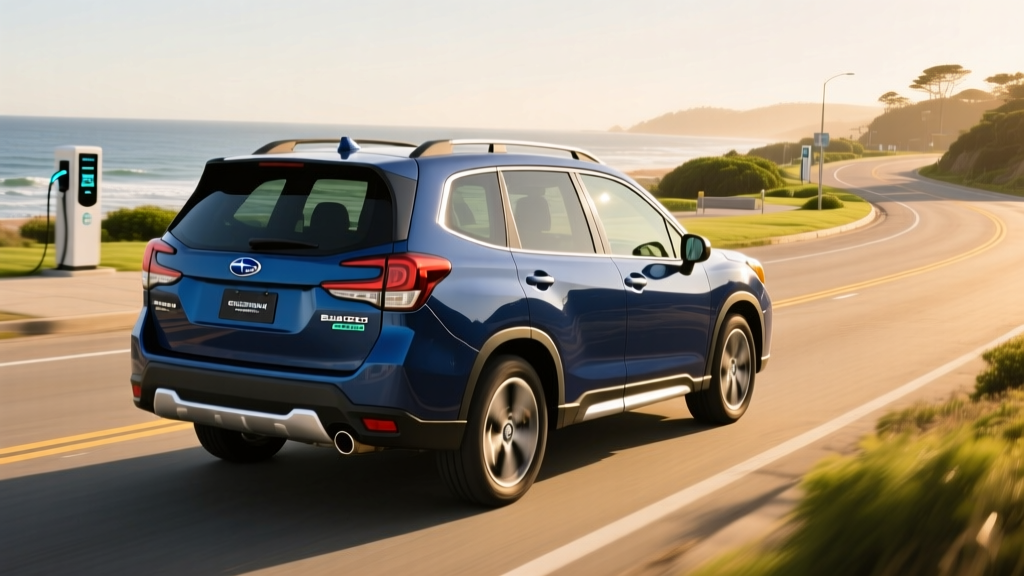
The 2026 Subaru Forester Touring Hybrid pairs Subaru's legendary symmetrical all-wheel drive with a fourth-generation hybrid powertrain, targeting buyers who want electrified efficiency without the range anxiety or charging infrastructure requirements of a full EV. As the top-tier trim in the newly hybridized Forester lineup, the Touring Hybrid adds premium touches — Nappa leather, a 12.3-inch digital cluster, and Subaru's EyeSight driver-assist suite — on top of a powertrain that returns an EPA-estimated 39 MPG combined. But how does that sticker number hold up in real-world driving, and does the Touring Hybrid justify its premium over lower trims? Here's the complete data-driven breakdown.
HEV vs PHEV: What the Forester Hybrid Actually Is
Let's clear up a common source of confusion before diving into specs. The 2026 Subaru Forester Hybrid is a conventional hybrid electric vehicle (HEV), not a plug-in hybrid (PHEV). This distinction matters because it fundamentally shapes how you own and operate the vehicle.
| Feature | HEV (Forester Hybrid) | PHEV (e.g., Toyota RAV4 Prime) |
|---|---|---|
| Plug-in charging | No — self-charging via regen + engine | Yes — requires outlet/charger for EV range |
| Electric-only range | ~1 mile at low speed | 35-42 miles typical |
| Battery size | ~1.1 kWh (small buffer) | 18-22 kWh usable |
| Federal tax credit (§30D) | Not eligible | Up to $7,500 (subject to rules) |
| Best for | No home charging access, simplicity | Home chargers, short commutes |
The Forester Hybrid recovers energy through regenerative braking and uses its compact lithium-ion battery to assist the gasoline engine during acceleration, enable brief low-speed electric-only crawling, and optimize engine stop-start behavior. You never plug it in. You simply fuel it with regular 87-octane gasoline and drive.
Powertrain Specs: 194 HP with Standard AWD
Subaru's hybrid system in the 2026 Forester pairs a 2.5-liter horizontally opposed (Boxer) four-cylinder engine with an electric motor integrated into the transmission housing. The combined system output is 194 horsepower, routed through a Lineartronic CVT to Subaru's Symmetrical All-Wheel Drive system.
| Specification | 2026 Forester Touring Hybrid |
|---|---|
| Engine | 2.5L Boxer 4-cylinder + electric motor |
| Combined system output | 194 hp |
| Transmission | Lineartronic CVT |
| Drivetrain | Symmetrical AWD (standard) |
| Battery type | Lithium-ion (~1.1 kWh) |
| 0-60 mph (est.) | ~8.5 seconds |
| Towing capacity | 1,500 lbs |
| Ground clearance | 8.7 inches |
The 194 hp figure represents a meaningful bump over the non-hybrid Forester's 180 hp. The electric motor's instant torque fill smooths out the CVT's typical rubber-band sensation during initial acceleration, making the hybrid feel noticeably more responsive around town than its gas-only sibling. On highway merges and uphill grades, the electric assist reduces the engine's workload, which is where a significant portion of the fuel savings materializes.
Fuel Economy: EPA Ratings and Real-World MPG
The headline number for the 2026 Forester Hybrid is its EPA-estimated fuel economy. Subaru's hybrid tuning prioritizes city efficiency — where electric assist and regenerative braking have the most impact — while highway figures are more modest.
| Driving Cycle | EPA Estimated | Real-World Expectation |
|---|---|---|
| City | 41 MPG | 38-43 MPG (hybrids often beat EPA city) |
| Highway | 38 MPG | 34-37 MPG (AWD drag + boxy aero) |
| Combined | 39 MPG | 36-40 MPG |
Conventional hybrids like the Forester frequently exceed their EPA city estimates in real-world stop-and-go driving. The electric motor handles low-speed propulsion where gasoline engines are least efficient, and regenerative braking recaptures energy at every stoplight. In suburban driving with frequent stops, owners commonly report 40-43 MPG.
Highway efficiency tells a different story. The Forester's tall, boxy profile creates aerodynamic drag that worsens at speed, and the AWD system's constant mechanical coupling adds parasitic loss. Expect 34-37 MPG at 70-75 mph on flat terrain. Cold weather further reduces efficiency — the engine runs more frequently to generate cabin heat, and battery performance dips in freezing temperatures. In sub-30°F conditions, plan for a 5-8 MPG combined reduction, bringing real-world winter figures to roughly 31-35 MPG combined.
Compared to the non-hybrid 2026 Forester (EPA 26 city / 33 highway / 29 combined), the hybrid delivers roughly a 34% improvement in combined fuel economy. Over 15,000 annual miles at $3.40/gallon, that translates to approximately $475 in annual fuel savings.
2026 Forester Touring Hybrid Pricing and Tax Credit Eligibility
The Touring Hybrid sits at the top of the Forester lineup. Here's where pricing lands for the 2026 model year:
| Trim | MSRP (incl. destination) |
|---|---|
| Forester Hybrid Premium | $34,495 |
| Forester Hybrid Sport | $36,495 |
| Forester Hybrid Limited | $38,495 |
| Forester Touring Hybrid | $41,495 |
Federal Tax Credit: Not Eligible
Because the Forester Hybrid is a conventional HEV — not a plug-in hybrid or battery electric vehicle — it does not qualify for the federal §30D Clean Vehicle Credit. That credit, which offers up to $7,500 for qualifying new PHEVs and BEVs, requires a minimum battery capacity of 7 kWh and plug-in charging capability, neither of which the Forester Hybrid meets. The previously available Alternative Fuel Vehicle Refueling Property Credit for non-plug-in hybrids expired for vehicles placed in service after 2010.
Some states offer their own incentives for hybrid vehicles, though these are increasingly rare as state programs shift focus to zero-emission vehicles. Check your state's energy office or department of environmental quality for current programs. A few states (e.g., Colorado) have offered modest hybrid rebates, but these vary by jurisdiction and change frequently — consult official state sources for current availability.
Battery Warranty, Reliability, and Replacement Cost
Hybrid battery longevity remains one of the top concerns for first-time hybrid buyers. Subaru addresses this with a robust warranty structure, and real-world data from the broader hybrid market provides additional reassurance.
Forester Hybrid Battery Warranty
- Hybrid battery: 8 years / 100,000 miles (10 years / 150,000 miles in CARB states including CA, NY, MA, WA, OR, CT, VT, ME, RI, NJ, MD, CO, NM, and NV)
- Hybrid system components: 8 years / 100,000 miles
- Powertrain warranty: 5 years / 60,000 miles
- Capacity retention threshold: Warranty covers failure or significant capacity loss below functional thresholds
The Forester Hybrid's lithium-ion battery pack is relatively small (~1.1 kWh) and operates within a conservative state-of-charge window — it never fully charges or fully depletes, which dramatically reduces degradation stress. Toyota and Honda hybrid systems using similar management strategies have demonstrated battery lifespans exceeding 150,000-200,000 miles with minimal capacity loss. Subaru's hybrid system, co-developed with Toyota (which holds a stake in Subaru's parent company), leverages proven hybrid architecture.
If replacement is needed out of warranty, expect a hybrid battery replacement cost between $2,500 and $4,000 including labor at a Subaru dealer, based on current parts pricing for comparable Subaru hybrid systems. Independent hybrid specialists may offer refurbished battery options for $1,500-$2,500. However, given the conservative charge management and Subaru's warranty coverage, premature battery failure is statistically unlikely.
For reliability data, the 2026 Forester is too new for long-term owner surveys. However, Subaru's hybrid system has been in production since 2019 (Crosstrek Hybrid, Outback/Forester e-Boxer in global markets), and IIHS has historically rated the Forester highly for crashworthiness. Check NHTSA.gov for the latest 5-star safety ratings once 2026 model testing is complete.
Who Should Buy the Forester Touring Hybrid?
The Forester Touring Hybrid occupies a specific niche. It's not trying to be a PHEV or an EV — it's optimizing the gasoline driving experience for buyers who want better fuel economy without changing their refueling behavior.
Pros
- 39 MPG combined with standard AWD — no compromises on capability
- No plug-in charging required; ideal for apartment dwellers or those without garage access
- Touring trim adds Nappa leather, heated rear seats, 12.3" digital cluster, Harman Kardon audio
- 8.7 inches of ground clearance for light off-road and snow duty
- EyeSight 4.0 with wide-angle mono camera for improved pedestrian/cyclist detection
- Strong hybrid battery warranty (8-10 yr depending on state)
Cons
- No federal tax credit eligibility (HEV, not PHEV/BEV)
- Highway MPG only marginally better than some turbocharged gas competitors
- Towing limited to 1,500 lbs (same as gas Forester)
- Touring trim pushes price above $41K — approaching luxury compact SUV territory
- No DC fast charging or meaningful electric-only range
Decision Framework: Hybrid vs PHEV vs EV
Choose the Forester Hybrid (HEV) if: You lack access to home or workplace charging, you want AWD and ground clearance for snow or trails, your daily driving is a mix of city and highway, and you want fuel savings without any behavioral change.
Choose a PHEV (e.g., Toyota RAV4 Prime, Subaru's potential future PHEV) if: You have reliable Level 2 home charging, your commute is under 40 miles round-trip, and you want electric-only daily driving with gas-engine backup for road trips. PHEVs may qualify for the §30D federal tax credit (subject to MSRP caps, income limits, and battery sourcing rules per IRS guidelines).
Choose a full EV (e.g., Hyundai Ioniq 5, Tesla Model Y) if: You have home charging, your daily driving is under 250 miles, you want the lowest per-mile energy cost (~$0.04-$0.06/mile on residential electricity vs ~$0.12/mile for the Forester Hybrid at 39 MPG), and you want zero tailpipe emissions with minimal maintenance.
Touring Trim: What the Premium Buys
The Touring Hybrid commands roughly $3,000 over the Limited Hybrid and approximately $7,000 over the Premium Hybrid base. Here's what the Touring badge adds:
- Nappa leather-trimmed upholstery with bronze stitching
- Heated and ventilated front seats; heated rear outboard seats
- Harman Kardon 9-speaker premium audio system
- 12.3-inch digital driver display with hybrid-specific energy flow graphics
- Power panoramic moonroof
- Heated steering wheel
- Reverse automatic braking and front-view camera
- Unique 19-inch alloy wheels with dark-gray finish
Whether the Touring premium is justified depends on your comfort priorities. The hybrid powertrain is identical across all Forester Hybrid trims — you're paying for luxury features, not additional performance or efficiency.
Frequently Asked Questions
How many MPG does the 2026 Subaru Forester Touring Hybrid get?
The EPA rates the 2026 Forester Hybrid at 41 MPG city, 38 MPG highway, and 39 MPG combined. In real-world driving, expect to match or slightly exceed the city figure in stop-and-go traffic (38-43 MPG), while highway cruising at 70+ mph typically yields 34-37 MPG. Cold weather reduces combined efficiency by roughly 5-8 MPG.
Does the Forester Hybrid need to be plugged in?
No. The Forester Hybrid is a conventional hybrid (HEV). It charges its small lithium-ion battery through regenerative braking and the gasoline engine. You never plug it in — you simply refuel with regular 87-octane gasoline as you would with any conventional car.
Can the Forester Hybrid drive on electric power alone?
Only at very low speeds (under ~25 mph) for roughly one mile or less, such as creeping through a parking lot or in heavy stop-and-go traffic. The battery is too small for meaningful electric-only driving. This is normal for conventional hybrids — the electric motor's primary role is to assist the gas engine, not replace it.
Does the 2026 Forester Hybrid qualify for a federal tax credit?
No. The federal §30D Clean Vehicle Credit applies only to plug-in hybrid electric vehicles (PHEVs) and battery electric vehicles (BEVs) with a minimum battery capacity of 7 kWh. The Forester Hybrid's ~1.1 kWh battery and lack of plug-in capability make it ineligible. Check with your state's energy office for any state-level hybrid incentives, which vary by jurisdiction.
How reliable is the Subaru hybrid system?
Subaru's hybrid system leverages technology co-developed with Toyota, whose hybrid systems have demonstrated exceptional longevity (200,000+ miles in fleet and owner data). The Forester Hybrid's battery is warrantied for 8 years/100,000 miles (10 years/150,000 miles in CARB states), and the conservative charge management strategy minimizes degradation. Replacement cost, if needed out of warranty, is estimated at $2,500-$4,000.
How does the Forester Hybrid compare to the Toyota RAV4 Hybrid?
The 2026 RAV4 Hybrid (EPA 41 city / 38 highway / 40 combined) delivers nearly identical fuel economy with 219 hp — a 25-hp advantage over the Forester Hybrid. The RAV4 also offers a PHEV variant (RAV4 Prime) with 42 miles of electric-only range and potential §30D credit eligibility. The Forester Hybrid's advantages include standard AWD with superior low-traction tuning, 8.7 inches of ground clearance (vs 8.1 for RAV4), and Subaru's EyeSight safety suite. Choose based on which ecosystem and driving dynamics you prefer.
What is the total driving range of the Forester Hybrid?
With a 13.2-gallon fuel tank and 39 MPG combined, the Forester Hybrid delivers approximately 515 miles of total range per tank. In city-heavy driving at 41 MPG, range extends to roughly 540 miles. This exceeds most EVs and eliminates any range anxiety for road trips.