Subaru brought the Forester Hybrid back for the 2025 model year after a multi-year hiatus, and the 2026 model carries over with the same proven Toyota-sourced hybrid system wrapped in Subaru's newly redesigned sixth-generation platform. If you've been searching for a 2026 Subaru Forester Hybrid for sale, you're likely weighing its real-world fuel economy against the Forester's trademark all-wheel-drive capability, cargo space, and off-road chops. This guide breaks down every number that matters — MPG, horsepower, pricing, battery warranty, and whether this hybrid SUV fits your garage better than a plug-in or full EV.
2026 Subaru Forester Hybrid: Powertrain and Performance Specs
The 2026 Forester Hybrid pairs a 2.5-liter naturally aspirated flat-four (boxer) engine with Toyota's fourth-generation hybrid transaxle system. The result is a combined output of 194 horsepower, routed through Subaru's symmetrical all-wheel drive with an electronically controlled CVT. Unlike some competitors that sacrifice AWD for hybrid efficiency, Subaru retains full-time AWD — a non-negotiable for buyers in snow-belt states.
| Spec | Value |
|---|---|
| Engine | 2.5L DOHC flat-4 (boxer) |
| Combined Horsepower | 194 hp (engine + electric motor) |
| Drivetrain | Symmetrical AWD (full-time) |
| Transmission | Lineartronic CVT (e-CVT hybrid transaxle) |
| 0–60 mph | ~7.7 seconds (est.) |
| Towing Capacity | 1,500 lbs |
| Cargo Volume (rear seats up) | 28.9 cu ft |
| Cargo Volume (rear seats folded) | 69.1 cu ft |
| Ground Clearance | 8.7 inches |
| Hybrid Battery | ~1.1 kWh (NiMH, self-charging HEV) |
The 0–60 time isn't going to embarrass a Tesla Model Y, but the electric motor's instant torque fill at low RPM gives the Forester Hybrid noticeably better around-town responsiveness than the gas-only Forester's 180-hp 2.5L. Highway passing confidence is adequate, though you'll hear the boxer engine drone under hard acceleration — a CVT trait shared with most hybrid SUVs in this class.
Fuel Economy: EPA Ratings and Real-World MPG
The headline number for the 2026 Forester Hybrid is an EPA-estimated 36 MPG combined, split across 35 MPG city and 38 MPG highway, according to fueleconomy.gov. That's a meaningful improvement over the gas-only Forester's 29 MPG combined — roughly a 24% gain in efficiency while adding AWD hybrid capability that most competitors can't match at this price point.
| Vehicle | City MPG | Highway MPG | Combined MPG | AWD? |
|---|---|---|---|---|
| 2026 Subaru Forester Hybrid | 35 | 38 | 36 | Yes (full-time) |
| 2026 Subaru Forester (gas) | 26 | 33 | 29 | Yes (full-time) |
| 2026 Toyota RAV4 Hybrid AWD | 41 | 38 | 39 | Yes (AWD-i) |
| 2026 Honda CR-V Hybrid AWD | 40 | 34 | 37 | Yes (Real Time AWD) |
| 2026 Ford Escape Hybrid AWD | 42 | 36 | 39 | Yes (eAWD) |
Real-world MPG note: Toyota-derived hybrid systems tend to match or slightly exceed their EPA city ratings in stop-and-go traffic because regenerative braking recaptures energy that gas cars waste as heat. On a mixed suburban commute with moderate traffic, owners of the mechanically similar 2025 Forester Hybrid have reported 36–40 MPG in warmer months. Highway-only driving at 75+ mph will pull the number closer to 32–34 MPG. In sub-freezing winter conditions, expect a 10–15% drop — roughly 30–32 MPG combined — as the engine runs more frequently to heat the cabin and keep the hybrid battery in its optimal temperature window.
HEV vs. PHEV vs. EV: Which Powertrain Fits You?
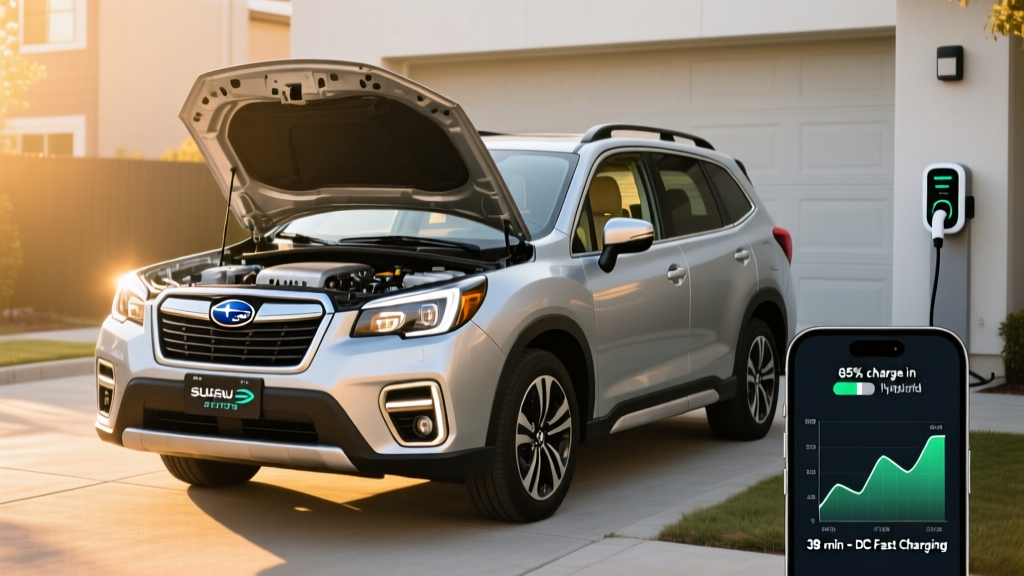
The 2026 Forester Hybrid is a conventional hybrid (HEV), not a plug-in hybrid. This is a critical distinction that trips up many shoppers. Here's what that means in practice:
HEV vs. PHEV — What's the Difference?
HEV (Hybrid Electric Vehicle): Charges its small battery (~1 kWh) through regenerative braking and the gas engine. You never plug it in. You fuel it with gas. The electric motor assists the engine for better MPG. The Forester Hybrid is an HEV.
PHEV (Plug-in Hybrid Electric Vehicle): Has a larger battery (typically 12–20 kWh) that you charge by plugging in, giving 25–40 miles of electric-only driving before the gas engine kicks in. Subaru does not currently offer a Forester PHEV for the US market (the Crosstrek PHEV was discontinued after 2023).
BEV (Battery Electric Vehicle): No gas engine. Runs entirely on a large battery (60–100+ kWh). Requires home or public charging infrastructure.
Choose the Forester Hybrid (HEV) if: You want better MPG without changing your fueling habits. No garage outlet? No problem. You drive in all weather and need proven AWD. Your daily commute is under 60 miles but you take regular road trips where charging infrastructure is sparse.
Consider a PHEV (like the Toyota RAV4 Prime) if: You have access to Level 2 home charging and a short commute (under 40 miles) that you want to drive on electricity alone, while keeping gas-engine flexibility for longer trips.
Go full EV (like the Hyundai Ioniq 5 or Tesla Model Y) if: You can install a Level 2 home charger, your daily driving is predictable, and you want to eliminate gas stops entirely while accessing the §30D federal tax credit of up to $7,500.
Pricing, Trims, and Tax Credit Eligibility
Subaru offers the 2026 Forester Hybrid in three trims, all including standard symmetrical AWD, EyeSight driver-assist technology, and an 11.6-inch infotainment touchscreen:
| Trim | MSRP | Key Additions Over Base |
|---|---|---|
| Hybrid Premium | $33,995 | Heated seats, power liftgate, dual-zone climate, 18" alloy wheels |
| Hybrid Sport | $36,495 | Sport-tuned suspension, black exterior accents, panoramic sunroof, Harman Kardon audio |
| Hybrid Touring | $39,495 | Nappa leather, ventilated front seats, heated steering wheel, 180° front camera, Starlink safety suite |
Federal Tax Credit: Does the Forester Hybrid Qualify?
No. Under current IRS §30D rules, the federal clean vehicle credit applies only to plug-in electric vehicles (PHEVs and BEVs) with a battery capacity of at least 7 kWh. The Forester Hybrid's ~1.1 kWh NiMH battery pack does not meet this threshold. You will not receive the $7,500 federal credit or any point-of-sale transfer for this vehicle.
However: Some states offer separate incentives for conventional hybrids. Check your state's energy office or AFDC state incentive database for current programs. Oregon, for example, has periodically offered rebates for hybrid purchases.
Battery Warranty, Lifespan, and Replacement Cost
Hybrid battery longevity is consistently the top concern among first-time hybrid buyers. Subaru backs the 2026 Forester Hybrid's battery pack with an 8-year / 100,000-mile warranty (10 years / 150,000 miles in California Air Resources Board states, which include CA, CO, CT, ME, MD, MA, NJ, NM, NY, OR, RI, VT, WA, and DC). This covers capacity loss below a defined threshold and defects.
Hybrid Battery Longevity — What the Data Shows
The Toyota-derived hybrid system in the Forester has been in continuous production since the late 1990s (Prius) and is among the most proven hybrid architectures in existence. Real-world fleet data from RAV4 Hybrids and Camry Hybrids using similar NiMH and lithium-ion packs shows most hybrid batteries lasting 150,000–200,000+ miles before significant degradation. Complete failure within the warranty period is statistically rare.
Replacement cost if out of warranty: A dealer-installed replacement hybrid battery pack typically runs $2,000–$3,500 depending on the source (OEM vs. refurbished). Independent hybrid specialists often offer refurbished packs for $1,500–$2,500 with a 3-year warranty. This is dramatically less than a full EV battery replacement ($8,000–$20,000+).
The Forester Hybrid's hybrid system also eliminates the traditional starter motor and alternator — two common failure points in gas cars — because the electric motor/generator handles both functions. The CVT has no conventional gear sets or clutch packs to wear out, and Subaru's CVT fluid is marketed as "lifetime" (though many mechanics recommend a drain-and-fill at 60,000–100,000 miles for longevity).
Driving Impressions: What the Hybrid Changes on the Road
The 2026 Forester Hybrid drives almost identically to the gas Forester at cruising speed, with two notable improvements. First, the electric motor's torque fill below 2,000 RPM makes city acceleration feel more immediate — merging onto highways and pulling away from stoplights requires less pedal effort. Second, the cabin is noticeably quieter at low speeds because the engine shuts off at stops and during gentle coasting, running on battery power alone at up to ~25 mph in light-load conditions.
Subaru's X-Mode off-road system carries over to the Hybrid trims, with hill descent control and selectable snow/dirt and deep snow/mud modes. The 8.7 inches of ground clearance remains unchanged from the gas model. The hybrid system adds roughly 180 pounds over the gas Forester, but the weight is mounted low in the chassis, so handling dynamics are virtually identical.
One honest trade-off: the hybrid battery and associated electronics eat into the under-floor cargo area slightly. You lose the spare tire (a tire-inflation kit is included instead), and the cargo floor sits roughly an inch higher than the gas model. For most buyers, this is a minor concession for 7 extra MPG.
Pros and Cons: The Honest Summary
✅ Pros
- 36 MPG combined with full-time AWD — a rare combination at this price
- 8.7 inches of ground clearance and genuine X-Mode off-road capability
- Proven Toyota-derived hybrid system with 8–10 year battery warranty
- No plug-in charging required — fuel normally at any gas station
- Standard EyeSight safety suite (IIHS Top Safety Pick+ contender)
- Strong resale value — Subaru hybrids historically depreciate less than rivals
❌ Cons
- No federal tax credit eligibility (HEV, not PHEV/BEV)
- 3–4 MPG behind the RAV4 Hybrid and Escape Hybrid AWD
- 1,500-lb towing capacity (gas Forester tows up to 1,500 lbs as well — no hybrid advantage here)
- No spare tire — tire inflation kit only
- CVT drone under hard acceleration
- ~$4,000 premium over equivalent gas Forester trim
Should You Buy the 2026 Forester Hybrid Over a Gas Forester or a Rival?
The math is straightforward. The Hybrid Premium at $33,995 carries roughly a $4,000 premium over the comparably equipped gas Forester Premium. At 36 MPG combined vs. 29 MPG combined, and assuming $3.40/gallon regular and 12,000 miles/year, the hybrid saves approximately $680 per year in fuel. That pays back the premium in roughly 5.9 years — or faster if gas prices rise above $4.00/gallon in your area.
Against the Toyota RAV4 Hybrid (39 MPG combined, ~$33,500 starting), the Forester Hybrid gives up 3 MPG but wins on ground clearance (8.7" vs. 8.1"), standard X-Mode, and Subaru's reputation for long-term AWD durability in severe winter conditions. The Honda CR-V Hybrid (37 MPG combined) is closer in efficiency but also lacks X-Mode and has 0.8 inches less ground clearance.
If AWD capability, off-road confidence, and Subaru's safety reputation are your priorities, the Forester Hybrid is the right choice. If pure MPG is your top metric and you don't need serious snow/mud capability, the RAV4 Hybrid edges it out.
Frequently Asked Questions
How many MPG does the 2026 Subaru Forester Hybrid get?
The EPA rates it at 35 city / 38 highway / 36 combined. Real-world testing shows 36–40 MPG in city and suburban driving in warm weather, dropping to 30–32 MPG combined in sub-freezing temperatures or sustained highway driving above 75 mph.
Is the 2026 Forester Hybrid a plug-in hybrid?
No. It is a conventional hybrid (HEV). You never plug it in. It charges its own small battery through regenerative braking and the gas engine. Subaru does not currently offer a Forester PHEV in the US market.
Does the 2026 Forester Hybrid qualify for a federal tax credit?
No. The IRS §30D clean vehicle credit applies only to plug-in vehicles (PHEVs and BEVs) with batteries of 7 kWh or larger. The Forester Hybrid's ~1.1 kWh pack does not qualify. Some state-level hybrid incentives may apply — check your state's energy office.
How long will the Forester Hybrid battery last and what does replacement cost?
Subaru warranties the hybrid battery for 8 years/100,000 miles (10 years/150,000 miles in CARB states). Toyota-derived hybrid batteries commonly last 150,000–200,000+ miles based on fleet data. Out-of-warranty replacement runs $2,000–$3,500 for an OEM pack, or $1,500–$2,500 for a refurbished unit.
Can the Forester Hybrid drive on electric power only?
Only at very low speeds (under ~25 mph) and light loads, for short distances of a few hundred yards — such as creeping through a parking lot or coasting to a stop. It is not designed for sustained electric-only driving like a PHEV.
How does the Forester Hybrid compare to a full EV like the Tesla Model Y?
The Model Y offers far lower per-mile fueling costs (~$0.04–0.06/mile on home electricity vs. ~$0.09/mile in the Forester Hybrid) and qualifies for up to $7,500 in federal tax credits. However, it requires home charging infrastructure, has reduced range in extreme cold, and costs significantly more upfront ($44,990+ vs. $33,995). The Forester Hybrid is the better choice if you lack reliable charging access, frequently drive in remote areas, or need the lowest upfront cost with no charging lifestyle change.