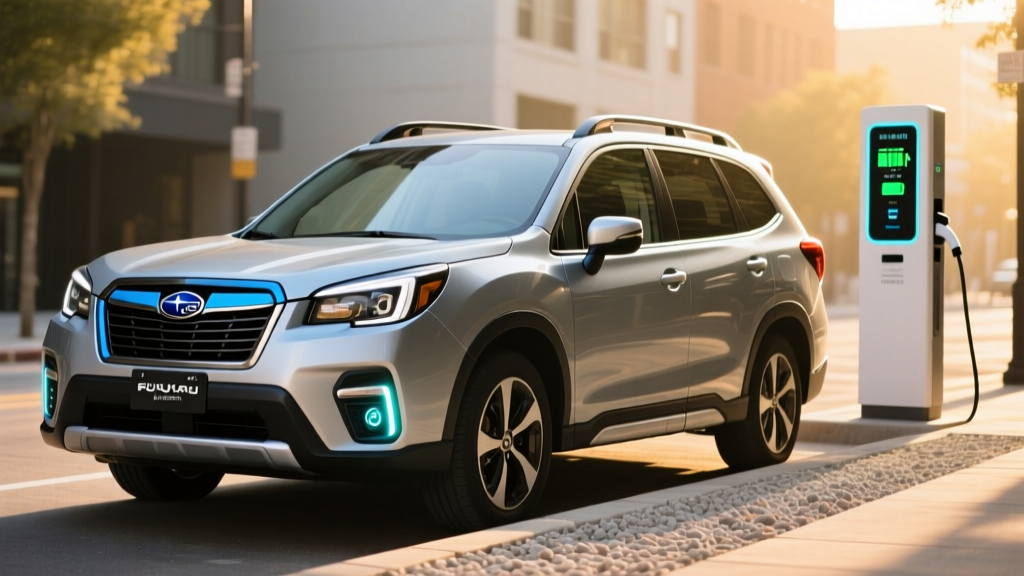
The Subaru Forester has been a staple of the compact crossover segment for decades, but one glaring omission has persisted in the U.S. market: a hybrid powertrain. With the sixth-generation Forester launching for the 2025 model year, buyers have been asking a single question — when will the 2026 Subaru Forester Hybrid be available?
As of early 2026, Subaru has not officially confirmed a U.S.-spec Forester Hybrid for the 2026 model year. However, the global picture tells a different story. The Forester e-BOXER hybrid is already on sale in Japan and Europe, and Subaru's corporate strategy commits to electrifying its entire lineup by 2030. That makes a 2026 or 2027 U.S. Forester Hybrid increasingly plausible — though buyers should understand what's confirmed, what's estimated, and what alternatives exist right now.
Here's everything we know, what the specs would likely look like based on the global e-BOXER platform, and how a Forester Hybrid would stack up against the competition.
2026 Subaru Forester Hybrid: Expected Release Timeline
Subaru has not published an official U.S. release date for a Forester Hybrid. Based on the company's typical product cadence and recent announcements, here's the most realistic timeline:
- Late 2026 (as a 2027 model): Most likely scenario if Subaru decides to bring the e-BOXER or a next-generation hybrid system to North America. Subaru typically unveils U.S.-spec models 6–9 months before they reach dealers.
- Early-to-mid 2027: Dealer deliveries would follow, assuming a late-2026 reveal.
- Japan/Europe now: The Forester e-BOXER is already available overseas, giving us a strong basis for estimating U.S. specs.
Subaru's U.S. Forester page currently lists only the 2.5-liter naturally aspirated gasoline engine for the 2025–2026 model years. Until Subaru of America issues a press release, any availability date remains estimated.
Expected Powertrain: What the e-BOXER Hybrid Would Deliver
The most likely hybrid system for a U.S. Forester is Subaru's e-BOXER mild-hybrid architecture, which pairs a 2.0-liter or 2.5-liter horizontally opposed ("boxer") four-cylinder engine with a small electric motor integrated into the Lineartronic CVT transmission. Based on the global-spec Forester e-BOXER and Subaru's existing hybrid Crosstrek, here's what U.S. buyers could expect:
| Specification | Estimated (U.S. Forester Hybrid) |
|---|---|
| Engine | 2.5L flat-4 + electric motor (e-BOXER) |
| Combined Horsepower | ~194 hp (est.) |
| Combined Torque | ~186 lb-ft (est.) |
| Transmission | Lineartronic CVT |
| Drivetrain | Symmetrical AWD (standard) |
| Hybrid Type | Conventional hybrid (HEV) — no plug-in |
| Battery | ~1.1 kWh lithium-ion (small buffer) |
| 0–60 mph | ~8.5 seconds (est.) |
| Towing Capacity | ~1,500 lbs (est.) |
This is a conventional hybrid (HEV), not a plug-in hybrid (PHEV). That means you never plug it in — the battery recharges through regenerative braking and the gasoline engine. This is a critical distinction many buyers confuse.
HEV vs. PHEV: Which Hybrid Type Is the Forester?
Understanding the difference between a conventional hybrid and a plug-in hybrid is essential before you evaluate the Forester's likely setup:
| Feature | HEV (Conventional Hybrid) | PHEV (Plug-In Hybrid) |
|---|---|---|
| Plug-in charging? | No — self-charging via regen + engine | Yes — plug into Level 1/2 charger |
| Battery size | ~1–2 kWh | ~13–20 kWh |
| Electric-only range | <1 mile (assist only) | 20–40 miles typical |
| DC fast charging | Not applicable | Rarely; most are Level 2 only |
| Federal tax credit | Not eligible (§30D requires plug-in) | Up to $7,500 (subject to sourcing rules) |
| Best for | Drivers without home charging access | Drivers with home charging + short commutes |
The Forester Hybrid would almost certainly be an HEV. Subaru does not currently offer any PHEV in its U.S. lineup (the previous Crosstrek PHEV was discontinued after 2023). If you need plug-in electric range, you'll need to look at competitors like the Toyota RAV4 Prime or the Hyundai Tucson PHEV.
Fuel Economy: Expected EPA MPG and Real-World Numbers
Since a U.S.-spec Forester Hybrid hasn't been EPA-certified, official numbers don't exist yet. However, we can build a reliable estimate from two data points: the current gas-only 2025 Forester (EPA-rated at 26 city / 33 highway / 29 combined, per fueleconomy.gov) and the Japan-spec Forester e-BOXER, which achieves roughly 40% better fuel economy under the JC08 testing cycle.
Translating that to the EPA's more rigorous testing methodology, here's a realistic projection:
| Model | City MPG | Highway MPG | Combined MPG |
|---|---|---|---|
| 2025 Forester (gas-only, AWD) | 26 | 33 | 29 |
| 2026 Forester Hybrid (est.) | 33–36 | 33–35 | 33–35 |
| Toyota RAV4 Hybrid (AWD, actual) | 41 | 38 | 39 |
| Honda CR-V Hybrid (AWD, actual) | 40 | 34 | 37 |
Real-world caveat: Subaru's e-BOXER system is a mild hybrid — it assists the engine rather than driving the wheels on electric power alone. That means the fuel economy advantage over the gas model is real but modest, likely in the 4–6 MPG combined range. Competitors with full-hybrid systems (Toyota's series-parallel setup, Honda's two-motor system) deliver bigger gains, especially in city driving where the electric motor handles more of the workload.
In real-world driving, conventional hybrids tend to exceed their EPA city rating in stop-and-go traffic (more regen = more electric assist) but may fall slightly short on the highway. Expect a Forester Hybrid to deliver roughly 35–38 MPG in mixed suburban driving and closer to 30–32 MPG on sustained highway trips at 70+ mph.
Pricing and Tax Credit Eligibility
Based on the pricing gap between gas and hybrid trims in the Crosstrek lineup (roughly $2,500–$3,500), a Forester Hybrid would likely slot in as follows:
- 2025 Forester Base (gas): $29,695 MSRP
- Estimated Forester Hybrid Premium trim: $33,000–$35,000 MSRP
- Estimated Forester Hybrid Limited trim: $37,000–$39,000 MSRP
Federal tax credit: Because the Forester Hybrid would be a conventional HEV (not a plug-in), it would not qualify for the IRS §30D Clean Vehicle Credit. That credit — up to $7,500 for new PHEVs and BEVs — requires a minimum battery capacity of 7 kWh and plug-in capability. A mild-hybrid system with a ~1 kWh battery doesn't meet that threshold. Some states may offer small rebates for any electrified vehicle; check your state energy office for specifics.
If Subaru were to surprise the market with a Forester PHEV (unlikely before 2028 based on current product plans), that version could qualify for partial or full §30D credit depending on battery sourcing and the buyer's income — subject to the current IRS rules.
Battery Warranty, Reliability, and Replacement Cost
Hybrid battery longevity is the number-one concern for buyers new to electrified vehicles. Here's what Subaru's track record and industry norms tell us:
Hybrid Battery Warranty & Lifespan
- Expected warranty: 8 years / 100,000 miles (federal minimum for hybrid battery components, per EPA/CARB requirements)
- California-emissions states: Likely 10 years / 150,000 miles (CARB mandate for PZEV/AT-PZEV components)
- Real-world lifespan: Modern lithium-ion hybrid batteries typically last 12–15 years / 150,000–200,000 miles before significant degradation. The small ~1 kWh battery in a mild hybrid undergoes shallow charge cycles, reducing stress.
- Replacement cost (out of warranty): Estimated $2,000–$4,000 for a mild-hybrid battery pack — far less than a full EV battery replacement ($8,000–$20,000+).
Subaru's hybrid reliability track record is limited in the U.S. (the Crosstrek Hybrid was low-volume and discontinued), but Toyota — whose hybrid technology Subaru has studied closely — has demonstrated that hybrid batteries routinely outlast 200,000 miles with minimal capacity loss. The e-BOXER system's small battery and shallow cycling should deliver comparable longevity.
Forester Hybrid vs. the Competition
If a Forester Hybrid arrives for 2027, it will enter a segment already dominated by proven hybrid crossovers. Here's how the estimated specs compare to what you can buy today:
| Model | Type | Combined MPG | AWD | Starting MSRP |
|---|---|---|---|---|
| Subaru Forester Hybrid (est.) | HEV | 33–35 | Standard | ~$33,000 |
| Toyota RAV4 Hybrid | HEV | 39 | Standard | $33,425 |
| Honda CR-V Hybrid | HEV | 37 | Optional | $35,395 |
| Toyota RAV4 Prime | PHEV | 38 (gas) / 94 MPGe | Standard | $43,690 |
| Hyundai Tucson Hybrid | HEV | 38 | Standard | $34,485 |
The Forester's advantages — standard AWD, excellent outward visibility, class-leading cargo space (roughly 28.9 cu ft behind the rear seats), and Subaru's EyeSight safety suite — remain compelling. But on pure fuel economy, Toyota's full-hybrid system holds a clear 4–6 MPG advantage.
Who Should Wait for the Forester Hybrid — and Who Shouldn't?
Wait for the Forester Hybrid if:
- You're a current Subaru owner committed to the brand and want AWD standard
- You don't have access to home or workplace charging (making an HEV ideal)
- You value Subaru's safety reputation, EyeSight ADAS, and X-Mode off-road capability
- Your purchase timeline extends to late 2026 or 2027
Buy a competitor now if:
- You need a hybrid immediately — the RAV4 Hybrid and CR-V Hybrid are proven, available, and more efficient
- You want plug-in electric range (20–42 miles) for short commutes — consider the RAV4 Prime or Tucson PHEV
- Maximum fuel economy is your priority — Toyota's system delivers ~39 MPG combined vs. an estimated 33–35 for the Forester
- You want federal tax credit eligibility — only PHEVs and BEVs qualify under §30D
Frequently Asked Questions
How many MPG does the 2026 Subaru Forester Hybrid get?
Official EPA numbers don't exist yet because Subaru hasn't confirmed a U.S. Forester Hybrid for 2026. Based on the e-BOXER platform, we estimate 33–36 city / 33–35 highway / 33–35 combined. The current gas-only Forester achieves 26/33/29.
Is the Subaru Forester Hybrid a plug-in?
No. The expected Forester Hybrid would be a conventional hybrid (HEV), meaning it charges its small battery through regenerative braking and the gasoline engine. You never plug it in. Subaru does not currently offer any plug-in hybrid in its U.S. lineup.
Does the Forester Hybrid qualify for any tax credit?
A conventional hybrid Forester would not qualify for the federal §30D Clean Vehicle Credit, which requires plug-in capability and a minimum 7 kWh battery. Some states offer small incentives for any hybrid — check your state's energy office. Only PHEVs and BEVs qualify for the federal credit (up to $7,500, subject to income, MSRP caps, and battery sourcing rules).
How reliable is a Subaru hybrid battery, and what does replacement cost?
Subaru's hybrid battery is expected to carry an 8-year/100,000-mile warranty (10 years/150,000 miles in CARB states). The mild-hybrid battery is small (~1 kWh) and undergoes shallow charge cycles, which typically yields a 12–15 year lifespan. Out-of-warranty replacement is estimated at $2,000–$4,000 — significantly less than a full EV battery.
Hybrid vs. PHEV vs. EV — which should I choose?
Choose a conventional hybrid (HEV) if you lack home charging access and want better MPG without changing habits. Choose a PHEV if you can charge at home and most trips are under 30 miles (you'll drive mostly on electricity). Choose a full EV (BEV) if you have reliable home charging, want zero tailpipe emissions, and are ready for the lowest per-mile fuel cost — typically $0.04–$0.06/mile on home electricity vs. $0.12–$0.15/mile for a hybrid on gasoline.
When can I actually buy a Subaru Forester Hybrid in the U.S.?
There is no confirmed date. The most realistic estimate is a late-2026 reveal for a 2027 model year, with dealer deliveries in early-to-mid 2027. Subaru has not issued an official announcement for the U.S. market. The Forester e-BOXER hybrid is currently available in Japan and Europe.
Note: All estimated specifications, pricing, and availability dates in this article are based on global-spec vehicle data, Subaru's product roadmap statements, and industry analysis. Final U.S. specs may differ. Always verify with Subaru of America before making a purchase decision.