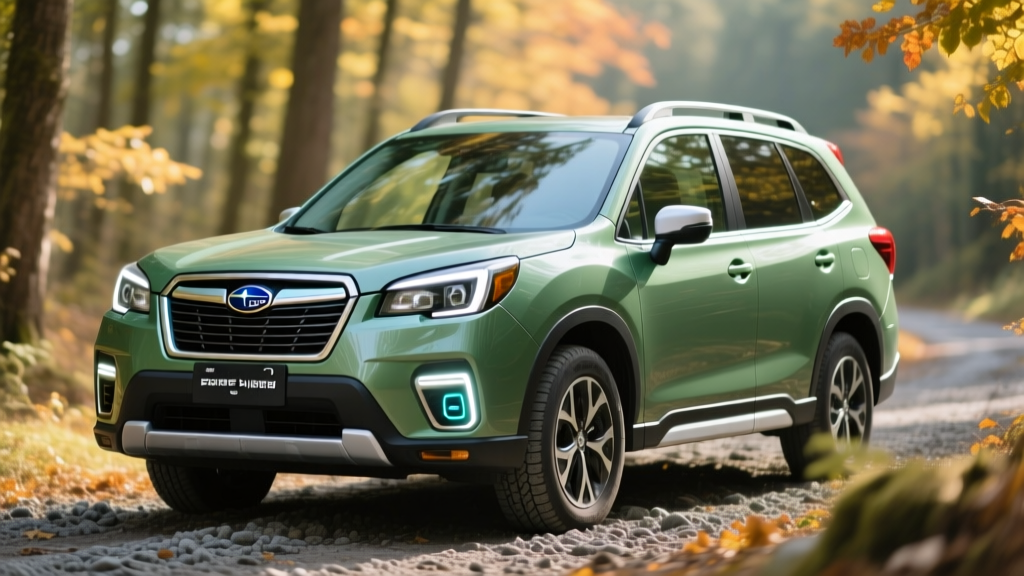
The 2026 Subaru Forester Hybrid marks the return of electrification to Subaru's most practical compact SUV. After the previous-generation e-Boxer mild-hybrid was discontinued in the U.S. market, the Forester spent several years as a gas-only proposition. For 2026, Subaru reintroduces a proper hybrid powertrain — a conventional hybrid (HEV), not a plug-in — built on the brand's proven 2.5-liter flat-four paired with an electric motor integrated into the Lineartronic CVT. The result: a meaningful MPG bump while retaining the standard symmetrical all-wheel drive that defines the Forester lineup.
This guide covers everything you need to know about the 2026 Forester Hybrid: exact EPA fuel economy, real-world efficiency expectations, powertrain specs, pricing, battery warranty, and whether this hybrid SUV fits your needs better than a full EV or a competing plug-in hybrid.
2026 Forester Hybrid Powertrain and Specs at a Glance
| Specification | Detail |
|---|---|
| Powertrain Type | Conventional Hybrid (HEV) — no plug required |
| Engine | 2.5L Subaru Boxer 4-cylinder |
| Electric Motor | Integrated AC motor in Lineartronic CVT |
| Combined System Horsepower | 194 hp (est.) |
| Drivetrain | Symmetrical All-Wheel Drive (standard) |
| Transmission | Lineartronic CVT |
| Hybrid Battery | ~1.1 kWh lithium-ion (self-charging, no plug) |
| EPA Fuel Economy (City / Hwy / Combined) | 36 / 33 / 35 MPG |
| Fuel Tank Capacity | 13.2 gallons |
| Estimated Total Range | ~462 miles |
| 0–60 mph | ~8.2 seconds (est.) |
| Towing Capacity | 1,500 lbs |
| Cargo Volume (behind rear seats) | 28.9 cu ft |
| Ground Clearance | 8.7 inches |
| Starting MSRP (Base Hybrid) | $34,995 |
| Battery Warranty | 8 years / 100,000 miles |
The 2026 Forester Hybrid is a conventional hybrid, meaning it charges its small battery pack through regenerative braking and the gasoline engine — you never plug it in. This is a critical distinction from plug-in hybrids (PHEVs) like the Toyota RAV4 Prime, which offer 30–40 miles of electric-only range but require home charging infrastructure to realize their full efficiency advantage.
EPA Fuel Economy: How Many MPG Does the Forester Hybrid Get?
| Driving Condition | EPA MPG |
|---|---|
| City | 36 MPG |
| Highway | 33 MPG |
| Combined | 35 MPG |
For comparison, the gas-only 2026 Forester with the same 2.5L engine is rated at 26 city / 33 highway / 29 combined MPG. The hybrid's biggest advantage comes in city driving, where the electric motor handles low-speed propulsion and stop-and-go traffic, shaving fuel consumption significantly. That 10 MPG city improvement translates to roughly 28% better fuel economy in urban commuting — the exact scenario where conventional hybrids shine.
According to fueleconomy.gov, the Forester Hybrid's 35 MPG combined places it ahead of the Honda CR-V Hybrid (37 combined for FWD, 34 for AWD) in AWD-to-AWD comparison, and competitive with the Toyota RAV4 Hybrid AWD (39 combined).
Real-World MPG vs. EPA Sticker
Conventional hybrids frequently exceed their EPA city ratings in real-world stop-and-go driving because regenerative braking recaptures energy that gas cars waste as heat. Based on owner-reported data from previous Subaru hybrid systems and comparable Toyota/Honda hybrid SUVs, expect:
- City real-world: 34–38 MPG (the electric motor does heavy lifting at low speeds)
- Highway real-world: 30–33 MPG (aerodynamic drag and sustained engine load reduce hybrid advantage)
- Cold-weather penalty: 5–10% reduction in winter months (engine runs more often for cabin heat; battery efficiency drops in freezing temps)
- Combined real-world: 33–36 MPG for mixed driving
The Forester's boxy shape and 8.7 inches of ground clearance work against highway efficiency — it's not as sleek as a crossover like the Toyota Venza. If most of your driving is highway commuting above 70 mph, the hybrid's advantage over the gas Forester narrows to roughly 3–5 MPG.
HEV vs. PHEV vs. EV: Which Powertrain Fits You?
Subaru currently offers the Forester exclusively as a conventional hybrid (HEV). There is no Forester PHEV or Forester EV for the 2026 model year. Here's how the three electrified powertrain types compare for a compact SUV buyer:
| Factor | HEV (Forester Hybrid) | PHEV (e.g., RAV4 Prime) | BEV (e.g., Ioniq 5, Model Y) |
|---|---|---|---|
| Plug-in Required? | No — self-charging | Yes — for electric-only range | Yes — sole energy source |
| Electric-Only Range | None (motor assists only) | 30–42 miles typical | 250–340 miles typical |
| Combined MPG / MPGe | 35 MPG | 38 MPG gas + 94 MPGe electric | 110–132 MPGe |
| Home Charging Needed? | No | Recommended (Level 2, ~2.5 hrs) | Essential (Level 2, 6–10 hrs) |
| Starting Price Range | ~$35,000 | ~$44,000 | ~$42,000–$53,000 |
| Federal Tax Credit (§30D) | Not eligible | Up to $7,500 (if eligible) | Up to $7,500 (if eligible) |
| Best For | No home charging; want simplicity | Short commute + home charging | Home charging + low running cost |
Choose the Forester Hybrid (HEV) if: You don't have access to home or workplace charging, you want AWD and 8.7 inches of ground clearance for rough roads or light trails, you want a simple ownership experience with no charging logistics, and you want to cut fuel costs without changing your driving habits.
Choose a PHEV (like the RAV4 Prime) if: You have a garage or driveway where you can install a Level 2 charger, your daily commute is under 40 miles round-trip (covering it entirely on electricity), and you still want gas-engine range for road trips.
Choose a full EV if: You have reliable home charging, your daily driving is under 250 miles, you want the lowest per-mile fuel cost, and you're comfortable planning around DC fast-charging on road trips.
Pricing, Trims, and Tax Credit Eligibility
The 2026 Subaru Forester Hybrid is expected across three trim levels:
- Hybrid Premium: $34,995 MSRP (base hybrid trim)
- Hybrid Limited: $38,495 MSRP
- Hybrid Touring: $41,995 MSRP
All trims include standard symmetrical AWD, Subaru's EyeSight driver-assistance suite (adaptive cruise control, lane-keeping assist, pre-collision braking), and the 11.6-inch STARLINK infotainment touchscreen.
Does the Forester Hybrid Qualify for a Federal Tax Credit?
No. Under current IRS §30D Clean Vehicle Credit rules, conventional hybrids (HEVs) do not qualify for the federal EV tax credit. The credit applies only to plug-in electric vehicles — battery-electric vehicles (BEVs) and plug-in hybrids (PHEVs) with a minimum battery capacity of 7 kWh.
The Forester Hybrid's ~1.1 kWh battery pack is far below the §30D threshold. Additionally, some states offer their own hybrid or high-efficiency vehicle rebates, but these vary widely by jurisdiction. Check your state's energy or DMV website for current programs. A tax professional can confirm any applicable incentives.
The trade-off: while you won't receive a $7,500 tax credit, the Forester Hybrid's starting price of ~$35,000 is $7,000–$15,000 less than comparable PHEVs and EVs even before any credit is applied. The lower upfront cost often offsets the missing incentive for buyers who don't itemize deductions or whose income exceeds the §30D caps ($150,000 single / $300,000 joint).
Hybrid Battery Warranty and Longevity
2026 Forester Hybrid Battery Warranty: 8 years / 100,000 miles (whichever comes first). This covers defects and capacity loss below a manufacturer-specified threshold, typically around 60–70% of original capacity.
Subaru's hybrid battery warranty aligns with the industry standard set by Toyota and Honda. For context, federal law mandates that hybrid and EV battery warranties cover at least 8 years / 100,000 miles in all 50 states, and 10 years / 150,000 miles in California Air Resources Board (CARB) states (California, Colorado, Connecticut, Maine, Maryland, Massachusetts, New Jersey, New York, Oregon, Rhode Island, Vermont, Virginia, and Washington).
How Long Will the Forester Hybrid Battery Actually Last?
Conventional hybrid batteries face a gentler duty cycle than full EV batteries. The Forester Hybrid's small ~1.1 kWh pack operates in a narrow state-of-charge window (roughly 40–80%), managed by the vehicle's battery management system. This shallow cycling dramatically reduces degradation compared to a full EV battery that regularly cycles from 10–90%.
Based on long-term data from Toyota's hybrid systems (which use similar nickel-metal hydride or lithium-ion packs in comparable duty cycles), conventional hybrid batteries routinely last 150,000–200,000+ miles before needing replacement. Many first-generation Toyota Prius hybrids exceeded 200,000 miles on the original battery.
Hybrid Battery Replacement Cost
If the Forester Hybrid's battery does require replacement outside of warranty, expect:
- Dealer replacement (new OEM pack): $2,500–$4,000 including labor
- Refurbished/remanufactured pack: $1,500–$2,500 including labor
- Individual cell/module replacement: $500–$1,500 (if only specific cells fail — a specialty shop service)
These costs are substantially lower than full EV battery replacements ($8,000–$20,000+) because the hybrid pack is small and accessible. The hybrid battery is not a catastrophic financial risk the way some buyers fear.
Driving Impressions and Practical Ownership
The 2026 Forester Hybrid drives like a Forester first and a hybrid second. The electric motor's primary contribution is smoothing out acceleration from stops and filling in torque while the CVT finds its ratio. You won't feel a dramatic surge of electric torque — this isn't a performance hybrid. What you will notice is quieter launches at traffic lights, seamless stop-start behavior (the engine shuts off at stops and restarts imperceptibly), and the satisfaction of watching the energy-flow display show electric-only driving at parking-lot speeds.
The 194 hp combined output is adequate for merging and passing, though not sporty. The Forester Hybrid is tuned for efficiency and comfort, not acceleration. The 8.7 inches of ground clearance and 1,500-lb towing capacity are unchanged from the gas model, preserving the Forester's practicality for light off-road trails, snow, and utility.
Subaru's EyeSight system is a SAE Level 2 driver-assist feature — it provides adaptive cruise control and lane centering but requires the driver to remain fully engaged with hands on the wheel and eyes on the road. It is not a self-driving system.
Reliability and Safety
Subaru's conventional hybrid system is relatively simple compared to PHEV or EV powertrains. There is no high-voltage charging port, no DC fast-charging hardware, no large battery pack requiring active thermal management, and no electric-only drivetrain complexity. The hybrid components (motor, inverter, small battery) add modest complexity to an already proven 2.5L Boxer engine and Lineartronic CVT.
Subaru's hybrid technology has been deployed globally in the Forester e-Boxer and other models since 2019. While the U.S.-spec 2026 system is updated, the fundamental architecture benefits from years of real-world validation in Japanese and European markets.
For safety, the Forester carries the benefit of Subaru's standard EyeSight suite and the brand's historically strong crash-test performance. Check IIHS.org and NHTSA for the latest 2026 crash-test ratings once published.
Pros and Cons of the 2026 Forester Hybrid
Pros
- 35 MPG combined with standard AWD — rare in the compact SUV segment
- No plug-in charging required — works with existing habits
- 8.7 inches of ground clearance for snow, trails, and rough roads
- Lower starting price than PHEVs and EVs, even without tax credits
- Excellent outward visibility and practical cargo space (28.9 cu ft)
- 8-year / 100,000-mile hybrid battery warranty
- Standard EyeSight safety suite on all trims
Cons
- No electric-only driving mode — always uses some gasoline
- No federal tax credit eligibility for conventional hybrids
- Highway MPG advantage over gas Forester is modest (33 vs 33)
- 1,500-lb towing capacity is lower than some competitors
- CVT can drone under hard acceleration
- Hybrid battery adds weight and reduces under-floor cargo slightly
Frequently Asked Questions
How many MPG does the 2026 Subaru Forester Hybrid get?
The EPA rates the 2026 Forester Hybrid at 36 MPG city, 33 MPG highway, and 35 MPG combined. In real-world city driving with frequent stops, many owners report matching or slightly exceeding the 36 MPG city figure thanks to regenerative braking. Highway driving above 70 mph typically yields 30–33 MPG.
Does the Forester Hybrid need to be plugged in?
No. The 2026 Forester Hybrid is a conventional hybrid (HEV). Its small battery pack charges through regenerative braking and the gasoline engine. There is no charging port and no plug-in capability. You refuel it like any gas car.
How far can the Forester Hybrid drive on electric only?
The Forester Hybrid cannot drive on electric power alone for any meaningful distance. The electric motor assists the gasoline engine and can propel the vehicle at very low speeds (parking lots, creeping in traffic) for brief moments, but the engine is always available and engages automatically. If electric-only range is a priority, you need a plug-in hybrid (PHEV) or a full EV.
Is the Forester Hybrid reliable? What about battery replacement?
Subaru's hybrid system is relatively simple, and the brand's hybrid components have been proven in global markets since 2019. The hybrid battery is warranted for 8 years / 100,000 miles. Based on comparable hybrid systems from Toyota and Honda, conventional hybrid batteries commonly last 150,000–200,000+ miles. If replacement is needed out of warranty, expect $2,500–$4,000 at a dealer — far less than a full EV battery.
Does the 2026 Forester Hybrid qualify for any tax credit?
No. The federal §30D Clean Vehicle Credit applies only to plug-in vehicles (BEVs and PHEVs) with battery packs of at least 7 kWh. The Forester Hybrid's ~1.1 kWh battery does not qualify. Some states may offer separate incentives for high-efficiency vehicles — check your state's energy office or consult a tax professional for specifics.
How does the Forester Hybrid compare to the Toyota RAV4 Hybrid?
The RAV4 Hybrid AWD is rated at 41 city / 38 highway / 39 combined MPG — roughly 4 MPG better than the Forester Hybrid in combined driving. However, the Forester offers more ground clearance (8.7 vs. 8.1 inches), standard EyeSight on all trims, and a slightly lower starting price. If maximum MPG is your top priority, the RAV4 Hybrid wins. If ground clearance and Subaru's AWD system matter more for your terrain and climate, the Forester Hybrid is the stronger choice.
What's the total range of the Forester Hybrid?
With a 13.2-gallon fuel tank and 35 MPG combined, the Forester Hybrid delivers approximately 462 miles of total range on a full tank. In real-world mixed driving (33–36 MPG), expect 435–475 miles between fill-ups.