Quick Verdict: The Forester Hybrid Returns with More Power and Better Efficiency
After years of absence from the U.S. lineup, the Subaru Forester Hybrid is back for the 2026 model year, pairing Subaru's proven symmetrical all-wheel-drive system with a Toyota-sourced hybrid powertrain. For buyers searching for 2026 Subaru Forester Hybrid colors, trims, and real-world efficiency data, this guide covers every detail you need before heading to the dealership. The 2026 Forester Hybrid delivers an EPA-estimated 36 MPG combined — a significant jump over the gas-only Forester's 29 MPG combined — while adding 24 extra horsepower and maintaining Subaru's trademark AWD capability in all weather conditions.
This is a conventional hybrid (HEV), not a plug-in hybrid. That means no charging cables, no home charger installation, and no electric-only driving range to manage. You simply fill up with gas and let the hybrid system handle the rest, capturing energy through regenerative braking to boost city efficiency. For SUV buyers who want better fuel economy without altering their refueling habits, the Forester Hybrid occupies a compelling middle ground between a gas-only compact SUV and a full battery-electric vehicle.
2026 Subaru Forester Hybrid Colors and Exterior Options
Subaru offers the 2026 Forester Hybrid in eight exterior colors across its trim lineup. Color availability varies by trim level (Hybrid Premium and Hybrid Limited), so confirm with your dealer before ordering. Here's the full palette:
- Crystal White Pearl — Available on all hybrid trims
- Crystal Black Silica — Available on all hybrid trims
- Magnetite Gray Metallic — Available on all hybrid trims
- Ice Silver Metallic — Available on all hybrid trims
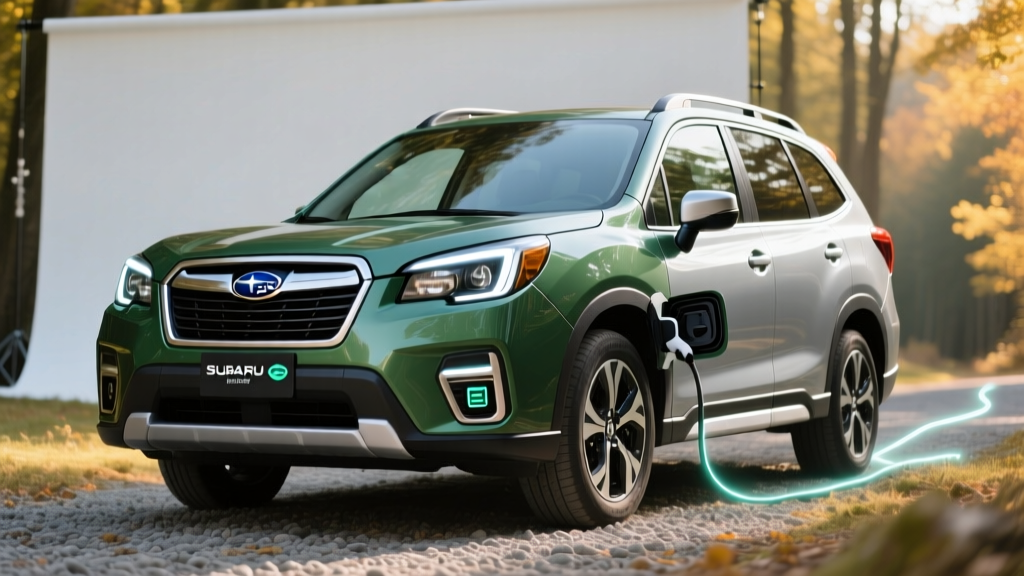
- Autumn Green Metallic — Hybrid-exclusive color, Premium and Limited
- River Rock Pearl — Available on Limited trim
- Horizon Blue Pearl — Available on Limited trim
- Crimson Red Pearl — Available on Limited trim
The hybrid-exclusive Autumn Green Metallic is the signature color for 2026, giving the Hybrid a distinct visual identity versus the gas-only Forester. All colors pair with either a gray or black interior depending on trim and option package. The Hybrid Premium starts with cloth upholstery, while the Hybrid Limited upgrades to leather-trimmed seats with available brown or black options.
Powertrain Specs: Toyota Hybrid Meets Subaru AWD
The 2026 Forester Hybrid uses a series-parallel hybrid system derived from Toyota's fifth-generation hybrid architecture, adapted for Subaru's boxer engine layout and symmetrical all-wheel-drive platform. This is the same collaborative engineering approach used in the Crosstrek Hybrid's predecessor, but with updated components for 2026.
| Specification | Detail |
|---|---|
| Engine | 2.5L DOHC 4-cylinder boxer (Atkinson cycle) |
| Engine Output | 163 hp / 149 lb-ft torque |
| Electric Motor (front) | 83 kW (111 hp) integrated in transaxle |
| Combined System Output | 194 hp |
| Drivetrain | Symmetrical AWD with electronic rear motor assist |
| Transmission | eCVT (electronically controlled continuously variable) |
| Hybrid Battery | ~1.1 kWh lithium-ion (sealed, not plug-in) |
| 0-60 mph (est.) | ~7.9 seconds |
| Towing Capacity | 1,500 lbs (est.) |
The 194 combined horsepower represents a meaningful upgrade over the gas-only Forester's 180 hp. The electric motor provides instant low-end torque, which makes a noticeable difference in stop-and-go traffic and during highway merging. Subaru's X-MODE with Hill Descent Control carries over to hybrid trims, preserving the off-road capability the Forester is known for, though the hybrid's additional weight (~200 lbs over the gas model) may slightly affect trail agility.
The 2026 Forester Hybrid is a conventional hybrid (HEV). Its ~1.1 kWh battery is charged exclusively through regenerative braking and the gasoline engine — you never plug it in. A plug-in hybrid (PHEV), by contrast, carries a larger battery (typically 10-20 kWh) that can be charged from a wall outlet and provides 20-40 miles of electric-only driving before the gas engine takes over. Subaru does not currently offer a Forester PHEV in the U.S. market. If you want plug-in capability from Subaru, you'd need to look at the discontinued Crosstrek PHEV (last sold 2023) or consider a competitor like the Toyota RAV4 Prime.
Fuel Economy: EPA Ratings and Real-World MPG
Fuel efficiency is the primary reason buyers choose the Forester Hybrid over the gas-only version. Here's how the EPA numbers break down:
| Metric | Forester Hybrid (AWD) | Forester Gas (AWD) |
|---|---|---|
| City MPG | 36 MPG | 26 MPG |
| Highway MPG | 35 MPG | 33 MPG |
| Combined MPG | 36 MPG | 29 MPG |
| Annual Fuel Cost (est.) | ~$1,650 | ~$2,050 |
Source: fueleconomy.gov — EPA estimates. Your actual mileage will vary.
Conventional hybrids like the Forester Hybrid typically exceed their EPA city rating in real-world urban driving because stop-and-go traffic maximizes regenerative braking opportunities. Owners of similar Toyota-sourced hybrid systems routinely report 38-40 MPG in city conditions. Highway driving at sustained 70-80 mph speeds tends to return closer to the EPA highway number or slightly below, around 33-35 MPG, because the electric motor contributes less at constant high speed. In cold weather (below 30°F), expect a 3-5 MPG reduction as the engine runs more frequently to provide cabin heat and maintain battery temperature. Overall, a realistic year-round average for mixed driving is 34-37 MPG.
The Forester Hybrid's city MPG advantage over the gas model is dramatic — a 10 MPG improvement — because the hybrid system lets the engine shut off at stops and uses electric motor torque for low-speed acceleration. Highway gains are more modest since aerodynamic drag and steady-speed cruising favor traditional engines. If your commute is primarily urban or suburban, the hybrid's fuel savings will be most pronounced.
Pricing, Trims, and Tax Credit Eligibility
The 2026 Forester Hybrid is offered in two trims. Pricing reflects Subaru's MSRP before destination charges:
| Trim | MSRP | Key Features |
|---|---|---|
| Hybrid Premium | $34,995 | 18" alloy wheels, EyeSight, 11.6" touchscreen, dual-zone climate, heated front seats, X-MODE |
| Hybrid Limited | $39,495 | Leather seats, power liftgate, Harman Kardon audio, blind-spot detection, rear cross-traffic alert, LED fog lights |
Destination and delivery adds approximately $1,420, bringing the Hybrid Premium to roughly $36,415 out-the-door before taxes and fees.
Does the 2026 Forester Hybrid Qualify for a Federal Tax Credit?
No. The Forester Hybrid is a conventional hybrid (HEV), not a plug-in electric vehicle. Under current IRS §30D rules, only battery-electric vehicles (BEVs) and plug-in hybrids (PHEVs) with sufficient battery capacity qualify for the federal Clean Vehicle Credit of up to $7,500. Conventional hybrids like the Forester Hybrid do not qualify for this credit.
Some states offer their own incentives for hybrid vehicles, though these are less common than EV incentives. Check your state's energy office or department of environmental quality for current programs. A few states have offered registration fee reductions or HOV lane access for hybrids, but these programs vary widely and may have expired. Always verify with official state sources before counting on a state-level hybrid incentive.
Battery Warranty, Reliability, and Replacement Cost
Hybrid battery longevity is one of the most common concerns among first-time hybrid buyers. Here's what Subaru covers:
- Hybrid Battery Warranty: 8 years / 100,000 miles (10 years / 150,000 miles in CARB states including CA, NY, MA, and others)
- Powertrain Warranty: 5 years / 60,000 miles
- Basic Vehicle Warranty: 3 years / 36,000 miles
The hybrid battery warranty covers capacity loss below a specified threshold (typically 70-80% of original capacity) and complete failure. Subaru's hybrid battery is a sealed lithium-ion unit designed to last the life of the vehicle under normal use.
How Reliable Is the Forester Hybrid System?
The 2026 Forester Hybrid's powertrain is derived from Toyota's hybrid architecture, which has accumulated over two decades of real-world reliability data across millions of vehicles (Prius, Camry Hybrid, RAV4 Hybrid). Toyota-sourced hybrid systems are widely regarded as among the most durable in the industry. The hybrid battery in vehicles using this architecture routinely lasts 150,000-200,000+ miles before needing replacement, and many original batteries are still in service beyond 200,000 miles.
Subaru's own hybrid components — the eCVT transaxle, electric motor, and power control unit — carry the same 8-year/100,000-mile warranty. The eCVT has no traditional gears or torque converter, which eliminates a common failure point in conventional automatic transmissions.
Hybrid Battery Replacement Cost
If the hybrid battery fails outside of warranty coverage, replacement costs for Toyota-architecture hybrid batteries in this class typically range from $2,500 to $4,500 including parts and labor, depending on the dealership and region. Third-party refurbished battery options can reduce this to $1,500-$2,500. However, given the proven longevity of these battery packs, most owners will never face this expense. The battery is also modular — individual cells can sometimes be replaced rather than the entire pack, further reducing out-of-warranty costs.
Who Should Buy the Forester Hybrid vs a Gas SUV or Full EV?
Choose the Forester Hybrid If:
- You want 30%+ better fuel economy without changing your refueling routine
- You live in an area with limited public charging infrastructure
- You need AWD for snow, rain, or light off-road use
- Your daily commute is city or suburban (where hybrid efficiency shines)
- You want lower running costs without the higher purchase price of a full EV
- You plan to keep the vehicle 8+ years and want proven hybrid reliability
Consider a Full EV Instead If:
- You have reliable home Level 2 charging (garage or driveway with 240V access)
- You want to qualify for the $7,500 federal tax credit (BEV/PHEV only)
- Your daily driving is under 250 miles and you rarely take long road trips
- You want zero tailpipe emissions and the lowest per-mile "fuel" cost
- You're interested in vehicles like the Hyundai Ioniq 5, Tesla Model Y, or Subaru Solterra
The Forester Hybrid makes the most sense for buyers who want to reduce fuel consumption and emissions incrementally but aren't ready — or able — to commit to plug-in charging. If you live in an apartment without charging access, frequently drive in rural areas with sparse charging networks, or regularly take road trips through charging deserts, the Forester Hybrid eliminates range anxiety entirely while still delivering meaningful fuel savings over the gas model.
For buyers who can charge at home and want maximum savings, a full EV will deliver lower per-mile energy costs (electricity at $0.13/kWh averages roughly $0.04/mile vs. the Forester Hybrid's ~$0.10/mile at $3.50/gallon) and access to federal and state incentives that the hybrid cannot claim.
Ownership Costs: 5-Year Comparison
| Cost Category | Forester Hybrid Premium | Forester Gas Premium |
|---|---|---|
| MSRP | $34,995 | $32,495 |
| Federal Tax Credit | $0 | $0 |
| Fuel (75,000 mi, $3.50/gal) | ~$7,290 | ~$9,050 |
| Maintenance (5 yr est.) | ~$2,800 | ~$3,100 |
| Insurance (5 yr est.) | ~$7,500 | ~$7,200 |
| 5-Year Total (approx.) | ~$52,585 | ~$51,845 |
Estimates based on 15,000 miles/year, national average fuel prices, and typical insurance premiums. Actual costs vary by region, driving habits, and insurer. Source: Author calculations using fueleconomy.gov data.
The Forester Hybrid's ~$2,500 price premium over the gas model is partially offset by roughly $1,760 in fuel savings over five years. The remaining gap narrows further when you factor in slightly lower maintenance costs (regenerative braking reduces brake pad wear, and the hybrid system eliminates the traditional starter motor and alternator). Over a 10-year ownership period, the hybrid's fuel savings will likely exceed its price premium, especially if gas prices rise.
Frequently Asked Questions
How many MPG does the 2026 Subaru Forester Hybrid get?
The EPA rates the 2026 Forester Hybrid at 36 MPG city, 35 MPG highway, and 36 MPG combined. Real-world mixed driving typically returns 34-37 MPG, with city-heavy commutes sometimes exceeding 38 MPG thanks to regenerative braking.
Do I need to plug in the Forester Hybrid to charge it?
No. The Forester Hybrid is a conventional hybrid (HEV). Its small lithium-ion battery charges automatically through regenerative braking and the gasoline engine. There is no plug, no charging port, and no need for home charging equipment.
Does the Forester Hybrid qualify for any federal tax credit?
No. Under current IRS §30D regulations, only plug-in electric vehicles (BEVs and PHEVs) qualify for the federal Clean Vehicle Credit. Conventional hybrids are not eligible. Check your state for any hybrid-specific incentives.
How long will the hybrid battery last, and what does replacement cost?
Subaru warranties the hybrid battery for 8 years/100,000 miles (10 years/150,000 miles in CARB states). Based on the Toyota-architecture hybrid system's track record, these batteries routinely last 150,000-200,000+ miles. Out-of-warranty replacement costs approximately $2,500-$4,500 at a dealership, with refurbished options available for less.
Is the Forester Hybrid good in snow and off-road?
Yes. The Forester Hybrid retains Subaru's symmetrical AWD system, X-MODE traction management, and 8.7 inches of ground clearance. The hybrid system adds electric rear-axle assist for improved low-speed traction. It performs identically to the gas Forester in snow, mud, and light trail conditions.
What's the difference between the Forester Hybrid and a PHEV like the RAV4 Prime?
The Toyota RAV4 Prime is a plug-in hybrid (PHEV) with a larger 18.1 kWh battery that provides 42 miles of electric-only driving before the gas engine engages. It qualifies for a partial federal tax credit and can be charged at home. The Forester Hybrid has no electric-only range and no plug — it's a simpler system with lower upfront cost but no electric-only commuting capability. If you can charge at home and want electric-only daily driving, a PHEV may be a better fit.
Which 2026 Forester Hybrid color is exclusive to the hybrid model?
Autumn Green Metallic is the hybrid-exclusive color available on both the Premium and Limited trims. It features a warm, earthy tone that distinguishes the Hybrid from gas-only Forester models on the road.