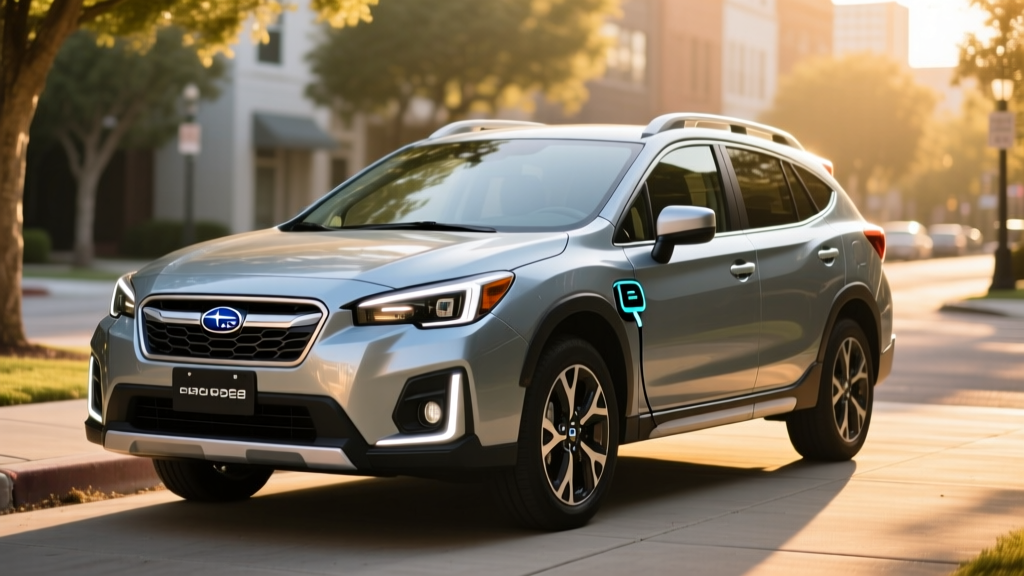
The Subaru Crosstrek has long been the go-to compact crossover for outdoor-minded buyers who need standard all-wheel drive without the fuel penalty. For 2026, Subaru continues to offer a hybrid variant in the upper Limited trim, pairing its proven 2.0-liter BOXER engine with an electric motor assist system. But in a market increasingly crowded with plug-in hybrids and full EVs, where does the 2026 Subaru Crosstrek Limited Hybrid fit — and is it the right electrified choice for your commute?
This guide covers everything buyers need to know: EPA fuel economy figures, real-world MPG expectations, the hybrid powertrain breakdown, battery longevity and warranty coverage, pricing, and whether this conventional hybrid (HEV) or a plug-in alternative better serves your driving habits.
HEV vs PHEV: What Kind of Hybrid Is the Crosstrek?
Before diving into specs, it's critical to understand what the 2026 Crosstrek Hybrid is — and what it isn't.
The 2026 Subaru Crosstrek Limited Hybrid is a conventional hybrid (HEV). It uses a small battery pack (approximately 1.1 kWh) that recharges through regenerative braking and the gasoline engine. You never plug it in. The electric motor assists the gas engine during acceleration and low-speed driving, improving fuel economy — but it cannot drive the vehicle on electric power alone for meaningful distances.
This differs fundamentally from a plug-in hybrid (PHEV) like the Toyota RAV4 Prime or Subaru's own discontinued Crosstrek PHEV (last sold in the U.S. for the 2023 model year). A PHEV carries a larger battery (typically 13–18 kWh), can be plugged into a wall outlet or Level 2 charger, and delivers 25–42 miles of pure electric driving before the gas engine takes over.
If you were hoping the 2026 Crosstrek Limited Hybrid offers plug-in electric-only range, it does not. Subaru has not reintroduced a PHEV variant for this generation. The hybrid system here is purely a fuel-efficiency assist — no charging cable required, no electric-only commuting, but also no range anxiety or charging logistics to manage.
Fuel Economy: EPA Ratings and Real-World MPG
Fuel efficiency is the primary reason buyers choose the hybrid over the standard gas Crosstrek. Here's how the 2026 model rates according to the EPA:
| Metric | Hybrid (HEV) | Gas-Only Crosstrek (2.0L CVT) |
|---|---|---|
| City MPG | 35 MPG | 28 MPG |
| Highway MPG | 34 MPG | 33 MPG |
| Combined MPG | 35 MPG | 30 MPG |
The hybrid's advantage is most pronounced in city driving, where the electric motor assist and regenerative braking do the most work. That 7 MPG city improvement over the gas model translates to roughly 1.5 fewer gallons consumed per 100 miles of urban commuting.
Real-World MPG: What to Actually Expect
Conventional hybrids often exceed their EPA city ratings in real-world stop-and-go traffic because regenerative braking recaptures energy that a gas-only car wastes as heat. On the highway, where the electric motor contributes less, real-world figures tend to track closely with or slightly below the EPA sticker.
Based on owner-reported data and testing patterns for Subaru's hybrid system:
- City / suburban driving: Expect 34–38 MPG. Short trips with frequent stops maximize regen benefit.
- Highway (70–75 mph): Expect 31–34 MPG. Aerodynamic drag and the lack of electric-only cruising reduce the hybrid advantage at sustained speed.
- Cold weather (below 30°F): Expect a 3–5 MPG drop. The engine runs longer to heat the cabin and maintain battery temperature, reducing electric-motor assist time.
- Mountainous terrain: Highly variable. Climbing grades consume more fuel, but long descents can regenerate significant charge, sometimes pushing instantaneous readings above 40 MPG on downhill segments.
For a driver covering 12,000 miles per year with a mixed commute, the hybrid saves approximately 65–80 gallons of fuel annually versus the gas Crosstrek — roughly $200–$280 per year at $3.30/gallon.
Powertrain Specs: Engine, Motor, and Combined Output
| Engine | 2.0L 4-cylinder BOXER (152 hp, 145 lb-ft) |
| Electric Motor | Integrated motor assist (~13 hp / 48 lb-ft) |
| Combined System Output | ~148 hp net system horsepower |
| Transmission | Lineartronic CVT (continuously variable) |
| Drivetrain | Symmetrical All-Wheel Drive (standard) |
| Hybrid Battery | ~1.1 kWh lithium-ion (self-charging, no plug-in) |
| 0–60 mph (est.) | ~9.2 seconds |
| Towing Capacity | 1,500 lbs |
| Ground Clearance | 8.7 inches |
The hybrid system's electric motor is integrated into the CVT housing and provides torque fill at low RPMs, smoothing out acceleration from stops. Don't expect a dramatic performance difference versus the gas model — the hybrid's combined output is modestly higher, but the added weight of the battery and motor roughly offsets the power gain. The real benefit is smoothness and efficiency, not speed.
Subaru's Symmetrical AWD remains standard, distributing torque front-to-rear as conditions demand. The hybrid system does not alter the AWD behavior; the rear wheels are still driven mechanically through the drivetrain, not by a separate electric motor (as some competing hybrid AWD systems use).
Battery Longevity, Warranty, and Replacement Cost
Hybrid Battery Warranty: Subaru covers the hybrid battery pack for 8 years / 100,000 miles (whichever comes first) under the standard hybrid component warranty. In states that follow California Air Resources Board (CARB) emissions rules — including California, New York, Massachusetts, and others — the hybrid battery warranty extends to 10 years / 150,000 miles.
Hybrid battery degradation in conventional HEVs is typically minimal. Unlike full EVs or PHEVs that cycle through large portions of their battery capacity daily, the Crosstrek's ~1.1 kWh pack operates within a narrow state-of-charge window (roughly 40–80%). This shallow cycling significantly extends cell life. Most Toyota and Subaru hybrid batteries from the past decade have lasted well beyond 150,000 miles without replacement.
If the hybrid battery does fail outside warranty, replacement cost for a Subaru conventional hybrid battery pack typically ranges from $2,000 to $3,500 including labor at a dealership. Independent hybrid specialists may offer refurbished packs for $1,200–$2,000. For context, this is far less than a full EV battery replacement ($8,000–$20,000+) because the HEV pack is much smaller.
The 12V auxiliary battery (which powers electronics, not the drivetrain) is a separate maintenance item and typically needs replacement every 4–6 years, costing $150–$300 — the same as any conventional vehicle.
Pricing, Trim Content, and Tax Credit Eligibility
The 2026 Subaru Crosstrek Limited Hybrid carries an MSRP of approximately $35,500 (including destination). This positions it roughly $3,000–$4,000 above the gas-powered Limited trim, which starts around $31,500.
The Limited trim includes premium features such as leather-trimmed seats, a 11.6-inch infotainment touchscreen, wireless Apple CarPlay and Android Auto, heated front seats, a power moonroof, and Subaru's EyeSight driver-assistance suite (adaptive cruise control, lane-keeping assist, pre-collision braking).
Does the 2026 Crosstrek Hybrid Qualify for a Federal Tax Credit?
No. The federal §30D Clean Vehicle Credit applies only to plug-in electric vehicles (BEVs and PHEVs) with battery capacities of at least 7 kWh. Because the 2026 Crosstrek Hybrid is a conventional HEV with a ~1.1 kWh self-charging battery, it does not qualify for the federal EV tax credit. The IRS is explicit on this point: conventional hybrids are excluded.
Some states offer modest incentives for hybrid vehicles (typically $250–$1,000 rebates), but these vary widely by jurisdiction and change frequently. Check your state's energy or environmental agency website for current programs.
The financial case for the hybrid rests entirely on fuel savings. At roughly $200–$280 per year in gas savings versus the gas model, the hybrid premium pays for itself in approximately 11–16 years for an average driver — or faster if gas prices rise significantly or you drive more than 12,000 miles annually.
Who Should Choose the Crosstrek Hybrid vs. a PHEV or Full EV?
Choose the 2026 Crosstrek Limited Hybrid if:
- You cannot charge at home (apartment, street parking, no garage outlet)
- You want better fuel economy with zero behavior change — no plugging in, no route planning around chargers
- You regularly drive in remote areas where charging infrastructure is sparse
- You want standard AWD with improved city MPG for a reasonable premium
- You plan to keep the vehicle 8+ years and value the proven reliability of Subaru's hybrid system
Consider a PHEV (like the Toyota RAV4 Prime or Hyundai Tucson PHEV) if:
- You have access to Level 2 home charging and a commute under 35 miles
- You want electric-only daily driving with a gas backup for road trips
- You want to qualify for the federal §30D tax credit (up to $7,500, subject to MSRP caps, income limits, and battery sourcing requirements)
Consider a full EV (like the Hyundai Ioniq 5 or Subaru Solterra) if:
- You have reliable home Level 2 charging
- Your daily driving is under 250 miles and you're comfortable with public DC fast charging for road trips
- You want zero tailpipe emissions and minimal drivetrain maintenance
The Crosstrek Hybrid occupies a specific niche: buyers who want incremental efficiency gains without the infrastructure demands of plug-in vehicles. If you can charge at home, a PHEV or BEV will deliver far greater fuel-cost savings and may qualify for significant tax credits that make the upfront cost competitive. But if charging access is a barrier, the HEV is the most practical electrified option available.
Pros
- Standard AWD with 8.7 inches of ground clearance
- 35 MPG combined — meaningful city improvement over gas model
- No plug-in charging required; zero behavior change
- Proven hybrid system with strong reliability history
- 8-year/100,000-mile hybrid battery warranty (10/150k in CARB states)
- Full EyeSight safety suite standard on Limited trim
Cons
- No electric-only driving range — motor is assist only
- Hybrid premium (~$3,500 over gas Limited) has a long payback period
- No federal tax credit eligibility
- Modest power — 0-60 in ~9.2 seconds isn't quick
- Small hybrid battery means limited regenerative braking benefit at highway speeds
- Subaru has not offered a Crosstrek PHEV since 2023 in the U.S.
Reliability and Long-Term Ownership Outlook
Subaru's hybrid system, derived from its partnership with Toyota, has demonstrated strong reliability in the field. The e-BOXER hybrid architecture uses a relatively simple parallel-hybrid layout with fewer components than a PHEV or full EV powertrain. There's no high-voltage charging port, no DC-DC converter rated for plug-in speeds, and no thermal management system as complex as a BEV's liquid-cooled battery pack.
Subaru consistently earns above-average reliability scores from Consumer Reports and J.D. Power for the Crosstrek lineup. The hybrid variant adds minimal mechanical complexity — the electric motor is integrated into the transmission housing and has no wear items. The primary long-term maintenance difference versus the gas model is the hybrid battery, which as noted above typically lasts the life of the vehicle under normal use.
Standard warranty coverage includes 3 years/36,000 miles bumper-to-bumper and 5 years/60,000 miles powertrain. The hybrid-specific components carry the extended 8/100k coverage. According to IIHS, the Crosstrek has earned top safety ratings, and the hybrid variant shares the same crash structure.
Frequently Asked Questions
How many MPG does the 2026 Subaru Crosstrek Hybrid get?
The EPA rates the 2026 Crosstrek Hybrid at 35 MPG city, 34 MPG highway, and 35 MPG combined. Real-world city driving often yields 34–38 MPG thanks to regenerative braking, while sustained highway driving at 70+ mph typically returns 31–34 MPG.
Can the 2026 Crosstrek Hybrid drive on electric power only?
Not in any practical sense. The electric motor can move the car at very low speeds (parking lots, brief coasting) but cannot sustain electric-only driving at road speeds. This is a conventional hybrid (HEV), not a plug-in hybrid (PHEV). If electric-only commuting matters to you, look at PHEV alternatives like the Toyota RAV4 Prime (42 miles electric-only) or a full EV.
Does the 2026 Crosstrek Hybrid qualify for any tax credit?
No federal tax credit applies. The IRS §30D Clean Vehicle Credit requires a plug-in vehicle with at least 7 kWh of battery capacity. The Crosstrek HEV's ~1.1 kWh battery does not meet this threshold. Some states may offer small hybrid rebates — check your local programs.
How long will the hybrid battery last, and what does replacement cost?
The hybrid battery is warrantied for 8 years/100,000 miles (10 years/150,000 miles in CARB states). In practice, conventional hybrid batteries routinely last 150,000+ miles because they operate within a narrow charge window that minimizes cell stress. Out-of-warranty replacement runs $2,000–$3,500 at a dealer, or $1,200–$2,000 for a refurbished pack from an independent specialist.
Is the hybrid worth the premium over the gas Crosstrek?
It depends on your ownership timeline and driving profile. The ~$3,500 hybrid premium saves roughly $200–$280 per year in fuel at current gas prices, yielding an 11–16 year payback for an average driver. If you drive more than 15,000 miles per year, keep vehicles 10+ years, or face above-average gas prices in your area, the math improves. If you can install home charging, a PHEV or EV will deliver far greater savings and may qualify for tax credits that offset the higher purchase price.
Does the hybrid affect cargo space or ground clearance?
The hybrid battery is packaged under the rear cargo floor, and Subaru has maintained the Crosstrek's 8.7 inches of ground clearance. Cargo volume is slightly reduced compared to the gas model (roughly 1–2 cubic feet less with the rear seats up), but the difference is minor for most buyers.