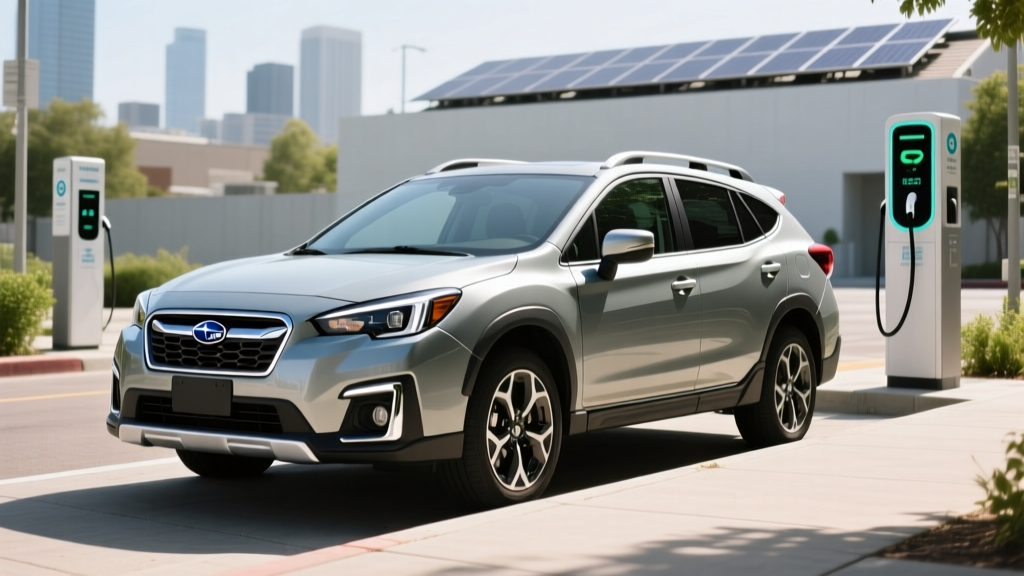
Subaru's compact crossover has long been the default choice for outdoorsy drivers who need standard all-wheel drive, solid ground clearance, and reasonable fuel economy. The 2026 Subaru Crosstrek Hybrid Sport adds a plug-in hybrid powertrain to that formula, promising short-commute electric driving without sacrificing the rugged utility the nameplate is known for. But with PHEV competition heating up from Toyota, Hyundai, and Kia, does Subaru's electrified Crosstrek hold up in 2026?
This guide breaks down everything you need to know: EPA fuel economy, real-world MPG, electric-only range, battery specs, pricing, tax credit eligibility, and whether this PHEV is the right fit for your driveway — or whether a conventional hybrid or full EV makes more sense.
2026 Subaru Crosstrek Hybrid Sport: Quick Specs
| Specification | 2026 Crosstrek Hybrid Sport |
|---|---|
| Powertrain | 2.0L flat-4 + electric motor (PHEV) |
| Combined Horsepower | 194 hp (net system) |
| Battery Capacity | 13.6 kWh (usable ~11.5 kWh, lithium-ion) |
| EV-Only Range (EPA) | ~17 miles |
| Total Combined Range | ~430 miles |
| EPA MPG (combined, gas) | 35 MPG combined / 36 city / 34 highway |
| MPGe (EV mode) | 92 MPGe |
| DC Fast Charging | No — Level 2 AC only (J1772) |
| Level 2 Charge Time (0–100%) | ~2.5 hours at 6.6 kW |
| Level 1 Charge Time (120V) | ~5.5 hours |
| 0–60 mph | ~7.8 seconds (est.) |
| Ground Clearance | 8.7 inches |
| Drivetrain | Standard Symmetrical AWD |
| Starting MSRP | ~$39,995 (Hybrid Sport trim) |
| Battery Warranty | 8 years / 100,000 miles |
HEV vs PHEV: Understanding the Crosstrek Hybrid
Before diving into the numbers, it's essential to clarify what you're buying. Subaru currently offers the Crosstrek Hybrid exclusively as a plug-in hybrid (PHEV) — not a conventional hybrid (HEV). Here's what that means in practice:
| Feature | Conventional Hybrid (HEV) | Plug-In Hybrid (PHEV) |
|---|---|---|
| Battery Size | Small (~1–2 kWh) | Larger (~10–20 kWh) |
| Plug In to Charge? | No — regenerates via braking/engine | Yes — plug in for EV range |
| Electric-Only Range | ~0.5–1 mile at low speed | ~15–40 miles depending on model |
| Federal Tax Credit | No | Up to $3,750 (varies by battery sourcing) |
| Driving Without Plugging In | Normal | Works fine as a hybrid, but wastes EV potential |
| Best For | Drivers who can't charge at home | Drivers with home/work charging + short commutes |
The Crosstrek Hybrid Sport is a PHEV. If you never plug it in, it will still function as a conventional hybrid — delivering roughly 35 MPG combined — but you'll be carrying around 300+ pounds of battery capacity you're not using. That defeats the purpose of the premium you paid for the plug-in system.
Fuel Economy: EPA Numbers vs Real-World MPG
The EPA rates the 2026 Crosstrek Hybrid Sport at 36 MPG city / 34 highway / 35 combined once the battery is depleted and the car operates in hybrid mode. In EV mode, it earns 92 MPGe. According to fueleconomy.gov, that puts it in the upper tier of AWD compact crossovers for efficiency.
| Driving Scenario | EPA Estimate | Real-World Expectation |
|---|---|---|
| City (hybrid mode) | 36 MPG | 37–40 MPG (regen braking excels in stop-and-go) |
| Highway (hybrid mode) | 34 MPG | 30–32 MPG (AWD + boxy shape increases drag at 70+ mph) |
| Combined (hybrid mode) | 35 MPG | 33–36 MPG depending on terrain and climate |
| EV-Only (MPGe) | 92 MPGe | 85–95 MPGe (cold weather reduces EV range by 20–30%) |
Electric-Only Range and Charging: What to Expect
The Crosstrek Hybrid Sport's 13.6 kWh battery pack (with roughly 11.5 kWh usable) provides an EPA-estimated 17 miles of pure electric driving. That's enough to cover a short commute, a school run, or a grocery trip without burning a drop of gasoline — but it's noticeably less than rivals like the Toyota RAV4 Prime (42 miles) or the Hyundai Tucson PHEV (33 miles).
Charging is straightforward but limited:
- Level 1 (120V household outlet): ~5.5 hours for a full charge. Fine for overnight top-ups if you drive fewer than 15 EV miles daily.
- Level 2 (240V, 6.6 kW onboard charger): ~2.5 hours from empty. A home Level 2 station fully replenishes the battery while you're at work or sleeping.
- DC Fast Charging: Not available. The Crosstrek Hybrid Sport uses a J1772 connector and cannot accept DC fast charging. This is common for PHEVs with smaller batteries — the added cost and weight of DC hardware rarely justifies the benefit at this battery size.
If your daily round-trip commute is under 15 miles and you can charge at home, you may go weeks between fill-ups. Subaru's AWD system remains fully functional in EV mode, so you don't sacrifice traction for efficiency.
Powertrain and Performance
Subaru pairs its familiar 2.0-liter boxer four-cylinder engine with an electric motor integrated into the CVT transmission. Net system output is 194 horsepower, a meaningful bump over the standard gas Crosstrek's 152 hp. The electric motor provides instant torque off the line, making the Hybrid Sport feel noticeably quicker in city driving and highway merging.
The estimated 0–60 mph time of ~7.8 seconds isn't sportscar territory, but it's a comfortable improvement over the gas model's ~9.0-second run. The CVT does its usual smooth-but-drone-under-hard-acceleration thing, and the added battery mass is perceptible in cornering — the Hybrid Sport is roughly 400 pounds heavier than its gas sibling. That said, the low-mounted battery slightly improves the center of gravity, and Subaru's standard Symmetrical AWD keeps traction exemplary in rain, snow, and gravel.
The 8.7 inches of ground clearance remains unchanged, meaning the Hybrid Sport retains the same light-off-road capability that makes the Crosstrek a favorite among hikers, skiers, and rural drivers.
Pricing, Tax Credits, and Ownership Costs
The 2026 Subaru Crosstrek Hybrid Sport starts at an estimated $39,995 MSRP (including destination). That's a significant premium over the gas-powered Crosstrek Sport (~$30,995) and even the Crosstrek Limited (~$34,495). The question is whether fuel savings and tax incentives close the gap.
Federal Tax Credit Eligibility (§30D)
Under the current IRS §30D clean vehicle credit rules, the Crosstrek Hybrid Sport may qualify for a partial federal tax credit. Here's the eligibility checklist:
- Battery capacity: Must be ≥7 kWh — the Crosstrek Hybrid's 13.6 kWh pack qualifies. ✓
- MSRP cap: SUVs/vans/pickups capped at $80,000 — the Crosstrek Hybrid passes easily. ✓
- Buyer income cap: AGI ≤ $150,000 (single) / $300,000 (joint) — varies by buyer. Check your situation.
- Critical minerals & battery component sourcing: A percentage must meet US/free-trade-agency sourcing thresholds. Subaru's PHEV supply chain has historically limited this — expect a partial credit ($3,750) rather than the full $7,500, depending on 2026 sourcing compliance.
- Point-of-sale transfer: The 2026 rules allow you to transfer the credit to the dealer at purchase, reducing your out-of-pocket cost immediately rather than waiting for tax filing.
- Final assembly: Must be in North America. Subaru's Lafayette, Indiana plant assembles some models, but confirm the Crosstrek Hybrid's assembly origin for your specific VIN.
5-Year Ownership Cost Snapshot
| Cost Category | Crosstrek Hybrid Sport (PHEV) | Crosstrek Sport (Gas) |
|---|---|---|
| Purchase Price (MSRP) | ~$39,995 | ~$30,995 |
| Est. Federal Tax Credit | –$3,750 (partial) | $0 |
| Effective Purchase Price | ~$36,245 | ~$30,995 |
| Fuel/Energy (5 yr, 15k mi/yr) | ~$4,800 | ~$8,200 |
| Maintenance (5 yr) | ~$2,100 | ~$2,600 |
| Insurance (5 yr, avg) | ~$7,500 | ~$6,800 |
| Estimated 5-Year Total | ~$50,645 | ~$48,595 |
The Hybrid Sport's fuel savings (~$3,400 over five years) partially offset its higher purchase price, but the gap doesn't fully close unless you maximize daily EV driving and benefit from the full available tax credit. Insurance tends to run slightly higher due to the more complex powertrain and battery replacement considerations.
Battery Warranty, Reliability, and Replacement Cost
Reliability Outlook
Subaru's PHEV system is a derivative of the Toyota hybrid architecture (the two companies share technology), which has a strong long-term reliability track record. The Crosstrek Hybrid's battery uses conventional lithium-ion chemistry — not the latest LFP cells found in some full EVs — but at 13.6 kWh, the pack is small and operates within a conservative state-of-charge window, which reduces stress and extends cycle life.
Based on historical data from Subaru's earlier Crosstrek Hybrid iterations and comparable Toyota PHEV systems, owners can expect minimal battery degradation over the first 8–10 years — typically 5–10% capacity loss under normal use.
Battery Replacement Cost
If you're planning to keep the vehicle well beyond the warranty period, a replacement high-voltage battery pack currently costs between $6,000 and $9,000 (parts and labor) at a Subaru dealer. That's a meaningful sum, but it's worth noting:
- Most PHEV batteries outlast the vehicle itself — complete failure is rare.
- Individual cell or module replacement may be possible at lower cost.
- Aftermarket and refurbished battery options are emerging as the PHEV fleet ages.
Who Should Buy the 2026 Crosstrek Hybrid Sport?
✓ Pros
- Standard AWD with 8.7" ground clearance — true all-weather/all-road capability
- 17-mile EV range covers many daily commutes gas-free
- 35 MPG combined as a hybrid is solid for an AWD crossover
- 194 hp is a noticeable upgrade over the gas model
- Partial federal tax credit reduces effective price
- 8-year/100,000-mile battery warranty
- Strong Subaru resale value and owner loyalty
✗ Cons
- 17-mile EV range trails RAV4 Prime (42 mi) and Tucson PHEV (33 mi)
- No DC fast charging
- ~$9,000 premium over the gas Crosstrek Sport
- Only partial ($3,750) tax credit likely — not the full $7,500
- CVT drone under hard acceleration
- Added battery weight (~400 lbs) affects handling dynamics
- Cargo space slightly reduced vs gas model due to battery placement
Decision Framework: Is the Crosstrek Hybrid Sport Right for You?
Choose the Crosstrek Hybrid Sport if: You need AWD and ground clearance for snow/gravel/trails, your daily commute is under 20 miles round-trip, you can charge at home (Level 1 or 2), and you want to reduce fuel consumption without committing to a full EV.
Choose the gas Crosstrek if: You can't charge at home, your budget is tight, or your daily driving far exceeds the EV range — the $9,000 premium won't pay for itself on gas savings alone.
Choose a full EV (e.g., Hyundai Ioniq 5, Subaru Solterra) if: You have reliable home charging, your daily driving is under 250 miles, you want zero tailpipe emissions, and you're ready to skip gas stations entirely.
Consider the Toyota RAV4 Prime instead if: You want a PHEV but need 40+ miles of EV range and don't mind a larger vehicle footprint.
Hybrid vs PHEV vs EV: Which Fits Your Life?
The 2026 Crosstrek Hybrid Sport sits in the middle of the electrification spectrum. Here's how to think about which category fits your situation:
| Factor | Gas (ICE) | Hybrid (HEV) | Plug-In Hybrid (PHEV) | Full EV (BEV) |
|---|---|---|---|---|
| Home Charging Needed? | No | No | Recommended | Essential |
| Daily Range Anxiety | None | None | Minimal | Depends on route |
| Fuel Cost (per mile) | ~$0.14 | ~$0.10 | ~$0.06 (EV mode) / ~$0.10 (hybrid) | ~$0.04 |
| Maintenance Cost | Highest | Moderate | Moderate | Lowest |
| Tax Credit | None | None | Up to $3,750–$7,500 | Up to $7,500 |
| Best For | Lowest upfront cost | No-plug efficiency | Short EV commute + gas flexibility | Home chargers, lowest running cost |
For the Crosstrek buyer specifically, the PHEV makes sense if you value Subaru's AWD system and ground clearance but want to eliminate gas use for local driving. If your routine includes frequent 200+ mile road trips to areas with sparse charging infrastructure, the PHEV's gas-engine backup is a genuine advantage over a full EV.
Frequently Asked Questions
How many MPG does the 2026 Subaru Crosstrek Hybrid Sport get?
The EPA rates it at 36 city / 34 highway / 35 combined MPG in hybrid mode (after the battery is depleted). In EV mode, it achieves 92 MPGe. Real-world city driving often yields 37–40 MPG thanks to regenerative braking, while sustained highway driving at 75+ mph may drop to 30–32 MPG.
How far can the Crosstrek Hybrid Sport go on electric only?
The EPA estimates 17 miles of electric-only range. In real-world conditions, expect 12–14 miles in cold weather or at highway speeds, and up to 19–20 miles in mild city driving. This is shorter than key PHEV competitors — the RAV4 Prime offers 42 miles and the Tucson PHEV offers 33 miles.
Does the 2026 Crosstrek Hybrid qualify for a federal tax credit?
It may qualify for a partial credit of $3,750 under IRS §30D, depending on battery component and critical mineral sourcing compliance for the 2026 model year. Buyer income limits ($150K single / $300K joint) and North American final assembly requirements also apply. The full $7,500 credit is unlikely due to Subaru's supply chain. Always confirm with a tax professional and check irs.gov for current rules.
Is the Crosstrek Hybrid reliable, and what does battery replacement cost?
Subaru's PHEV system benefits from shared Toyota hybrid technology, which has a strong reliability record. The high-voltage battery is warranted for 8 years / 100,000 miles. Out-of-warranty replacement costs approximately $6,000–$9,000, though full battery failure is uncommon — most PHEV packs retain 90%+ capacity after a decade of normal use.
Can I charge the Crosstrek Hybrid at a DC fast charger?
No. The Crosstrek Hybrid Sport only supports Level 1 (120V) and Level 2 (240V) AC charging via a J1772 connector. It does not have a DC fast-charging port. At a Level 2 home charger (6.6 kW), the battery charges fully in about 2.5 hours. This is standard for PHEVs with smaller battery packs.
Is the Crosstrek Hybrid Sport better than the gas version?
It depends on your driving pattern and charging access. If you can charge at home and your daily driving is under 20 miles, the PHEV will save you significant fuel costs and provide smoother, quieter electric driving. If you can't charge at home or regularly drive long distances, the gas Crosstrek Sport offers similar utility at ~$9,000 less. The Hybrid Sport's 194 hp also makes it the quickest Crosstrek in the lineup.
Does the hybrid battery reduce cargo space?
Yes, slightly. The high-voltage battery pack is mounted beneath the rear cargo floor, reducing under-floor storage and raising the load floor marginally. Total cargo volume drops by approximately 2–3 cubic feet compared to the gas Crosstrek. The rear seats still fold flat, but the slight floor height difference is noticeable when loading large items.