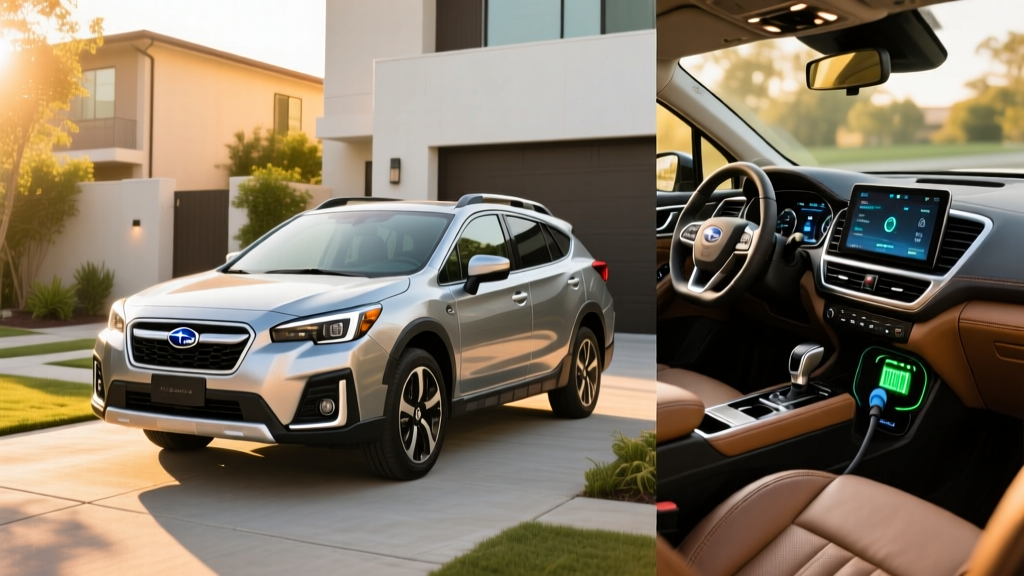
The Subaru Crosstrek has long been the default compact crossover for outdoor-minded drivers who need standard all-wheel drive without the bulk of a larger SUV. For 2026, the Subaru Crosstrek Hybrid returns as a plug-in hybrid (PHEV), pairing Subaru's symmetrical AWD with a battery-assisted powertrain that promises meaningful electric-only commuting and strong overall fuel economy. But with the PHEV market crowded by rivals like the Toyota RAV4 Prime and Mitsubishi Outlander PHEV, does the 2026 Crosstrek Hybrid justify its premium over the gas-only model? This guide breaks down every spec that matters.
HEV vs PHEV: What the 2026 Crosstrek Hybrid Actually Is
Before evaluating specs, it is critical to understand what Subaru is selling. The 2026 Crosstrek Hybrid is a plug-in hybrid electric vehicle (PHEV), not a conventional hybrid (HEV).
| Feature | Conventional Hybrid (HEV) | Plug-In Hybrid (PHEV) |
|---|---|---|
| Plug in to charge? | No — charges via regen and engine | Yes — has a charge port for grid power |
| Electric-only driving | Very limited (under 1 mi at low speed) | 17+ miles on battery alone |
| Battery size | ~1.0–1.5 kWh | ~13–20 kWh usable |
| Tax credit eligibility | Generally no (some mild credits) | Potentially up to $7,500 under §30D |
| Example | Toyota Prius (standard hybrid) | 2026 Subaru Crosstrek Hybrid |
If you see "Crosstrek Hybrid" and assume you never need to plug it in, you are only half right. The PHEV will operate as a conventional hybrid once the battery is depleted, so plugging in is optional for functionality — but skipping it means you are paying extra for electric range you never use.
Fuel Economy: EPA MPG and Real-World Expectations
The headline question for any hybrid buyer: how many miles per gallon does the 2026 Subaru Crosstrek Hybrid get?
| Metric | EPA Estimate | Real-World Expectation |
|---|---|---|
| Combined MPG (hybrid mode, battery depleted) | 35 MPG | 33–37 MPG |
| City MPG (hybrid mode) | 36 MPG | 36–40 MPG (regen-heavy driving favors city) |
| Highway MPG (hybrid mode) | 34 MPG | 31–34 MPG (AWD drag and boxy aero hurt at speed) |
| MPGe (combined, with charge) | 90 MPGe | Varies heavily by charge frequency |
| Electric-only range | 17 miles | 14–17 miles (less in cold or at highway speeds) |
| Total range (electric + gas) | ~450 miles | ~420–460 miles |
For comparison, the gas-only 2026 Crosstrek with the 2.5L engine returns an EPA-estimated 29 MPG combined. The PHEV's 35 MPG in hybrid mode represents roughly a 20% improvement in fuel consumption once the battery is depleted. Drivers who plug in nightly and commute under 17 miles may use almost no gasoline on weekdays.
Real-world note: Hybrids and PHEVs typically beat their EPA city estimates because stop-and-go driving maximizes regenerative braking. Highway efficiency is where the Crosstrek's tall ride height, roof rails, and permanent AWD create aerodynamic and mechanical drag. Expect highway fuel economy to land closer to the low end of the range on sustained 70+ mph trips. In sub-freezing temperatures, the electric-only range can drop 20–30% due to cabin heating demands and reduced battery efficiency.
Powertrain, Battery, and Charging Specs
| Specification | 2026 Subaru Crosstrek Hybrid |
|---|---|
| Powertrain type | Plug-in hybrid (PHEV) |
| Engine | 2.0L 4-cylinder Boxer (Atkinson cycle) |
| Engine output | 152 hp / 145 lb-ft |
| Electric motor output | 118 hp / 149 lb-ft (integrated into transmission) |
| Combined system horsepower | 194 hp |
| Drivetrain | Symmetrical AWD (standard) |
| Transmission | Lineartronic CVT |
| Battery chemistry | Lithium-ion (NMC) |
| Battery capacity (usable) | ~13.5 kWh |
| Level 1 charging (120V, 12A) | ~5 hours (0–100%) |
| Level 2 charging (240V, 32A) | ~2.5 hours (0–100%) |
| DC fast charging | Not supported |
| Charge port | J1772 (Level 1/2) |
| 0–60 mph | ~7.0 seconds |
| Cargo volume (behind rear seats) | ~19.9 cu ft (slightly reduced vs gas model) |
The combined 194 horsepower is a meaningful step up from the gas-only Crosstrek's 182 hp (2.5L), and the electric motor's instant torque makes the PHEV feel noticeably quicker in city driving and passing maneuvers. The 0–60 time of approximately 7.0 seconds puts it ahead of most compact crossover PHEVs.
Charging reality: The Crosstrek Hybrid does not support DC fast charging, which is typical for PHEVs in this class. The battery is small enough that Level 2 charging fully replenishes it in roughly 2.5 hours — adequate for topping up at work or between errands. Most PHEV owners charge overnight on Level 2 at home, waking to a full battery every morning. A standard 120V household outlet works but takes about 5 hours, making it viable only for overnight use.
Pricing, Trims, and Federal Tax Credit Eligibility
The 2026 Subaru Crosstrek Hybrid starts at an MSRP of approximately $36,995 (including destination). That represents a premium of roughly $7,000–$8,000 over a comparably equipped gas-only Crosstrek Premium.
Under the current IRS §30D Clean Vehicle Credit rules, PHEVs may qualify for up to $7,500 in federal tax credits — but eligibility is far from guaranteed. Here is the checklist that applies to the 2026 Crosstrek Hybrid:
- MSRP cap: SUVs must be under $80,000 — the Crosstrek Hybrid clears this easily.
- Buyer income cap: Modified AGI must not exceed $150,000 (single), $225,000 (head of household), or $300,000 (joint). Check your prior-year or current-year income, whichever is lower.
- Battery sourcing: A percentage of critical minerals and battery components must be sourced from the U.S. or free-trade-agreement countries. These thresholds increase annually. Subaru's supply chain compliance for 2026 must be verified on the fueleconomy.gov credit lookup at time of purchase.
- Point-of-sale transfer: As of 2024, buyers can transfer the credit to the dealer at purchase, reducing the out-of-pocket price directly — even if you owe less than $7,500 in taxes. This is effectively an instant rebate.
- Assembly: Final assembly must occur in North America. The Crosstrek is assembled in Gunma, Japan, which disqualifies it from the §30D new-vehicle credit under current rules.
Battery Warranty, Lifespan, and Replacement Cost
Hybrid and PHEV battery longevity is consistently the top concern among prospective buyers. Subaru backs the 2026 Crosstrek Hybrid's lithium-ion battery pack with a warranty of 8 years or 100,000 miles (whichever comes first), covering defects and capacity loss below a specified threshold — typically around 60–70% of original capacity. In California Air Resources Board (CARB) states, the warranty extends to 10 years or 150,000 miles under PZEV/AT-PZEV emissions rules.
The Crosstrek Hybrid's relatively small 13.5 kWh battery experiences shallower charge cycles than a full EV's larger pack, which generally translates to slower degradation. Subaru's thermal management system actively conditions the battery during charging and heavy discharge to mitigate heat-related wear.
Reliability and Ownership Track Record
Subaru's hybrid system has evolved from the earlier Crosstrek Hybrid (discontinued after 2023 in the U.S.) and benefits from Toyota's hybrid synergy drive technology, as Subaru and Toyota share powertrain engineering through their partnership. The 2.0L Boxer engine is a proven design with extensive service history.
Based on IIHS testing of the Crosstrek platform, the vehicle earns top safety marks, and the hybrid variant carries the same structural safety ratings. Subaru's EyeSight driver-assistance suite (adaptive cruise, lane centering, pre-collision braking) is standard — note this is an SAE Level 2 system requiring full driver attention at all times.
Common reliability considerations for Subaru PHEVs include the CVT transmission (which has improved significantly in recent generations but historically had higher failure rates in older models) and the added complexity of managing both an internal combustion engine and high-voltage electrical system. Subaru's dealer network for hybrid service is adequate but thinner than Toyota's in many regions.
Crosstrek Hybrid vs Full EV vs Gas: Who Should Choose What?
✅ Reasons to Choose the Crosstrek Hybrid
- Your daily commute is under 20 miles and you can charge at home
- You need standard AWD for snow, mud, or trail access
- You take long road trips where EV charging infrastructure is sparse
- You want better fuel economy without changing your driving habits
- You prefer Subaru's ground clearance (8.7 in) and X-MODE for light off-road use
❌ Reasons to Skip It
- You cannot charge at home or work (you will never use the electric range)
- You drive mostly highway miles (the efficiency advantage shrinks)
- You want the lowest total cost of ownership (a full EV like the Hyundai Ioniq 5 or a conventional HEV like the Toyota RAV4 Hybrid may be cheaper long-term)
- You need maximum cargo space (the battery reduces rear cargo slightly)
- You expected a federal tax credit (Japan-built = ineligible under §30D)
Decision Framework
Choose the 2026 Crosstrek Hybrid (PHEV) if: You have home charging, a short commute, frequent weekend adventures requiring AWD, and you value the flexibility of a gas engine for road trips into charging deserts.
Choose a full EV (e.g., Hyundai Ioniq 5, Subaru Solterra) if: You have reliable home and/or workplace charging, your daily driving is under 250 miles, you want zero tailpipe emissions, and you want to qualify for the $7,500 federal credit (Solterra is built in Japan too, so check current eligibility; Ioniq 5 U.S.-built models qualify).
Choose a conventional HEV (e.g., Toyota RAV4 Hybrid) if: You cannot plug in at all, you want simpler ownership with no charging routine, and you want a proven hybrid with strong resale value and no range planning.
Stick with the gas Crosstrek if: Your annual mileage is low (under 10,000 miles), the $7,000+ PHEV premium cannot be recouped in fuel savings within your ownership period, and you prioritize lower upfront cost.
Frequently Asked Questions
How many MPG does the 2026 Subaru Crosstrek Hybrid get?
The EPA rates it at 35 MPG combined, 36 city, and 34 highway when operating in hybrid mode with a depleted battery. Real-world city driving often yields 36–40 MPG thanks to regenerative braking. Highway trips at sustained speeds tend to land around 31–34 MPG.
How far can the 2026 Crosstrek Hybrid go on electric only?
The EPA estimates 17 miles of electric-only range. In real-world conditions — particularly in cold weather, at highway speeds, or with climate control running — expect 14–17 miles. This is sufficient for short commutes and errands but not enough for most drivers to go fully gas-free on a daily basis.
Does the 2026 Crosstrek Hybrid qualify for a federal tax credit?
Under current §30D rules, no — the Crosstrek is assembled in Japan, which fails the North American final assembly requirement. State-level PHEV rebates may be available depending on your jurisdiction. The used-vehicle credit (§25E, up to $4,000) may apply if you purchase a qualifying pre-owned unit from a dealer.
Is the Crosstrek Hybrid reliable, and what does a battery replacement cost?
Subaru's hybrid system benefits from Toyota-shared engineering with a strong reliability track record. The battery carries an 8-year/100,000-mile warranty (10 years/150,000 miles in CARB states). Out-of-warranty battery replacement is estimated at $4,000–$7,000, though historical data suggests complete battery failure before 150,000 miles is rare.
Does the Crosstrek Hybrid need to be plugged in?
No — it will operate as a conventional hybrid once the battery is depleted. However, to benefit from the electric-only range and optimal fuel economy, plugging in via a standard 120V outlet or 240V Level 2 charger is strongly recommended. Without plugging in, you are carrying dead battery weight and paying a PHEV premium for no benefit.
How does the Crosstrek Hybrid compare to the Toyota RAV4 Prime?
The RAV4 Prime offers significantly more electric-only range (42 miles EPA), a larger battery (18.1 kWh), and more combined horsepower (302 hp). It is also a larger vehicle with more cargo room but a higher starting price (~$44,000). The Crosstrek Hybrid is more compact, more affordable, and better suited for tight trails and urban parking, but with roughly half the electric range.
Sources: EPA fuel economy data via fueleconomy.gov, IRS §30D rules via irs.gov, Subaru of America official specifications. Tax credit eligibility is subject to change; consult a tax professional and verify on fueleconomy.gov before purchase.