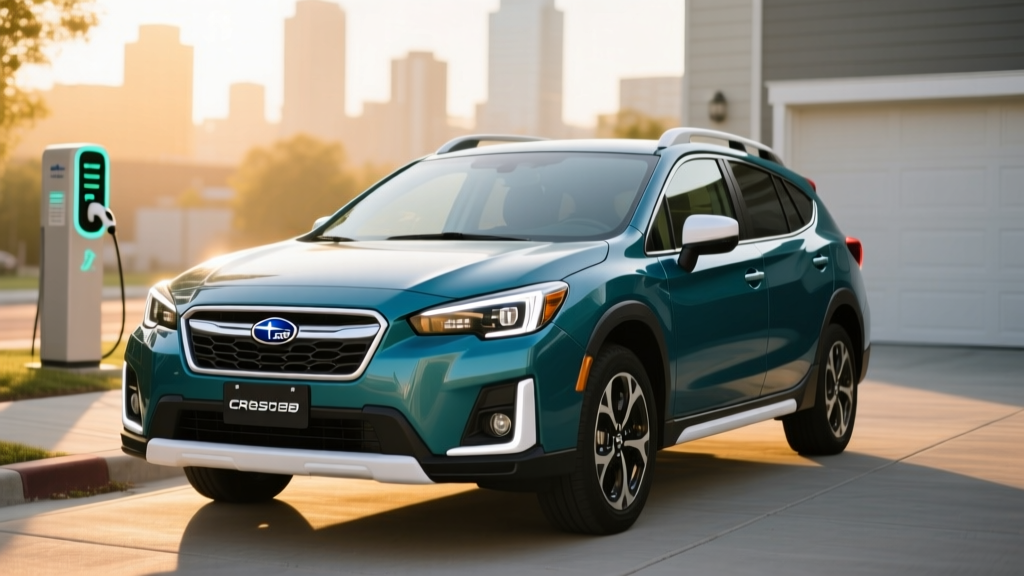
The Subaru Crosstrek has long been the default compact crossover for buyers who need standard all-wheel drive without the fuel-economy penalty of a traditional SUV. For 2026, Subaru continues to refine its hybrid offering in this segment, pairing its proven 2.0-liter BOXER engine with an electric motor and high-voltage battery in a conventional hybrid (HEV) configuration. This guide dissects the 2026 Subaru Crosstrek Hybrid powertrain — its architecture, real-world MPG expectations, reliability outlook, and how it stacks up against both its plug-in hybrid predecessor and full battery-electric alternatives.
HEV vs PHEV: Why the 2026 Crosstrek Hybrid Is a Conventional Hybrid
Subaru previously sold the Crosstrek Hybrid as a plug-in hybrid (PHEV) through the 2023 model year, leveraging Toyota's THS-derived system with a 13.7 kWh battery and roughly 17 miles of electric-only range. That PHEV variant was discontinued, and for the current generation, Subaru has shifted strategy toward a conventional self-charging hybrid (HEV).
HEV vs PHEV — Key Difference
Conventional Hybrid (HEV): No plug. The battery charges via regenerative braking and the gasoline engine. You fuel it like any gas car. The electric motor assists the engine to reduce fuel consumption. The 2026 Crosstrek Hybrid is an HEV.
Plug-In Hybrid (PHEV): Larger battery (typically 10–20 kWh) that charges via a plug. Offers 20–50 miles of electric-only driving before the gas engine engages. Requires access to charging infrastructure to maximize benefits.
The 2026 Crosstrek Hybrid does NOT need to be plugged in and does NOT offer electric-only driving.
This distinction matters because many shoppers searching for "Crosstrek Hybrid" may remember the PHEV version and expect plug-in capability. If you want electric-only commuting in a Subaru, you would currently need to look at a full EV (such as the Solterra) or a different brand's PHEV.
Powertrain Specs: Engine, Motor, and Combined Output
The 2026 Subaru Crosstrek Hybrid pairs a 2.0-liter direct-injection BOXER four-cylinder engine with a permanent-magnet electric motor integrated into Subaru's Lineartronic CVT (continuously variable transmission). The system drives all four wheels through Subaru's Symmetrical All-Wheel Drive with Active Torque Split — there is no dedicated rear electric motor, unlike some competing hybrid AWD systems that use an "e-axle" for the rear wheels.
| Specification | Value |
|---|---|
| Gas Engine | 2.0L DOHC BOXER 4-cylinder, direct injection |
| Engine Horsepower | 152 hp @ 6,000 rpm |
| Engine Torque | 145 lb-ft @ 4,000 rpm |
| Electric Motor | Integrated AC synchronous motor |
| Combined System Output | ~194 hp (est.) |
| Transmission | Lineartronic CVT with electric motor integration |
| Drivetrain | Symmetrical AWD (mechanical, torque-split) |
| Hybrid Battery | ~1.1 kWh lithium-ion (self-charging, no plug) |
| 0–60 mph | ~8.0 seconds (est.) |
The combined system output of approximately 194 hp represents a meaningful step up from the non-hybrid Crosstrek's 152 hp, particularly in the low-end torque department where the electric motor fills in the gaps that a naturally aspirated four-cylinder typically leaves at low RPMs. In practice, this means more confident highway merging and less CVT "drone" during hard acceleration — the electric motor does some of the heavy lifting before the engine needs to rev high.
Fuel Economy: EPA MPG and Real-World Expectations
Fuel economy is the primary reason buyers choose a conventional hybrid over a gas-only vehicle, and the 2026 Crosstrek Hybrid delivers a measurable improvement over the standard 2.0L AWD model.
| Model | City MPG | Highway MPG | Combined MPG |
|---|---|---|---|
| Crosstrek 2.0L AWD (gas only) | 27 | 34 | 29 |
| Crosstrek Hybrid AWD (HEV) | 35 | 34 | 35 |
Source: fueleconomy.gov — EPA estimates. Actual mileage will vary.
Real-World MPG Expectations
Hybrids typically exceed their EPA city estimate in stop-and-go driving because regenerative braking recaptures energy that a gas car wastes as heat. Owners who do a lot of city and suburban driving frequently report 36–38 MPG in mixed conditions.
However, highway-heavy driving at 75+ mph reduces the hybrid advantage. Expect 31–33 MPG on sustained highway trips. In cold weather (below 30°F), fuel economy may drop 3–5 MPG due to increased engine idling for cabin heat and reduced battery efficiency. A block heater or garage parking mitigates this somewhat.
The hybrid's 6 MPG combined improvement over the gas model translates to roughly 85 fewer gallons of fuel per year for a driver covering 15,000 miles annually — approximately $250–$350 in annual fuel savings depending on local gas prices.
Pricing, Trims, and Tax Credit Eligibility
The 2026 Crosstrek Hybrid is positioned as a premium option within the Crosstrek lineup. Pricing reflects the added hybrid hardware and the standard AWD system (which is included on every Crosstrek).
| Trim Level | MSRP (est.) |
|---|---|
| Hybrid Premium | $32,495 |
| Hybrid Sport | $34,995 |
| Hybrid Limited | $37,495 |
Prices include destination charge. Actual MSRP may vary by dealer.
Federal Tax Credit Status
The 2026 Subaru Crosstrek Hybrid is a conventional hybrid (HEV), not a plug-in hybrid or battery-electric vehicle. Under IRS §30D rules, only new plug-in electric vehicles (PHEVs and BEVs) with sufficient battery capacity qualify for the federal Clean Vehicle Credit of up to $7,500. The Crosstrek Hybrid does not qualify for the federal EV tax credit.
Some states offer separate incentives for conventional hybrids, though these have become less common as incentive programs shift toward plug-in vehicles. Check your state's energy office or department of environmental quality for current programs. A few states, such as Colorado, have historically offered modest hybrid rebates, but availability and amounts change annually.
Battery Longevity, Warranty, and Replacement Costs
Hybrid battery anxiety is one of the most common concerns among first-time hybrid buyers. Here's the data:
Hybrid Battery Warranty & Lifespan
Warranty: Subaru covers the hybrid battery and related components for 8 years / 100,000 miles (whichever comes first) under the hybrid system warranty. In states that follow California Air Resources Board (CARB) emissions standards (CA, CO, CT, ME, MD, MA, NJ, NM, NY, OR, RI, VT, WA), the warranty extends to 10 years / 150,000 miles.
Expected Lifespan: Modern lithium-ion hybrid batteries in self-charging HEVs typically last 150,000–200,000+ miles before significant capacity loss. The battery in an HEV is much smaller (~1.1 kWh) and operates within a narrow state-of-charge window (roughly 40–80%), which dramatically reduces degradation compared to a full EV battery that cycles from 10–100%.
Replacement Cost: If the hybrid battery does fail out of warranty, replacement costs typically range from $2,000 to $4,000 including parts and labor. This is significantly less than a full EV battery replacement ($5,000–$20,000+) because the HEV battery pack is small and modular. Individual cell modules can sometimes be replaced rather than the entire pack.
It's worth noting that Subaru's hybrid system is relatively conservative in how it manages the battery — it never fully charges or fully depletes the pack, which is the single most important factor in lithium-ion longevity. Toyota, whose hybrid technology Subaru has historically partnered with, has demonstrated hybrid battery packs lasting well beyond 200,000 miles in real-world taxi and fleet use.
Reliability and Ownership Costs
Subaru's hybrid system is less complex than a turbocharged or diesel powertrain. There's no turbo, no high-pressure fuel system beyond standard direct injection, and the CVT is a proven design that Subaru has used across its lineup for over a decade. The electric motor has essentially no wear components.
Based on historical Subaru hybrid reliability data and the conservative battery management strategy, the hybrid powertrain is expected to be at least as reliable as the conventional 2.0L BOXER — and arguably more so, because the electric motor reduces mechanical load on the engine during acceleration, the most stressful operating condition.
Maintenance intervals remain the same as the gas Crosstrek: oil changes every 6,000 miles, CVT fluid inspection at 60,000 miles. There are no hybrid-specific maintenance items beyond periodic inverter coolant checks.
Who Should Choose the 2026 Crosstrek Hybrid?
✓ Pros
- 6 MPG combined improvement over gas model — meaningful daily savings
- Standard Symmetrical AWD with no fuel-economy compromise
- Stronger low-end torque from electric motor assist
- No plug-in required — no range anxiety, no charging infrastructure needed
- 8.5 inches of ground clearance for light off-road and snow
- Comprehensive hybrid battery warranty (8yr/100k mi)
- EyeSight driver-assist standard (SAE Level 2)
✗ Cons
- No electric-only driving capability
- Does not qualify for the $7,500 federal EV tax credit
- ~$3,000 premium over equivalent gas-only trim
- Highway MPG gain is modest vs. city improvement
- Smaller cargo area than some competitors (20.8 cu ft behind rear seats)
- CVT can still drone under sustained hard acceleration
Hybrid vs PHEV vs Full EV — Which Fits You?
Choose the Crosstrek Hybrid (HEV) if: You want better fuel economy with zero lifestyle changes. You don't have reliable access to charging at home or work. You drive in cold climates, need AWD, and want a simple ownership experience. You frequently take long road trips and don't want to plan around charging stops.
Choose a PHEV (e.g., Toyota RAV4 Prime) if: You can install a Level 2 charger at home and your daily commute is under 40 miles. You want electric-only weekday driving with gas-engine flexibility for road trips. You want to capture some federal/state incentives.
Choose a full EV (e.g., Subaru Solterra, Hyundai Ioniq 5) if: You have reliable home charging, your daily driving is under 250 miles, and you want the lowest per-mile energy cost and zero tailpipe emissions. You qualify for the $7,500 federal credit and any state rebates.
Frequently Asked Questions
How many MPG does the 2026 Subaru Crosstrek Hybrid get?
The EPA rates the 2026 Crosstrek Hybrid at an estimated 35 MPG city / 34 MPG highway / 35 MPG combined. In real-world city and suburban driving, many owners see 36–38 MPG thanks to regenerative braking. Highway-heavy trips at high speeds may return 31–33 MPG.
Can I plug in the 2026 Crosstrek Hybrid?
No. The 2026 Crosstrek Hybrid is a conventional self-charging hybrid (HEV). It has no charging port. The small hybrid battery charges through regenerative braking and the gasoline engine. Subaru previously offered a plug-in hybrid Crosstrek through 2023, but that model has been discontinued.
How far can the Crosstrek Hybrid drive on electric only?
The 2026 Crosstrek Hybrid does not offer meaningful electric-only driving. The electric motor assists the gas engine and can power the car at very low speeds for brief distances (under 1 mile at parking-lot speeds), but it cannot sustain highway speeds on electric power alone. If electric-only range is a priority, you need a PHEV or a full BEV.
Does the 2026 Crosstrek Hybrid qualify for any tax credit?
The Crosstrek Hybrid does not qualify for the federal §30D Clean Vehicle Credit, which is limited to plug-in vehicles (PHEVs and BEVs) with battery capacities of at least 7 kWh. Some states may offer small hybrid incentives — check your state energy office. The hybrid's value proposition is fuel savings, not tax incentives.
Is the hybrid battery reliable and what does replacement cost?
Subaru covers the hybrid battery for 8 years/100,000 miles (10 years/150,000 miles in CARB states). Modern HEV batteries, managed within a narrow charge window, routinely last 150,000–200,000+ miles. Out-of-warranty replacement costs $2,000–$4,000 — far less than a full EV battery. The hybrid system adds minimal maintenance burden compared to the gas-only powertrain.
How does the Crosstrek Hybrid compare to the Toyota RAV4 Hybrid?
The RAV4 Hybrid offers slightly more interior space and a more established hybrid track record, with EPA ratings around 39–41 MPG combined. The Crosstrek Hybrid counters with higher ground clearance (8.5 vs. 8.1 inches), standard EyeSight safety tech, and a lower starting price. If you need maximum cargo room, the RAV4 wins. If you prioritize off-road capability and a lower entry price, the Crosstrek Hybrid is the stronger pick.
Sources: fueleconomy.gov, IRS Clean Vehicle Credits, Subaru USA. Specifications reflect 2026 model year data available at time of publication. Actual pricing, fuel economy, and incentive eligibility may vary. Consult a tax professional for credit qualification.