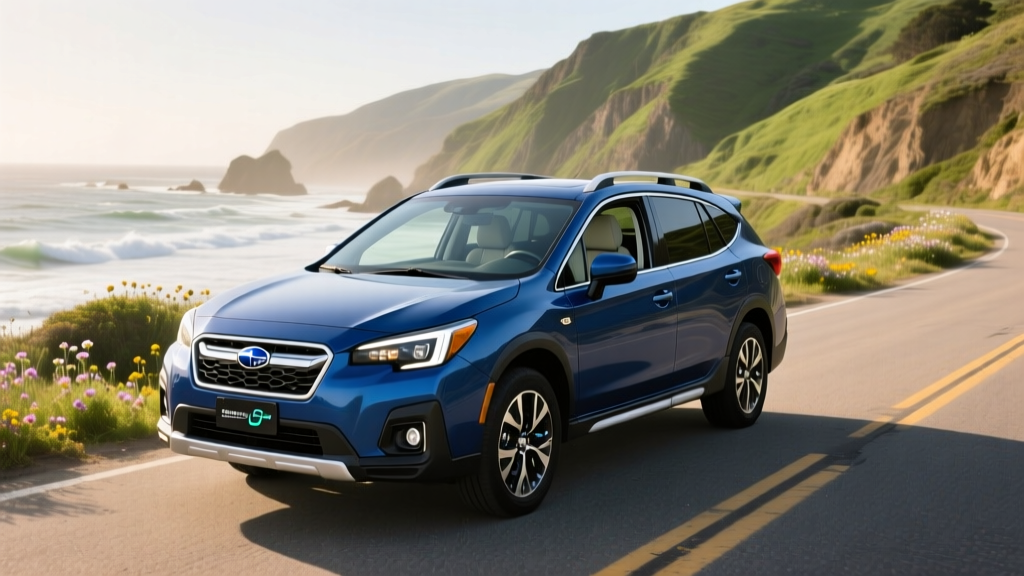
The Subaru Crosstrek has long been the go-to compact crossover for outdoor-minded buyers who need standard all-wheel drive and genuine ground clearance without the bulk of a larger SUV. For 2026, the 2026 Subaru Crosstrek Hybrid Limited sits at the top of the lineup, pairing Subaru's proven boxer-hybrid powertrain with the premium features buyers expect from a Limited trim. But with plug-in hybrids, full EVs, and conventional gas models all competing for the same buyer, where does this hybrid actually fit?
This guide gives you the exact numbers — EPA MPG, real-world fuel economy expectations, powertrain output, pricing, tax credit status, and battery warranty — so you can decide whether the 2026 Crosstrek Hybrid Limited earns a spot in your driveway or whether a PHEV or full BEV serves you better.
HEV vs. PHEV: What the 2026 Crosstrek Hybrid Actually Is
Before we get into the numbers, it's critical to understand what you're buying. The 2026 Subaru Crosstrek Hybrid is a conventional hybrid (HEV), not a plug-in hybrid (PHEV). That distinction matters enormously for how you'll own and operate the vehicle day to day.
HEV vs. PHEV at a Glance
| Feature | HEV (Crosstrek Hybrid) | PHEV (e.g., Toyota RAV4 Prime) |
|---|---|---|
| Plugs in? | No — refuels with gas only | Yes — has a charge port |
| Electric-only range | ~1 mile at low speed | 25–42 miles typical |
| Battery size | ~1.1 kWh (small buffer) | 13–18 kWh usable |
| Home charging needed? | No | Yes (Level 2 recommended) |
| Federal tax credit (§30D)? | No — HEVs don't qualify | Up to $7,500 if eligible |
| Best for | No home charger, wants better MPG | Home charging, short commutes |
If you don't have access to home or workplace charging, the Crosstrek Hybrid's HEV setup is a genuine advantage: you never change your fueling routine. You simply fill up at the gas station and the hybrid system handles the rest, using regenerative braking and engine optimization to cut fuel consumption.
Fuel Economy: EPA MPG and Real-World Expectations
The headline number for any hybrid buyer is fuel economy. Based on Subaru's published specifications and EPA data at fueleconomy.gov, here is what the 2026 Crosstrek Hybrid delivers:
Why real-world city MPG often beats the sticker: Hybrids recapture energy through regenerative braking every time you slow down. In stop-and-go urban traffic, the electric motor handles more low-speed propulsion, and the engine shuts off at stops. This is the opposite of a gas-only car, which gets its worst mileage in the city.
Why highway MPG can fall short: The Crosstrek's 8.7 inches of ground clearance and upright wagon shape create more aerodynamic drag than a sleek sedan. At 70–80 mph, that drag penalty is significant. Additionally, Subaru's symmetrical all-wheel drive adds mechanical friction that two-wheel-drive hybrids don't carry. Expect a 2–3 MPG drop from the EPA highway figure on sustained interstate drives.
For context, the gas-only 2026 Crosstrek (2.5L, CVT, AWD) returns an EPA 27 city / 34 highway / 29 combined. The hybrid's biggest gain is in city driving, where it delivers roughly a 22% improvement.
Powertrain Specs: Engine, Motor, and Combined Output
The 2026 Crosstrek Hybrid Limited uses Subaru's e-Boxer hybrid system — a 2.0-liter horizontally opposed (boxer) four-cylinder engine paired with an electric motor integrated into the Lineartronic CVT. Here's the full breakdown:
The e-Boxer system is tuned for efficiency, not performance. The electric motor's primary role is filling in torque at low RPMs (where the 2.0L boxer is weakest), smoothing stop-start transitions, and enabling brief engine-off coasting. Don't expect the punchy acceleration of a Toyota RAV4 Prime or a full EV — this is a fuel-economy play, not a performance hybrid.
Pricing: What the Limited Trim Costs in 2026
The 2026 Subaru Crosstrek Hybrid Limited is the top trim in the hybrid lineup. Based on Subaru's pricing structure:
- Base MSRP (Crosstrek Hybrid, lower trim): ~$31,000–$33,000
- 2026 Crosstrek Hybrid Limited MSRP: ~$36,500–$38,000 (including destination)
- Typical options/upgrades: $500–$1,500 (popular packages, cargo accessories, etc.)
The Limited trim adds leather-trimmed upholstery, a 10-way power driver's seat, heated front seats, a Harman Kardon premium audio system, blind-spot detection with rear cross-traffic alert, and reverse automatic braking — features that justify the price premium for many buyers.
Federal Tax Credit Eligibility
If the federal tax credit is a dealbreaker for your purchase, you'll need to look at a PHEV (like the Toyota RAV4 Prime or Hyundai Tucson PHEV) or a full BEV (like the Hyundai Ioniq 5 or Tesla Model Y). But remember: PHEVs only deliver their efficiency advantage if you can charge at home or work. Without plugging in, a PHEV operates as a heavier, less-efficient conventional hybrid.
Battery Warranty, Reliability, and Replacement Cost
Hybrid battery longevity is the number-one concern we hear from buyers considering their first hybrid. Here's the reality for the 2026 Crosstrek Hybrid:
Subaru Hybrid Battery Warranty
- Hybrid battery warranty: 8 years / 100,000 miles (whichever comes first)
- CARB-state extended warranty: 10 years / 150,000 miles in states that follow California Air Resources Board standards (CA, NY, MA, WA, OR, CO, and others)
- Powertrain warranty: 5 years / 60,000 miles
- Capacity threshold: Warranty covers battery if capacity drops below ~60–70% of original
Real-world reliability: Subaru's e-Boxer system has been in production since 2019 (earlier in Japan). The hybrid battery in this system is small (~1.1 kWh) and operates within a narrow state-of-charge window — typically between 40% and 80%. This shallow cycling is far less stressful on battery cells than the deep cycles a full EV or PHEV undergoes. As a result, HEV battery packs routinely last 150,000–200,000+ miles before any meaningful degradation.
Replacement cost if out of warranty: Based on current parts pricing and dealer labor rates, a Crosstrek hybrid battery replacement runs approximately $2,500–$4,000. This is significantly less than a full EV battery replacement ($8,000–$20,000+) because the pack is small. Independent hybrid-battery shops can often refurbish or replace individual modules for $1,500–$2,500.
For comparison, the conventional gas Crosstrek's CVT transmission — which the hybrid shares in modified form — has had some historical reliability concerns in earlier Subaru generations. The hybrid version's CVT benefits from the electric motor smoothing load transitions, which may actually reduce long-term wear.
Who Should Buy the 2026 Crosstrek Hybrid Limited?
Decision Framework: Is This the Right Electrified Vehicle for You?
Choose the 2026 Crosstrek Hybrid Limited if:
- You don't have access to home or workplace charging (apartment, street parking, no garage)
- You want AWD and 8.7" ground clearance for dirt roads, snow, or trailheads
- Your daily driving is a mix of city and highway and you want 33–36 real-world combined MPG
- You want Subaru's EyeSight safety suite and the Limited's premium features
- You prefer to refuel at gas stations and don't want to change your routine
Choose a PHEV (like the RAV4 Prime or Tucson PHEV) instead if:
Choose a full BEV (like the Ioniq 5, Model Y, or EV6) instead if:
- You have reliable home charging and your typical trips are under 250 miles
- You want the lowest per-mile fuel cost (electricity at $0.13/kWh ≈ $0.04/mile vs. gas at $3.50/gal ≈ $0.12/mile)
- You want maximum acceleration, instant torque, and minimal maintenance
- You want to qualify for the full federal tax credit
Pros and Cons at a Glance
✓ Pros
- Standard AWD with 8.7" ground clearance — genuine off-road capability
- 35 MPG combined EPA; 36–38 MPG achievable in real city driving
- No plug-in charging required — zero change to fueling routine
- Limited trim is well-equipped: leather, Harman Kardon, EyeSight
- Small hybrid battery means low replacement cost ($2,500–$4,000)
- 8-year/100,000-mile hybrid battery warranty (10yr/150k in CARB states)
- Strong Subaru resale value historically
✗ Cons
- No federal tax credit eligibility (HEV, not PHEV/BEV)
- ~165 hp combined — adequate but not quick (0–60 in ~9 seconds)
- Highway MPG falls short of EPA sticker due to AWD drag and boxy shape
- 1,000-lb towing capacity limits utility vs. larger crossovers
- Hybrid battery takes some cargo space vs. gas model
- No DC fast charging capability (not applicable for HEV)
- Premium Limited trim pushes price near $38,000+ with options
Frequently Asked Questions
How many MPG does the 2026 Subaru Crosstrek Hybrid get?
The EPA rates the 2026 Crosstrek Hybrid at 35 city / 34 highway / 35 combined MPG. In real-world driving, expect 36–38 MPG in city conditions (where regenerative braking helps most) and 31–33 MPG on sustained highway drives. The gas-only Crosstrek AWD returns 29 combined, so the hybrid saves roughly 4–6 gallons per 100 miles of mixed driving.
Can the Crosstrek Hybrid drive on electric power only?
Only very briefly. The e-Boxer system can propel the car on electric power alone for roughly one mile at very low speeds (under 25 mph) — useful for creeping through a parking lot or a residential street. This is not a meaningful electric-only driving range. If you want 25+ miles of electric-only commuting, you need a PHEV or a full BEV.
Does the 2026 Crosstrek Hybrid qualify for any tax credit?
No. The federal §30D Clean Vehicle Credit applies only to plug-in vehicles (PHEVs and BEVs) with battery packs of at least 7 kWh. The Crosstrek Hybrid's ~1.1 kWh battery does not meet this threshold. Some states may offer smaller incentives for conventional hybrids — check the AFDC state laws database for your jurisdiction. Always consult a tax professional for your specific eligibility.
Is the Subaru hybrid system reliable? What about battery replacement?
Subaru's e-Boxer system has been in production since 2019 and shares core hybrid architecture with Toyota (a Subaru partner). The small battery pack cycles shallowly (40–80% SoC), which greatly extends cell life. Most hybrid batteries last well beyond 150,000 miles. The battery carries an 8-year/100,000-mile warranty (10 years/150,000 miles in CARB states). Out-of-warranty replacement costs approximately $2,500–$4,000 — far less than a full EV pack.
Should I get the Crosstrek Hybrid or a full EV like the Solterra?
It depends entirely on your charging situation. If you have Level 2 home charging and most trips are under 220 miles, Subaru's own Solterra (222–228 mi EPA range, eligible for the $7,500 federal credit) may save you more money long-term on fuel. But if you lack home charging, regularly drive in remote areas with sparse charging infrastructure, or frequently take 400+ mile road trips, the Crosstrek Hybrid eliminates range anxiety while still cutting your fuel bill by roughly 20% versus the gas Crosstrek.
How does the Crosstrek Hybrid compare to the Toyota RAV4 Hybrid?
The RAV4 Hybrid is larger, more powerful (219 hp combined), and rated at 41 city / 38 highway / 41 combined EPA — significantly more efficient, especially in the city, thanks to Toyota's more advanced hybrid synergy drive. However, the RAV4 Hybrid costs more, has only 8.1" of ground clearance vs. the Crosstrek's 8.7", and doesn't offer the same compact footprint for tight urban parking. If cargo space and rear-seat room matter, the RAV4 wins. If compact size and trail capability matter, the Crosstrek Hybrid holds its own.
Sources: EPA fuel economy data via fueleconomy.gov; Subaru of America official specifications; IRS §30D Clean Vehicle Credit guidelines via irs.gov; Alternative Fuels Data Center state incentive database. Pricing and specifications reflect 2026 model year information available at time of publication and are subject to change. Consult your local Subaru dealer and a tax professional for final figures.