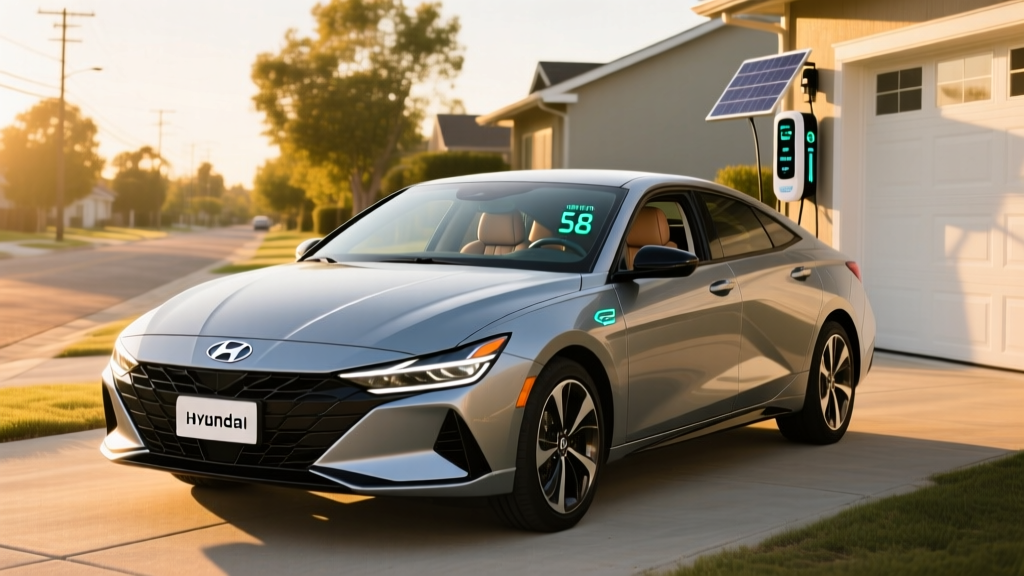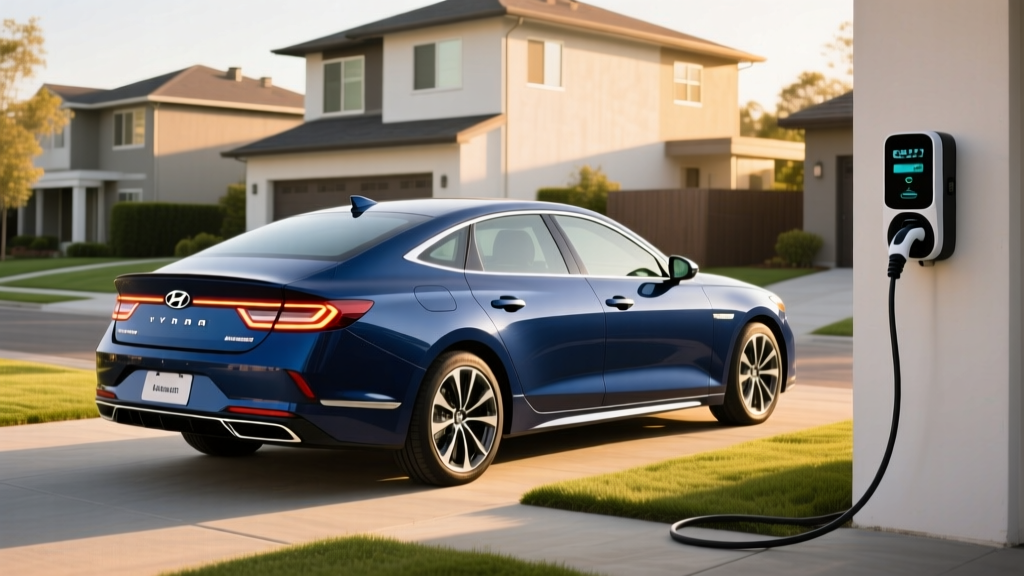
If you want electric commuting without range anxiety on road trips, the 2026 Hyundai Sonata Plug-In Hybrid sits in a narrow sweet spot: enough battery for a typical daily commute on electrons alone, a gas engine for weekend hauls, and a sedan price tag that undercuts most electric crossovers. This guide walks through the real-world numbers, charging logistics, and ownership economics you need before signing the paperwork.
HEV vs PHEV: What the Sonata Plug-In Actually Is
The Sonata lineup comes in two electrified flavors, and confusing them is the single most common mistake shoppers make at the dealership.
| Feature | Sonata Hybrid (HEV) | Sonata Plug-In Hybrid (PHEV) |
|---|---|---|
| Plugs in to charge? | No — charges via engine and regen | Yes — plug in to a wall outlet or charger |
| Battery size | 1.6 kWh (small buffer) | 13.8 kWh usable |
| Electric-only driving | Brief low-speed assist only | Up to 32 miles at highway-capable speeds |
| EPA combined MPG | 47 MPG | 44 MPG (gas) / 100 MPGe (electric) |
| Tax credit eligible | No | Up to $3,750 under §30D (see eligibility below) |
| Starting MSRP | ~$31,000 | ~$36,400 |
The conventional Sonata Hybrid never needs a plug — it captures energy from braking and the engine to charge its small battery. The Sonata Plug-In Hybrid (PHEV) carries a much larger battery that you charge from the grid, enabling genuine electric-only commutes before the 2.0-liter gas engine kicks in. If you can charge at home and your round-trip commute is under ~30 miles, the PHEV will run on electricity most days and burn almost no gas.
Electric-Only Range, Total Range, and Efficiency Numbers
| Spec | 2026 Sonata Plug-In Hybrid |
|---|---|
| EPA electric-only range | 32 miles |
| Total range (electric + gas) | ~550 miles |
| EPA combined MPG (gas mode) | 44 MPG |
| EPA city / highway MPG | 45 city / 42 highway |
| MPGe (electric mode) | 100 MPGe |
| Usable battery capacity | 13.8 kWh |
| Battery chemistry | NMC (nickel manganese cobalt) |
| Combined horsepower | 178 HP (engine + motor) |
| Engine | 2.0L 4-cylinder (148 HP) + 50 kW electric motor |
| Transmission | 6-speed automatic |
| 0-60 mph (estimated) | ~7.5 seconds |
The EPA rates the Sonata PHEV at 32 miles of electric-only range. In real-world testing, expect 28–30 miles on a mixed suburban/highway commute in mild weather. In cold conditions (below 35°F), cabin heating and battery chemistry reduce that to roughly 22–25 miles. If your commute is mostly stop-and-go city driving, you may actually exceed the EPA number — regenerative braking recaptures more energy at low speeds.
Once the battery depletes, the Sonata PHEV operates as a conventional hybrid, returning the EPA-rated 44 MPG combined. That's slightly less than the dedicated Sonata Hybrid (47 MPG combined) because the PHEV carries roughly 300 extra pounds of battery mass. On the highway, real-world fuel economy tends to land between 39–42 MPG at 70+ mph — typical for midsize hybrid sedans.
Charging: What You Need to Plug In at Home
The Sonata PHEV uses a standard J1772 connector for AC charging. Here is what charging looks like across the three levels:
| Charging Level | Power (kW) | Full Charge Time | Where You'll Use It |
|---|---|---|---|
| Level 1 (120V household outlet) | ~1.4 kW | ~10 hours | Overnight at a standard outlet |
| Level 2 (240V home charger) | ~3.3 kW (onboard charger limit) | ~4.5 hours | Home garage, workplace charging |
| DC Fast Charging | Not supported | N/A | Not available on this model |
A critical spec many buyers overlook: the Sonata PHEV's onboard charger is rated at 3.3 kW. Even if you install a 7.2 kW or 11.5 kW Level 2 home charger (which costs $500–$1,200 for the unit plus installation), the car will only accept 3.3 kW. That means a full charge takes roughly 4.5 hours regardless of how powerful your wall box is.
For most owners, this is not a problem. Plug in when you get home at 6 PM, and the battery is full by 10:30 PM — well before your morning commute. The 13.8 kWh battery is small enough that even Level 1 (a standard 120V outlet) can replenish it overnight, though just barely. If your daily electric commute uses 20–25 miles of range (~9–11 kWh), a standard outlet adds enough overnight to cover it.
DC fast charging is not available on the Sonata PHEV. This is standard for most plug-in hybrids — the battery is small enough that AC charging is sufficient, and adding DC fast-charge hardware would increase cost and weight. If you need rapid public charging, you're looking at a full battery electric vehicle (BEV), not a PHEV.
Pricing, Trims, and Federal Tax Credit Eligibility
The 2026 Sonata Plug-In Hybrid starts at approximately $36,400 (SEL trim, including destination charge). A Limited trim adds premium features like leather seats, a panoramic sunroof, and advanced highway driving assist for roughly $40,000.
The Sonata Plug-In Hybrid may qualify for a partial federal tax credit of up to $3,750 under IRS §30D. The full $7,500 credit requires meeting both critical-mineral and battery-component sourcing thresholds, and most Hyundai/Kia PHEVs currently qualify for only the critical-minerals portion ($3,750).
- Battery capacity: Must be ≥ 7 kWh ✓ (Sonata PHEV has 13.8 kWh)
- MSRP cap: Sedans must be under $55,000 ✓
- Buyer income cap: AGI ≤ $150K (single) / $300K (joint) ✓ for most buyers
- Final assembly: Must be in North America — verify VIN at IRS.gov eligible vehicle list
- Point-of-sale transfer: You can apply the credit as a down-payment reduction at the dealer instead of waiting for tax filing
Always verify current eligibility on the IRS website and consult a tax professional. Sourcing requirements tighten annually and can change a vehicle's credit status mid-year.
After a potential $3,750 credit, the effective starting price drops to roughly $32,650 — competitive with well-equipped non-hybrid midsize sedans once you factor in fuel savings.
Reliability, Battery Warranty, and Replacement Costs
- Hybrid battery: 10 years / 100,000 miles (original owner)
- Hybrid system components: 10 years / 100,000 miles
- Powertrain (engine, transmission): 10 years / 100,000 miles
- New vehicle limited warranty: 5 years / 60,000 miles
Note: In states that follow California emissions warranty rules (CARB states), the hybrid battery warranty extends to 10 years / 150,000 miles. Check your state's requirements.
Hyundai's hybrid battery warranty is among the strongest in the industry. The 10-year/100,000-mile coverage means most owners will never face an out-of-pocket battery replacement. For context, the Sonata PHEV's NMC battery pack is engineered for a capacity retention threshold of 70% — if the battery degrades below 70% of its original 13.8 kWh capacity within the warranty period, Hyundai replaces it at no cost.
Should you need a replacement outside warranty (rare, but possible for high-mileage or second owners), expect a cost between $3,500 and $5,500 including parts and labor for the PHEV battery pack. This is significantly less than a full EV battery replacement ($8,000–$20,000+) because the PHEV pack is much smaller.
Reliability data from IIHS and owner surveys shows the Sonata PHEV's powertrain — a naturally aspirated 2.0L engine paired with an electric motor and conventional 6-speed automatic — is mechanically straightforward. There's no turbocharger, no CVT, and no high-voltage complexity beyond the battery pack itself. The Sonata earned strong marks in crash testing, and Hyundai's hybrid systems have proven durable across the Ioniq, Tucson, and Sonata families.
Who Should Choose the Sonata PHEV vs. a Full EV or Gas Car
Choose the Sonata Plug-In Hybrid if:
- Your daily round-trip commute is 20–30 miles and you can charge at home
- You take road trips of 300+ miles several times a year and don't want to plan around chargers
- You live in an apartment or area where reliable public DC fast charging is sparse
- You want EV-like daily driving without the $40,000+ price of a long-range BEV
Choose a full EV (BEV) instead if:
- You have reliable home Level 2 charging AND access to DC fast chargers for road trips
- Your daily driving exceeds 40 miles (the PHEV battery won't cover it all)
- You want zero tailpipe emissions and minimal maintenance (no oil changes, no gas engine)
- You qualify for the full $7,500 federal credit on a BEV, narrowing the price gap
Choose the conventional Sonata Hybrid (HEV) instead if:
- You cannot charge at home or at work (no garage, no outlet access)
- Your commute is consistently over 40 miles one-way (the PHEV battery runs out and you're carrying dead weight)
- You want maximum MPG without plugging in — the HEV returns 47 MPG combined with zero behavior change
The Sonata PHEV's ideal owner has a garage or driveway with a 120V or 240V outlet, commutes 15–30 miles each way, and takes 3–5 road trips per year where charging infrastructure might be uncertain. In that scenario, you'll burn roughly 5–8 gallons of gas per month during commute-heavy months and use the engine freely on highway trips. Total annual fuel cost for a 12,000-mile driver who charges daily: roughly $600–$900, compared to $1,600–$2,000 for a comparable gas-only midsize sedan.
Pros and Cons at a Glance
- 32 miles electric-only covers most commutes
- 550+ miles total range eliminates trip planning
- Strong 10-year / 100K-mile battery warranty
- Spacious midsize sedan with 16 cu-ft trunk
- Partial $3,750 federal tax credit eligibility
- Comfortable ride, well-equipped interior
- 3.3 kW onboard charger is slow for Level 2
- No DC fast charging capability
- Electric range drops to ~22 miles in cold weather
- $5,000+ price premium over the Sonata HEV
- Only partial tax credit (not the full $7,500)
- 6-speed auto feels less refined than competitors' e-CVTs
Frequently Asked Questions
How many MPG does the Sonata Plug-In Hybrid get?
The EPA rates the 2026 Sonata PHEV at 44 MPG combined (45 city / 42 highway) when running on gas after the battery is depleted. In electric mode, it achieves 100 MPGe. Real-world highway driving at 70+ mph typically yields 39–42 MPG. In city driving with frequent regenerative braking, many owners report 45–48 MPG in hybrid mode — slightly above the EPA city estimate.
How far can the Sonata Plug-In Hybrid go on electric only?
The EPA electric-only range is 32 miles. In real-world conditions, expect 28–30 miles in mild weather and 22–25 miles in freezing temperatures. This covers the average American one-way commute (~16 miles per the Census Bureau) with margin to spare, meaning most daily driving can be gas-free if you charge overnight.
Does the Sonata Plug-In Hybrid qualify for a tax credit?
It may qualify for a partial federal tax credit of up to $3,750 under IRS §30D, depending on battery sourcing compliance, your income (AGI ≤ $150K single / $300K joint), and the vehicle's final assembly location. The credit can be applied at the point of sale as a down-payment reduction. Always verify current eligibility at IRS.gov before purchasing, as sourcing rules tighten annually.
Is the Sonata Plug-In Hybrid reliable, and what does a battery replacement cost?
Hyundai backs the PHEV battery with a 10-year / 100,000-mile warranty (150,000 miles in CARB states). The powertrain is mechanically simple — a naturally aspirated engine, a conventional automatic transmission, and an electric motor — with fewer failure points than turbocharged or CVT-equipped competitors. Out-of-warranty battery replacement runs $3,500–$5,500 if needed, though most owners will never reach that point. Data from fueleconomy.gov and long-term owner surveys shows Hyundai's hybrid systems have strong longevity records.
Hybrid vs. PHEV vs. EV — which is right for me?
It comes down to charging access and daily miles. If you cannot charge at home, choose a conventional hybrid (HEV) — it needs no plug and still delivers excellent MPG. If you can charge at home and commute under 30 miles round-trip, a PHEV like the Sonata Plug-In gives you EV-like daily driving with gas-engine freedom for road trips. If you have reliable home and public charging access and want the lowest operating cost and zero tailpipe emissions, a full BEV is the long-term play — but expect to pay $40,000+ and plan road trips around DC fast chargers.
Can I charge the Sonata PHEV on a regular household outlet?
Yes. The 13.8 kWh battery can charge fully in about 10 hours on a standard 120V (Level 1) outlet. If you use 20–25 miles of electric range daily (~9–11 kWh), an overnight Level 1 charge replenishes enough to cover your commute. A 240V Level 2 charger cuts the time to ~4.5 hours but isn't strictly necessary for most PHEV owners.
What's the difference between the Sonata Hybrid and Sonata Plug-In Hybrid?
The conventional Sonata Hybrid (HEV) has a small 1.6 kWh battery, gets 47 MPG combined, never needs to plug in, and starts around $31,000. The Sonata Plug-In Hybrid (PHEV) has a larger 13.8 kWh battery, delivers 32 miles of electric-only range, gets 44 MPG once the battery is depleted, and starts around $36,400. The PHEV is the better value if you can charge at home and commute under 30 miles daily; the HEV is simpler and cheaper if you can't plug in.
Sources: EPA Fuel Economy (fueleconomy.gov), IRS §30D Eligible Vehicles, Hyundai Motor America specifications. Pricing and credit eligibility reflect 2026 model year data and are subject to change.