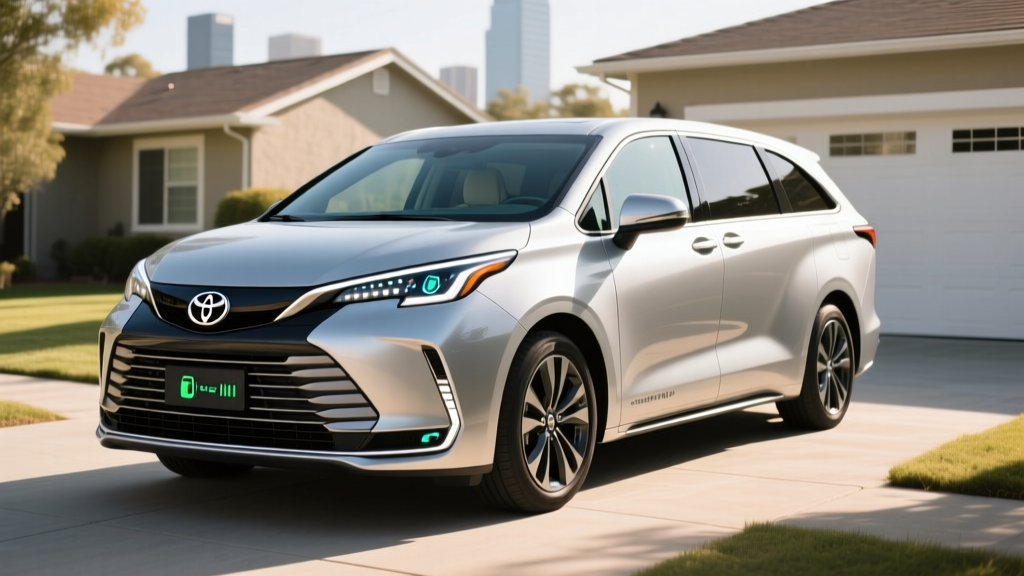
The 2026 Toyota Sienna remains the only hybrid-only minivan in the U.S. market, a distinction Toyota has held since the fourth generation debuted for the 2021 model year. With no plug-in variant and no gasoline alternative, every Sienna that rolls off the Princeton, Indiana, assembly line is a self-charging hybrid electric vehicle (HEV). That singular powertrain strategy has paid off: the Sienna delivers minivan-leading fuel economy, standard all-wheel drive availability, and the cargo versatility families demand — all without ever needing to plug in.
This guide covers everything a buyer needs to know about the 2026 Sienna hybrid: EPA fuel economy, real-world MPG data, the hybrid powertrain architecture, battery longevity and warranty, trim pricing, and how it stacks up against full EVs and plug-in hybrids for family hauling.
Fuel Economy: EPA Ratings and Real-World MPG
The 2026 Sienna uses Toyota's fourth-generation hybrid system paired with a 2.5-liter inline-four engine. Front-wheel-drive (FWD) models achieve the highest EPA ratings, while all-wheel-drive (AWD) trims — which add a rear-mounted electric motor — sacrifice one MPG across the board.
| Drivetrain | City MPG | Highway MPG | Combined MPG | Annual Fuel Cost* |
|---|---|---|---|---|
| FWD | 36 | 36 | 36 | $1,550 |
| AWD (Electronic On-Demand) | 35 | 35 | 35 | $1,600 |
*Based on 15,000 miles/year at $3.50/gallon regular unleaded. Source: fueleconomy.gov
Real-World MPG: What Owners Actually See
Hybrids typically outperform their EPA city ratings in stop-and-go traffic because regenerative braking recovers energy that a gas car wastes as heat. The Sienna is no exception. Owner-reported data on Fuelly and Edmunds forums consistently shows FWD Siennas averaging 33–38 MPG combined in mixed suburban driving, with some owners hitting 40+ MPG on city-heavy commutes.
Highway driving tells a different story. At sustained 75–80 mph speeds, the Sienna's boxy aerodynamics work against it. Expect 30–33 MPG on long interstate runs. Cold weather further reduces efficiency — winter fuel economy can dip to 28–30 MPG combined as the engine runs more frequently to heat the cabin and warm the catalytic converter. These are physics realities, not defects.
- City/suburban mix: 34–38 MPG (often beats EPA)
- Highway cruising (70–80 mph): 30–33 MPG
- Cold weather (below 35°F): 28–32 MPG combined
- Best observed (warm weather, light foot): 40+ MPG city
Total range on a single 17.9-gallon tank: approximately 535–645 miles depending on conditions.
HEV vs PHEV vs EV: Where the Sienna Fits
A common question from minivan shoppers: why isn't the Sienna a plug-in hybrid? Toyota made a deliberate choice. The Sienna is a conventional hybrid (HEV), meaning it generates all its electricity internally through the gasoline engine and regenerative braking. There is no plug, no charging cable, and no electric-only driving mode beyond very low-speed creep (under ~1 mph in parking situations).
| Feature | HEV (Sienna) | PHEV (e.g., Chrysler Pacifica Hybrid) | Full EV (e.g., Kia EV9) |
|---|---|---|---|
| Plug-in required? | No | Yes (for EV range) | Yes |
| Electric-only range | ~0 miles | 32 miles (Pacifica Hybrid) | 270+ miles |
| Combined efficiency | 36 MPG | 30 MPG + 82 MPGe | 89 MPGe |
| Home charging needed? | No | Recommended | Required |
| Total range | ~580 miles | ~430 miles | ~270 miles |
| Tax credit (federal) | None | Up to $7,500 (if eligible) | Up to $7,500 (if eligible) |
| Starting MSRP (2026) | ~$39,500 | ~$51,000 | ~$56,000 |
The Sienna's advantage is simplicity: you fuel it like any gas car and it returns hybrid efficiency without behavioral changes. The PHEV's advantage is electric-only school runs and errands if you can charge at home. A full EV's advantage is the lowest per-mile cost and zero tailpipe emissions, but range and charging logistics on family road trips require planning.
Powertrain: The 245-HP Hybrid System Explained
Every 2026 Sienna uses Toyota's 2.5-liter Dynamic Force four-cylinder engine combined with two front-mounted electric motors (one primarily for propulsion, one as a generator/starter). AWD trims add a third, independent 54-hp electric motor driving the rear axle — there is no mechanical driveshaft connecting the engine to the rear wheels.
| Specification | Detail |
|---|---|
| Engine | 2.5L inline-4, Atkinson cycle |
| Engine output | 189 hp / 176 lb-ft |
| Front electric motors | Two (propulsion + generator) |
| Rear electric motor (AWD only) | 54 hp / 89 lb-ft |
| Net combined horsepower | 245 hp |
| Transmission | Continuously variable (eCVT, planetary gearset) |
| 0–60 mph | ~7.1 seconds (FWD), ~7.4 seconds (AWD) |
| Towing capacity | 3,500 lbs (all trims) |
| Fuel tank | 17.9 gallons |
| Drivetrain | FWD or Electronic On-Demand AWD |
The eCVT is not a belt-driven CVT like those in some competitors — it uses a planetary gearset that seamlessly blends engine and motor power with no rubber-band effect. Acceleration is linear and adequate for merging, though the Sienna won't win drag races against the turbocharged Honda Odyssey or the twin-turbo Kia Carnival. The 245 combined horsepower is sufficient for a loaded minivan, and the electric motor torque fill at low RPMs makes city driving feel more responsive than the horsepower number suggests.
Pricing, Trims, and Tax Credit Eligibility
The 2026 Sienna lineup spans seven trims, with AWD available on most. Here is the MSRP structure (destination charge included):
- LE (FWD): $39,485 | LE (AWD): $40,285
- XLE (FWD): $44,185 | XLE (AWD): $44,985
- XSE (AWD only): $46,385
- Woodland Edition (AWD): $48,185
- Limited (FWD): $50,235 | Limited (AWD): $51,035
- Platinum (FWD): $54,485 | Platinum (AWD): $55,285
Federal Tax Credit: Does the Sienna Qualify?
No. Under IRS §30D rules, the federal clean vehicle credit applies only to plug-in electric vehicles (BEVs and PHEVs) with a minimum battery capacity of 7 kWh that meet battery component and critical mineral sourcing requirements. The Sienna's hybrid battery is approximately 1.6 kWh — far below the threshold, and the vehicle has no plug. The Sienna does not qualify for any federal EV tax credit.
Some states offer hybrid-specific incentives, but these are uncommon and typically modest. Check your state's energy office or the Alternative Fuels Data Center for current state-level programs. A few states offer sales tax exemptions or HOV lane access for hybrids, but most incentive programs have shifted toward plug-in vehicles.
Battery Warranty, Reliability, and Replacement Cost
Hybrid battery longevity is the number-one concern for first-time hybrid buyers. Toyota's track record here is among the best in the industry, dating back to the 1997 Prius.
- Hybrid battery: 10 years / 150,000 miles (whichever comes first)
- Hybrid system components: 8 years / 100,000 miles
- Basic vehicle warranty: 3 years / 36,000 miles
- Powertrain warranty: 5 years / 60,000 miles
The hybrid battery warranty covers capacity loss below a defined threshold and any manufacturing defect. Toyota covers diagnostics and replacement at no cost within the warranty period.
How Long Does the Sienna Hybrid Battery Actually Last?
The Sienna uses a nickel-metal hydride (NiMH) hybrid battery pack rated at approximately 1.6 kWh. Unlike the large lithium-ion packs in EVs, this battery is designed for shallow, frequent charge-discharge cycles — it never fully charges or fully depletes, which dramatically extends its lifespan.
Real-world data from high-mileage Toyota hybrids (Prius, Camry Hybrid, Highlander Hybrid) consistently shows original hybrid batteries lasting 150,000–200,000+ miles with proper maintenance. The Sienna's hybrid system, introduced in 2021, is too new for 200,000-mile data, but it uses the same proven architecture as the RAV4 Hybrid and Highlander Hybrid, which share components.
Replacement cost if out of warranty: A new OEM Sienna hybrid battery runs approximately $3,000–$4,500 installed at a Toyota dealer. Third-party refurbished batteries are available for $1,500–$2,500 installed. This is a fraction of EV battery replacement costs, which can exceed $10,000–$20,000.
Reliability Ratings
Toyota's hybrid powertrain is among the most reliable in the industry. The Sienna carries above-average predicted reliability scores from Consumer Reports and J.D. Power. The eCVT transmission has fewer moving parts than a conventional automatic (no clutch packs, no torque converter, no gear shifts), which reduces failure points. Common maintenance items are limited to standard oil changes (every 10,000 miles with synthetic), brake pad replacement (which lasts longer than gas cars thanks to regenerative braking), and tire rotation.
Who Should Buy the Sienna Hybrid — And Who Shouldn't
Pros
- Class-leading 36 MPG combined — saves ~$800–$1,200/year vs. gas minivans
- No plug-in required; zero behavior change from a gas car
- Available AWD with dedicated rear electric motor
- 10-year/150,000-mile hybrid battery warranty
- 3,500-lb towing across all trims
- Smooth, quiet hybrid operation in city driving
Cons
- No federal tax credit (HEV, not a plug-in)
- Engine drone under hard acceleration (CVT characteristic)
- No plug-in hybrid variant for electric-only short trips
- Third-row seat doesn't fold into the floor (unlike Pacifica/Odyssey)
- 245 hp is adequate but not quick when fully loaded
- Premium trims push past $55,000
Choose the Sienna Hybrid If:
- You want minivan space with the lowest fuel cost and no charging hassle
- You live in an apartment or lack home charging access (making a PHEV or EV impractical)
- You take frequent road trips and don't want to plan around charging stops
- You want AWD for snow/rain without the fuel penalty of a traditional AWD minivan
- You plan to keep the vehicle 10+ years and value Toyota's hybrid reliability history
Look Elsewhere If:
- You want electric-only driving for school drop-offs and errands → consider the Chrysler Pacifica Hybrid (PHEV, 32 miles EV range)
- You want maximum powertrain warranty and the lowest per-mile cost → consider a full EV three-row SUV like the Kia EV9 (270+ mile range, $0.04–$0.12/mile electricity)
- You need fold-into-the-floor third-row seating for maximum cargo flexibility → the Honda Odyssey or Chrysler Pacifica offer this; the Sienna's third row folds forward but stays above the load floor
5-Year Ownership Cost Snapshot
| Category | Estimated Cost |
|---|---|
| Fuel (75,000 mi ÷ 36 MPG × $3.50/gal) | $7,292 |
| Maintenance (oil, tires, brakes, fluids) | $2,800–$3,500 |
| Insurance (national avg. minivan rate) | $7,500–$9,000 |
| Depreciation (est. 45% of $39,485) | ~$17,768 |
| Federal tax credit | $0 (HEV not eligible) |
| Total estimated 5-year cost | ~$35,360–$37,560 |
For comparison, a similarly priced gas-only minivan averaging 22 MPG combined would cost approximately $11,932 in fuel over the same period — a $4,640 fuel savings for the Sienna.
Frequently Asked Questions
How many MPG does the 2026 Toyota Sienna hybrid get?
The 2026 Sienna FWD achieves 36 MPG city / 36 MPG highway / 36 MPG combined per the EPA. AWD trims drop to 35/35/35. Real-world city driving often exceeds these numbers, while sustained highway speeds above 75 mph typically yield 30–33 MPG.
Does the Toyota Sienna come as a plug-in hybrid?
No. Every 2026 Sienna is a conventional hybrid (HEV). It charges its own battery through the engine and regenerative braking. There is no plug, no charging port, and no meaningful electric-only range. If you need plug-in hybrid capability in a minivan, the Chrysler Pacifica Hybrid is currently the only PHEV option.
Is the Sienna hybrid battery expensive to replace?
Out-of-warranty replacement runs $3,000–$4,500 for an OEM battery at a Toyota dealer, or $1,500–$2,500 for a refurbished unit. However, Toyota's hybrid batteries routinely last 150,000–200,000+ miles, and the factory warranty covers 10 years / 150,000 miles. Most owners will never need a replacement.
Can the 2026 Sienna tow a trailer?
Yes. All 2026 Sienna trims are rated for 3,500 pounds of towing capacity when properly equipped with the factory tow package. This is competitive with gas minivans and sufficient for a small camper, boat trailer, or utility trailer.
Does the Sienna qualify for any federal tax credit?
No. The IRS §30D clean vehicle credit requires a plug-in vehicle with at least 7 kWh of battery capacity. The Sienna's 1.6 kWh NiMH battery and lack of a charging port make it ineligible. Check your state's incentive database for any hybrid-specific programs.
How does the Sienna hybrid compare to the Honda Odyssey on fuel cost?
The 2026 Honda Odyssey (gas-only, 22 MPG combined) would use roughly 3,409 gallons over 75,000 miles, costing about $11,932 at $3.50/gallon. The Sienna hybrid (36 MPG combined) uses 2,083 gallons, costing about $7,292. That's a $4,640 fuel savings over five years — enough to offset a significant portion of the Sienna's higher base price.
Is the Sienna's AWD system always engaged?
No. The Sienna's Electronic On-Demand AWD operates primarily in front-wheel drive for maximum efficiency. The rear electric motor engages automatically when the system detects front-wheel slip (wet roads, snow, hard acceleration). There is no mechanical connection between the engine and rear wheels — it's entirely electric, which minimizes efficiency loss compared to traditional mechanical AWD systems.
Sources: EPA fuel economy data from fueleconomy.gov; warranty and specification details from Toyota Motor North America; tax credit rules from IRS.gov §30D. Pricing and specifications reflect 2026 model year information available at time of publication and are subject to change.