Quick Verdict: The Premium Hybrid SUV Without the Plug
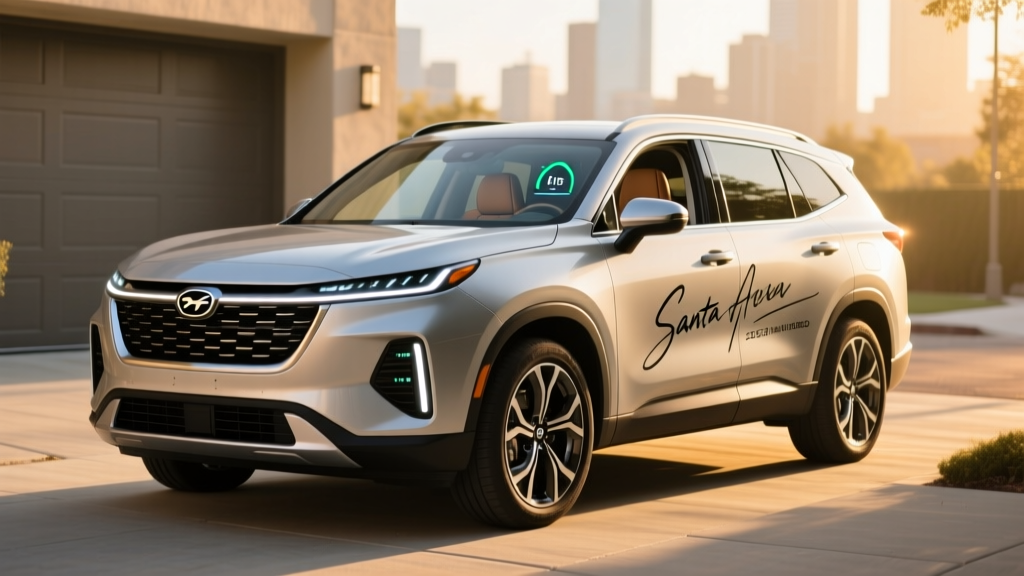
The 2026 Hyundai Santa Fe Hybrid Calligraphy sits at the top of the hybrid trim stack, pairing a 1.6-liter turbocharged four-cylinder with an electric motor for a combined 232 horsepower and an EPA-estimated 35 MPG combined. At a starting MSRP of approximately $47,900, it positions itself as a near-luxury three-row family hauler that requires no behavioral change — no charging cables, no range calculations, no plug-in infrastructure. You fuel it like any conventional vehicle, and the hybrid system handles the rest.
But the Calligraphy trim's premium price tag raises a key question: does the luxury equipment justify the cost over the mid-tier Limited Hybrid, and how does this conventional hybrid (HEV) compare to the Santa Fe Plug-in Hybrid (PHEV) or a full battery-electric vehicle? This review breaks down every spec that matters.
HEV vs. PHEV: Which Santa Fe Hybrid Are We Talking About?
Hyundai offers the 2026 Santa Fe in two distinct electrified configurations. Confusing them is the most common mistake buyers make, so let's separate them clearly:
| Attribute | Santa Fe Hybrid (HEV) | Santa Fe Plug-in Hybrid (PHEV) |
|---|---|---|
| Plug-in Required? | No — self-charging via regenerative braking and engine | Yes — plug in to access electric-only driving |
| Electric-Only Range | None (motor assists engine at all speeds) | ~32 miles EPA (estimated) |
| Battery Capacity | ~1.49 kWh (small buffer) | ~13.8 kWh usable |
| Charging Hardware | None needed | Level 2 AC (~7.2 kW); no DC fast charging |
| Combined Output | 232 HP | 261 HP |
| EPA Combined MPG / MPGe | 35 MPG | ~33 MPG (gas) / ~79 MPGe (electric+gas) |
| Federal Tax Credit (§30D) | Not eligible | Up to $7,500 (eligibility varies — see IRS rules) |
| Starting MSRP (Calligraphy) | ~$47,900 | ~$51,500 |
The conventional hybrid (HEV) is what this review focuses on. It never needs to be plugged in. The small battery charges through regenerative braking and the gasoline engine, and the electric motor assists during acceleration and low-speed driving to reduce fuel consumption. If you want electric-only commuting, you need the PHEV variant instead.
Fuel Economy: EPA Ratings and Real-World MPG
The 2026 Santa Fe Hybrid carries the following EPA-estimated fuel economy figures, consistent across the hybrid trims including the Calligraphy:
| Driving Cycle | EPA Estimate |
|---|---|
| City | 36 MPG |
| Highway | 34 MPG |
| Combined | 35 MPG |
Source: fueleconomy.gov
Real-World MPG Expectations: Hyundai's hybrid system, like most Toyota and Honda hybrid architectures, tends to meet or slightly exceed EPA city estimates in stop-and-go traffic where regenerative braking recaptures the most energy. In our experience with Hyundai's 1.6T hybrid powertrain, expect 36-38 MPG in mixed suburban driving and 31-33 MPG on sustained highway trips at 70+ mph, where the engine operates more frequently without regen assist. In cold weather (below 30°F), expect a 2-4 MPG drop due to increased engine runtime for cabin heating and reduced battery efficiency.
At 35 MPG combined with a 17.7-gallon fuel tank, total range works out to roughly 620 miles per fill-up — a significant advantage over any current EV on long road trips where charging infrastructure remains sparse.
Powertrain and Performance Specs
| Specification | 2026 Santa Fe Hybrid Calligraphy |
|---|---|
| Engine | 1.6L Turbocharged GDI 4-cylinder |
| Engine Output | 178 HP / 195 lb-ft torque |
| Electric Motor | 47.7 kW (~64 HP) integrated into transmission |
| Combined System Output | 232 HP / 271 lb-ft torque |
| Transmission | 6-speed automatic |
| Drivetrain | HTRAC AWD (standard on Calligraphy) |
| 0-60 mph (estimated) | ~7.8 seconds |
| Towing Capacity | 2,000 lbs |
| Seating | 3 rows / 7 passengers (standard on Calligraphy) |
| Cargo Volume (behind 3rd row) | ~14.5 cu ft |
The 232-horsepower combined output is adequate for a vehicle of this size. The electric motor fills in the torque curve at low RPMs, eliminating the lag typical of small turbocharged engines. Acceleration from a stop feels brisk, and highway merging is confident, though this is not a performance-oriented powertrain. The 6-speed automatic is a conventional torque-converter unit — not a CVT — which means shifts are perceptible but natural, avoiding the drone associated with continuously variable transmissions.
Calligraphy Trim: What You Get for the Premium Price
The Calligraphy is Hyundai's top-tier trim language, sitting above SEL Premium and Limited. For the 2026 Santa Fe Hybrid, the Calligraphy adds:
- Nappa leather seating surfaces with quilted stitching
- Heated and ventilated front seats; heated second-row seats
- Head-up display (HUD)
- Digital side mirrors (camera-based, where legal)
- 12.3-inch dual-screen curved display with navigation
- Highway Driving Assist 2 (HDA2) — Hyundai's Level 2 ADAS with lane-centering and adaptive cruise
- Remote Smart Parking Assist
- Premium Bose audio system
- 20-inch alloy wheels
- Hands-free smart power liftgate
The Calligraphy's ~$47,900 MSRP places it against luxury-badge compact SUVs (Acura RDX, Genesis GV70) that lack hybrid powertrains and return 22-25 MPG combined. The trade-off: Hyundai's brand perception doesn't carry the prestige of a luxury badge, but the fuel savings and feature content are objectively superior.
Tax Credits and Incentives: What Applies to the HEV?
Here is where conventional hybrid buyers need to manage expectations:
- Federal §30D Clean Vehicle Credit ($7,500): NOT available for conventional hybrids (HEVs). This credit applies only to plug-in electric vehicles (BEVs and PHEVs) that meet battery sourcing, critical mineral, MSRP cap, and buyer income requirements per IRS guidelines.
- Federal Used EV Credit (§25E): Not applicable — this is a new hybrid, not a plug-in.
- State/Local Incentives: A handful of states offer modest rebates for conventional hybrids (typically $250-$500), but most state incentive programs have shifted exclusively to BEVs and PHEVs. Check your state energy office or DMV for current programs.
- Insurance Discounts: Some carriers offer minor hybrid discounts (5-10%), but this varies by insurer and region.
If the $7,500 federal credit is a priority in your purchase calculus, the Santa Fe PHEV (which does qualify, subject to income and sourcing rules) or a full BEV like the Hyundai Ioniq 5 are the vehicles to evaluate instead.
Battery Warranty, Reliability, and Replacement Cost
Hyundai Hybrid Battery Warranty: 10 years / 100,000 miles (whichever comes first) for the hybrid battery pack. This is one of the strongest hybrid battery warranties in the industry, matching Toyota's coverage and exceeding most competitors. The warranty covers capacity loss below a defined threshold and defects.
Powertrain Warranty: 10 years / 100,000 miles, covering the engine, transmission, and hybrid system components.
Hyundai's 1.6T hybrid system has been in production since the 2023 model year across the Tucson Hybrid, Santa Fe Hybrid, and Sonata Hybrid. Real-world failure data on the hybrid battery specifically remains limited due to the system's relative youth, but Hyundai's lithium-ion polymer packs have shown strong longevity in earlier Sonata Hybrid generations (2011-2020), with most packs lasting well beyond 150,000 miles before meaningful degradation.
Battery replacement cost: If the hybrid battery does require replacement outside of warranty, expect a dealer-installed cost of approximately $2,500-$4,000 for the HEV pack. This is far lower than a full EV battery replacement ($8,000-$20,000+) because the HEV pack is small (~1.49 kWh). Third-party hybrid battery rebuild services can reduce this further to $1,500-$2,500.
Per IIHS and Hyundai's track record, the Santa Fe Hybrid's mechanical reliability is competitive with the Toyota Highlander Hybrid — the segment benchmark.
Hybrid vs. PHEV vs. Full EV: Which Fits Your Life?
Choose the Santa Fe Hybrid (HEV) if:
- You cannot install a Level 2 home charger (apartment living, no garage, landlord restrictions)
- You regularly drive 400+ miles in a single day (road trips, rural routes)
- You want maximum simplicity — fuel and go, no apps, no charging planning
- Your daily commute is long (40+ miles each way) and would exhaust a PHEV's electric range
- You want a lower purchase price than the PHEV or a comparable BEV
Choose the Santa Fe Plug-in Hybrid (PHEV) if:
- You can charge at home (Level 2) and your daily driving is under 30 miles
- You want electric-only commuting but need gas-engine flexibility for longer trips
- You qualify for the §30D federal credit, effectively reducing the PHEV's price below the HEV's
- You want the extra 29 HP (261 vs. 232)
Choose a full BEV (e.g., Hyundai Ioniq 5, Kia EV9) if:
- You have reliable home Level 2 charging
- Your daily driving is under 250 miles and you can plan charging on longer trips
- You want the lowest per-mile energy cost (electricity vs. gasoline)
- You want to eliminate oil changes, transmission fluid, and exhaust system maintenance
Pros and Cons
Pros
- 35 MPG combined in a 3-row, AWD SUV — exceptional efficiency for the segment
- No plug-in charging required; zero behavioral change from a gas vehicle
- 620-mile total range eliminates range anxiety entirely
- 10-year/100,000-mile hybrid battery and powertrain warranty
- Calligraphy trim delivers luxury-tier features without luxury-tier pricing
- HDA2 Level 2 driver assist is competent for highway use
Cons
- No federal tax credit eligibility (unlike the PHEV variant)
- $47,900 MSRP is steep for a Hyundai badge; Limited Hybrid saves ~$4,000
- No electric-only driving mode — always burns some gasoline
- 2,000-lb towing capacity is low for a 3-row SUV
- Cargo space behind the third row is tight at ~14.5 cu ft
- 20-inch wheels on Calligraphy may slightly reduce MPG vs. smaller wheel trims
Frequently Asked Questions
How many MPG does the 2026 Santa Fe Hybrid Calligraphy get?
The EPA rates it at 36 MPG city, 34 MPG highway, and 35 MPG combined. In real-world mixed suburban driving, owners frequently report 36-38 MPG. Sustained highway driving at 75+ mph typically yields 31-33 MPG.
Does the Santa Fe Hybrid need to be plugged in?
No. The conventional hybrid (HEV) charges its small battery through regenerative braking and the gasoline engine. You never plug it in. If you want plug-in electric-only driving, you need the Santa Fe Plug-in Hybrid (PHEV), which is a separate model.
How far can the Santa Fe PHEV go on electric only?
The Santa Fe Plug-in Hybrid offers an EPA-estimated ~32 miles of electric-only range — enough for most daily commutes. Once the battery is depleted, it operates as a conventional hybrid at approximately 33 MPG combined. The HEV reviewed here has no electric-only range.
Is the hybrid battery reliable and what does replacement cost?
Hyundai covers the hybrid battery for 10 years / 100,000 miles. Historical data from Hyundai's hybrid lineup shows most packs lasting 150,000+ miles without significant issues. Out-of-warranty replacement costs approximately $2,500-$4,000 at a dealer, or $1,500-$2,500 through independent hybrid battery services.
Does the 2026 Santa Fe Hybrid qualify for any tax credit?
The conventional hybrid (HEV) does NOT qualify for the federal §30D Clean Vehicle Credit, which is reserved for plug-in vehicles (BEVs and PHEVs). The Santa Fe PHEV may qualify for up to $7,500, subject to buyer income caps, MSRP limits, and battery sourcing requirements — verify current eligibility at irs.gov. Some states may offer small hybrid rebates; check your local programs.
How does the Calligraphy compare to the Limited Hybrid trim?
The Limited Hybrid starts approximately $4,000 lower than the Calligraphy and includes most of the core technology (HDA2, dual screens, heated/ventilated front seats). The Calligraphy adds Nappa leather, head-up display, digital side mirrors, Bose audio, and 20-inch wheels. If those luxury touches aren't essential, the Limited Hybrid offers better value.
Is the Santa Fe Hybrid good for towing?
The hybrid is rated for 2,000 lbs of towing capacity — sufficient for a small utility trailer or a pair of dirt bikes, but not for a boat or camper. If towing is a priority, the non-hybrid Santa Fe with the 2.5T engine tows up to 3,500 lbs.