Quick Verdict: The 2026 RAV4 Prime Still Sets the PHEV Benchmark
The 2026 Toyota RAV4 Plug-In Hybrid (badged RAV4 Prime) remains one of the most compelling bridge vehicles for drivers who want meaningful electric-only commuting without range anxiety on longer trips. With an EPA-rated 42 miles of electric-only range, 302 combined horsepower, and a combined 94 MPGe when running on battery power, it occupies a narrow sweet spot: practical enough for daily zero-gas commutes, flexible enough for a 500-mile road trip without a single charging stop.
But the 2026 model year arrives in a shifting incentive landscape. The RAV4 Prime no longer qualifies for the full $7,500 federal §30D tax credit due to battery-sourcing requirements that took effect in 2024 and tightened further by 2025. Buyers need to understand exactly what they're getting — and what they're paying — before signing.
EPA electric-only range: 42 miles
Real-world expectation: 36–40 miles in mild weather (mixed city/highway); 30–34 miles in freezing temperatures or sustained 75+ mph highway driving. The RAV4 Prime's heat pump helps, but cold chemistry losses and cabin heating still bite.
Total combined range (electric + gas): ~600 miles EPA
HEV vs. PHEV: Which RAV4 Hybrid Are You Actually Looking At?
Toyota sells two electrified RAV4 variants, and confusing them is the most common buyer mistake in this segment.
| Attribute | RAV4 Hybrid (HEV) | RAV4 Prime (PHEV) |
|---|---|---|
| Plug-in required? | No — self-charging via regenerative braking | Yes — plug in to access electric-only range |
| Electric-only range | None (motor assists gas engine only) | 42 miles EPA |
| Combined horsepower | 219 hp | 302 hp |
| Battery capacity | ~1.6 kWh (small buffer) | 18.1 kWh usable (lithium-ion) |
| EPA combined MPG (gas) | 39 MPG | 38 MPG (charge-sustaining) |
| MPGe (electric mode) | N/A | 94 MPGe |
| Starting MSRP (2026) | ~$34,500 | $44,795 |
| Federal tax credit eligible | No | See §30D details below |
The core difference: The conventional RAV4 Hybrid never plugs in. Its small battery captures energy from braking and the engine, then uses that energy to assist acceleration and enable brief low-speed electric creep. The RAV4 Prime has a much larger 18.1 kWh battery and a more powerful electric motor, enabling genuine electric-only highway driving at speeds up to 84 mph — but only if you plug it in regularly.
If you cannot charge at home or at work, the RAV4 Prime's advantage collapses. You'd be carrying 400+ lbs of battery you never use, and the conventional RAV4 Hybrid is the smarter buy.
Powertrain and Performance: 302 HP That Punches Above Its Weight
The 2026 RAV4 Prime pairs a 2.5-liter Atkinson-cycle four-cylinder engine (177 hp, 165 lb-ft) with a front permanent-magnet electric motor (134 kW / 180 hp) and a rear electric motor (40 kW / 54 hp) for electronic AWD. Combined system output is 302 horsepower.
| Spec | Value |
|---|---|
| Combined horsepower | 302 hp |
| 0–60 mph | 5.7 seconds |
| Engine | 2.5L 4-cyl Atkinson-cycle |
| Front electric motor | 134 kW (180 hp) |
| Rear electric motor | 40 kW (54 hp), eAWD |
| Battery (usable) | 18.1 kWh, lithium-ion |
| Transmission | eCVT (planetary gearset) |
| Drivetrain | Electronic AWD (eAWD) |
| Towing capacity | 2,500 lbs |
| Cargo volume (rear seats up) | 33.5 cu ft |
The 5.7-second 0–60 mph time makes the RAV4 Prime the quickest RAV4 Toyota sells — faster than the turbo-four gas model and considerably quicker than the conventional hybrid. The electric motor's instant torque delivery makes it feel even quicker in city driving, where most Prime owners spend their time.
Fuel Economy: EPA MPG and Real-World Results
Understanding the RAV4 Prime's efficiency requires separating its two operating modes: charge-depleting (running on battery, measured in MPGe) and charge-sustaining (battery depleted, running as a conventional hybrid).
| Mode | City | Highway | Combined |
|---|---|---|---|
| Electric-only (MPGe) | 105 MPGe | 84 MPGe | 94 MPGe |
| Gas hybrid (MPG) | 40 MPG | 36 MPG | 38 MPG |
Real-world MPG observations: Like most Toyota hybrids, the RAV4 Prime tends to match or slightly exceed its EPA city rating in actual stop-and-go driving, where regenerative braking recovers the most energy. Owners consistently report 40–43 MPG city in charge-sustaining mode. Highway driving at 75+ mph typically yields 33–35 MPG — slightly below the EPA highway sticker, which is common for boxy crossover aerodynamics at sustained speed.
In electric-only mode, expect to consume roughly 36–39 kWh/100mi in mixed driving. If your electricity costs $0.14/kWh (the U.S. residential average), that translates to about $0.05 per mile on battery versus $0.12–$0.14 per mile on gasoline at $3.50/gallon. The per-mile savings are substantial for daily commuters.
Charging: Level 1, Level 2, and the DC Fast-Charging Limitation
The 2026 RAV4 Prime charges via a J1772 inlet (standard for non-Tesla PHEVs in North America). Here is what charging actually looks like:
| Level | Power (kW) | 0–Full Time | Notes |
|---|---|---|---|
| Level 1 (120V outlet) | ~1.2 kW | ~16 hours | Included portable cord; adequate for overnight if driven <30 mi/day |
| Level 2 (240V, 16A) | ~3.3 kW | ~5.5 hours | Standard onboard charger; typical home wallbox |
| DC Fast Charge | Not supported | N/A | No DC fast-charging capability |
Critical limitation: The RAV4 Prime cannot DC fast charge. Its 3.3 kW onboard charger is the bottleneck. This is typical for PHEVs — the smaller battery makes DC fast charging less necessary — but it means public fast-charging stations are irrelevant to Prime owners. All meaningful charging happens at home or at a workplace Level 2 station.
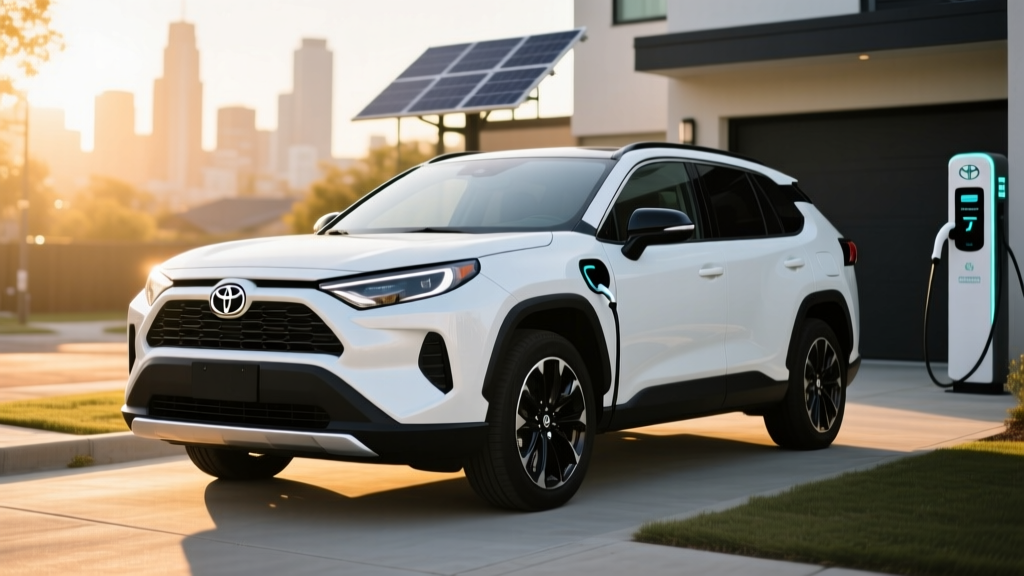
For most Prime owners, a Level 2 home charger installed on a 240V circuit is the ideal setup. A full charge in ~5.5 hours means you can plug in at 10 PM and wake up to a full battery by 6 AM. The included Level 1 cord works as a backup but is too slow for daily full recharges if you deplete the battery each day.
Pricing, Trims, and Tax Credit Eligibility
The 2026 RAV4 Prime is offered in two trims:
- SE: Starting at $44,795 (including destination)
- XSE: Starting at $48,295 (including destination)
Both trims include eAWD, Toyota Safety Sense 3.0, a 9-inch touchscreen, and wireless Apple CarPlay/Android Auto. The XSE adds SofTex seats, a panoramic moonroof, a 10.5-inch digital cluster, and premium audio.
Federal §30D Tax Credit: The Complicated Reality
Current §30D requirements for new PHEVs (2026 tax year):
- Vehicle MSRP must not exceed $80,000 for SUVs (RAV4 Prime qualifies)
- Buyer AGI must not exceed $150K single / $300K joint filers
- Battery must meet critical-mineral and battery-component sourcing thresholds (tightened annually since 2024)
- Vehicle must undergo final assembly in North America
- Credit can be transferred to dealer as point-of-sale discount
The catch: Due to battery-component and critical-mineral sourcing rules that phased in under the Inflation Reduction Act, the RAV4 Prime's eligibility for the full $7,500 credit has been restricted. Toyota's battery supply chain has not fully met the escalating domestic-sourcing thresholds. As of early 2026, the RAV4 Prime may qualify for a partial credit ($3,750 if it meets one requirement but not both) or no federal credit at all depending on the specific production batch. Always verify current eligibility on IRS.gov's clean vehicle credit page and confirm with your dealer before purchase.
Some states offer additional PHEV rebates (California's CVRP, for example, has been restructured; check your state's current program). These stack independently of federal rules.
Battery Longevity, Warranty, and Replacement Cost
Coverage: 10 years / 150,000 miles (whichever comes first), in all 50 states.
What's covered: Defects and capacity loss below a functional threshold. Toyota's hybrid battery warranty has historically been among the most generous in the industry.
Real-world degradation: PHEV batteries experience more charge cycles than conventional hybrid batteries, but Toyota's conservative buffer strategy (the Prime never uses 100% of its 18.1 kWh — a top and bottom buffer protects the cells) has yielded strong longevity data. Early RAV4 Prime owners (2021–2023 models) report minimal noticeable range loss at 60,000+ miles.
Replacement cost if out of warranty: A full RAV4 Prime traction battery replacement currently runs between $5,500 and $7,500 including labor at a Toyota dealership, depending on parts availability. This is a meaningful number, but it's also a cost most owners will never face — Toyota's hybrid battery track record over two decades (dating back to the original Prius) suggests the vast majority of batteries outlast the vehicle itself.
The conventional RAV4 Hybrid carries the same 10-year/150,000-mile battery warranty, and its smaller battery is arguably even less stressed, since it operates in a narrower state-of-charge window.
RAV4 Prime vs. Full EV vs. Gas: Which Powertrain Fits You?
Choose the RAV4 Prime (PHEV) if:
- You can charge at home (Level 1 or Level 2) and your daily round-trip commute is under ~40 miles
- You regularly take road trips over 200 miles and don't want to plan around DC fast chargers
- You want EV-like daily operating costs without committing to a full BEV
- You live in a region with harsh winters where EV range loss is a concern
Choose a full EV (e.g., Tesla Model Y, Hyundai Ioniq 5) if:
- You have reliable home Level 2 charging and your daily driving is under 250 miles
- You want zero tailpipe emissions and minimal maintenance (no oil changes, no engine)
- You want to access the full $7,500 federal credit (many BEVs still qualify)
- You want the lowest per-mile fuel cost and fastest home "refueling"
Choose the conventional RAV4 Hybrid (HEV) if:
- You cannot charge at home or at work
- You want hybrid efficiency without paying the ~$10,000 PHEV premium
- Your driving is a mix of city and highway with no predictable short-commute pattern
- You want the lowest upfront cost in an electrified RAV4
The RAV4 Prime's ideal owner charges nightly at home, drives 20–40 miles round-trip on weekdays (burning zero gas most weeks), and takes a handful of longer road trips per year where the gas engine seamlessly takes over. That usage pattern yields annual fuel costs as low as $400–$600, versus $1,800+ for a comparable gas-only compact SUV.
Pros and Cons
- 42 miles electric-only covers most commutes gas-free
- 302 hp / 5.7s 0–60 — quickest RAV4 available
- 38 MPG as a hybrid after battery depletion (no range cliff)
- 10-year/150,000-mile hybrid battery warranty
- eAWD standard; strong resale value
- No dependence on public charging infrastructure
- 3.3 kW onboard charger — slow Level 2 speed, no DC fast charging
- $44,795 starting price is ~$10K above the conventional RAV4 Hybrid
- Federal tax credit eligibility uncertain due to sourcing rules
- Cargo space slightly reduced vs. gas RAV4 (battery packaging)
- Dealer markups have plagued the Prime since launch — verify MSRP pricing
- Infotainment system lags behind competitors in responsiveness
Frequently Asked Questions
How many MPG does the 2026 RAV4 Plug-In Hybrid get?
When the battery is depleted and the RAV4 Prime operates as a conventional hybrid, it achieves an EPA-rated 40 MPG city / 36 MPG highway / 38 MPG combined. In electric-only mode, it delivers 94 MPGe combined. Real-world city MPG in hybrid mode often reaches 40–43 MPG; highway driving at 75+ mph typically yields 33–35 MPG.
How far can the 2026 RAV4 Prime go on electric only?
The EPA rates the RAV4 Prime at 42 miles of electric-only range. In real-world conditions, expect 36–40 miles in mild weather with mixed driving, and 30–34 miles in cold weather or at sustained highway speeds. The electric motor can propel the vehicle up to 84 mph before the engine engages.
Does the 2026 RAV4 Prime qualify for the $7,500 federal tax credit?
Eligibility is uncertain and batch-dependent. The RAV4 Prime meets the MSRP cap (under $80,000 for SUVs) and North American assembly requirements, but battery-component and critical-mineral sourcing rules under §30D have restricted eligibility for many Toyota PHEVs. It may qualify for a partial $3,750 credit or none at all. Verify on IRS.gov and with your dealer before purchasing. Income caps also apply: $150K single / $300K joint AGI.
Is the RAV4 Prime reliable, and what does battery replacement cost?
Toyota's hybrid powertrains have a two-decade reliability track record, and the RAV4 Prime benefits from conservative battery management (top/bottom charge buffers reduce cell stress). The hybrid battery is warrantied for 10 years / 150,000 miles. Out-of-warranty replacement costs approximately $5,500–$7,500. Toyota's NHTSA safety ratings and IIHS testing further support its strong ownership profile.
Can the RAV4 Prime DC fast charge?
No. The RAV4 Prime does not support DC fast charging. Its onboard charger is limited to 3.3 kW on Level 2 (240V), meaning a full charge takes approximately 5.5 hours. This is standard for PHEVs with smaller batteries, but it means public DC fast-charging stations are not usable for the Prime.
RAV4 Prime vs. RAV4 Hybrid — is the $10K premium worth it?
It depends on your charging access and commute. If you can charge at home and your daily driving is under 42 miles, the Prime effectively eliminates your weekday gas bill, saving $1,200–$1,500 per year versus the conventional hybrid. At that rate, the premium pays back in roughly 7 years before factoring in the performance advantage (302 hp vs. 219 hp). If you cannot charge at home, the conventional RAV4 Hybrid is the better financial choice.