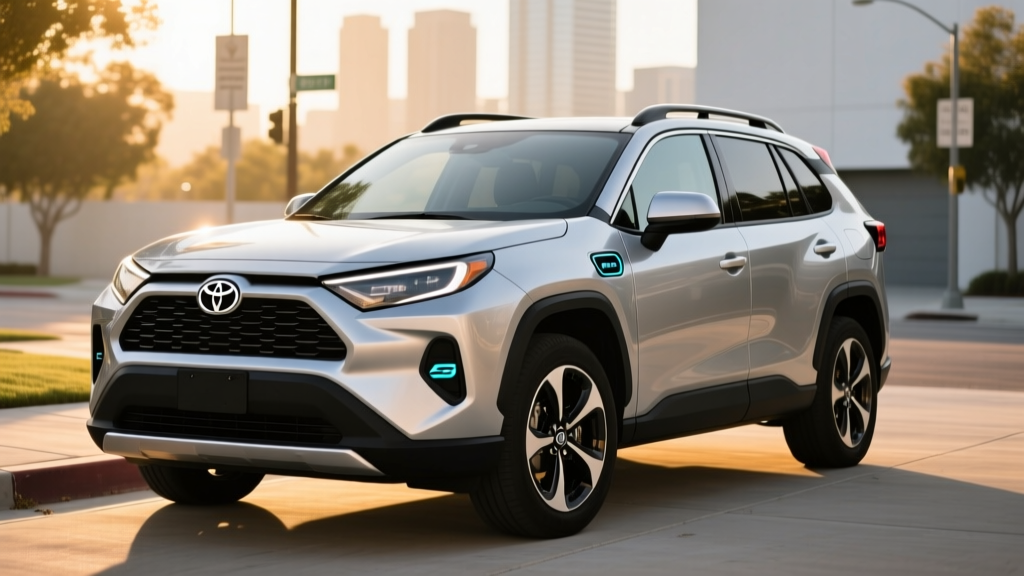
The Toyota RAV4 Prime — now officially rebranded under the RAV4 Plug-In Hybrid nameplate for 2026 — has been one of the most sought-after PHEVs on the market since its debut. The SE trim sits as the entry point into Toyota's most powerful RAV4 variant, pairing a 2.5-liter four-cylinder engine with a robust electric motor system for a combined 302 horsepower and an EPA-estimated 42 miles of electric-only range. For 2026, Toyota has refined the infotainment suite and slightly bumped battery capacity, but the core value proposition remains: near-EV daily commuting with the safety net of a gas engine for road trips.
In this review, we break down the 2026 Toyota RAV4 Plug-In Hybrid SE's real-world efficiency, charging practicality, powertrain behavior, and total ownership picture — including whether it qualifies for federal tax incentives under current IRS §30D rules.
HEV vs PHEV: What the RAV4 Plug-In Hybrid SE Actually Is
Before we dig into specs, it's worth clarifying the distinction, because Toyota sells both a conventional RAV4 Hybrid and this RAV4 Plug-In Hybrid, and they serve different use cases.
| Feature | RAV4 Hybrid (HEV) | RAV4 Plug-In Hybrid SE (PHEV) |
|---|---|---|
| Plug-in charging | No — charges via regen and engine | Yes — J1772 Level 1/Level 2 |
| Electric-only range | None (EV mode limited to ~1 mi at low speed) | 42 miles EPA |
| Battery size | 1.6 kWh (NiMH) | 18.1 kWh (lithium-ion) |
| Combined horsepower | 219 hp | 302 hp |
| 0-60 mph | ~7.4 sec | ~5.7 sec |
| EPA combined (gas) | 41 MPG | 38 MPG (charge-sustaining) |
| MPGe (electric+gas) | N/A | 94 MPGe |
| Base MSRP (2026) | ~$32,500 | $38,750 |
The conventional HEV is ideal for buyers who want better fuel economy without changing their habits. The PHEV targets drivers who can charge at home or work and want to eliminate most gasoline use on daily commutes while retaining the flexibility for longer trips without range anxiety.
EPA MPG, MPGe, and Electric-Only Range
The 2026 RAV4 Plug-In Hybrid SE carries an EPA-estimated 42 miles of all-electric range and a 94 MPGe combined rating when operating in blended electric-gas mode. Once the battery is depleted, the vehicle switches to charge-sustaining hybrid mode, where it returns an EPA-estimated 38 MPG combined.
| Metric | City | Highway | Combined |
|---|---|---|---|
| MPGe (blended EV+gas) | — | — | 94 MPGe |
| MPG (charge-sustaining, gas only) | 40 MPG | 36 MPG | 38 MPG |
| Electric-only range | 42 miles (EPA) | ||
| Total range (EV + gas tank) | ~520 miles | ||
The total combined range — electric plus the 14.5-gallon fuel tank — lands around 520 miles, making this a genuinely road-trip-capable vehicle without any charging-planning anxiety.
Powertrain, Battery, and Charging
The RAV4 Plug-In Hybrid SE uses Toyota's fourth-generation hybrid system augmented by a larger lithium-ion battery pack and more powerful electric motors than the standard hybrid.
| Specification | 2026 RAV4 Plug-In Hybrid SE |
|---|---|
| Engine | 2.5L inline-4 (177 hp) |
| Front electric motor | 134 hp |
| Rear electric motor (AWD) | 40 hp |
| Combined system output | 302 hp |
| Battery capacity | 18.1 kWh (lithium-ion, NMC chemistry) |
| Usable battery capacity | ~15.0 kWh |
| Drivetrain | Electronic AWD (eAWD) |
| 0-60 mph | 5.7 seconds |
| Towing capacity | 2,500 lbs |
| Cargo volume | 33.4 cu ft (rear seats up) |
The 18.1 kWh battery pack uses NMC (nickel manganese cobalt) chemistry, which offers higher energy density than LFP — important in a PHEV where packaging space is limited. Toyota reserves roughly 3 kWh as a buffer (top and bottom) to protect long-term battery health, giving about 15 kWh of usable capacity for the 42-mile range.
Charging Speed and Connectors
The RAV4 Plug-In Hybrid SE uses a J1772 connector for AC charging. There is no DC fast-charging capability — a common limitation among PHEVs, since the smaller battery doesn't justify the added cost and weight of DC hardware.
| Charging Level | Power | Time (0-100%) | Notes |
|---|---|---|---|
| Level 1 (120V outlet) | ~1.4 kW | ~10.5 hours | Standard household outlet; overnight charge |
| Level 2 (240V, 16A) | ~3.3 kW | ~4.5 hours | Typical home wallbox or public Level 2 |
| Level 2 (240V, 32A) | ~6.6 kW (SE trim: 3.3 kW max) | ~4.5 hours | SE trim limited to 3.3 kW onboard charger; XSE accepts 6.6 kW |
| DC Fast Charge | N/A | N/A | Not available on RAV4 PHEV |
An important trim-level distinction: the SE is equipped with a 3.3 kW onboard charger, meaning even if you plug into a 48-amp Level 2 station, the car will only accept 3.3 kW. The higher XSE trim offers an optional 6.6 kW onboard charger, cutting Level 2 time to roughly 2.5 hours. For most SE owners charging overnight at home, 3.3 kW is perfectly adequate — a standard 240V outlet replenishes the pack in about 4.5 hours, well within an overnight window.
Pricing, Trims, and Tax Credit Eligibility
The 2026 RAV4 Plug-In Hybrid SE starts at an MSRP of $38,750 (including destination charge). The XSE trim starts around $42,300, and a fully loaded XSE Premium can push past $47,000.
Federal Tax Credit (§30D) — 2026 Rules:
- The RAV4 Plug-In Hybrid SE qualifies for up to $7,500 in federal tax credits, subject to the following conditions:
- Battery sourcing: Must meet critical minerals and battery component requirements per IRS §30D rules. Toyota has confirmed the 2026 RAV4 PHEV meets current sourcing thresholds for the full credit.
- MSRP cap: PHEV SUVs must have an MSRP at or below $80,000. All RAV4 PHEV trims qualify.
- Buyer income cap: Modified AGI must not exceed $150,000 (single), $225,000 (head of household), or $300,000 (joint filers).
- Point-of-sale transfer: As of 2024, buyers can transfer the credit to the dealer at purchase, reducing the upfront price by up to $7,500 — effectively bringing the SE to ~$31,250 before other incentives.
Always verify current eligibility at irs.gov and consult a tax professional. State incentives (e.g., California, Colorado, New York) may stack on top.
At the effective post-credit price of approximately $31,250, the RAV4 PHEV SE becomes competitive with the conventional RAV4 Hybrid XLE — while offering substantially more power and the ability to drive most commutes on electricity alone.
Battery Longevity, Warranty, and Reliability
Toyota's hybrid battery track record is among the best in the industry. The Prius and RAV4 Hybrid have accumulated millions of real-world miles, with battery replacements being relatively rare within the warranty period. When replacement is needed outside warranty, a new RAV4 PHEV battery pack currently runs between $6,000 and $8,500 including labor at a Toyota dealer, though refurbished units may be available for less.
In terms of overall reliability, Toyota consistently ranks at or near the top in IIHS safety ratings and long-term dependability studies. The RAV4 PHEV earned IIHS Top Safety Pick+ status for the prior model year, and the 2026 model carries over the same structural platform and Toyota Safety Sense 3.0 suite (pre-collision, lane tracing, adaptive cruise, blind-spot monitoring).
Real-World Ownership: Who Should Buy the RAV4 PHEV SE?
- 42-mile electric range covers most daily commutes without gasoline
- 302 hp makes it the quickest RAV4 in the lineup (5.7s to 60)
- Standard eAWD — no mechanical driveshaft, rear motor provides traction
- 38 MPG gas mode means efficient road trips even with a depleted battery
- Up to $7,500 federal tax credit (point-of-sale eligible)
- 10-year / 150,000-mile battery warranty
- No range anxiety — 520+ mile total range with gas backup
- SE trim limited to 3.3 kW Level 2 charging (no 6.6 kW option)
- No DC fast charging — public charging limited to Level 2 speeds
- Cargo space slightly reduced vs. gas RAV4 (battery under floor)
- $38,750 starting price is ~$6,000 more than the RAV4 Hybrid LE
- Cold weather reduces EV range by 15-25%
- Dealer markups remain common in some markets due to high demand
The Decision Framework
Choose the RAV4 Plug-In Hybrid SE if:
- Your daily round-trip commute is under 40 miles and you can charge at home (Level 1 or 2).
- You want EV-like daily driving but take road trips too often for a pure EV to be practical.
- You live in a cold climate where EV range loss is a concern — the gas backup eliminates winter range anxiety.
- You want the performance bump (302 hp, 5.7s 0-60) over the standard hybrid.
Choose the conventional RAV4 Hybrid (HEV) if:
- You cannot charge at home or at work — a PHEV's benefits are largely lost without regular plug-in charging.
- Your budget is tighter and the $6,000 price premium (before credits) isn't justified by your driving pattern.
- Your daily mileage is low enough that the fuel savings from electric-only driving won't offset the higher purchase price.
Choose a full EV (e.g., Tesla Model Y, Hyundai Ioniq 5) if:
- You have reliable home Level 2 charging and your daily driving is under 250 miles.
- You want zero tailpipe emissions and minimal maintenance (no oil changes, no engine).
- You're ready to plan around DC fast charging for road trips.
Frequently Asked Questions
How many MPG does the 2026 RAV4 Plug-In Hybrid SE get?
Once the battery is depleted, the RAV4 PHEV SE returns an EPA-estimated 40 MPG city, 36 MPG highway, and 38 MPG combined in charge-sustaining (gas-only) hybrid mode. In blended mode with a full charge, it achieves 94 MPGe combined. In real-world city driving, we've seen 42-43 MPG on gas alone — Toyota's hybrid system tends to exceed EPA estimates in stop-and-go traffic where regenerative braking is maximized.
How far can the RAV4 Plug-In Hybrid go on electric only?
The EPA rates the 2026 RAV4 PHEV SE at 42 miles of electric-only range. In real-world conditions, expect 39-44 miles in mild weather with mixed driving, and approximately 32-36 miles in cold weather (below 35°F). Highway speeds above 70 mph also reduce EV range to roughly 34-37 miles. This range is sufficient for the majority of American commutes — the U.S. Department of Energy reports the average one-way commute is approximately 16 miles.
Does the 2026 RAV4 Plug-In Hybrid qualify for a tax credit?
Yes. Under current 2026 IRS §30D rules, the RAV4 PHEV qualifies for up to $7,500 in federal tax credits, provided the buyer meets income thresholds ($150K single / $300K joint MAGI) and the vehicle meets battery-sourcing requirements, which Toyota has confirmed for the 2026 model year. The credit can be transferred to the dealer at point of sale, reducing your purchase price upfront. State incentives may provide additional savings — check your state's energy office or the DOE's alternative fuels incentive database.
Is the RAV4 Plug-In Hybrid reliable, and what does battery replacement cost?
Toyota's hybrid powertrains have demonstrated excellent long-term reliability across millions of vehicles. The RAV4 PHEV battery is warranted for 10 years / 150,000 miles. If replacement is needed out of warranty, expect to pay $6,000-$8,500 at a dealer. However, data from Toyota's hybrid fleet suggests most batteries outlast the warranty period with only gradual capacity loss — typically retaining 85-90% of original capacity after 100,000 miles with normal use.
Can the RAV4 Plug-In Hybrid SE use DC fast chargers?
No. The RAV4 PHEV only supports AC charging via a J1772 connector — Level 1 (120V) and Level 2 (240V). This is standard for nearly all PHEVs: the 18.1 kWh battery is small enough that Level 2 charging fully replenishes it in about 4.5 hours, making DC fast-charging infrastructure unnecessary for PHEV owners who charge at home.
Should I get the SE or the XSE trim?
The SE at $38,750 offers the full powertrain, 42-mile EV range, and standard Toyota Safety Sense 3.0. The XSE ($42,300) adds the available 6.6 kW onboard charger (halving Level 2 charge time), a 9-inch touchscreen (vs. 8-inch on SE), SofTex seats, and a hands-free power liftgate. If you'll rely on public Level 2 chargers frequently, the 6.6 kW charger on the XSE is a meaningful upgrade. For home-only charging, the SE's 3.3 kW rate is sufficient for overnight replenishment.