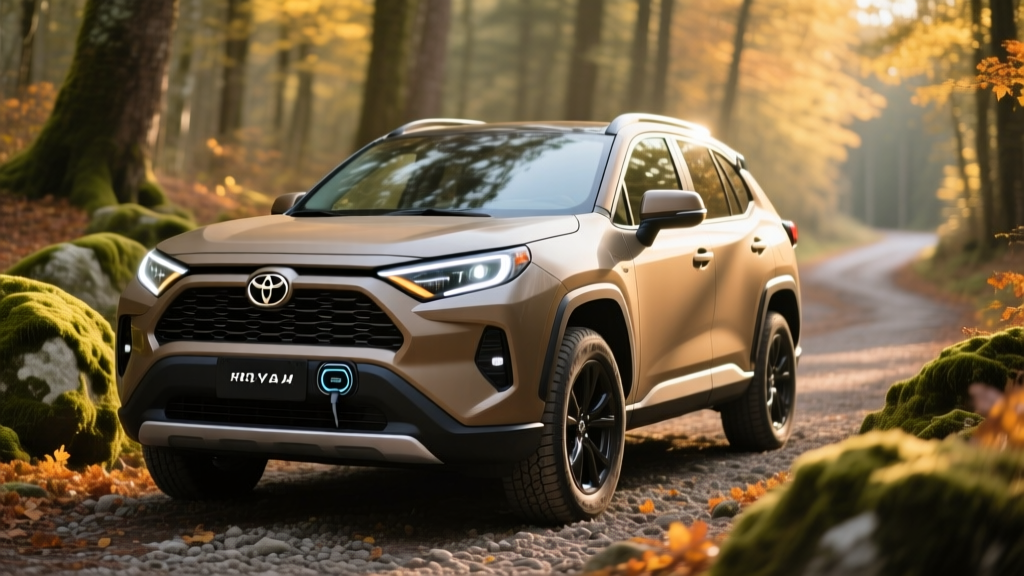
The 2026 Toyota RAV4 Plug-In Hybrid Woodland Edition occupies a rare niche: a compact SUV that can commute on electricity alone, tackle light trails with all-wheel drive, and still deliver over 500 miles of total range without range anxiety. For buyers who want electrification without committing to a full battery-electric vehicle, the RAV4 PHEV Woodland is one of the most capable options on the market. Here's everything you need to know — real-world MPG, electric-only range, charging logistics, tax credit eligibility, and whether this PHEV fits your lifestyle.
Quick Verdict: Who Is the RAV4 PHEV Woodland For?
The 2026 RAV4 Plug-In Hybrid Woodland is best for drivers who have home Level 2 charging access, commute under 40 miles round-trip, and want the flexibility to road-trip without planning charging stops. It's also one of the few PHEVs with genuine light-off-road capability thanks to its standard electronic all-wheel drive and increased ground clearance. If you can't charge at home or your commute exceeds the 42-mile electric range, a conventional RAV4 Hybrid (HEV) may be a better fit.
A conventional hybrid (HEV) like the RAV4 Hybrid uses a small battery recharged by regenerative braking and the gas engine — you never plug it in. A plug-in hybrid (PHEV) like the RAV4 Prime/Woodland has a much larger battery (18.1 kWh) that you charge from a wall outlet or charger, enabling 42 miles of pure electric driving before the gas engine activates. Think of a PHEV as an EV for short trips and a hybrid for long ones.
2026 RAV4 PHEV Woodland: Full Spec Sheet
| Spec | Value |
|---|---|
| Powertrain | 2.5L 4-cyl + front & rear electric motors |
| Combined Horsepower | 302 hp |
| Battery (Usable) | 18.1 kWh lithium-ion (NMC chemistry) |
| EV-Only Range (EPA) | 42 miles |
| Total Combined Range | ~600 miles (EV + gas) |
| MPGe (EV Mode) | 94 MPGe combined |
| MPG (Hybrid Mode) | 38 city / 36 hwy / 38 combined |
| 0–60 mph | 5.7 seconds |
| Drivetrain | Electronic AWD (eAWD) standard |
| Ground Clearance | 8.1 inches (Woodland trim) |
| Level 2 Charge Time (0–100%) | ~2.5 hours at 6.6 kW |
| DC Fast Charging | Not available |
| Base MSRP (Woodland) | ~$47,500 (est.) |
| Federal Tax Credit (§30D) | Up to $7,500 (eligibility varies) |
Sources: EPA fueleconomy.gov, Toyota Motor Corporation 2026 model-year specifications. MSRP is estimated based on prior-year pricing trends; confirm with dealer.
Fuel Economy: Real-World MPG vs EPA Estimates
The EPA rates the 2026 RAV4 PHEV at 94 MPGe combined when operating in electric mode and 38 MPG combined (38 city / 36 highway) once the battery is depleted and the hybrid system takes over. But real-world results tell a more nuanced story.
| Driving Scenario | EPA Estimate | Real-World Expectation |
|---|---|---|
| City (hybrid mode) | 38 MPG | 39–42 MPG (regen-heavy routes favor hybrids) |
| Highway (hybrid mode, 70+ mph) | 36 MPG | 33–35 MPG (aero drag + AWD losses) |
| EV-only commute (city/suburban) | 94 MPGe | 90–100 MPGe (season dependent) |
| Cold weather (below 30°F, EV mode) | — | ~30–35 mi EV range (20–25% reduction) |
| Cold weather (hybrid mode) | — | 34–36 MPG combined |
Toyota's hybrid system excels in stop-and-go traffic where regenerative braking recaptures energy. On the highway at sustained speeds, you'll see the numbers drop closer to 33–35 MPG — typical for a boxy, AWD-equipped compact SUV. In winter, expect the electric-only range to contract from 42 miles down to roughly 30–35 miles due to battery chemistry limitations and cabin heating demands. The RAV4 PHEV uses engine waste heat for cabin warming in hybrid mode, which actually improves winter efficiency once the engine is running.
Electric-Only Range and Charging Logistics
EPA rated: 42 miles electric-only
Real-world (mild weather, mixed driving): 38–44 miles
Real-world (highway, 70 mph): ~32–35 miles
Real-world (cold, below 30°F): ~30–35 miles
The 42-mile EPA figure is achievable on suburban commutes at moderate speeds with mild temperatures. Highway driving and cold weather both reduce range noticeably.
The 18.1 kWh battery pack charges via the onboard 6.6 kW Level 2 charger. Here's what that means in practice:
| Charge Method | Power (kW) | 0–100% Time | Practical Note |
|---|---|---|---|
| Level 1 (120V household outlet) | ~1.4 kW | ~12 hours | Overnight top-up only; won't fully charge in short windows |
| Level 2 (240V, 32A home charger) | 6.6 kW | ~2.5 hours | Ideal setup — full charge while you work or sleep |
| DC Fast Charging | N/A | N/A | Not supported — PHEV batteries are too small to justify DCFC hardware |
The lack of DC fast charging is standard for PHEVs. With only 18.1 kWh to fill, a 2.5-hour Level 2 session is sufficient for daily use. The key requirement is installing a 240V Level 2 home charger — budget $500–$1,500 for equipment and electrician labor depending on your panel capacity and run distance. A Level 1 trickle charge from a standard 120V outlet works but adds only about 4–5 miles of EV range per hour, which may not cover your daily commute.
Powertrain and Performance: 302 HP With Electric Torque
The RAV4 PHEV pairs a 2.5-liter Atkinson-cycle four-cylinder engine (177 hp on its own) with a front electric motor (134 kW / 180 hp) and a rear electric motor (40 kW / 54 hp) for a combined system output of 302 horsepower. That makes it the quickest RAV4 in the lineup, hitting 0–60 mph in 5.7 seconds — genuinely quick for a compact SUV.
The electronic AWD system (eAWD) is worth noting for Woodland buyers: there's no mechanical driveshaft connecting the front and rear axles. Instead, the rear electric motor independently powers the rear wheels when traction is needed. This means AWD engagement is instant and seamless, but it also means the rear wheels only receive power under acceleration or slip conditions — you won't get the low-speed crawl control of a traditional mechanical 4WD system. For forest roads, snow, mud, and gravel, the eAWD is highly capable. For rock crawling or deep sand, it's not the right tool.
The Woodland trim adds All-Terrain tires and 8.1 inches of ground clearance (compared to 7.9 inches on other RAV4 PHEV trims), along with Toyota's Multi-Terrain Select system for optimizing traction across mud, sand, and rock settings.
Pricing, Tax Credits, and Total Cost
The 2026 RAV4 Plug-In Hybrid Woodland Edition is estimated to start around $47,500 MSRP before destination charges. That positions it roughly $8,000–$10,000 above a conventional RAV4 Hybrid and $5,000–$7,000 above other RAV4 PHEV trims, reflecting the off-road equipment and standard AWD.
The RAV4 PHEV may qualify for up to $7,500 in federal tax credits under IRS §30D, but eligibility depends on multiple factors that change annually:
- Battery sourcing: Critical minerals and battery components must meet phased-in domestic-content thresholds. Check the latest IRS clean vehicle credit page for current sourcing compliance.
- Buyer income caps: Modified AGI must not exceed $150,000 (single), $225,000 (head of household), or $300,000 (joint).
- MSRP cap: SUVs must have an MSRP at or below $80,000 — the RAV4 PHEV clears this easily.
- Point-of-sale transfer: As of 2024+, you can transfer the credit to the dealer at purchase for an immediate price reduction, rather than waiting to claim it on your tax return.
Important: Tax credit eligibility can change mid-year as battery sourcing rules tighten. Consult a tax professional and verify on irs.gov before purchasing.
If the full $7,500 credit applies, the effective price drops to roughly $40,000 — narrowing the gap with the conventional RAV4 Hybrid significantly. Factor in fuel savings (many owners report $0 fuel cost on weekdays when commuting within EV range) and the PHEV's total cost of ownership can undercut the HEV within 3–5 years for the right driver profile.
Reliability, Battery Warranty, and Replacement Costs
Hybrid battery: 10 years / 150,000 miles (whichever comes first)
Powertrain: 5 years / 60,000 miles
Bumper-to-bumper: 3 years / 36,000 miles
Capacity retention threshold: Toyota warrants the hybrid battery against defects and abnormal loss of function. Unlike some EV makers, Toyota does not publish a specific percentage retention guarantee (e.g., "70% at 10 years"), but real-world data from Toyota PHEV and hybrid owners shows minimal degradation — typically 5–10% capacity loss over 100,000+ miles.
Toyota's hybrid powertrains have an outstanding reliability track record. The RAV4 PHEV's hybrid system is a proven evolution of technology Toyota has refined since the original Prius in 1997. The e-CVT transmission has no traditional gears or bands to wear out, and the electric motors have far fewer moving parts than a conventional drivetrain.
If the hybrid battery does need replacement out of warranty (rare before 150,000 miles based on fleet data), expect a cost of $3,000–$5,000 for a new OEM pack, or roughly $1,500–$2,500 for a refurbished unit from a certified supplier. Third-party hybrid battery repair shops can sometimes replace individual failed modules for $500–$1,200, extending the pack's life at a fraction of full replacement cost.
RAV4 PHEV Woodland vs Alternatives: Which Should You Choose?
Choose the RAV4 PHEV Woodland If:
- You can install a Level 2 charger at home
- Your daily commute is under 40 miles round-trip
- You want EV commuting + gas-engine road trip flexibility
- You need light off-road capability (forest roads, snow, gravel)
- You value 302 hp and quick acceleration in a compact SUV
Consider a Full EV Instead If:
- You want zero maintenance on an internal combustion engine
- Your daily driving exceeds 42 miles and you don't mind public charging
- You want access to HOV lanes (varies by state — PHEVs sometimes excluded)
- You're eligible for the full $7,500 credit on a BEV with lower total cost
Choose the RAV4 Hybrid (HEV) If:
- You can't charge at home (apartment, no garage)
- You want lower upfront cost (~$8,000 less)
- Your commute is long and mostly highway (PHEV EV range won't cover it)
- You don't want to manage charging routines
Frequently Asked Questions
How many MPG does the 2026 RAV4 Plug-In Hybrid get?
In hybrid mode (battery depleted), the EPA rates it at 38 city / 36 highway / 38 combined MPG. In electric mode, it achieves 94 MPGe combined. Real-world city driving often yields 39–42 MPG in hybrid mode thanks to strong regenerative braking, while sustained highway driving at 70+ mph typically returns 33–35 MPG.
How far can the RAV4 PHEV go on electric only?
The EPA rates the electric-only range at 42 miles. In practice, expect 38–44 miles in mild weather on suburban routes, 32–35 miles on the highway, and 30–35 miles in cold weather below 30°F. The total combined range (EV + full gas tank) is approximately 600 miles.
Does the 2026 RAV4 PHEV qualify for a tax credit?
It may qualify for up to $7,500 under the IRS §30D federal clean vehicle credit, subject to battery sourcing requirements, buyer income caps ($300K joint / $150K single), and MSRP limits (under $80K for SUVs). The credit can be transferred to the dealer at point of sale for an immediate price reduction. Eligibility rules change — always verify current status at irs.gov before purchase.
Is the RAV4 PHEV reliable, and what does battery replacement cost?
Toyota's hybrid systems are among the most reliable in the industry, with decades of proven data from Prius and RAV4 Hybrid fleets. The hybrid battery is warrantied for 10 years / 150,000 miles. Out-of-warranty replacement runs $3,000–$5,000 for a new OEM battery, though many owners see 200,000+ miles with minimal degradation. Individual cell module repair is available for $500–$1,200 at specialty shops.
Does the RAV4 PHEV have DC fast charging?
No. Like virtually all PHEVs, the RAV4 PHEV charges only via Level 1 (120V) or Level 2 (240V) AC charging. The 18.1 kWh battery fills in about 2.5 hours on a Level 2 home charger. DC fast charging hardware would add weight, cost, and complexity for a battery too small to benefit meaningfully from rapid charging.
Can I charge the RAV4 PHEV from a regular wall outlet?
Yes, using the included Level 1 charging cable on a standard 120V household outlet. However, Level 1 delivers only about 1.4 kW, meaning a full charge takes roughly 12 hours and adds only 4–5 miles of EV range per hour. For daily use, a 240V Level 2 home charger is strongly recommended.
How does the Woodland trim differ from other RAV4 PHEV trims?
The Woodland Edition adds All-Terrain tires, increased ground clearance (8.1 inches vs 7.9), Multi-Terrain Select drive modes, and rugged exterior styling cues. It's positioned for buyers who need light off-road capability alongside their plug-in hybrid efficiency. Mechanically, the powertrain and battery are identical to other RAV4 PHEV trims.