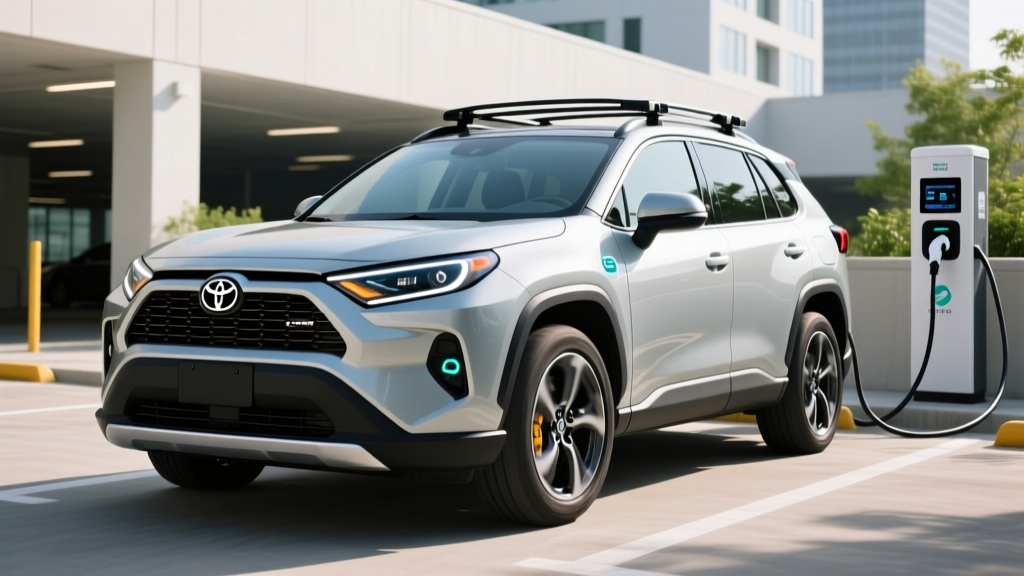
The Toyota RAV4 Hybrid has held its position as America's best-selling hybrid SUV for good reason: it delivers genuine fuel savings without demanding a plug or a lifestyle change. For 2026, Toyota carries forward the proven fifth-generation architecture with minor trim and technology updates, keeping the RAV4 Hybrid squarely in the crosshairs of buyers who want electrified efficiency without range anxiety or charging infrastructure dependence.
Below, we break down every critical number — EPA fuel economy, powertrain output, battery warranty, pricing by trim, and how real-world MPG stacks up against the sticker. We also compare the conventional hybrid (HEV) against the plug-in RAV4 Prime (PHEV) so you can determine which electrified RAV4 actually fits your driving pattern.
2026 RAV4 Hybrid Powertrain and Performance Specs
The 2026 RAV4 Hybrid pairs a 2.5-liter Dynamic Force four-cylinder engine with Toyota's fourth-generation hybrid system. Electronic on-demand AWD is standard across all trims — there is no front-wheel-drive option, which sets it apart from some competitors that reserve AWD for higher trims.
| Specification | Value |
|---|---|
| Engine | 2.5L inline-4 (176 hp / 163 lb-ft) |
| Electric Motors | Front: 88 kW (118 hp) / Rear: 40 kW (54 hp) |
| Net Combined Horsepower | 219 hp |
| 0–60 mph | 7.4 seconds (est.) |
| Drivetrain | Electronic AWD (standard all trims) |
| Transmission | eCVT (planetary gearset, no belt) |
| Hybrid Battery | 1.6 kWh lithium-ion (sealed, not plug-in) |
| Towing Capacity | 1,750 lbs |
| Cargo Volume (rear seats up) | 37.6 cu ft |
| Cargo Volume (rear seats folded) | 69.8 cu ft |
A critical distinction: the RAV4 Hybrid's 1.6 kWh battery is a conventional hybrid (HEV) pack. It charges exclusively through regenerative braking and the gasoline engine. You never plug it in. This is fundamentally different from the RAV4 Prime (PHEV), which carries an 18.1 kWh battery and a charge port — more on that below.
EPA Fuel Economy and Real-World MPG
The 2026 RAV4 Hybrid carries EPA ratings of 41 MPG city / 38 MPG highway / 39 MPG combined for most trims (LE, XLE, XLE Premium, Woodland Edition, Limited). The SE trim, with its sport-tuned suspension and larger wheels, drops slightly to 40/37/39 MPG.
| Trim | City MPG | Highway MPG | Combined MPG |
|---|---|---|---|
| LE | 41 | 38 | 39 |
| XLE | 41 | 38 | 39 |
| XLE Premium | 41 | 38 | 39 |
| Woodland Edition | 41 | 38 | 39 |
| SE | 40 | 37 | 39 |
| Limited | 41 | 38 | 39 |
Source: fueleconomy.gov — EPA estimates for the current-generation RAV4 Hybrid AWD.
Real-World MPG: What Owners Actually See
Toyota's hybrid system excels in stop-and-go traffic, where the electric motor handles low-speed propulsion and regenerative braking recaptures energy. In real-world ownership, many drivers report exceeding the EPA city estimate, routinely seeing 42–45 MPG in urban and suburban driving. Highway driving at sustained 70–80 mph speeds tends to land closer to 34–37 MPG, as the gasoline engine carries the full load with less regenerative benefit.
RAV4 Hybrid (HEV) vs. RAV4 Prime (PHEV): Which Is Right for You?
Toyota sells two electrified RAV4 variants, and confusing them is one of the most common buyer mistakes. Here is the fundamental difference:
- RAV4 Hybrid (HEV): Conventional hybrid. No plug. No electric-only range to speak of (under 1 mile at very low speeds). The battery assists the gas engine for efficiency gains. You fuel it like any other car.
- RAV4 Prime (PHEV): Plug-in hybrid. Has a charge port and an 18.1 kWh battery. Delivers 42 miles of electric-only driving (EPA) before the gas engine engages. You can plug it in at home or at public Level 2 chargers.
| Attribute | RAV4 Hybrid (HEV) | RAV4 Prime (PHEV) |
|---|---|---|
| Powertrain Type | Conventional Hybrid | Plug-in Hybrid |
| Plug-in Charging | No — never plug in | Yes — Level 1 & Level 2 |
| Combined HP | 219 hp | 302 hp |
| Electric-Only Range | N/A (<1 mi low-speed) | 42 miles (EPA) |
| Total Range | ~570 miles | ~600 miles (EV + gas) |
| Battery Capacity | 1.6 kWh | 18.1 kWh |
| DC Fast Charging | N/A | No (Level 2 AC only, ~2.5 hrs) |
| 0–60 mph | 7.4 sec | 5.7 sec |
| EPA Combined MPG / MPGe | 39 MPG | 94 MPGe (EV mode) / 38 MPG (gas) |
| Starting MSRP | ~$33,575 | ~$44,575 |
| Federal Tax Credit (§30D) | Not eligible | Up to $7,500 (eligibility varies) |
RAV4 Prime Charging Details
The RAV4 Prime's 18.1 kWh battery charges via AC only — there is no DC fast-charging capability. On a standard 120V household outlet (Level 1, ~1.4 kW), a full charge takes approximately 12 hours. On a 240V Level 2 charger at 3.3 kW (the Prime's onboard charger limit), a full charge takes roughly 4.5 hours. With the available 6.6 kW onboard charger upgrade (available on XSE and standard on XSE Premium), charge time drops to about 2.5 hours.
The 42-mile electric-only range is enough to cover most daily commutes and errands without burning a drop of gasoline. Once the battery is depleted, the Prime operates as a conventional hybrid at 38 MPG combined — so there is no range penalty for not charging.
2026 RAV4 Hybrid Pricing by Trim
The 2026 RAV4 Hybrid lineup spans six trims, with AWD standard across the board. Pricing below reflects MSRP including destination charge:
| Trim | MSRP (incl. destination) |
|---|---|
| LE | $33,575 |
| XLE | $35,075 |
| XLE Premium | $37,325 |
| Woodland Edition | $36,825 |
| SE | $38,025 |
| Limited | $40,825 |
Note: Pricing is based on current-generation RAV4 Hybrid MSRP data from Toyota's official site. Final 2026 model-year pricing may vary slightly upon official release.
Tax Credit Eligibility
The conventional RAV4 Hybrid (HEV) does not qualify for the federal §30D clean vehicle tax credit. That credit is reserved for plug-in electric vehicles (BEVs and PHEVs) meeting battery sourcing, MSRP caps, and buyer income requirements under current IRS rules.
The RAV4 Prime (PHEV) may qualify for up to $7,500 under §30D, but eligibility depends on several factors that change periodically:
- Buyer modified adjusted gross income must not exceed $150,000 (single) or $300,000 (joint)
- Vehicle MSRP must not exceed $80,000 for SUVs (the Prime clears this easily)
- Battery critical-mineral and component sourcing must meet phased-in thresholds per IRS §30D rules
- The credit can be transferred to the dealer at point of sale as an upfront discount
Battery Warranty, Reliability, and Replacement Cost
Hybrid battery longevity is consistently the top concern among first-time hybrid buyers. Toyota addresses this with one of the strongest hybrid battery warranties in the industry.
• Hybrid battery: 10 years / 150,000 miles (whichever comes first)
• Hybrid system components (inverter, motor, control module): 8 years / 100,000 miles
• Basic vehicle warranty: 3 years / 36,000 miles
• Powertrain warranty: 5 years / 60,000 miles
Real-World Reliability
Toyota's hybrid synergy drive system has been in production since 1997 (Prius), and the eCVT planetary gearset is one of the most durable transmissions ever engineered — it has no belts, no clutch packs, and no traditional friction components to wear out. The RAV4 Hybrid specifically benefits from this mature architecture.
The hybrid battery in the RAV4 Hybrid is a relatively small 1.6 kWh pack that operates in a narrow state-of-charge window (roughly 40–80%), which significantly reduces stress and degradation compared to a full EV battery that cycles through deeper ranges. Real-world data from high-mileage Prius and RAV4 Hybrid owners shows these batteries routinely lasting 150,000–200,000+ miles before any meaningful capacity loss.
Battery Replacement Cost
If the hybrid battery does fail outside of warranty, replacement costs for the RAV4 Hybrid's 1.6 kWh pack typically range from $2,000 to $4,000 (parts and labor at a dealership). Independent hybrid specialists and refurbished battery options can bring this down to $1,500–$2,500. This is dramatically less than a full EV battery replacement, which can exceed $10,000–$15,000, because the hybrid pack is much smaller.
The eCVT transmission is effectively a sealed, maintenance-free unit. There are no transmission fluid changes on the standard service schedule, and failure rates in the field are extremely low.
Who Should Choose the RAV4 Hybrid vs. a PHEV or Full EV?
The decision between a conventional hybrid, a plug-in hybrid, and a battery-electric vehicle comes down to your charging access, driving pattern, and willingness to adapt.
Choose the RAV4 Hybrid (HEV) If:
- You lack home charging access (apartment, street parking, no garage)
- You want zero behavior change — fuel and go
- Your budget is under $35,000
- You drive a mix of city and highway and want 39 MPG without thinking about it
- You want Toyota's proven reliability with a 10-year hybrid battery warranty
Choose the RAV4 Prime (PHEV) If:
- You can charge at home (Level 2 preferred)
- Your daily commute is under 42 miles round-trip (you could rarely use gas)
- You want 302 hp and 5.7-second 0–60 performance
- You want to reduce fuel consumption dramatically while keeping road-trip flexibility
- You qualify for the §30D tax credit, offsetting the ~$11,000 price premium
Choose a Full EV (e.g., Tesla Model Y, Hyundai Ioniq 5) If:
- You have reliable home Level 2 charging
- You want zero tailpipe emissions and minimal maintenance (no oil, no gas engine)
- Your daily driving is under 250 miles and you're comfortable planning road-trip charging stops
- You want the lowest per-mile fuel cost (electricity at $0.13/kWh ≈ $0.04/mile vs. gas at $3.50/gal ≈ $0.09/mile at 39 MPG)
Pros and Cons: 2026 RAV4 Hybrid
Pros
- 39 MPG combined with no plug-in required
- Standard AWD across all trims
- 10-year / 150,000-mile hybrid battery warranty
- Proven, mature powertrain with exceptional reliability record
- Competitive cargo space (37.6 cu ft) for the compact SUV segment
- Real-world city MPG often exceeds EPA estimates
- Accessible pricing starting at $33,575
Cons
- Not eligible for federal §30D tax credit (HEV)
- Highway MPG drops to ~35–37 in real-world driving at 75+ mph
- eCVT drone under hard acceleration (no simulated gear shifts)
- Modest 219 hp — adequate, not quick, by modern standards
- 1,750-lb towing capacity trails some turbo-gas competitors
- Interior materials on LE/XLE trims feel dated vs. rivals
- Infotainment system functional but not class-leading in responsiveness
Frequently Asked Questions
How many MPG does the 2026 RAV4 Hybrid get?
The EPA rates the 2026 RAV4 Hybrid at 41 MPG city, 38 MPG highway, and 39 MPG combined for most trims. In real-world driving, city-heavy commuters frequently see 42–45 MPG, while highway-dominant driving at sustained speeds yields 34–37 MPG.
Does the RAV4 Hybrid need to be plugged in?
No. The RAV4 Hybrid is a conventional hybrid (HEV). Its 1.6 kWh battery charges through regenerative braking and the gasoline engine. You never plug it in. Only the RAV4 Prime (PHEV) has a charge port.
How far can the RAV4 Prime go on electric only?
The RAV4 Prime delivers 42 miles of EPA-rated electric-only range. After that, it operates as a conventional hybrid at 38 MPG combined. Total combined range (electric + gasoline) is approximately 600 miles.
Is the RAV4 Hybrid reliable, and what does battery replacement cost?
The RAV4 Hybrid uses Toyota's mature hybrid system with an exceptionally reliable eCVT gearset and a small, conservatively managed battery. The hybrid battery is warranted for 10 years / 150,000 miles. Out-of-warranty replacement typically costs $2,000–$4,000 at a dealer, or $1,500–$2,500 through independent specialists.
Does the RAV4 Hybrid qualify for any tax credit?
The conventional RAV4 Hybrid (HEV) does not qualify for the federal §30D clean vehicle tax credit, which is reserved for plug-in vehicles. The RAV4 Prime (PHEV) may qualify for up to $7,500, subject to buyer income limits, battery-sourcing requirements, and MSRP caps per current IRS rules. Always verify eligibility for the specific model year at purchase.
How does the RAV4 Hybrid compare to a gas-only RAV4?
The gas-only RAV4 (2.5L, 203 hp, FWD or AWD) is rated at roughly 30 MPG combined. The Hybrid costs approximately $2,000–$2,500 more upfront but saves roughly $500–$700 per year in fuel for a driver covering 15,000 miles annually (at $3.50/gallon). The payback period is typically 3–5 years, after which the Hybrid continues to save money for the life of the vehicle.
What is the difference between the RAV4 Hybrid and the RAV4 Prime?
The RAV4 Hybrid is a conventional HEV — no plug, 219 hp, 39 MPG, starting at ~$33,575. The RAV4 Prime is a PHEV — it plugs in, has 302 hp, 42 miles of electric-only range, 94 MPGe in EV mode, and starts at ~$44,575 (but may qualify for up to $7,500 in federal tax credits). The Prime is the performance and efficiency leader; the Hybrid is the value and simplicity leader.