2026 Toyota RAV4 Electrified Lineup: HEV vs PHEV at a Glance
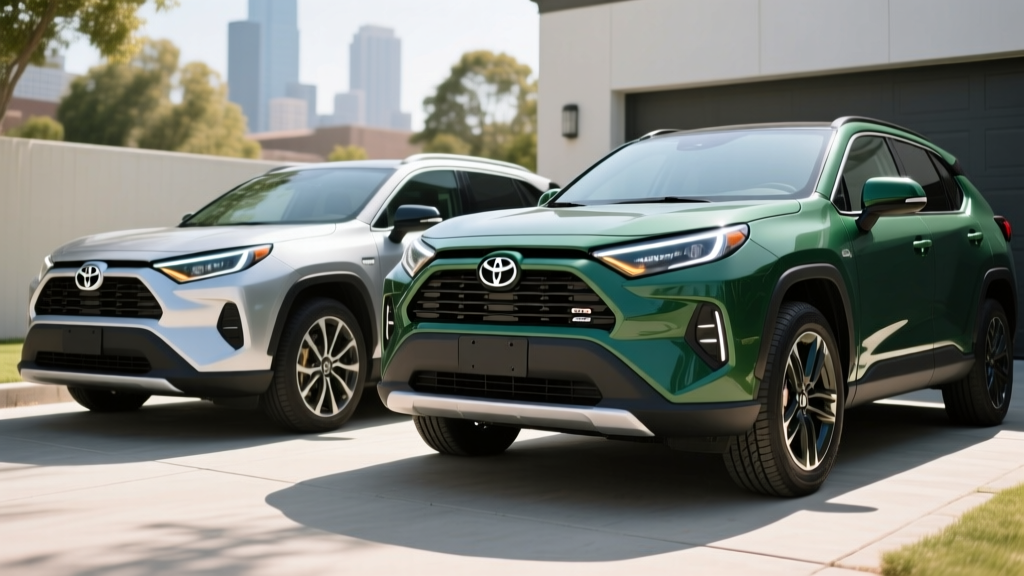
The 2026 Toyota RAV4 continues to dominate the compact SUV segment, and its electrified variants — the conventional RAV4 Hybrid (HEV) and the plug-in RAV4 Prime (PHEV) — are the versions most worth your attention. Both pair a 2.5-liter four-cylinder with electric motors, but they serve very different use cases. The HEV never needs a plug and delivers a reliable 39 MPG combined. The PHEV (marketed as RAV4 Prime) adds a larger battery you can charge at home, giving you roughly 42 miles of electric-only driving before the gas engine kicks in.
If you've searched for the 2026 RAV4 hybrid plug in, you're likely weighing whether the PHEV premium is worth it over the standard hybrid — or whether a full battery-electric vehicle (BEV) makes more sense. This guide breaks down every number that matters.
HEV vs PHEV: What's the Difference?
RAV4 Hybrid (HEV): Uses a small battery recharged by the engine and regenerative braking. You never plug it in. It operates as a blended system — the electric motor assists the gas engine at all speeds, dramatically improving city MPG.
RAV4 Prime (PHEV): Carries a much larger 18.1 kWh lithium-ion battery. You plug it in to charge (Level 1 or Level 2). It can drive up to 42 miles on electricity alone at highway speeds. Once the battery depletes, it functions exactly like the standard hybrid.
Spec Table: 2026 RAV4 Hybrid vs RAV4 Prime
| Specification | RAV4 Hybrid (HEV) | RAV4 Prime (PHEV) |
|---|---|---|
| Powertrain | 2.5L I4 + 2 electric motors (AWD) | 2.5L I4 + front/rear electric motors (AWD) |
| Combined Horsepower | 219 hp | 302 hp |
| 0-60 mph | 7.4 sec | 5.7 sec |
| Battery Capacity | ~1.6 kWh (NiMH) | 18.1 kWh (Li-ion) |
| Electric-Only Range | N/A (blended assist only) | 42 miles (EPA) |
| Total Combined Range | ~580 miles | ~600 miles (42 EV + 558 gas) |
| Plug-In Charging | No | Yes (Level 1 / Level 2) |
| DC Fast Charging | N/A | No |
| Charge Time (0-100%) | N/A | ~12 hr (L1 120V) / ~2.5 hr (L2 240V, 6.6 kW) |
| Drivetrain | AWD (electronic rear motor) | AWD (electronic rear motor) |
| Starting MSRP (est.) | ~$33,800 | ~$44,500 |
Fuel Economy: How Many MPG Does the 2026 RAV4 Hybrid Get?
| Model | City | Highway | Combined | MPGe (EV Mode) |
|---|---|---|---|---|
| RAV4 Hybrid (AWD) | 41 MPG | 38 MPG | 39 MPG | N/A |
| RAV4 Prime (gas mode) | 40 MPG | 36 MPG | 38 MPG | 94 MPGe |
Real-world MPG reality check: Toyota's hybrid system excels in stop-and-go city driving where regenerative braking and electric-motor assist do the heavy lifting. Many owners report exceeding the 41 MPG city EPA estimate in warm-weather urban commutes. Highway driving flips the script — at sustained 70-80 mph, expect closer to 34-36 MPG from the HEV and 33-35 from the Prime in gas mode, since aerodynamic drag overwhelms the hybrid system's advantages. According to fueleconomy.gov, these figures assume a mix of 55% city and 45% highway driving.
For the RAV4 Prime, the 94 MPGe figure applies only when you're driving within the 42-mile electric range. MPGe (miles per gallon equivalent) converts the electrical energy consumed into the energy equivalent of a gallon of gasoline. Once the battery depletes, you're back to the 38 MPG combined gas rating. The lesson: the Prime's efficiency advantage depends entirely on how often you plug in and how short your daily drives are.
RAV4 Prime Electric Range and Charging: What to Expect
The RAV4 Prime's 42-mile EPA electric-only range is among the best in the compact PHEV segment. In real-world driving, expect roughly 35-40 miles on a full charge at highway speeds in moderate temperatures. In cold weather (below 35°F), lithium-ion batteries lose efficiency, and cabin heating draws significant power — plan for 28-33 miles of electric range in winter conditions.
Charging the RAV4 Prime:
- Level 1 (120V household outlet): Approximately 12 hours from empty to full using the included portable cord. This works if you park near an outlet and drive less than 42 miles daily — you'll top up overnight.
- Level 2 (240V home charger): About 2.5 hours with the onboard 6.6 kW charger. A dedicated Level 2 station at home means you'll always start each morning with a full battery.
- DC Fast Charging: The RAV4 Prime does not support DC fast charging. This is typical for PHEVs — the battery is too small to justify the hardware cost and thermal complexity.
Hybrid Battery Warranty
Toyota covers the hybrid battery in both the RAV4 Hybrid and RAV4 Prime for 10 years or 150,000 miles (whichever comes first) in all 50 states. This applies to the traction battery pack specifically. The conventional powertrain warranty is 3 years / 36,000 miles bumper-to-bumper and 5 years / 60,000 miles powertrain.
Battery replacement cost: If the hybrid battery fails out of warranty, dealer replacement typically runs $3,000–$5,000 for the HEV and $5,000–$8,000 for the Prime's larger pack. Third-party refurbished options can reduce this by 30-40%. In practice, Toyota's hybrid batteries have an excellent longevity track record — many first-generation Prius packs lasted well beyond 200,000 miles.
Pricing, Trims, and Federal Tax Credit Eligibility
Estimated 2026 pricing for the RAV4 electrified lineup:
- RAV4 Hybrid LE: ~$33,800 MSRP
- RAV4 Hybrid XLE: ~$35,300 MSRP
- RAV4 Hybrid Woodland Edition: ~$37,000 MSRP
- RAV4 Hybrid Limited: ~$40,200 MSRP
- RAV4 Prime SE: ~$44,500 MSRP
- RAV4 Prime XSE: ~$48,000 MSRP
Federal tax credit (§30D): This is where the picture gets complicated and where many buyers are misinformed. Under current IRS §30D rules, the RAV4 Prime's eligibility for the up-to-$7,500 federal clean vehicle credit depends on three factors that shift frequently:
- Battery component sourcing: A percentage of battery components must be manufactured or assembled in North America. This threshold increases annually.
- Critical minerals: A percentage of critical minerals in the battery must be sourced from the U.S. or free-trade-agreement countries. This threshold also increases yearly.
- Buyer income caps: Adjusted gross income must not exceed $150,000 (single), $225,000 (head of household), or $300,000 (joint).
- MSRP cap: SUVs must have an MSRP at or below $80,000 — both RAV4 variants clear this easily.
As of the 2026 model year, the RAV4 Prime's battery sourcing compliance has been inconsistent across model-year transitions. Check the official fueleconomy.gov tax credit lookup for the specific VIN before purchasing. The standard RAV4 Hybrid (HEV) does not qualify for the §30D credit — it is not a plug-in vehicle. Some states offer separate rebates for PHEVs; check your state energy office for details.
Reliability: Is the RAV4 Hybrid a Safe Long-Term Bet?
Toyota's hybrid powertrain is arguably the most proven electrified system on the road. The company has sold over 25 million hybrids globally since the 1997 Prius, and the RAV4 Hybrid specifically has been in production since 2016. The 2.5-liter Dynamic Force engine (A25A-FXS) used in both the HEV and Prime is naturally aspirated and relatively low-stress, contributing to long-term durability.
Key reliability considerations:
- No turbocharger complexity: Unlike many competitors, Toyota uses a naturally aspirated engine paired with electric motors for power. Fewer pressurized components means fewer failure points.
- eCVT transmission: Toyota's planetary-gear eCVT has no belts, clutches, or traditional gears to wear out. It's one of the most durable transmission designs in the industry.
- Brake longevity: Regenerative braking reduces wear on the friction brakes. Many hybrid owners report original brake pads lasting 80,000–100,000+ miles.
- AWD system: The electronic rear motor (no mechanical driveshaft) eliminates the universal joints and transfer-case maintenance of traditional AWD.
The IIHS has historically rated the RAV4 highly for crash safety, and Toyota Safety Sense 3.0 (standard on all trims) includes pre-collision braking, lane-tracing assist, adaptive cruise control, and road-sign assist.
Who Should Buy the RAV4 Hybrid vs Prime vs a Full EV?
RAV4 Hybrid (HEV) Pros
- No plug-in required — works with your existing routine
- 39 MPG combined, better in city driving
- Lower starting price (~$33,800)
- Proven, low-maintenance powertrain
- 580+ mile total range
RAV4 Hybrid (HEV) Cons
- No electric-only driving
- No federal tax credit eligibility
- Modest 219 hp
- Still burns gas for every trip
RAV4 Prime (PHEV) Pros
- 42 miles electric-only covers most daily commutes
- 302 hp — the quickest RAV4 ever
- 38 MPG in gas mode after battery depletes
- Potential $7,500 federal tax credit (verify VIN)
- 600+ mile total range eliminates range anxiety
RAV4 Prime (PHEV) Cons
- ~$10,700 premium over the Hybrid LE
- Requires home/outlet access for meaningful benefit
- No DC fast charging
- Tax credit eligibility uncertain — sourcing-dependent
- Heavier due to larger battery
Decision Framework
Choose the RAV4 Hybrid (HEV) if: You don't have access to a plug at home or work, you want the lowest purchase price, or your daily commute exceeds 50 miles and you'd rarely use the Prime's electric range.
Choose the RAV4 Prime (PHEV) if: You can charge at home (even a 120V outlet works for overnight), your daily round-trip commute is under 40 miles, you want the performance bump to 302 hp, and you qualify for the federal tax credit (which largely closes the price gap with the HEV).
Choose a full EV (like the Toyota bZ4X, Tesla Model Y, or Hyundai Ioniq 5) if: You have reliable home Level 2 charging, your daily driving is under 250 miles, you want zero tailpipe emissions, and you're ready to fully leave gas behind.
Frequently Asked Questions
How many MPG does the 2026 RAV4 Hybrid get in real-world driving?
The EPA rates the RAV4 Hybrid AWD at 41 city / 38 highway / 39 combined. In real-world use, many owners see 42-45 MPG in warm-weather city driving thanks to aggressive regenerative braking. Highway-only trips at 75+ mph typically drop to 33-36 MPG. Cold weather (below freezing) reduces MPG by roughly 5-10% due to engine warm-up cycles and cabin heating demands.
How far can the RAV4 Prime go on electric only?
The EPA rates the RAV4 Prime at 42 miles of electric-only range. In real-world conditions, expect 35-40 miles at highway speeds in moderate weather and 28-33 miles in freezing temperatures. This covers the average American's daily round-trip commute (approximately 37 miles, per FHWA data) entirely on electricity — meaning many Prime owners visit gas stations only for longer road trips.
Does the 2026 RAV4 Hybrid or Prime qualify for a federal tax credit?
The standard RAV4 Hybrid (HEV) does not qualify for the §30D federal clean vehicle credit because it is not a plug-in vehicle. The RAV4 Prime (PHEV) may qualify for up to $7,500, but eligibility depends on battery-component and critical-mineral sourcing requirements that change annually, plus buyer income caps ($150K single / $300K joint). Always verify the specific vehicle's eligibility on fueleconomy.gov before purchase. The credit can be transferred to the dealer as a point-of-sale discount if eligible.
Is the RAV4 Hybrid battery reliable, and what does replacement cost?
Toyota's hybrid batteries carry a 10-year / 150,000-mile warranty in all states. Real-world data shows many Toyota hybrid batteries lasting 200,000+ miles without significant degradation. If replacement is needed out of warranty, expect $3,000–$5,000 for the HEV's smaller NiMH pack and $5,000–$8,000 for the Prime's larger lithium-ion pack. Refurbished and third-party options can reduce costs by 30-40%.
Can I charge the RAV4 Prime at a public DC fast charger?
No. The RAV4 Prime does not have a DC fast-charge port. It charges via Level 1 (120V, ~12 hours) or Level 2 (240V, ~2.5 hours at 6.6 kW). This is standard for plug-in hybrids — the 18.1 kWh battery is small enough that Level 2 charging fully replenishes it in a practical timeframe, and adding DC fast-charge hardware would add cost, weight, and packaging complexity.
Should I buy the RAV4 Hybrid, the Prime, or a full EV?
If you can't charge at home, the RAV4 Hybrid is the obvious choice — no plug needed, 39 MPG combined, lowest price. If you can charge at home and your commute is under 40 miles round-trip, the Prime lets you drive electric daily while keeping gas as a backup for road trips. If you have Level 2 home charging and want to eliminate gas entirely, consider a full EV like the Tesla Model Y (320-mile range) or Hyundai Ioniq 5 (303-mile range) — but accept the need to plan around charging on long trips.