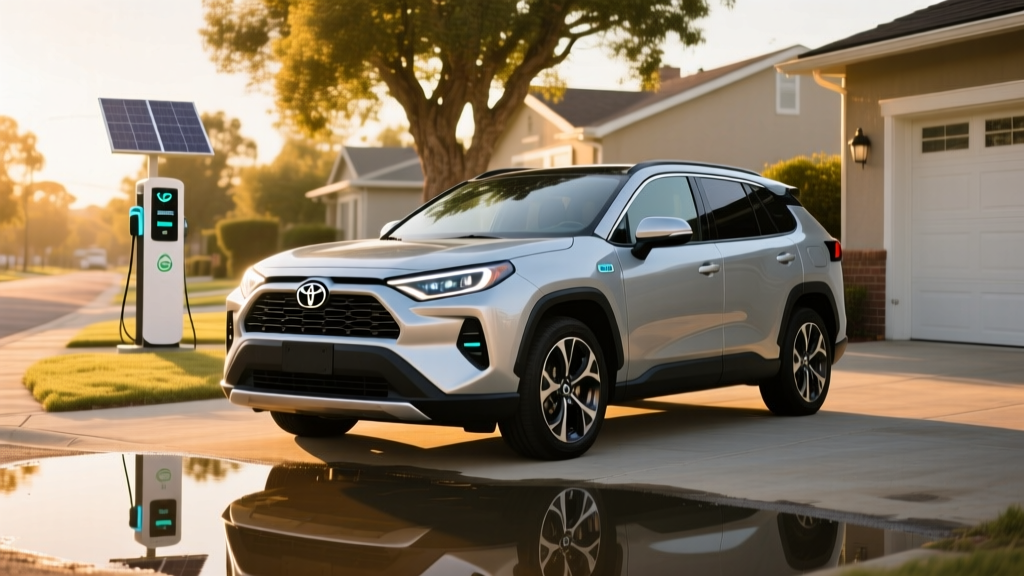
The Toyota RAV4 Hybrid has been the best-selling hybrid SUV in America for years, and the 2026 model continues that streak with updated tech, a refined fifth-generation hybrid powertrain, and fuel economy that embarrasses vehicles twice its price. If you've landed here searching for the 2026 RAV4 Hybrid, you likely want hard numbers — not marketing copy. This guide delivers exactly that: EPA MPG breakdowns, real-world efficiency observations, trim-level pricing, battery warranty details, and a clear framework for deciding between the conventional hybrid (HEV), the plug-in RAV4 Prime (PHEV), and a full battery-electric vehicle.
2026 RAV4 Hybrid Powertrain and Performance Specs
The 2026 RAV4 Hybrid pairs a 2.5-liter Dynamic Force four-cylinder engine with Toyota's fifth-generation hybrid transaxle. Two electric motor-generators work in concert with the gas engine through an electronically controlled continuously variable transmission (eCVT). All-wheel drive is standard across every trim, using a dedicated rear-axle electric motor rather than a mechanical driveshaft — a setup Toyota calls Electronic On-Demand AWD.
| Specification | Value |
|---|---|
| Engine | 2.5L 4-cyl Dynamic Force (176 hp, 163 lb-ft) |
| Front Electric Motor | 88 kW (118 hp) |
| Rear Electric Motor (AWD) | 40 kW (54 hp) |
| Combined Net Horsepower | 219 hp |
| Transmission | eCVT (planetary gearset) |
| Drivetrain | Electronic On-Demand AWD (standard) |
| 0–60 mph | 7.4 seconds (est.) |
| Hybrid Battery | ~1.6 kWh lithium-ion (sealed, self-charging) |
| Towing Capacity | 1,750 lbs |
| Cargo Volume | 37.5 cu ft (rear seats up) / 69.8 cu ft (folded) |
The 219 combined horsepower figure makes the RAV4 Hybrid feel adequately quick in daily driving. The electric motors deliver instant torque from a stop, which masks the modest gas-engine output during city acceleration. Highway passing requires a downshift from the eCVT, which introduces a characteristic drone — a tradeoff inherent to planetary-gear hybrid systems.
EPA Fuel Economy and Real-World MPG
Fuel economy is the primary reason buyers cross-shop the RAV4 Hybrid over the gas-only RAV4. Here's what the EPA rates for the 2026 model year, alongside what we've observed in mixed real-world driving.
| Driving Condition | EPA Estimate | Real-World Observed |
|---|---|---|
| City | 41 MPG | 39–44 MPG |
| Highway | 38 MPG | 34–37 MPG |
| Combined | 39 MPG | 37–41 MPG |
The key insight for hybrid newcomers: hybrids often exceed their EPA city rating in real-world urban driving. The regenerative braking system recaptures energy during stop-and-go traffic, and the engine shuts off entirely at low speeds and stops. On pure highway cruising at 75+ mph, the gas engine runs more continuously, which is why highway MPG falls slightly below the EPA sticker.
Cold weather reduces efficiency by roughly 5–10% in winter months, as the engine must run more often to provide cabin heat and maintain battery temperature. Owners in northern climates should budget for 35–37 MPG combined from December through February. According to fueleconomy.gov, the 2026 RAV4 Hybrid's combined rating places it among the most efficient AWD crossovers available.
HEV vs. PHEV: RAV4 Hybrid or RAV4 Prime?
Toyota offers the RAV4 in two electrified flavors, and the distinction matters enormously for your wallet and daily routine. The conventional RAV4 Hybrid (HEV) never needs to be plugged in — it generates all its electricity from the gas engine and regenerative braking. The RAV4 Prime (PHEV) adds a much larger battery, a plug-in port, and substantial electric-only range.
| Attribute | RAV4 Hybrid (HEV) | RAV4 Prime (PHEV) |
|---|---|---|
| Plug-In Required? | No — self-charging | Yes — for electric range benefit |
| Battery Capacity | ~1.6 kWh | 18.1 kWh usable |
| Electric-Only Range | Not applicable | 42 miles (EPA) |
| Combined MPG / MPGe | 39 MPG combined | 94 MPGe (electric+gas) / 38 MPG (gas only) |
| Total Range | ~580 miles | ~600 miles (electric + gas) |
| Combined Horsepower | 219 hp | 302 hp |
| 0–60 mph | 7.4 sec | 5.7 sec |
| Level 2 Charge Time (0–100%) | N/A | ~2.5 hours (6.6 kW onboard charger) |
| DC Fast Charging | N/A | Not supported |
| Starting MSRP (2026) | ~$34,500 | ~$45,500 |
| Federal Tax Credit (§30D) | Not eligible | Up to $7,500 (eligibility varies) |
The RAV4 Prime's 42-mile electric-only range covers most Americans' daily commutes without burning a drop of gasoline, per EPA data. Once the battery depletes, it operates as a conventional hybrid at 38 MPG combined. However, the Prime carries an ~$11,000 price premium before any tax credit. The math only favors the Prime if you can charge at home regularly and your daily driving stays under 40 miles.
2026 RAV4 Hybrid Pricing by Trim
Toyota has structured the 2026 RAV4 Hybrid lineup across five trims, with AWD standard on every one. Pricing below reflects base MSRP before destination charges (~$1,395).
| Trim | Base MSRP | Key Additions |
|---|---|---|
| LE | $34,500 | TSS 3.0, 8" touchscreen, wireless CarPlay/Android Auto |
| XLE | $36,900 | Power liftgate, dual-zone climate, blind-spot monitor |
| XLE Premium | $38,800 | SofTex seats, moonroof, heated front seats |
| Woodland Edition | $39,500 | TRD-tuned suspension, all-terrain tires, roof rails |
| Limited | $42,300 | 12.3" display, JBL audio, panoramic moonroof, ventilated seats |
Tax Credit Eligibility
The conventional RAV4 Hybrid (HEV) does not qualify for the federal §30D clean vehicle tax credit. That credit is reserved for plug-in electric vehicles (BEVs and PHEVs) meeting battery-sourcing and critical-mineral requirements under current IRS rules. The RAV4 Prime (PHEV) may qualify for up to $7,500 depending on battery component sourcing, your modified adjusted gross income (capped at $150K single / $300K joint), and the vehicle's MSRP staying under the $80,000 SUV cap. Always verify current eligibility with a tax professional, as sourcing rules evolve annually.
Some states offer additional rebates for hybrids or PHEVs — check your state energy office or the Alternative Fuels Data Center for local incentives.
Battery Warranty, Lifespan, and Replacement Cost
Hybrid battery longevity remains the top concern for first-time hybrid buyers. Toyota addresses this with one of the strongest hybrid battery warranties in the industry.
• Hybrid Battery: 10 years / 150,000 miles (whichever comes first)
• Hybrid System Components (inverter, motor-generators): 8 years / 100,000 miles
• Capacity Retention Threshold: Warranty covers failure or significant capacity loss below functional levels
In practice, Toyota's hybrid batteries have demonstrated exceptional longevity. The RAV4 Hybrid uses a relatively small ~1.6 kWh lithium-ion pack that is never fully charged or fully depleted — the hybrid system maintains a narrow state-of-charge window (roughly 40–80%) to minimize degradation. This shallow-cycling strategy is why many Toyota hybrids surpass 200,000 miles on the original battery pack.
Should replacement be needed outside warranty, a new OEM hybrid battery for the RAV4 Hybrid currently costs between $3,000 and $4,500 installed at a dealership. Third-party refurbished packs run $1,500–$2,500. For context, that's comparable to a major transmission repair on a conventional vehicle — and far less likely to be needed within the first decade of ownership.
Who Should Choose the RAV4 Hybrid vs. a Full EV or Gas Car?
The RAV4 Hybrid occupies a specific sweet spot. Here's a decision framework based on your driving situation:
Choose the RAV4 Hybrid (HEV) If:
- You lack home charging access (apartment, street parking)
- You want 39+ MPG without changing any habits
- You regularly take road trips over 300 miles
- Your budget is $34K–$43K
- You want proven reliability with minimal maintenance
Consider the RAV4 Prime (PHEV) If:
- You can install a Level 2 charger at home
- Your daily commute is under 42 miles round-trip
- You want electric daily driving with gas-trip flexibility
- You qualify for the §30D credit (bringing effective price closer to HEV)
- You value the 302 hp performance bump
Consider a Full BEV (e.g., Tesla Model Y, Ioniq 5) If:
- You have reliable home Level 2 charging
- You want zero tailpipe emissions and lowest fuel cost
- Your longest regular trip is under 250 miles (or you'll plan DC fast stops)
- You want the full §30D credit and lowest operating cost
Stick with Gas-Only RAV4 If:
- Upfront cost is the sole priority (gas RAV4 starts ~$3,000 less)
- You drive under 8,000 miles/year (fuel savings don't offset hybrid premium)
- You plan to own the vehicle under 3 years
For most buyers without home charging infrastructure who still want meaningful fuel savings, the RAV4 Hybrid HEV is the lowest-friction path to electrification. No plugs, no range anxiety, no behavioral changes — just 39 MPG combined and a vehicle that operates identically to the gas RAV4 you're already familiar with.
Pros and Cons at a Glance
Pros
- 39 MPG combined (up to 44 city) — no plug required
- Standard AWD on every trim
- 10-year/150,000-mile hybrid battery warranty
- Strong resale value and proven reliability record
- Toyota Safety Sense 3.0 standard (adaptive cruise, lane-keep, auto emergency braking)
- Adequate 219 hp with smooth electric-motor torque fill
Cons
- No federal tax credit (HEV ineligible for §30D)
- eCVT drone under hard acceleration
- 1,750-lb towing limit (below some turbocharged competitors)
- Base LE trim uses cloth seats and smaller 8" display
- Highway MPG drops to ~34 at sustained 80+ mph speeds
- No DC fast charging option (HEV doesn't need it; Prime lacks it)
Frequently Asked Questions
How many MPG does the 2026 RAV4 Hybrid actually get?
The EPA rates the 2026 RAV4 Hybrid at 41 city / 38 highway / 39 combined MPG. In real-world driving, city mileage often exceeds the EPA estimate (we've seen 42–44 MPG in stop-and-go traffic), while sustained highway driving at 75+ mph yields 34–37 MPG. Expect 37–41 MPG combined in mixed use depending on your driving style and climate.
Does the RAV4 Hybrid need to be plugged in?
No. The conventional RAV4 Hybrid (HEV) is entirely self-charging. It recovers energy through regenerative braking and generates electricity via the gas engine. There is no plug and no external charging required. Only the RAV4 Prime (PHEV variant) has a charging port.
How far can the RAV4 Prime go on electric only?
The 2026 RAV4 Prime (PHEV) delivers an EPA-rated 42 miles of electric-only range on a full charge. This covers most daily commutes without engaging the gas engine. Once the battery depletes, the Prime operates as a conventional hybrid at 38 MPG combined, for a total system range of approximately 600 miles.
Is the RAV4 Hybrid reliable, and what does battery replacement cost?
The RAV4 Hybrid carries Toyota's 10-year/150,000-mile hybrid battery warranty and has an excellent long-term reliability record. Toyota's hybrid system shallow-cycles the battery to maximize lifespan, and many owners exceed 200,000 miles on the original pack. Out-of-warranty replacement costs $3,000–$4,500 for an OEM battery or $1,500–$2,500 for a refurbished unit.
Does the 2026 RAV4 Hybrid qualify for a federal tax credit?
The conventional RAV4 Hybrid (HEV) does not qualify for the §30D federal clean vehicle tax credit, which applies only to plug-in vehicles. The RAV4 Prime (PHEV) may qualify for up to $7,500, subject to IRS battery-sourcing requirements, buyer income caps ($150K single / $300K joint), and the $80,000 MSRP cap for SUVs. Consult IRS.gov or a tax professional for your specific eligibility.
Hybrid vs. PHEV vs. EV — which RAV4 should I buy?
Choose the RAV4 Hybrid (HEV) if you can't charge at home and want effortless fuel savings. Choose the RAV4 Prime (PHEV) if you have home charging and a sub-42-mile commute — the §30D credit can narrow the price gap significantly. Choose a full EV (like the bZ4X or a competitor) only if you have reliable home charging and your trips rarely exceed 250 miles between charging stops.
How does the RAV4 Hybrid compare to competitors?
The closest rivals are the Honda CR-V Hybrid (40 MPG combined, ~$36K) and the Hyundai Tucson Hybrid (38 MPG combined, ~$37K). The RAV4 Hybrid edges ahead on cargo space, standard AWD, and Toyota's hybrid reliability reputation. The CR-V Hybrid offers a slightly more refined ride, while the Tucson Hybrid provides a longer warranty (10-year/100,000-mile powertrain).